
5. Determinant
5.1 The Properties of Determinants
The determinant of the n by n identity matrix is 1 : \(det I = 1\).
The determinant changes sign when two rows are exchanged(sign reversal) : \(det P = \pm 1\) (det P = +1 for an even number of row exchange and det P = -1 for an odd number.)
The determinant is linear function of each row separately :
- 3a : multiply row i for any number t det is multiplied by t : \(\left[ \begin{matrix} ta&tb \\ c&d \end{matrix} \right] = t\left| \begin{matrix} a&b \\ c&d \end{matrix} \right|\)
- 3b: add row i of A to row i of A' then determinants add : \(\left[ \begin{matrix} a+a'&b+b' \\ c&d \end{matrix} \right] = \left| \begin{matrix} a&b \\ c&d \end{matrix} \right| + \left| \begin{matrix} a'&b' \\ c&d \end{matrix} \right|\)
From rules 1-3 we will reach rules 4-10.
If two rows of A are equal, the det A = 0.
Subtracting a multiple of one row from another row leaves det A unchanged. ( eliminaton steps doesn't change determinant : det A = det D, without row exchanges.)
A matrix with a row of zeros has det A = 0.
If A is triangular then \(det A = a_{11}a_{22}...a_{nn}\)=product of diagnonal entries.
If A is singular then det A = 0. If A is invertible then \(det A \neq 0\).
The determinant of AB is det A times det B : \(|AB| = |A||B|\) .
The transpose \(A^T\) has the same determinant as A: \(det A^T = det A\).
- A zero column will make the det A = 0.
- Two equal columns will make the det A = 0.
- If a column is multiplied by t, so is the determinant.
5.2 Three Formula for Determinant
The Pivot Formula
When elimination leads to \(A=LU\), the pivots \(d_1,d_2,...,d_n\) are on the diagonal of the upper triangular U.
No row exchanges: \(det A = (det L)(det U)=(1)(d_1d_2...d_n)\)
Row exchanges: \((detP)(detA)= (detL)(detU)\) gives \(detA = \pm(d_1d_2...d_n)\) , odd leads to minus(-), even leads to plus(+)
The Big Formula
The big formula has n! terms.
\]
example:
\left| \begin{matrix} a_{11}&&\\ &a_{22}& \\ &&a_{33} \\\end{matrix} \right| +
\left| \begin{matrix} &a_{12}&\\ &&a_{23} \\ a_{31}&& \\\end{matrix} \right| +
\left| \begin{matrix} &&a_{13}\\ a_{21}&& \\ &a_{32}& \\\end{matrix} \right| +\\
\quad \quad \quad \quad \quad \quad \quad \quad
\left| \begin{matrix} a_{11}&&\\ &&a_{23} \\ &a_{32}& \\\end{matrix} \right| +
\left| \begin{matrix} &a_{12}&\\ a_{21}&& \\ &&a_{33} \\\end{matrix} \right| +
\left| \begin{matrix} &&a_{13}\\ &a_{22}& \\ a_{31}&& \\\end{matrix} \right| + \\
\Downarrow \\
det A = a_{11}a_{22}a_{33}\left| \begin{matrix} 1&&\\ &1& \\ &&1\\\end{matrix} \right| + a_{12}a_{23}a_{31}\left| \begin{matrix} &1&\\ &&1 \\ 1&&\\\end{matrix} \right| +
a_{13}a_{21}a_{32}\left| \begin{matrix} &&1\\ 1&& \\ &1&\\\end{matrix} \right| + \\
\quad \quad \quad
a_{11}a_{23}a_{32}\left| \begin{matrix} 1&&\\ &&1 \\ &1&\\\end{matrix} \right| +
a_{12}a_{21}a_{33}\left| \begin{matrix} &1&\\ 1&& \\ &&1\\\end{matrix} \right| +
a_{13}a_{22}a_{31}\left| \begin{matrix} &&1\\ &1& \\ 1&&\\\end{matrix} \right| \\
\quad \quad \quad
=a_{11}a_{22}a_{33} + a_{12}a_{23}a_{31} +
a_{13}a_{21}a_{32}-a_{11}a_{23}a_{32} -
a_{12}a_{21}a_{33} -
a_{13}a_{22}a_{31}
\]
The Cofactors Formula
The determinant is the dot product of any row i of A with its cofactors using other rows:
\]
Each cofactor \(C_{ij}\) (order n-1, without row i and column j) includes its correct sign:
\]
example:
\left| \begin{matrix} a_{11}&&\\ &a_{22}&a_{23} \\ &a_{32}&a_{33} \\\end{matrix} \right| +
\left| \begin{matrix} &a_{12}&\\ a_{21}&&a_{23} \\ a_{31}&&a_{33} \\\end{matrix} \right| +
\left| \begin{matrix} &&a_{13}\\ a_{21}&a_{22}& \\ a_{31}&a_{32}& \\\end{matrix} \right|
\]
C_{12} = -(a_{21}a_{33}-a_{23}a_{31}) \\
C_{13} = a_{21}a_{32}-a_{22}a_{31}
\]
5.3 Inverse\ Cramer's Rule\ Volumn of box
Formula for \(A^{-1}\)
The i, j entry of \(A^{-1}\) is the cofactor \(C_{ji}\) divided by det A:
A^{-1} = \frac {C^T}{detA}
\]
proof :
\Uparrow \\
AC^T = (detA)I \\
\Uparrow \\
\left[ \begin{matrix} a_{11}&a_{12}&a_{13}\\ a_{21}&a_{22}&a_{23} \\ a_{31}&a_{32}&a_{33} \\\end{matrix} \right]
\left[ \begin{matrix} C_{11}&C_{21}&C_{31}\\ C_{12}&C_{22}&C_{32} \\ C_{13}&C_{23}&C_{33} \\\end{matrix} \right] =
\left[ \begin{matrix} detA&0&0\\ 0&detA&0 \\ 0&0&detA \\\end{matrix} \right]
\]
Cramer's Rule
If det A is not zero, Ax=b is solved by determinants:
\]
The matrix \(B_j\) has the jth column of A replaced by the vector b.
example:
det B_1 = \left| \begin{matrix} 1&a_{12}&a_{13}\\ 0&a_{22}&a_{23} \\ 0&a_{32}&a_{33} \\\end{matrix} \right| \\
det B_2 =\left| \begin{matrix} a_{11}&1&a_{13}\\ a_{21}&0&a_{23} \\ a_{31}&0&a_{33} \\\end{matrix} \right| \\
det B_3 =\left| \begin{matrix} a_{11}&a_{12}&1\\ a_{21}&a_{22}&0\\ a_{31}&a_{32}&0 \\\end{matrix} \right|
\]
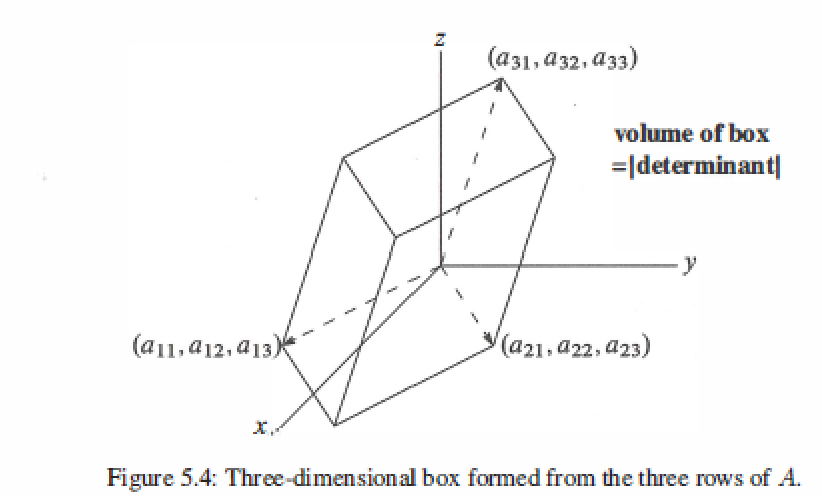
Volumn of box
The volume equals the absolute value of det A.
Area of Parallelogram and Triangle
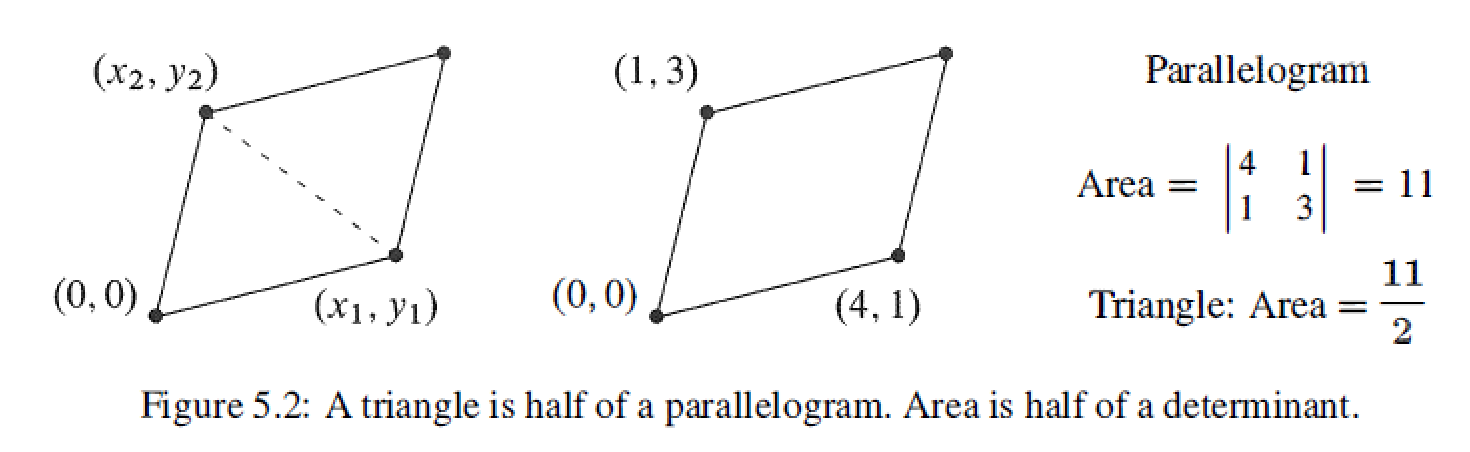
Determinants are the best way to find area.
Area of Parallelogram : \(Area = Determinant\)
Area of Triangle: \(Area = Determinant / 2\)
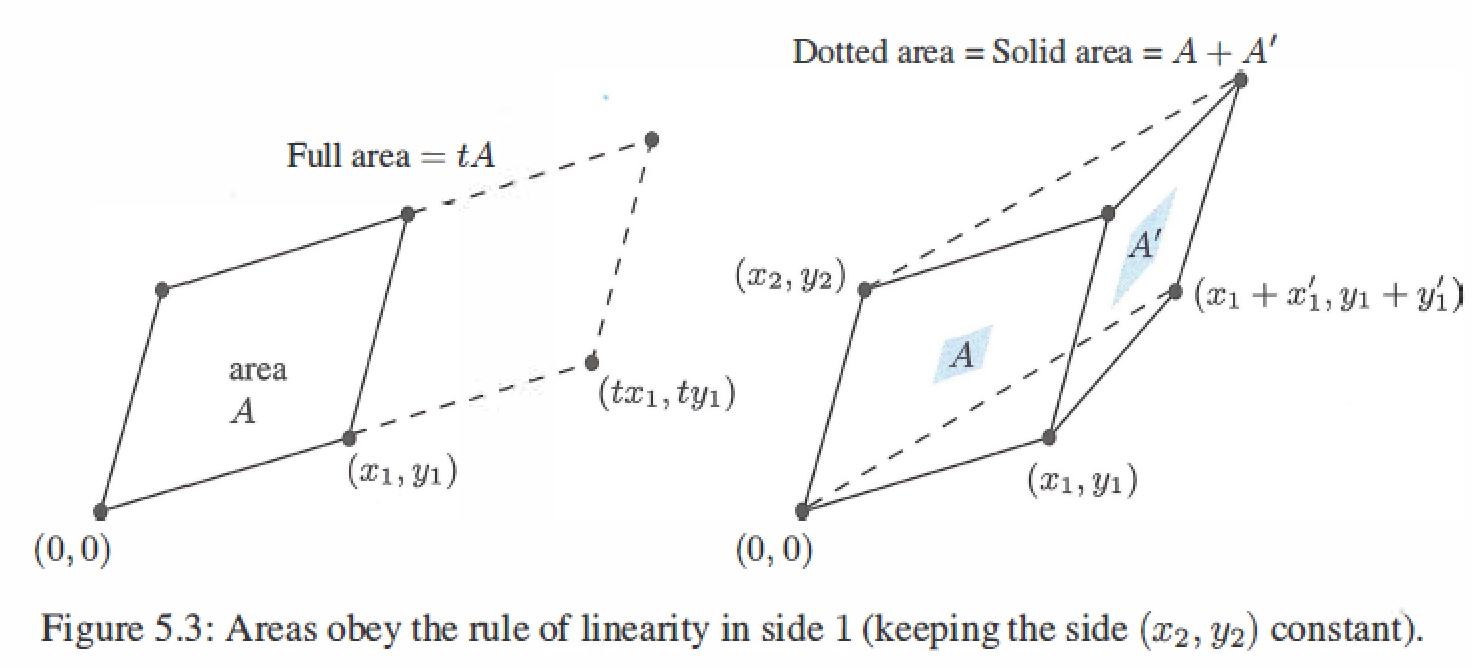
When an edge is stretched by a factor t, the volume is multiplied by t. (Rule 3a)
When edge 1 is added to edge 1', the volume is the sum of the two original volumes.(Rule 3b)
5.4 Cross Product
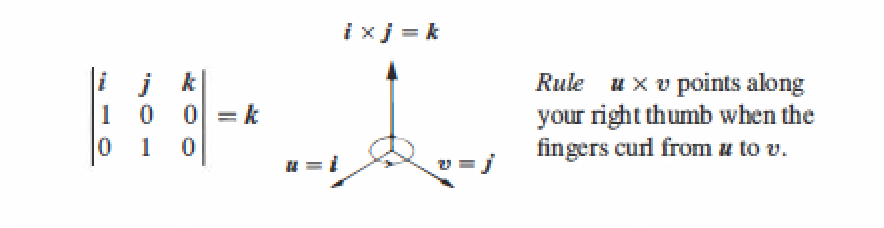
The cross product of \(u=(u_1,u_2,u_3)\) and \(v=(v_1,v_2,v_3)\) is a vector.
\]
The cross product is a vector with length \(||u|| \ \ ||v|| \ \ |sin\theta|\). Its direction is perpendicular to u and v.It points "up" or "down" by the right hand rule.
\]
5. Determinant的更多相关文章
- bzoj 2107: Spoj2832 Find The Determinant III 辗转相除法
2107: Spoj2832 Find The Determinant III Time Limit: 1 Sec Memory Limit: 259 MBSubmit: 154 Solved: ...
- SPOJ - DETER3:Find The Determinant III (求解行列式)
Find The Determinant III 题目链接:https://vjudge.net/problem/SPOJ-DETER3 Description: Given a NxN matrix ...
- SPOJ - Find The Determinant III 计算矩阵的行列式答案 + 辗转相除法思想
SPOJ -Find The Determinant III 参考:https://blog.csdn.net/zhoufenqin/article/details/7779707 参考中还有几个关于 ...
- XTU 1260 - Determinant - [2017湘潭邀请赛A题(江苏省赛)][高斯消元法][快速幂和逆元]
是2017江苏省赛的第一题,当时在场上没做出来(废话,那个时候又不懂高斯消元怎么写……而且数论也学得一塌糊涂,现在回来补了) 省赛结束之后,题解pdf就出来了,一看题解,嗯……加一行再求逆矩阵从而得到 ...
- 2017湘潭赛 A题 Determinant (高斯消元取模)
链接 http://202.197.224.59/OnlineJudge2/index.php/Problem/read/id/1260 今年湘潭的A题 题意不难 大意是把n*(n+1)矩阵去掉某一列 ...
- Linear Algebra - Determinant(几何意义)
二阶行列式的几何意义 二阶行列式 \(D = \begin{vmatrix}a_1&a_2\\b_1&b_2\end{vmatrix} = a_1b_2 - a_2b_1\) 的几何意 ...
- Linear Algebra - Determinant(基础)
1. 行列式的定义 一阶行列式: \[ \begin{vmatrix} a_1 \end{vmatrix} = a_1 \] 二阶行列式: \[ \begin{vmatrix} a_{11} & ...
- The Evaluation of Determinant(求行列式mod一个数的值)
#include<cstdio> #include<iostream> #include<algorithm> #include<cstring> #i ...
- 行列式(determinant)的物理意义及性质
1. 物理(几何)意义 detA=output areainput area 首选,矩阵代表的是线性变换(linear transformation).上式说明一个矩阵的行列式(detA)几何意义上, ...
- SP1772 Find The Determinant II
题意 \(T\) 组数据,每组给定两个整数 \(n,k\),求 \(\det A\),其中 \(A\) 为一个 \(n\times n\) 的矩阵且 \(A_{i,j}=\gcd(i,j)^k\),对 ...
随机推荐
- 【LeetCode剑指offer#06】实现pow函数、计算x的平方根
实现pow函数 实现 pow(x, n) ,即计算 x 的整数 n 次幂函数(即,xn ). 示例 1: 输入:x = 2.00000, n = 10 输出:1024.00000 示例 2: 输入:x ...
- 简化Simulink的建模与模型重构
简化Simulink的建模与模型重构 模型重构 Simulink作为汽车和自动化领域中经典的模型工程必备工具,不管是专业的汽车控制器的开发还是自动化控制的专业应用编程,都会使用到Simulink进行图 ...
- 记一次酣畅淋漓的 K8s Ingress 排错过程(302,404,503,...)
故事开始 第 1 关:[流量重定向到 /] 第 2 关:[应用返回 302,重定向到 /,引入 503 错误] 第 3 关:[静态资源访问遇到 503 问题] 第 4 关:[静态资源访问遇到 403 ...
- 【Azure Compute Gallery】使用 Python 代码从 Azure Compute Gallery 复制 Image-Version
问题描述 Azure Compute Gallery 可以帮助围绕 Azure 资源(例如映像和应用程序)生成结构和组织,并且支持全局复制. 如果想通过Python代码实现 Image-Version ...
- 【Azure Redis】Redis客户端出现15分钟的超时异常
问题描述 客户端使用 Lettuce.io 连接 Azure Redis,出现了长达15分钟的Timeout异常. 问题解答 Azure Redis作为PaaS服务,由于一些平台的升级操作而引发的故障 ...
- BeanShell Sampler 前置处理器
一概念: 前置处理器主要作用: 用于修改即将发送的http的请求数据 BeanShell预处理器可以在取样器发送请求之前被执行,可以通过它完成发送请求所需的数据 其中的ctx.vars.props.p ...
- Prometheus技术分享——如何监控宿主机和容器
这一期主要来跟大家聊一下,使用node_exporter工具来暴露主机和因公程序上的指标,利用prometheus来监控宿主机:以及通过通过Cadvisor监控docker容器. 一.部署node_e ...
- windows条件下安装linux双系统
工具: U盘 + rufus(使用烧录进linux镜像) linux镜像 1.windows 管理-压缩卷出一块空闲的磁盘空间(不要使用) 重启电脑 启动项 U盘启动 linux就自动安装,选 ...
- trans.bat 将.m4a 文件拖拽到这个上面 自动转换成.mp3 老歌精选-歌曲z
@chcp 65001 >nul echo off :: 获取文件名 SET filePath=%1 :: 因为这里目录的路径是 E:\老歌精选-歌曲z 是11个字符,所以是从第12个字符到最后 ...
- WPF之事件
目录 WPF的树形结构 事件 路由事件 使用WPF内置路由事件 自定义路由事件 ButtonBase类的Click路由事件 创建一个路由事件 RoutedEventArgs的Source与Origin ...