
spark(1.1) mllib 源代码分析
在spark mllib 1.1加入版本stat包,其中包括一些统计数据有关的功能。本文分析中卡方检验和实施的主要原则:
一个、根本
在stat包实现Pierxunka方检验,它包括以下类别
(1)适配度检验(Goodness of Fit test):验证一组观察值的次数分配是否异于理论上的分配。
(2)独立性检验(independence test) :验证从两个变量抽出的配对观察值组是否互相独立(比如:每次都从A国和B国各抽一个人,看他们的反应是否与国籍无关)
计算公式:
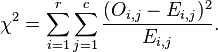
当中O表示观測值,E表示期望值
具体原理能够參考:http://zh.wikipedia.org/wiki/%E7%9A%AE%E7%88%BE%E6%A3%AE%E5%8D%A1%E6%96%B9%E6%AA%A2%E5%AE%9A
二、java api调用example
三、源代码分析
1、外部api
通过Statistics类提供了4个外部接口

// Goodness of Fit test

def chiSqTest(observed: Vector, expected: Vector): ChiSqTestResult = {

    ChiSqTest.chiSquared(observed, expected)

  }

//Goodness of Fit test

def chiSqTest(observed: Vector): ChiSqTestResult = ChiSqTest.chiSquared(observed)

//independence test

def chiSqTest(observed: Matrix): ChiSqTestResult = ChiSqTest.chiSquaredMatrix(observed)

//independence test

def chiSqTest(data: RDD[LabeledPoint]): Array[ChiSqTestResult] = {

    ChiSqTest.chiSquaredFeatures(data)

}
2、Goodness of Fit test实现
这个比較简单。关键是依据(observed-expected)2/expected计算卡方值
 /*

   * Pearon's goodness of fit test on the input observed and expected counts/relative frequencies.

   * Uniform distribution is assumed when `expected` is not passed in.

   */

  def chiSquared(observed: Vector,

      expected: Vector = Vectors.dense(Array[Double]()),

      methodName: String = PEARSON.name): ChiSqTestResult = {

    // Validate input arguments

    val method = methodFromString(methodName)

    if (expected.size != 0 && observed.size != expected.size) {

      throw new IllegalArgumentException("observed and expected must be of the same size.")

    }

    val size = observed.size

    if (size > 1000) {

      logWarning("Chi-squared approximation may not be accurate due to low expected frequencies "

        + s" as a result of a large number of categories: $size.")

    }

    val obsArr = observed.toArray

  // 假设expected值没有设置,默认取1.0 / size

    val expArr = if (expected.size == 0) Array.tabulate(size)(_ => 1.0 / size) else expected.toArray

  / 假设expected、observed值都必需要大于1

    if (!obsArr.forall(_ >= 0.0)) {

      throw new IllegalArgumentException("Negative entries disallowed in the observed vector.")

    }

    if (expected.size != 0 && ! expArr.forall(_ >= 0.0)) {

      throw new IllegalArgumentException("Negative entries disallowed in the expected vector.")

    }

    // Determine the scaling factor for expected

    val obsSum = obsArr.sum

    val expSum = if (expected.size == 0.0) 1.0 else expArr.sum

    val scale = if (math.abs(obsSum - expSum) < 1e-7) 1.0 else obsSum / expSum

    // compute chi-squared statistic

    val statistic = obsArr.zip(expArr).foldLeft(0.0) { case (stat, (obs, exp)) =>

      if (exp == 0.0) {

        if (obs == 0.0) {

          throw new IllegalArgumentException("Chi-squared statistic undefined for input vectors due"

            + " to 0.0 values in both observed and expected.")

        } else {

          return new ChiSqTestResult(0.0, size - 1, Double.PositiveInfinity, PEARSON.name,

            NullHypothesis.goodnessOfFit.toString)

        }

      }

  // 计算(observed-expected)2/expected

      if (scale == 1.0) {

        stat + method.chiSqFunc(obs, exp)

      } else {

        stat + method.chiSqFunc(obs, exp * scale)

      }

    }

    val df = size - 1

    val pValue = chiSquareComplemented(df, statistic)

    new ChiSqTestResult(pValue, df, statistic, PEARSON.name, NullHypothesis.goodnessOfFit.toString)

  }
3、independence test实现
先通过以下的公式计算expected值,矩阵共同拥有 r 行 c 列

然后依据(observed-expected)2/expected计算卡方值
/*

   * Pearon's independence test on the input contingency matrix.

   * TODO: optimize for SparseMatrix when it becomes supported.

   */

  def chiSquaredMatrix(counts: Matrix, methodName:String = PEARSON.name): ChiSqTestResult = {

    val method = methodFromString(methodName)

    val numRows = counts.numRows

    val numCols = counts.numCols

    // get row and column sums

    val colSums = new Array[Double](numCols)

    val rowSums = new Array[Double](numRows)

    val colMajorArr = counts.toArray

    var i = 0

    while (i < colMajorArr.size) {

      val elem = colMajorArr(i)

      if (elem < 0.0) {

        throw new IllegalArgumentException("Contingency table cannot contain negative entries.")

      }

      colSums(i / numRows) += elem

      rowSums(i % numRows) += elem

      i += 1

    }

    val total = colSums.sum

    // second pass to collect statistic

    var statistic = 0.0

    var j = 0

    while (j < colMajorArr.size) {

      val col = j / numRows

      val colSum = colSums(col)

      if (colSum == 0.0) {

        throw new IllegalArgumentException("Chi-squared statistic undefined for input matrix due to"

          + s"0 sum in column [$col].")

      }

      val row = j % numRows

      val rowSum = rowSums(row)

      if (rowSum == 0.0) {

        throw new IllegalArgumentException("Chi-squared statistic undefined for input matrix due to"

          + s"0 sum in row [$row].")

      }

      val expected = colSum * rowSum / total

      statistic += method.chiSqFunc(colMajorArr(j), expected)

      j += 1

    }

    val df = (numCols - 1) * (numRows - 1)

    val pValue = chiSquareComplemented(df, statistic)

    new ChiSqTestResult(pValue, df, statistic, methodName, NullHypothesis.independence.toString)

  }
版权声明:本文博客原创文章,博客,未经同意,不得转载。
spark(1.1) mllib 源代码分析的更多相关文章
- Spark机器学习之MLlib整理分析
友情提示: 本文档根据林大贵的<Python+Spark 2.0 + Hadoop机器学习与大数据实战>整理得到,代码均为书中提供的源码(python 2.X版本). 本文的可以利用pan ...
- Spark里边:Worker源代码分析和架构
首先由Spark图表理解Worker于Spark中的作用和地位: watermark/2/text/aHR0cDovL2Jsb2cuY3Nkbi5uZXQvYW56aHNvZnQ=/font/5a6L ...
- Spark SQL 源代码分析系列
从决定写Spark SQL文章的源代码分析,到现在一个月的时间,一个又一个几乎相同的结束很快,在这里也做了一个综合指数,方便阅读,下面是读取顺序 :) 第一章 Spark SQL源代码分析之核心流程 ...
- Spark MLlib之线性回归源代码分析
1.理论基础 线性回归(Linear Regression)问题属于监督学习(Supervised Learning)范畴,又称分类(Classification)或归纳学习(Inductive Le ...
- Spark MLlib LDA 基于GraphX实现原理及源代码分析
LDA背景 LDA(隐含狄利克雷分布)是一个主题聚类模型,是当前主题聚类领域最火.最有力的模型之中的一个,它能通过多轮迭代把特征向量集合按主题分类.眼下,广泛运用在文本主题聚类中. LDA的开源实现有 ...
- Spark SQL 源代码分析之 In-Memory Columnar Storage 之 in-memory query
/** Spark SQL源代码分析系列文章*/ 前面讲到了Spark SQL In-Memory Columnar Storage的存储结构是基于列存储的. 那么基于以上存储结构,我们查询cache ...
- Spark SQL Catalyst源代码分析之TreeNode Library
/** Spark SQL源代码分析系列文章*/ 前几篇文章介绍了Spark SQL的Catalyst的核心执行流程.SqlParser,和Analyzer,本来打算直接写Optimizer的,可是发 ...
- Spark SQL Catalyst源代码分析Optimizer
/** Spark SQL源代码分析系列*/ 前几篇文章介绍了Spark SQL的Catalyst的核心运行流程.SqlParser,和Analyzer 以及核心类库TreeNode,本文将具体解说S ...
- Spark SQL源代码分析之核心流程
/** Spark SQL源代码分析系列文章*/ 自从去年Spark Submit 2013 Michael Armbrust分享了他的Catalyst,到至今1年多了,Spark SQL的贡献者从几 ...
随机推荐
- Apache+Tomcat部署负载均衡(或集群)
本来只打算写Tomcat集群部署,简化Apache和Tomcat整合过程的.后来想了想,这样不便于没有用过Apache的朋友来学习本文内容.于是干脆加大篇幅,让对Apache不了解的朋友能对Apach ...
- Linux 环境下 Lua 安装(转)
系统环境:CentOS-6.2-x86_64. Lua 是嵌入式脚本语言,应用场景很广泛. 引自官网:Lua is used in many products and projects around ...
- [Unity3D]脚本中Start()和Awake()的差别
Unity3D刚開始学习的人常常把Awake和Start混淆. 简单说明一下,Awake在MonoBehavior创建后就立马调用,Start将在MonoBehavior创建后在该帧Update之前. ...
- Apple Watch 1.0 开发介绍 1.2 简介 配置Xcode工程
WatchKit app需要一个现有的iOS app.在iOS app工程中,添加一个新的WatchKit app target,它包含了WatchKit app和WatchKit extension ...
- CSS3制作精美的iphone电话图标,不使用图片
<!DOCTYPE HTML> <html lang=zh-cn> <head> <meta charset=utf-8> <title>C ...
- javascript于"return obj === void 0"这样的书面理由和优势
得知underscore.js什么时候,查看源代码经常出现的类别似下面的代码: if (context === void 0) return func; if (array == null) retu ...
- Codeforces Beta Round #3 A. Shortest path of the king
标题效果: 鉴于国际棋盘两点,寻求同意的操作,是什么操作的最小数量,在操作过程中输出. 解题思路: 水题一个,见代码. 以下是代码: #include <set> #include < ...
- SPOJ 15. The Shortest Path 堆优化Dijsktra
You are given a list of cities. Each direct connection between two cities has its transportation cos ...
- Android虚拟机器学习总结Dalvik虚拟机创建进程和线程分析
Dalvik调用一个成员函数时,虚拟机,假设发现,该成员函数是一个JNI办法,然后,它会直接跳转到其地址来运行.也就是说.JNI方法是直接在本地操作系统上运行的.而不是由Dalvik虚拟机解释器运行. ...
- QTbutton设置背景颜色和文字显示位置设置
QPushButton * pQBtn = new QPushButton( cBuff, this ); pQBtn->setStyleSheet("text-align: left ...