
Main event loop
https://developer.apple.com/library/archive/documentation/General/Conceptual/Devpedia-CocoaApp/MainEventLoop.html
In the main event loop, an application continuously routes incoming events to objects for handling and, as a result of that handling, updates its appearance and state. An event loop is simply a run loop: an event-processing loop for scheduling work and coordinating the receipt of events from various input sources attached to the run loop. Every thread has access to a run loop. In all but the main thread, the run loop must be configured and run manually by your code. In Cocoa applications, the run loop for the main thread—the main event loop—is run automatically by the application object. What distinguishes the main event loop is that its primary input source receives events from the operating system that are generated by user actions—for example, tapping a view or entering text using a keyboard.
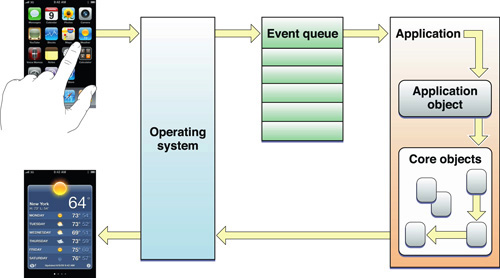
The Application Object Gets and Dispatches Events
Just after an application is launched, it sets up the infrastructure for the main event loop. It establishes a connection with those underlying system components that are responsible for the delivery of low-level user events. The application receives these events through an input source installed in the main thread’s run loop. Because the application must handle each event separately, in order of its arrival, these low-level events are placed in a first-in first-out event queue.
Once the initial user interface is on the screen, the application is thereafter driven by external events. The application object obtains the topmost object in the event queue, converts it to an event object (UIEvent on iOS, NSEvent on OS X), and dispatches it to other objects in the application for handling. When the call that dispatched the event returns, the application fetches the next object in the queue and dispatches it. It continues doing this until the application terminates.
Core Objects Respond to Events and Draw the User Interface
When an application is launched, it also sets up a core group of objects that are responsible for drawing the user interface and handling events. These core objects include windows and various kinds of views. When the application object gets an event from the event queue, it dispatches it to the window in which the user event occurred. The window sends the event to the view that is the most appropriate handler for it:
For multitouch and mouse events, the view is the one under the touch or mouse pointer.
For keyboard, motion, and other events, the view is the first responder.
If this initial view does not handle the event, it can pass it to other views in the application via the responder chain.
In handling the event, the view often initiates a series of actions that modify the appearance of the application and update the application’s state and data. When these actions have been completed, control returns to the application, which fetches the next event from the event queue.
Prerequisite Articles
Related Articles
Definitive Discussion
Event Handling Guide for iOS
Sample Code Projects
(None)
Main event loop的更多相关文章
- PYTHON ASYNCIO: FUTURE, TASK AND THE EVENT LOOP
from :http://masnun.com/2015/11/20/python-asyncio-future-task-and-the-event-loop.html Event Loop On ...
- [Javascript] Task queue & Event loop.
Javascript with Chorme v8 engine works like this : For Chorme engine, v8, it has call stack. And all ...
- 以setTimeout来聊聊Event Loop
平时的工作中,也许你会经常用到setTimeout这个方法,可是你真的了解setTimeout吗?本文想通过总结setTimeout的用法,顺便来探索javascript里面的事件执行机制. setT ...
- 浏览器与Node的事件循环(Event Loop)有何区别?
前言 本文我们将会介绍 JS 实现异步的原理,并且了解了在浏览器和 Node 中 Event Loop 其实是不相同的. 一.线程与进程 1. 概念 我们经常说 JS 是单线程执行的,指的是一个进程里 ...
- 【原】以setTimeout来聊聊Event Loop
平时的工作中,也许你会经常用到setTimeout这个方法,可是你真的了解setTimeout吗?本文想通过总结setTimeout的用法,顺便来探索javascript里面的事件执行机制. setT ...
- IDEA 运行报错 failed to create a child event loop
背景 在IDEA中写了测试代码,但是运行的时候一直提示 java.lang.IllegalStateException: failed to create a child event loop ... ...
- 事件轮询 event loop
Understanding the node.js event loop The first basic thesis of node.js is that I/O is expensive: So ...
- The Node.js Event Loop, Timers, and process.nextTick() Node.js事件循环,定时器和process.nextTick()
个人翻译 原文:https://nodejs.org/en/docs/guides/event-loop-timers-and-nexttick/ The Node.js Event Loop, Ti ...
- js的事件循环(Event Loop)
(本文从掘金小册整理) 首先介绍一下几个概念 进程与线程 相信大家经常会听到 JS 是单线程执行的,但是你是否疑惑过什么是线程? 讲到线程,那么肯定也得说一下进程.本质上来说,两个名词都是 CPU 工 ...
随机推荐
- 整合SSM框架
整合SSM 基本环境搭建 导入相关的pom依赖! <dependencies> <!--Junit--> <dependency> <groupId>j ...
- 小白经典CNN论文复现系列(一):LeNet1989
小白的经典CNN复现系列(一):LeNet-1989 之前的浙大AI作业的那个系列,因为后面的NLP的东西我最近大概是不会接触到,所以我们先换一个系列开始更新博客,就是现在这个经典的CNN复现啦(。・ ...
- %@ taglib uri="http://java.sun.com/jsp/jstl/core"prefix="c"%报错
用eclipse写jsp代码时发现下面两行代码报错:<%@ taglib uri="http://java.sun.com/jsp/jstl/core" prefix=&qu ...
- Echarts数据可视化,easyshu图表集成。
介绍: ECharts,一个使用 JavaScript 实现的开源可视化库,可以流畅的运行在 PC 和移动设备上,兼容当前绝大部分浏览器(IE8/9/10/11,Chrome,Firefox,Sa ...
- JVM的艺术-对象创建与内存分配机制深度剖析
JVM的艺术-对象创建与内存分配机制深度剖析 引言 本章将介绍jvm的对象创建与内存分配.彻底带你了解jvm的创建过程以及内存分配的原理和区域,以及包含的内容. 对象的创建 类加载的过程 固定的类加载 ...
- sendfile“零拷贝”和mmap内存映射
在学习sendfille之前,我们先来了解一下浏览器访问页面时,后台服务器的大致工作流程. 下图是从用户访问某个页面到页面的显示这几秒钟的时间当中,在后台的整个工作过程. 如上图,黑色箭头所示的过程, ...
- 【分布式锁的演化】“超卖场景”,MySQL分布式锁篇
前言 之前的文章中通过电商场景中秒杀的例子和大家分享了单体架构中锁的使用方式,但是现在很多应用系统都是相当庞大的,很多应用系统都是微服务的架构体系,那么在这种跨jvm的场景下,我们又该如何去解决并发. ...
- hive2
4.hive优化 1)跑sql的时候会出现的参数: In order to change the average load for a reducer (in bytes): set hive.exe ...
- 如何限制电脑访问网址—使用Host限制访问网址
如何限制电脑访问网址-使用Host限制访问网址 1. 打开C:\Windows\System32\drivers\etc 2. 打开hosts 3. 修改host内容,如下示例 127.0.0.1 ...
- 【转载】一种git commit前自动格式化的方式
查看原文 简介 这个系列为了解决一个问题:自动化的去管理代码风格和格式 前提:Linux,C语言,Clang 如何在每次commit的时候,将代码风格自动格式化后再提交commit,且格式化的内容必须 ...