
Libevent库基础(1)
1.创建 eevent_base
struct event_base *base = event_base_new();
2.创建 事件event
struct event *ev;
struct event *event_new(struct event_base *base,evutil_socket_t fd,short what,event_callback_fn cb; void *arg);
base: event_base_new()返回值。
fd:绑定到event上的文件描述符
what:对应的事件(r、w、e)
EV_READ 一次 读事件
EV_WRITE 一次 写事件
EV_PERSIST 持续触发。结合 event_base_dispatch 函数使用,生效。
cb:一旦事件满足监听条件,回调的函数。
typedef void (*event_callback_fn)(evutil_socket_t fd, short, void *)
arg:回调的函数的参数。
返回值:成功创建的event
3.添加事件到 event_base
int event_add(struct event *ev, const struct timeval *tv);
ev: event_new() 的返回值。
tv:NULL
从event_base上摘下事件 【了解】
int event_del(struct event *ev);
ev: event_new() 的返回值。
4.销毁事件
int event_free(struct event *ev);
ev: event_new() 的返回值。
操作管道代码:
read管道代码
 1 #include <stdio.h>

 2 #include <unistd.h>

 3 #include <stdlib.h>

 4 #include <sys/types.h>

 5 #include <sys/stat.h>

 6 #include <string.h>

 7 #include <fcntl.h>

 8 #include <event2/event.h>

 9

10 // 对操作处理函数

11 void read_cb(evutil_socket_t fd, short what, void *arg)

12 {

13     // 读管道

14     char buf[1024] = {0};

15

16     int len = read(fd, buf, sizeof(buf));

17

18     printf("read event: %s \n", what & EV_READ ? "Yes" : "No");

19     printf("data len = %d, buf = %s\n", len, buf);

20

21     sleep(1);

22 }

23

24

25 // 读管道

26 int main(int argc, const char* argv[])

27 {

28     unlink("myfifo");

29

30     //创建有名管道

31     mkfifo("myfifo", 0664);

32

33     // open file

34     //int fd = open("myfifo", O_RDONLY | O_NONBLOCK);

35     int fd = open("myfifo", O_RDONLY);

36     if(fd == -1)

37     {

38         perror("open error");

39         exit(1);

40     }

41

42     // 创建个event_base

43     struct event_base* base = NULL;

44     base = event_base_new();

45

46     // 创建事件

47     struct event* ev = NULL;

48     ev = event_new(base, fd, EV_READ | EV_PERSIST, read_cb, NULL);

49

50     // 添加事件

51     event_add(ev, NULL);

52

53     // 事件循环

54     event_base_dispatch(base);  // while(1) { epoll();}

55

56     // 释放资源

57     event_free(ev);

58     event_base_free(base);

59     close(fd);

60

61     return 0;

62 }
write管道代码
 1 #include <stdio.h>

 2 #include <unistd.h>

 3 #include <stdlib.h>

 4 #include <sys/types.h>

 5 #include <sys/stat.h>

 6 #include <string.h>

 7 #include <fcntl.h>

 8 #include <event2/event.h>

 9

10 // 对操作处理函数

11 void write_cb(evutil_socket_t fd, short what, void *arg)

12 {

13     // write管道

14     char buf[1024] = {0};

15

16     static int num = 0;

17     sprintf(buf, "hello,world-%d\n", num++);

18     write(fd, buf, strlen(buf)+1);

19

20     sleep(1);

21 }

22

23

24 // 写管道

25 int main(int argc, const char* argv[])

26 {

27     // open file

28     //int fd = open("myfifo", O_WRONLY | O_NONBLOCK);

29     int fd = open("myfifo", O_WRONLY);

30     if(fd == -1)

31     {

32         perror("open error");

33         exit(1);

34     }

35

36     // 写管道

37     struct event_base* base = NULL;

38     base = event_base_new();

39

40     // 创建事件

41     struct event* ev = NULL;

42     // 检测的写缓冲区是否有空间写

43     //ev = event_new(base, fd, EV_WRITE , write_cb, NULL);

44     ev = event_new(base, fd, EV_WRITE | EV_PERSIST, write_cb, NULL);

45

46     // 添加事件

47     event_add(ev, NULL);

48

49     // 事件循环

50     event_base_dispatch(base);

51

52     // 释放资源

53     event_free(ev);

54     event_base_free(base);

55     close(fd);

56

57     return 0;

58 }
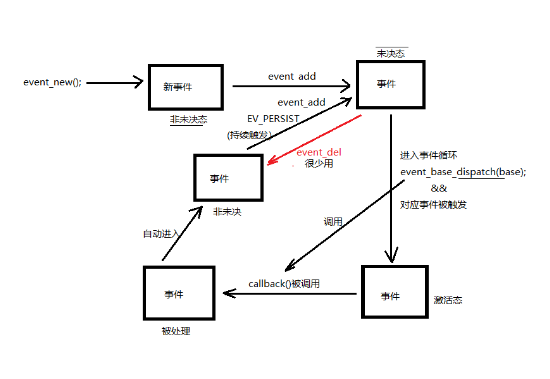
未决和非未决:
非未决: 没有资格被处理
未决: 有资格被处理,但尚未被处理
event_new --> event ---> 非未决 --> event_add --> 未决 --> dispatch() && 监听事件被触发 --> 激活态
--> 执行回调函数 --> 处理态 --> 非未决 event_add && EV_PERSIST --> 未决 --> event_del --> 非未决
Libevent库基础(1)的更多相关文章
- Libevent库基础(2)
带缓冲区的事件 bufferevent #include <event2/bufferevent.h> read/write 两个缓冲. 借助 队列. 创建.销毁bufferevent: ...
- Libevent库学习笔记
Libevent是一个事件触发的网络库,适用于windows.linux.bsd等多种平台,Libevent在底层select.pool.kqueue和epoll等机制基础上,封装出一致的事件接口.可 ...
- libevent库介绍--事件和数据缓冲
首先在学习libevent库的使用前,我们还要从基本的了解开始,已经熟悉了epoll以及reactor,然后从event_base学习,依次学习事件event.数据缓冲Bufferevent和数据封装 ...
- Windows平台下libevent库的使用
1 引子 手头上有一个使用了4个年头的HttpClient库,自己封装的,对于集成了IE浏览器的应用程序很友好.但最近想把产品扩展到Chrome和FireFox阵营,萌发了重构HttpClie ...
- C10K问题和Libevent库介绍
http://blog.chinaunix.net/uid-20761674-id-75056.html 一.C10K的问题 C10K的问题在上个世纪90年代就被提出来了.大概的意思是当用户数超过1万 ...
- R1:创建Libevent库
原文链接:http://www.wangafu.net/~nickm/libevent-book/Ref1_libsetup.html Setting up the Libevent library ...
- python linecache标准库基础学习
#python标准库基础之:linecacge:高效读取文本文件#说明与作用"""可以从文件或者导入python模块获取文件,维护一个结果缓存,从而可以更高效地从相同文件 ...
- C 标准库基础 IO 操作总结
其实输入与输出对于不管什么系统的设计都是异常重要的,比如设计 C 接口函数,首先要设计好输入参数.输出参数和返回值,接下来才能开始设计具体的实现过程.C 语言标准库提供的接口功能很有限,不像 Pyth ...
- libevent库简单使用
一.libevent库简介 Libevent是一个用于开发可扩展性网络服务器的基于事件驱动(event-driven)模型的网络库.Libevent有几个显著的亮点: (1)事件驱动(event-dr ...
随机推荐
- Docker:四、Docker进阶 Windows Docker IIS 部署
前面的三篇docker 文档大家看的肯定不过瘾,自己可能也已经上手一试了...不知道有没有发现问题... 哈哈... 我来说说我遇到的问题哦 一.windows docker 镜像越来越大 默认的do ...
- SpringBoot+RabbitMQ 方式收发消息
本篇会和SpringBoot做整合,采用自动配置的方式进行开发,我们只需要声明RabbitMQ地址就可以了,关于各种创建连接关闭连接的事都由Spring帮我们了~ 交给Spring帮我们管理连接可以让 ...
- 关于Linux软连接和硬链接
(注:此文章仅为个人学习,研究,原创作者:iTech,原创文章网址:https://www.cnblogs.com/itech/archive/2009/04/10/1433052.html) 1.L ...
- 【CF1425H】Huge Boxes of Animal Toys 题解
原题链接 题意简介: 已知分别处在 \((-\infty,-1]\) H.\((-1,0)\) .\((0,1)\) .\([1,\infty)\) 的实数的数量(下记为集合 \(A,B,C,D\) ...
- 梯度提升树 Gradient Boosting Decision Tree
Adaboost + CART 用 CART 决策树来作为 Adaboost 的基础学习器 但是问题在于,需要把决策树改成能接收带权样本输入的版本.(need: weighted DTree(D, u ...
- Leetcode-二分
69. x的平方根 https://leetcode-cn.com/problems/sqrtx/ 实现 int sqrt(int x) 函数. 计算并返回 x 的平方根,其中 x 是非负整数. 由于 ...
- windows 漏洞列表
漏洞列表 #Security Bulletin #KB #Description #Operating System CVE-2017-0213 [Windows COM Eleva ...
- Java安全之Commons Collections1分析(一)
Java安全之Commons Collections1分析(一) 0x00 前言 在CC链中,其实具体执行过程还是比较复杂的.建议调试前先将一些前置知识的基础给看一遍. Java安全之Commons ...
- PropertySheet外壳扩展AppWizard
下载source files - 39 Kb 下载Wizard - 17 Kb 本文旨在简化属性表外壳扩展的实现.它紧接我的第一篇文章 处理上下文菜单壳扩展和灵感 由Michael Dunn最优秀的系 ...
- Elasticsearch(3):别名
ES中可以为索引添加别名,一个别名可以指向到多个索引中,同时在添加别名时可以设置筛选条件,指向一个索引的部分数据,实现在关系数据库汇总的视图功能,这就是ES中别名的强大之处.别名是一个非常实用的功 ...