
我的Python升级打怪之路【二】:Python的基本数据类型及操作
基本数据类型
1.数字
int(整型)
在32位机器上,整数的位数是32位,取值范围是-2**31~2--31-1
在64位系统上,整数的位数是64位,取值范围是-2**63~2**63-1
 class int(object):

     """

     int(x=0) -> integer

     int(x, base=10) -> integer

     Convert a number or string to an integer, or return 0 if no arguments

     are given.  If x is a number, return x.__int__().  For floating point

     numbers, this truncates towards zero.

     If x is not a number or if base is given, then x must be a string,

     bytes, or bytearray instance representing an integer literal in the

     given base.  The literal can be preceded by '+' or '-' and be surrounded

     by whitespace.  The base defaults to 10.  Valid bases are 0 and 2-36.

     Base 0 means to interpret the base from the string as an integer literal.

     >>> int('0b100', base=0)

     4

     """

     def bit_length(self):

         """

         返回表示该数字的时候占用的最小位数

         """

         return 0

     def conjugate(self, *args, **kwargs):

         """ 返回该复数的共轭复数 """

         pass

     @classmethod # known case

     def from_bytes(cls, bytes, byteorder, *args, **kwargs): # real signature unknown; NOTE: unreliably restored from __doc__

         pass

     def to_bytes(self, length, byteorder, *args, **kwargs): # real signature unknown; NOTE: unreliably restored from __doc__

         pass

     def __abs__(self, *args, **kwargs): # real signature unknown

         """ 返回绝对值 """

         pass

     def __add__(self, *args, **kwargs): # real signature unknown

         """ Return self+value. """

         pass

     def __and__(self, *args, **kwargs): # real signature unknown

         """ Return self&value. """

         pass

     def __bool__(self, *args, **kwargs): # real signature unknown

         """ self != 0 """

         pass

     def __ceil__(self, *args, **kwargs): # real signature unknown

         """ Ceiling of an Integral returns itself. """

         pass

     def __divmod__(self, *args, **kwargs): # real signature unknown

         """ 相除,的得到商和余数组成的元组 """

         pass

     def __eq__(self, *args, **kwargs): # real signature unknown

         """ Return self==value. """

         pass

     def __float__(self, *args, **kwargs): # real signature unknown

         """ 转换位浮点数 """

         pass

     def __floordiv__(self, *args, **kwargs): # real signature unknown

         """ Return self//value. """

         pass

     def __floor__(self, *args, **kwargs): # real signature unknown

         """ Flooring an Integral returns itself. """

         pass

     def __format__(self, *args, **kwargs): # real signature unknown

         pass

     def __getattribute__(self, *args, **kwargs): # real signature unknown

         """ Return getattr(self, name). """

         pass

     def __getnewargs__(self, *args, **kwargs): # real signature unknown

         ''' 内部调用__new__方法或创建对象时传入参数使用 '''

         pass

     def __ge__(self, *args, **kwargs): # real signature unknown

         """ Return self>=value. """

         pass

     def __gt__(self, *args, **kwargs): # real signature unknown

         """ Return self>value. """

         pass

     def __hash__(self, *args, **kwargs): # real signature unknown

         """ 如果对象object位哈希表类型,返回对象object的哈希值。哈希值为整数。在字典查找中,

             哈希值用于快速比较字典的键。两个数值相等,则哈希值也相等

         """

         pass

     def __index__(self, *args, **kwargs): # real signature unknown

         """ 用于切片 """

         pass

     def __init__(self, x, base=10): # known special case of int.__init__

         """

         int(x=0) -> integer

         int(x, base=10) -> integer

         Convert a number or string to an integer, or return 0 if no arguments

         are given.  If x is a number, return x.__int__().  For floating point

         numbers, this truncates towards zero.

         If x is not a number or if base is given, then x must be a string,

         bytes, or bytearray instance representing an integer literal in the

         given base.  The literal can be preceded by '+' or '-' and be surrounded

         by whitespace.  The base defaults to 10.  Valid bases are 0 and 2-36.

         Base 0 means to interpret the base from the string as an integer literal.

         >>> int('0b100', base=0)

         4

         # (copied from class doc)

         """

         pass

     def __int__(self, *args, **kwargs): # real signature unknown

         """ 转化为整数 """

         pass

     def __invert__(self, *args, **kwargs): # real signature unknown

         """ ~self """

         pass

     def __le__(self, *args, **kwargs): # real signature unknown

         """ Return self<=value. """

         pass

     def __lshift__(self, *args, **kwargs): # real signature unknown

         """ Return self<<value. """

         pass

     def __lt__(self, *args, **kwargs): # real signature unknown

         """ Return self<value. """

         pass

     def __mod__(self, *args, **kwargs): # real signature unknown

         """ Return self%value. """

         pass

     def __mul__(self, *args, **kwargs): # real signature unknown

         """ Return self*value. """

         pass

     def __neg__(self, *args, **kwargs): # real signature unknown

         """ -self """

         pass

     @staticmethod # known case of __new__

     def __new__(*args, **kwargs): # real signature unknown

         """ Create and return a new object.  See help(type) for accurate signature. """

         pass

     def __ne__(self, *args, **kwargs): # real signature unknown

         """ Return self!=value. """

         pass

     def __or__(self, *args, **kwargs): # real signature unknown

         """ Return self|value. """

         pass

     def __pos__(self, *args, **kwargs): # real signature unknown

         """ +self """

         pass

     def __pow__(self, *args, **kwargs): # real signature unknown

         """ 幂,次方 """

         pass

     def __radd__(self, *args, **kwargs): # real signature unknown

         """ Return value+self. """

         pass

     def __rand__(self, *args, **kwargs): # real signature unknown

         """ Return value&self. """

         pass

     def __rdivmod__(self, *args, **kwargs): # real signature unknown

         """ Return divmod(value, self). """

         pass

     def __repr__(self, *args, **kwargs): # real signature unknown

         """ 转化为解释器可读取的形式 """

         pass

     def __rfloordiv__(self, *args, **kwargs): # real signature unknown

         """ Return value//self. """

         pass

     def __rlshift__(self, *args, **kwargs): # real signature unknown

         """ Return value<<self. """

         pass

     def __rmod__(self, *args, **kwargs): # real signature unknown

         """ Return value%self. """

         pass

     def __rmul__(self, *args, **kwargs): # real signature unknown

         """ Return value*self. """

         pass

     def __ror__(self, *args, **kwargs): # real signature unknown

         """ Return value|self. """

         pass

     def __round__(self, *args, **kwargs): # real signature unknown

         """

         Rounding an Integral returns itself.

         Rounding with an ndigits argument also returns an integer.

         """

         pass

     def __rpow__(self, *args, **kwargs): # real signature unknown

         """ Return pow(value, self, mod). """

         pass

     def __rrshift__(self, *args, **kwargs): # real signature unknown

         """ Return value>>self. """

         pass

     def __rshift__(self, *args, **kwargs): # real signature unknown

         """ Return self>>value. """

         pass

     def __rsub__(self, *args, **kwargs): # real signature unknown

         """ Return value-self. """

         pass

     def __rtruediv__(self, *args, **kwargs): # real signature unknown

         """ Return value/self. """

         pass

     def __rxor__(self, *args, **kwargs): # real signature unknown

         """ Return value^self. """

         pass

     def __sizeof__(self, *args, **kwargs): # real signature unknown

         """ Returns size in memory, in bytes """

         pass

     def __str__(self, *args, **kwargs): # real signature unknown

         """ 转化为阅读的形式,如果没有适合于人阅读的形式则返回解释器阅读的形式 """

         pass

     def __sub__(self, *args, **kwargs): # real signature unknown

         """ Return self-value. """

         pass

     def __truediv__(self, *args, **kwargs): # real signature unknown

         """ Return self/value. """

         pass

     def __trunc__(self, *args, **kwargs): # real signature unknown

         """ 返回数值被截取为整形的值,在整数中无意义 """

         pass

     def __xor__(self, *args, **kwargs): # real signature unknown

         """ Return self^value. """

         pass

     denominator = property(lambda self: object(), lambda self, v: None, lambda self: None)  # default

     """分母 = 1"""

     imag = property(lambda self: object(), lambda self, v: None, lambda self: None)  # default

     """虚数,无意义"""

     numerator = property(lambda self: object(), lambda self, v: None, lambda self: None)  # default

     """分子 = 数字大小"""

     real = property(lambda self: object(), lambda self, v: None, lambda self: None)  # default

     """实数,无意义"""
int源代码剖析
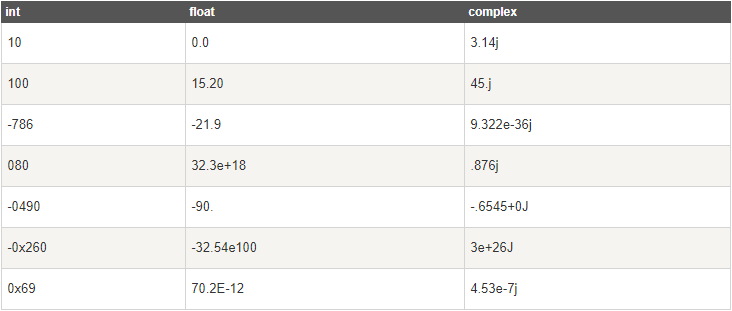
数值的类型:
2.布尔值
真或假
1 或 0
3.字符串
"hello python" 一个标准的字符串
字符串的常用操作:
- 移除空白
- 分割
- 长度
- 索引
- 切片
 class str(object):

     """

     str(object='') -> str

     str(bytes_or_buffer[, encoding[, errors]]) -> str

     Create a new string object from the given object. If encoding or

     errors is specified, then the object must expose a data buffer

     that will be decoded using the given encoding and error handler.

     Otherwise, returns the result of object.__str__() (if defined)

     or repr(object).

     encoding defaults to sys.getdefaultencoding().

     errors defaults to 'strict'.

     """

     def capitalize(self):

         """

         首字母大写

         """

         return ""

     def casefold(self):

         """

         S.casefold() -> str

         Return a version of S suitable for caseless comparisons.

         """

         return ""

     def center(self, width, fillchar=None):

         """

         内容居中,width:总长度;fillchar:空白处填充内容,默认为''

         """

         return ""

     def count(self, sub, start=None, end=None):

         """

         子序列个数

         """

         return 0

     def encode(self, encoding='utf-8', errors='strict'):

         """

         编码,针对unicode

         """

         return b""

     def endswith(self, suffix, start=None, end=None):

         """

         判断是否是以xxx结束

         """

         return False

     def expandtabs(self, tabsize=8):

         """

         将tab转换为空格,默认一个tab转换为8个空格

         """

         return ""

     def find(self, sub, start=None, end=None):

         """

         寻找子序列位置,如果没找到,返回-1

         """

         return 0

     def format(self, *args, **kwargs):

         """

         字符串格式化,动态参数

         """

         pass

     def format_map(self, mapping):

         """

         S.format_map(mapping) -> str

         Return a formatted version of S, using substitutions from mapping.

         The substitutions are identified by braces ('{' and '}').

         """

         return ""

     def index(self, sub, start=None, end=None):

         """

         子序列的位置,如果没有 报错

         """

         return 0

     def isalnum(self):

         """

         是否是字母和数字

         """

         return False

     def isalpha(self):

         """

         是否是字母

         """

         return False

     def isdecimal(self):

         """

         S.isdecimal() -> bool

         Return True if there are only decimal characters in S,

         False otherwise.

         """

         return False

     def isdigit(self):

         """

         是否是数字

         """

         return False

     def isidentifier(self):

         """

         S.isidentifier() -> bool

         Return True if S is a valid identifier according

         to the language definition.

         Use keyword.iskeyword() to test for reserved identifiers

         such as "def" and "class".

         """

         return False

     def islower(self):

         """

         是否小写

         """

         return False

     def isnumeric(self): # real signature unknown; restored from __doc__

         """

         S.isnumeric() -> bool

         Return True if there are only numeric characters in S,

         False otherwise.

         """

         return False

     def isprintable(self): # real signature unknown; restored from __doc__

         """

         S.isprintable() -> bool

         Return True if all characters in S are considered

         printable in repr() or S is empty, False otherwise.

         """

         return False

     def isspace(self): # real signature unknown; restored from __doc__

         """

         S.isspace() -> bool

         Return True if all characters in S are whitespace

         and there is at least one character in S, False otherwise.

         """

         return False

     def istitle(self): # real signature unknown; restored from __doc__

         """

         S.istitle() -> bool

         Return True if S is a titlecased string and there is at least one

         character in S, i.e. upper- and titlecase characters may only

         follow uncased characters and lowercase characters only cased ones.

         Return False otherwise.

         """

         return False

     def isupper(self): # real signature unknown; restored from __doc__

         """

         S.isupper() -> bool

         Return True if all cased characters in S are uppercase and there is

         at least one cased character in S, False otherwise.

         """

         return False

     def join(self, iterable):

         """

         可用于拼接字符串

         """

         return ""

     def ljust(self, width, fillchar=None):

         """

         内容左对齐,右侧填充

         """

         return ""

     def lower(self):

         """

         变小写

         """

         return ""

     def lstrip(self, chars=None):

         """

         移除左侧空白

         """

         return ""

     def maketrans(self, *args, **kwargs): # real signature unknown

         """

         Return a translation table usable for str.translate().

         If there is only one argument, it must be a dictionary mapping Unicode

         ordinals (integers) or characters to Unicode ordinals, strings or None.

         Character keys will be then converted to ordinals.

         If there are two arguments, they must be strings of equal length, and

         in the resulting dictionary, each character in x will be mapped to the

         character at the same position in y. If there is a third argument, it

         must be a string, whose characters will be mapped to None in the result.

         """

         pass

     def partition(self, sep): # real signature unknown; restored from __doc__

         """

         S.partition(sep) -> (head, sep, tail)

         Search for the separator sep in S, and return the part before it,

         the separator itself, and the part after it.  If the separator is not

         found, return S and two empty strings.

         """

         pass

     def replace(self, old, new, count=None):

         """

         替换

         """

         return ""

     def rfind(self, sub, start=None, end=None): # real signature unknown; restored from __doc__

         """

         S.rfind(sub[, start[, end]]) -> int

         Return the highest index in S where substring sub is found,

         such that sub is contained within S[start:end].  Optional

         arguments start and end are interpreted as in slice notation.

         Return -1 on failure.

         """

         return 0

     def rindex(self, sub, start=None, end=None): # real signature unknown; restored from __doc__

         """

         S.rindex(sub[, start[, end]]) -> int

         Return the highest index in S where substring sub is found,

         such that sub is contained within S[start:end].  Optional

         arguments start and end are interpreted as in slice notation.

         Raises ValueError when the substring is not found.

         """

         return 0

     def rjust(self, width, fillchar=None): # real signature unknown; restored from __doc__

         """

         S.rjust(width[, fillchar]) -> str

         Return S right-justified in a string of length width. Padding is

         done using the specified fill character (default is a space).

         """

         return ""

     def rpartition(self, sep): # real signature unknown; restored from __doc__

         """

         S.rpartition(sep) -> (head, sep, tail)

         Search for the separator sep in S, starting at the end of S, and return

         the part before it, the separator itself, and the part after it.  If the

         separator is not found, return two empty strings and S.

         """

         pass

     def rsplit(self, sep=None, maxsplit=-1):

         return []

     def rstrip(self, chars=None): # real signature unknown; restored from __doc__

         """

         S.rstrip([chars]) -> str

         Return a copy of the string S with trailing whitespace removed.

         If chars is given and not None, remove characters in chars instead.

         """

         return ""

     def split(self, sep=None, maxsplit=-1):

         """

         分割,maxsplit分割多少次

         """

         return []

     def splitlines(self, keepends=None):

         """

         根据换行进行分割

         """

         return []

     def startswith(self, prefix, start=None, end=None):

         """

         是否起始

         """

         return False

     def strip(self, chars=None):

         """

         移除两端的空白

         """

         return ""

     def swapcase(self):

         """

         大小写之间的转换

         """

         return ""

     def title(self): # real signature unknown; restored from __doc__

         """

         S.title() -> str

         Return a titlecased version of S, i.e. words start with title case

         characters, all remaining cased characters have lower case.

         """

         return ""

     def translate(self, table):

         """

         转换,需要先做一个对应表,最后一个表示删除字符集合

         """

         return ""

     def upper(self): # real signature unknown; restored from __doc__

         """

         S.upper() -> str

         Return a copy of S converted to uppercase.

         """

         return ""

     def zfill(self, width):

         """

         返回固定长度的字符串,原字符串右对齐,前面填充0

         """

         return ""

     def __add__(self, *args, **kwargs): # real signature unknown

         """ Return self+value. """

         pass

     def __contains__(self, *args, **kwargs): # real signature unknown

         """ Return key in self. """

         pass

     def __eq__(self, *args, **kwargs): # real signature unknown

         """ Return self==value. """

         pass

     def __format__(self, format_spec): # real signature unknown; restored from __doc__

         """

         S.__format__(format_spec) -> str

         Return a formatted version of S as described by format_spec.

         """

         return ""

     def __getattribute__(self, *args, **kwargs): # real signature unknown

         """ Return getattr(self, name). """

         pass

     def __getitem__(self, *args, **kwargs): # real signature unknown

         """ Return self[key]. """

         pass

     def __getnewargs__(self, *args, **kwargs): # real signature unknown

         pass

     def __ge__(self, *args, **kwargs): # real signature unknown

         """ Return self>=value. """

         pass

     def __gt__(self, *args, **kwargs): # real signature unknown

         """ Return self>value. """

         pass

     def __hash__(self, *args, **kwargs): # real signature unknown

         """ Return hash(self). """

         pass

     def __init__(self, value='', encoding=None, errors='strict'): # known special case of str.__init__

         """

         str(object='') -> str

         str(bytes_or_buffer[, encoding[, errors]]) -> str

         Create a new string object from the given object. If encoding or

         errors is specified, then the object must expose a data buffer

         that will be decoded using the given encoding and error handler.

         Otherwise, returns the result of object.__str__() (if defined)

         or repr(object).

         encoding defaults to sys.getdefaultencoding().

         errors defaults to 'strict'.

         # (copied from class doc)

         """

         pass

     def __iter__(self, *args, **kwargs): # real signature unknown

         """ Implement iter(self). """

         pass

     def __len__(self, *args, **kwargs): # real signature unknown

         """ Return len(self). """

         pass

     def __le__(self, *args, **kwargs): # real signature unknown

         """ Return self<=value. """

         pass

     def __lt__(self, *args, **kwargs): # real signature unknown

         """ Return self<value. """

         pass

     def __mod__(self, *args, **kwargs): # real signature unknown

         """ Return self%value. """

         pass

     def __mul__(self, *args, **kwargs): # real signature unknown

         """ Return self*value.n """

         pass

     @staticmethod # known case of __new__

     def __new__(*args, **kwargs): # real signature unknown

         """ Create and return a new object.  See help(type) for accurate signature. """

         pass

     def __ne__(self, *args, **kwargs): # real signature unknown

         """ Return self!=value. """

         pass

     def __repr__(self, *args, **kwargs): # real signature unknown

         """ Return repr(self). """

         pass

     def __rmod__(self, *args, **kwargs): # real signature unknown

         """ Return value%self. """

         pass

     def __rmul__(self, *args, **kwargs): # real signature unknown

         """ Return self*value. """

         pass

     def __sizeof__(self): # real signature unknown; restored from __doc__

         """ S.__sizeof__() -> size of S in memory, in bytes """

         pass

     def __str__(self, *args, **kwargs): # real signature unknown

         """ Return str(self). """

         pass
Str源码剖析
4.列表
创建列表:
 list1 = ['','',3]

 list2 = list( ['','',3] )
基本操作:
- 索引
- 切片
- 追加
- 删除
- 长度
- 切片
- 循环
- 包含
 class list(object):

     """

     list() -> new empty list

     list(iterable) -> new list initialized from iterable's items

     """

     def append(self, p_object):

         """ list添加数据的常用方法 """

         pass

     def clear(self): # real signature unknown; restored from __doc__

         """ L.clear() -> None -- remove all items from L """

         pass

     def copy(self): # real signature unknown; restored from __doc__

         """ L.copy() -> list -- a shallow copy of L """

         return []

     def count(self, value): # real signature unknown; restored from __doc__

         """ 计数 """

         return 0

     def extend(self, iterable): # real signature unknown; restored from __doc__

         """ L.extend(iterable) -> None -- extend list by appending elements from the iterable """

         pass

     def index(self, value, start=None, stop=None): # real signature unknown; restored from __doc__

         """

         L.index(value, [start, [stop]]) -> integer -- return first index of value.

         Raises ValueError if the value is not present.

         """

         return 0

     def insert(self, index, p_object): # real signature unknown; restored from __doc__

         """ L.insert(index, object) -- insert object before index """

         pass

     def pop(self, index=None): # real signature unknown; restored from __doc__

         """

         弹出

         """

         pass

     def remove(self, value): # real signature unknown; restored from __doc__

         """

         移除

         """

         pass

     def reverse(self): # real signature unknown; restored from __doc__

         """ L.reverse() -- reverse *IN PLACE* """

         pass

     def sort(self, key=None, reverse=False): # real signature unknown; restored from __doc__

         """ L.sort(key=None, reverse=False) -> None -- stable sort *IN PLACE* """

         pass

     def __add__(self, *args, **kwargs): # real signature unknown

         """ Return self+value. """

         pass

     def __contains__(self, *args, **kwargs): # real signature unknown

         """ Return key in self. """

         pass

     def __delitem__(self, *args, **kwargs): # real signature unknown

         """ Delete self[key]. """

         pass

     def __eq__(self, *args, **kwargs): # real signature unknown

         """ Return self==value. """

         pass

     def __getattribute__(self, *args, **kwargs): # real signature unknown

         """ Return getattr(self, name). """

         pass

     def __getitem__(self, y): # real signature unknown; restored from __doc__

         """ x.__getitem__(y) <==> x[y] """

         pass

     def __ge__(self, *args, **kwargs): # real signature unknown

         """ Return self>=value. """

         pass

     def __gt__(self, *args, **kwargs): # real signature unknown

         """ Return self>value. """

         pass

     def __iadd__(self, *args, **kwargs): # real signature unknown

         """ Implement self+=value. """

         pass

     def __imul__(self, *args, **kwargs): # real signature unknown

         """ Implement self*=value. """

         pass

     def __init__(self, seq=()): # known special case of list.__init__

         """

         list() -> new empty list

         list(iterable) -> new list initialized from iterable's items

         # (copied from class doc)

         """

         pass

     def __iter__(self, *args, **kwargs): # real signature unknown

         """ Implement iter(self). """

         pass

     def __len__(self, *args, **kwargs): # real signature unknown

         """ Return len(self). """

         pass

     def __le__(self, *args, **kwargs): # real signature unknown

         """ Return self<=value. """

         pass

     def __lt__(self, *args, **kwargs): # real signature unknown

         """ Return self<value. """

         pass

     def __mul__(self, *args, **kwargs): # real signature unknown

         """ Return self*value.n """

         pass

     @staticmethod # known case of __new__

     def __new__(*args, **kwargs): # real signature unknown

         """ Create and return a new object.  See help(type) for accurate signature. """

         pass

     def __ne__(self, *args, **kwargs): # real signature unknown

         """ Return self!=value. """

         pass

     def __repr__(self, *args, **kwargs): # real signature unknown

         """ Return repr(self). """

         pass

     def __reversed__(self): # real signature unknown; restored from __doc__

         """ L.__reversed__() -- return a reverse iterator over the list """

         pass

     def __rmul__(self, *args, **kwargs): # real signature unknown

         """ Return self*value. """

         pass

     def __setitem__(self, *args, **kwargs): # real signature unknown

         """ Set self[key] to value. """

         pass

     def __sizeof__(self): # real signature unknown; restored from __doc__

         """ L.__sizeof__() -- size of L in memory, in bytes """

         pass

     __hash__ = None
List源码剖析
5.元组
创建元组:
 ages1 = (1,2,3,)

 ages2 = tuple((1,2,3,))
基本操作:
- 索引
- 切片
- 循环
- 长度
- 包含
 lass tuple(object):

     """

     tuple() -> empty tuple

     tuple(iterable) -> tuple initialized from iterable's items

     If the argument is a tuple, the return value is the same object.

     """

     def count(self, value): # real signature unknown; restored from __doc__

         """ T.count(value) -> integer -- return number of occurrences of value """

         return 0

     def index(self, value, start=None, stop=None): # real signature unknown; restored from __doc__

         """

         T.index(value, [start, [stop]]) -> integer -- return first index of value.

         Raises ValueError if the value is not present.

         """

         return 0

     def __add__(self, y): # real signature unknown; restored from __doc__

         """ x.__add__(y) <==> x+y """

         pass

     def __contains__(self, y): # real signature unknown; restored from __doc__

         """ x.__contains__(y) <==> y in x """

         pass

     def __eq__(self, y): # real signature unknown; restored from __doc__

         """ x.__eq__(y) <==> x==y """

         pass

     def __getattribute__(self, name): # real signature unknown; restored from __doc__

         """ x.__getattribute__('name') <==> x.name """

         pass

     def __getitem__(self, y): # real signature unknown; restored from __doc__

         """ x.__getitem__(y) <==> x[y] """

         pass

     def __getnewargs__(self, *args, **kwargs): # real signature unknown

         pass

     def __getslice__(self, i, j): # real signature unknown; restored from __doc__

         """

         x.__getslice__(i, j) <==> x[i:j]

                    Use of negative indices is not supported.

         """

         pass

     def __ge__(self, y): # real signature unknown; restored from __doc__

         """ x.__ge__(y) <==> x>=y """

         pass

     def __gt__(self, y): # real signature unknown; restored from __doc__

         """ x.__gt__(y) <==> x>y """

         pass

     def __hash__(self): # real signature unknown; restored from __doc__

         """ x.__hash__() <==> hash(x) """

         pass

     def __init__(self, seq=()): # known special case of tuple.__init__

         """

         tuple() -> empty tuple

         tuple(iterable) -> tuple initialized from iterable's items

         If the argument is a tuple, the return value is the same object.

         # (copied from class doc)

         """

         pass

     def __iter__(self): # real signature unknown; restored from __doc__

         """ x.__iter__() <==> iter(x) """

         pass

     def __len__(self): # real signature unknown; restored from __doc__

         """ x.__len__() <==> len(x) """

         pass

     def __le__(self, y): # real signature unknown; restored from __doc__

         """ x.__le__(y) <==> x<=y """

         pass

     def __lt__(self, y): # real signature unknown; restored from __doc__

         """ x.__lt__(y) <==> x<y """

         pass

     def __mul__(self, n): # real signature unknown; restored from __doc__

         """ x.__mul__(n) <==> x*n """

         pass

     @staticmethod # known case of __new__

     def __new__(S, *more): # real signature unknown; restored from __doc__

         """ T.__new__(S, ...) -> a new object with type S, a subtype of T """

         pass

     def __ne__(self, y): # real signature unknown; restored from __doc__

         """ x.__ne__(y) <==> x!=y """

         pass

     def __repr__(self): # real signature unknown; restored from __doc__

         """ x.__repr__() <==> repr(x) """

         pass

     def __rmul__(self, n): # real signature unknown; restored from __doc__

         """ x.__rmul__(n) <==> n*x """

         pass

     def __sizeof__(self): # real signature unknown; restored from __doc__

         """ T.__sizeof__() -- size of T in memory, in bytes """

         pass
元组源码剖析
6.字典
创建字典:
 dict1 = {'k1':'v1','k2':'v2'}

 dict2  =dict({'k1':'v1','k2':'v2'})
常用操作:
- 索引
- 新增
- 删除
- 键、值、键值对的操作
- 循环
- 长度
 class dict(object):

     """

     dict() -> new empty dictionary

     dict(mapping) -> new dictionary initialized from a mapping object's

         (key, value) pairs

     dict(iterable) -> new dictionary initialized as if via:

         d = {}

         for k, v in iterable:

             d[k] = v

     dict(**kwargs) -> new dictionary initialized with the name=value pairs

         in the keyword argument list.  For example:  dict(one=1, two=2)

     """

     def clear(self): # real signature unknown; restored from __doc__

         """ 清除内容 """

         """ D.clear() -> None.  Remove all items from D. """

         pass

     def copy(self): # real signature unknown; restored from __doc__

         """ 浅拷贝 """

         """ D.copy() -> a shallow copy of D """

         pass

     @staticmethod # known case

     def fromkeys(S, v=None): # real signature unknown; restored from __doc__

         """

         dict.fromkeys(S[,v]) -> New dict with keys from S and values equal to v.

         v defaults to None.

         """

         pass

     def get(self, k, d=None): # real signature unknown; restored from __doc__

         """ 根据key获取值,d是默认值 """

         """ D.get(k[,d]) -> D[k] if k in D, else d.  d defaults to None. """

         pass

     def has_key(self, k): # real signature unknown; restored from __doc__

         """ 是否有key """

         """ D.has_key(k) -> True if D has a key k, else False """

         return False

     def items(self): # real signature unknown; restored from __doc__

         """ 所有项的列表形式 """

         """ D.items() -> list of D's (key, value) pairs, as 2-tuples """

         return []

     def iteritems(self): # real signature unknown; restored from __doc__

         """ 项可迭代 """

         """ D.iteritems() -> an iterator over the (key, value) items of D """

         pass

     def iterkeys(self): # real signature unknown; restored from __doc__

         """ key可迭代 """

         """ D.iterkeys() -> an iterator over the keys of D """

         pass

     def itervalues(self): # real signature unknown; restored from __doc__

         """ value可迭代 """

         """ D.itervalues() -> an iterator over the values of D """

         pass

     def keys(self): # real signature unknown; restored from __doc__

         """ 所有的key列表 """

         """ D.keys() -> list of D's keys """

         return []

     def pop(self, k, d=None): # real signature unknown; restored from __doc__

         """ 获取并在字典中移除 """

         """

         D.pop(k[,d]) -> v, remove specified key and return the corresponding value.

         If key is not found, d is returned if given, otherwise KeyError is raised

         """

         pass

     def popitem(self): # real signature unknown; restored from __doc__

         """ 获取并在字典中移除 """

         """

         D.popitem() -> (k, v), remove and return some (key, value) pair as a

         2-tuple; but raise KeyError if D is empty.

         """

         pass

     def setdefault(self, k, d=None): # real signature unknown; restored from __doc__

         """ 如果key不存在,则创建,如果存在,则返回已存在的值且不修改 """

         """ D.setdefault(k[,d]) -> D.get(k,d), also set D[k]=d if k not in D """

         pass

     def update(self, E=None, **F): # known special case of dict.update

         """ 更新

             {'name':'alex', 'age': 18000}

             [('name','sbsbsb'),]

         """

         """

         D.update([E, ]**F) -> None.  Update D from dict/iterable E and F.

         If E present and has a .keys() method, does:     for k in E: D[k] = E[k]

         If E present and lacks .keys() method, does:     for (k, v) in E: D[k] = v

         In either case, this is followed by: for k in F: D[k] = F[k]

         """

         pass

     def values(self): # real signature unknown; restored from __doc__

         """ 所有的值 """

         """ D.values() -> list of D's values """

         return []

     def viewitems(self): # real signature unknown; restored from __doc__

         """ 所有项,只是将内容保存至view对象中 """

         """ D.viewitems() -> a set-like object providing a view on D's items """

         pass

     def viewkeys(self): # real signature unknown; restored from __doc__

         """ D.viewkeys() -> a set-like object providing a view on D's keys """

         pass

     def viewvalues(self): # real signature unknown; restored from __doc__

         """ D.viewvalues() -> an object providing a view on D's values """

         pass

     def __cmp__(self, y): # real signature unknown; restored from __doc__

         """ x.__cmp__(y) <==> cmp(x,y) """

         pass

     def __contains__(self, k): # real signature unknown; restored from __doc__

         """ D.__contains__(k) -> True if D has a key k, else False """

         return False

     def __delitem__(self, y): # real signature unknown; restored from __doc__

         """ x.__delitem__(y) <==> del x[y] """

         pass

     def __eq__(self, y): # real signature unknown; restored from __doc__

         """ x.__eq__(y) <==> x==y """

         pass

     def __getattribute__(self, name): # real signature unknown; restored from __doc__

         """ x.__getattribute__('name') <==> x.name """

         pass

     def __getitem__(self, y): # real signature unknown; restored from __doc__

         """ x.__getitem__(y) <==> x[y] """

         pass

     def __ge__(self, y): # real signature unknown; restored from __doc__

         """ x.__ge__(y) <==> x>=y """

         pass

     def __gt__(self, y): # real signature unknown; restored from __doc__

         """ x.__gt__(y) <==> x>y """

         pass

     def __init__(self, seq=None, **kwargs): # known special case of dict.__init__

         """

         dict() -> new empty dictionary

         dict(mapping) -> new dictionary initialized from a mapping object's

             (key, value) pairs

         dict(iterable) -> new dictionary initialized as if via:

             d = {}

             for k, v in iterable:

                 d[k] = v

         dict(**kwargs) -> new dictionary initialized with the name=value pairs

             in the keyword argument list.  For example:  dict(one=1, two=2)

         # (copied from class doc)

         """

         pass

     def __iter__(self): # real signature unknown; restored from __doc__

         """ x.__iter__() <==> iter(x) """

         pass

     def __len__(self): # real signature unknown; restored from __doc__

         """ x.__len__() <==> len(x) """

         pass

     def __le__(self, y): # real signature unknown; restored from __doc__

         """ x.__le__(y) <==> x<=y """

         pass

     def __lt__(self, y): # real signature unknown; restored from __doc__

         """ x.__lt__(y) <==> x<y """

         pass

     @staticmethod # known case of __new__

     def __new__(S, *more): # real signature unknown; restored from __doc__

         """ T.__new__(S, ...) -> a new object with type S, a subtype of T """

         pass

     def __ne__(self, y): # real signature unknown; restored from __doc__

         """ x.__ne__(y) <==> x!=y """

         pass

     def __repr__(self): # real signature unknown; restored from __doc__

         """ x.__repr__() <==> repr(x) """

         pass

     def __setitem__(self, i, y): # real signature unknown; restored from __doc__

         """ x.__setitem__(i, y) <==> x[i]=y """

         pass

     def __sizeof__(self): # real signature unknown; restored from __doc__

         """ D.__sizeof__() -> size of D in memory, in bytes """

         pass

     __hash__ = None
字典代码剖析
7.集合
set集合,一个无序而且不重复的元素集合
常用操作:
- 追加
- 删除
- 并集
- 交集
- 差集
 class set(object):

     """

     set() -> new empty set object

     set(iterable) -> new set object

     Build an unordered collection of unique elements.

     """

     def add(self, *args, **kwargs): # real signature unknown

         """

         Add an element to a set,添加元素

         This has no effect if the element is already present.

         """

         pass

     def clear(self, *args, **kwargs): # real signature unknown

         """ Remove all elements from this set. 清除内容"""

         pass

     def copy(self, *args, **kwargs): # real signature unknown

         """ Return a shallow copy of a set. 浅拷贝  """

         pass

     def difference(self, *args, **kwargs): # real signature unknown

         """

         Return the difference of two or more sets as a new set. A中存在,B中不存在

         (i.e. all elements that are in this set but not the others.)

         """

         pass

     def difference_update(self, *args, **kwargs): # real signature unknown

         """ Remove all elements of another set from this set.  从当前集合中删除和B中相同的元素"""

         pass

     def discard(self, *args, **kwargs): # real signature unknown

         """

         Remove an element from a set if it is a member.

         If the element is not a member, do nothing. 移除指定元素,不存在不保错

         """

         pass

     def intersection(self, *args, **kwargs): # real signature unknown

         """

         Return the intersection of two sets as a new set. 交集

         (i.e. all elements that are in both sets.)

         """

         pass

     def intersection_update(self, *args, **kwargs): # real signature unknown

         """ Update a set with the intersection of itself and another.  取交集并更更新到A中 """

         pass

     def isdisjoint(self, *args, **kwargs): # real signature unknown

         """ Return True if two sets have a null intersection.  如果没有交集,返回True,否则返回False"""

         pass

     def issubset(self, *args, **kwargs): # real signature unknown

         """ Report whether another set contains this set.  是否是子序列"""

         pass

     def issuperset(self, *args, **kwargs): # real signature unknown

         """ Report whether this set contains another set. 是否是父序列"""

         pass

     def pop(self, *args, **kwargs): # real signature unknown

         """

         Remove and return an arbitrary set element.

         Raises KeyError if the set is empty. 移除元素

         """

         pass

     def remove(self, *args, **kwargs): # real signature unknown

         """

         Remove an element from a set; it must be a member.

         If the element is not a member, raise a KeyError. 移除指定元素,不存在保错

         """

         pass

     def symmetric_difference(self, *args, **kwargs): # real signature unknown

         """

         Return the symmetric difference of two sets as a new set.  对称差集

         (i.e. all elements that are in exactly one of the sets.)

         """

         pass

     def symmetric_difference_update(self, *args, **kwargs): # real signature unknown

         """ Update a set with the symmetric difference of itself and another. 对称差集,并更新到a中 """

         pass

     def union(self, *args, **kwargs): # real signature unknown

         """

         Return the union of sets as a new set.  并集

         (i.e. all elements that are in either set.)

         """

         pass

     def update(self, *args, **kwargs): # real signature unknown

         """ Update a set with the union of itself and others. 更新 """

         pass
Set集合代码剖析
这里补充几点
1.for循环
用户按照顺序循环可迭代对象中的内容
 li = [1,2,3]

 for item in li:

     print(item)
2.enumrate与for循环连用
为可迭代对象添加序号
 li = [1,2,3]

 for item_index,item_value in enumerate(li,1):    #表示序号从1开始

     print(item_index,item_value)
3.range和xrange
python2.x:
生成一个范围
 print(range(1,10))

 # 结果:[1,2,3,4,5,6,7,8,9]

 print(range(1,10,2))

 # 结果:[1,3,5,7,9]

 print(range(10,0,-2))

 # 结果:[10,8,6,4,2]
这里额外说一句:
xrange会返回一个生成器对象
python3.x:
Python3中取消了xrange,但是python3中的range返回的就是生成器对象
 print(rage(0,10))

 # 结果:range(0,10)
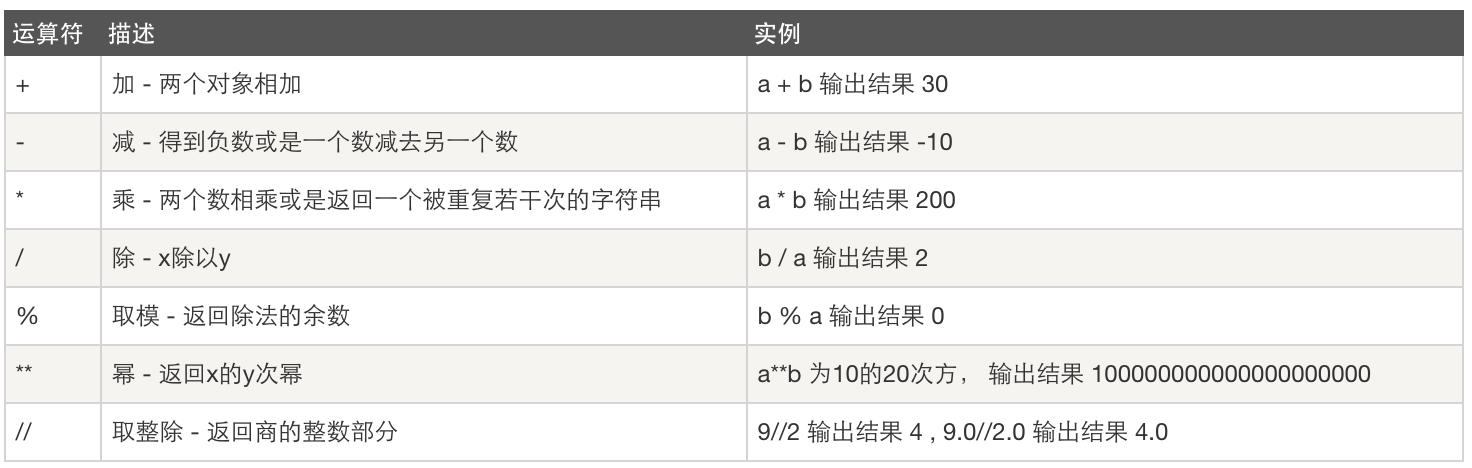
这里再补充几点:运算符
1.算数运算
2.比较运算

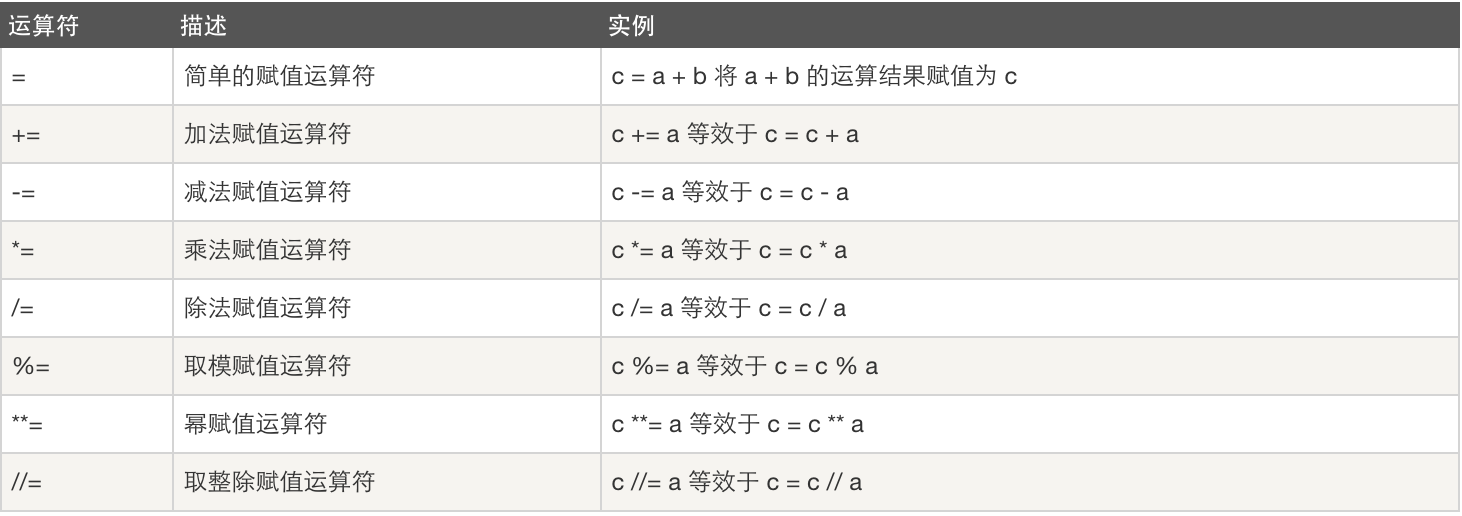
3.赋值运算
4.逻辑运算

5.成员运算

我的Python升级打怪之路【二】:Python的基本数据类型及操作的更多相关文章
- 我的Python升级打怪之路【一】:python的简单认识
Python的简介 Python与其他语言的对比: C和Python.Java.C# C语言:代码直接编译成了机器码,在处理器上直接执行 Python.Java.C#:编译得到相应的字节码,虚拟机执行 ...
- 我的Python升级打怪之路【六】:面向对象(二)
面向对象的一些相关知识点 一.isinstance(obj,cls) 检查实例obj是否是类cls的对象 class Foo(object): pass obj = Foo() isinstance( ...
- 我的Python升级打怪之路【七】:网络编程
Socket网络套接字 socket通常也称为"套接字",用于描述IP地址和端口,是一个通信链的句柄.应用程序通常通过”套接字“向网络发出请求或者应答网络请求. socket起源于 ...
- 我的Python升级打怪之路【六】:面向对象(一)
面向对象的概述 面向过程:根据业务逻辑从上到下写代码 函数式:将其功能代码封装到函数中,日后便无需编写,仅仅调用即可 [执行函数] 面向对象:对函数进行分类和封装.[创建对象]==>[通过对象执 ...
- 我的Python升级打怪之路【五】:Python模块
模块,是一些代码实现了某个功能的集合 模块的分类: 自定义模块 第三方模块 内置模块 导入模块 import module from module.xx.xx import xx from modul ...
- 我的Python升级打怪之路【三】:Python函数
函数 在函数之前,我们一直遵循者:面向过程编程,即:根据业务逻辑从上到下实现功能,开发过程中最常见的就是粘贴复制.代码就没有重复利用率. 例如:有好多的重复的代码 if 条件: 发送指令 接收结果 e ...
- 我的Python升级打怪之路【四】:Python之前的一些补充
字符串的格式化 1.百分号的方式 %[(name)][flags][width].[precision]typecode (name) 可选,用于选择指定的key flags 可选,可供选择的值有: ...
- gitlab 迁移、升级打怪之路:8.8.5--> 8.10.8 --> 8.17.8 --> 9.5.9 --> 10.1.4 --> 10.2.5
gitlab 迁移.升级打怪之路:8.8.5--> 8.10.8 --> 8.17.8 --> 9.5.9 --> 10.1.4 --> 10.2.5 gitlab 数据 ...
- Python的自学之路:Python基础(一)
声明:我写博客不是为了什么,只是为了记录自己的学习状态,学过的知识点!方便以后进行好的复习!python小白,勿喷 python环境的搭建,在这里就不细说了,这里有我的链接,可以参考一下:https: ...
随机推荐
- unittest测试框架详谈及实操(五)
测试报告——生成HTML格式的测试报告 前面的实例输出的所有测试结果都是以命令行日志的方式展示,不止于难看,但也不适合直接把那样的测试结果截图发给相关人员,尤其是领导.这时需要更加友好的测试结果,既能 ...
- Linux下MySQL表名不区分大小写的设置方法
MySQL表名不区分大小写的设置方法 在用centox安装mysql后,把项目的数据库移植了过去,发现一些表的数据查不到,排查了一下问题,最后发现是表名的大小写不一致造成的. mysql在window ...
- hadoop大致问题
一.项目编码实现 HDFS文件上传 HDFS文件下载 定位文件读取 通过API操作HDFS 通过IO流操作HDFS HDFS写数据流程 HDFS读数据流程 统计一堆文件中单词出现的个数(WordCou ...
- XJOI3363 树3/Codeforces 682C Alyona and the Tree(dfs)
Alyona decided to go on a diet and went to the forest to get some apples. There she unexpectedly fou ...
- 1、Semantic-UI之开发环境搭建
下载webstrom(其他的任何可以进行前端开发的软件都可以) Download WebStorm: The Smartest JavaScript IDE by JetBrains 安装并激活web ...
- delphi实现截全屏功能
procedure TForm1.Button10Click(Sender: TObject);var bmp: TBitmap; can: TCanvas; dc: HDC; Image1: TIm ...
- C# 连接 IBM MQ
安装 IBM WebSphere MQ:http://www-01.ibm.com/software/integration/wmq/explorer/downloads/ 正确安装要注意几个地方,集 ...
- WinForm使用Label控件模拟分割线(竖向)
用Label控件进行模拟 宽度设为1:this.lblPagerSpliter1.Size = new System.Drawing.Size(1, 21); 去掉边框:this.lblPagerSp ...
- centos7 minimal 安装 &网络配置
1.下载centos7manimal.iso 下载地址: http://isoredirect.centos.org/centos/7/isos/x86_64/CentOS-7-x86_64-Min ...
- 谈谈iOS开发如何写个人中心这类页面--静态tableView页面的编写
本文来自 网易云社区 . 一.本文讲的是什么问题? 在开发 iOS 应用时,基本都会遇到个人中心.设置.详情信息等页面,这里截取了某应用的详情编辑页面和个人中心页面,如下: 我们以页面结构的角度考虑这 ...