
Simple Addition Permits Voltage Control Of DC-DC Converter's Output
http://electronicdesign.com/power/simple-addition-permits-voltage-control-dc-dc-converters-output
In a standard dc-dc converter, a resistor divider typically defines a fixed output voltage. However, applications like programmable output voltage power supplies and motor control circuits require dynamic control of the dc-dc converter’s output voltage. The circuit described here allows control of the converter’s output voltage, VOut, with a control voltage, VC.
In a conventional dc-dc buck converter, VOut is:

so VOut is fixed by the values of R1 and R2 (Fig. 1).
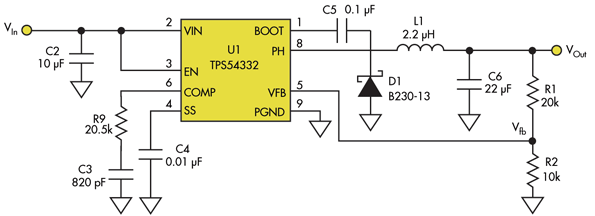
1. The output voltage in a conventional dc-dc buck converter is fixed and depends on the resistor divider, R1/R2.
The added circuitry in Figure 2 enables users to control the same dc-dc converter’s output voltage using VC.
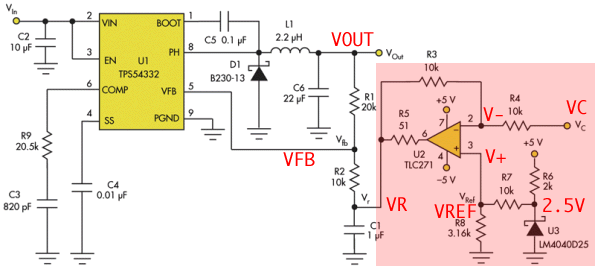
In this case, R2 is not connected to the ground but, rather, to Vr. Equation 1 then becomes:
VOUT = VFB + ( ( VFB - VR ) / R2 ) * R1
VOUT - VR = VFB - VR + ( ( VFB - VR ) / R2 ) * R1
VOUT - VR = ( VFB - VR ) * R2 / R2 + ( VFB - VR ) * R1 / R2
VOUT - VR = ( VFB - VR ) * ( R2 + R1 ) / R2

Since R1 = 20 kΩ and R2 = 10 kΩ, Equation 2 can be simplified to:
VOut – Vr = 3(Vfb – Vr)(3)
or:
VOut = 3 Vfb – 2 Vr(4)
( VC - V- ) / R4 = ( V- - VR ) / R3 ( I4 = I3 )
VC / R4 - V- / R4 = V- / R3 - VR / R3
V- / R4 + V- / R3 = VC / R4 + VR / R3
V- * ( R3 + R4 ) / ( R3 * R4 ) = ( VC * R3 + VR * R4 )/ ( R3 * R4 )
V- * ( R3 + R4 ) = ( VC * R3 + VR * R4 )
VR * R4 = V- * ( R3 + R4 ) - VC * R3
V- = V+ = VREF : VR * R4 = VREF * ( R3 + R4 ) - VC * R3
R3 = R4 : VR * R3 = VREF * ( R3 + R3 ) - VC * R3
VR = VREF * 2 - VC
R3 and R4 have the same value, 10 kΩ, so amplifier U2’s output voltage is:
Vr = 2 VRef – VC(5)
where VRef is the reference voltage generated by U3 after resistor divider R7/R8.
VOut = 3 Vfb – 2 Vr(4)
Combining Equation 4 and Equation 5:
VOut = 3 Vfb – 4 VRef + 2 VC (6)
To simplify Equation 6, choose components that make:
3 Vfb = 4 VRef(7)
Then Equation 6 becomes:
VOut = 2 VC (8)
The internal voltage reference of U1 is 0.8 V. ( TPS54332 )
VREF = 3VFB / 4 = 3 *0.8 / 4 = 0.6V
LM4040D25 : 2.5V : By choosing R7 = 10 kΩ and R8 = 3.16 kΩ, VRef = 0.6 V, satisfying Equation 7.
Finally, C1 lowers U2’s output impedance at high frequencies,
maintaining the stability of U1’s feedback loop.
The added circuitry allows users to control the buck converter’s output voltage,
VOut, in the range of 0 to 5 V with a control voltage, VC, in the range of 0 to 2.5 V.
Similar circuitry can be designed for use with a boost converter,
or any other dc-dc converter, as long as its feedback voltage pin is accessible.
Using an operational amplifier in the feedback path
A very flexible way of influencing the feedback pin while not being so restricted
in terms of the control signal is to use an operational amplifier.
It can be used to inject some current into the feedback divider which then
forces the control loop of the power supply to change the output voltage.
This way the output voltage can be varied continuously as a function
of the current injected into the feedback node.
Often, the information controlling the output voltage change on a power supply in sensor applications
as well as motor drive applications is an analog signal.
Depending on the nature of this control signal, the circuit around the operational amplifier
can be defined to set the lowest voltage output independent of what the control signal range is.
Also there is great flexibility in the ratio of control signal change to change in the output voltage.
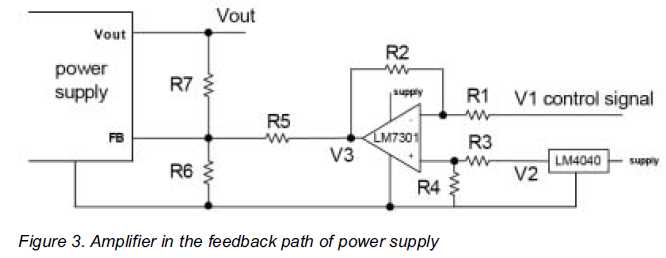
Figure 3 shows an amplifier circuit in the feedback path of a switching power supply.
The difference amplifier uses an operational amplifier and four additional resistors R1 through R4.
The output of the operational amplifier acts like a voltage source.
In order to inject a current into the feedback node this voltage is converted into a current by resistor R5.
It equals the internal impedance of the current source which the operational amplifier and R5 constitute.
Together with the feedback resistors R6 and R7 any output voltage changes
can be set based on almost any given control signal.
The signal voltage V1 is the control signal.
The voltage V2 is a reference voltage for the operational amplifier.
It should be a fairly constant voltage since variations on it will
change the output voltage of the power supply as well.
If a fairly precise rail in the system is available it can generally be used.
A good solution is a low voltage reference IC such as National Semiconductors LM4040.
Simple Addition Permits Voltage Control Of DC-DC Converter's Output的更多相关文章
- Simple dc/dc converter increases available power in dual-voltage system
The schematic in Figure 1 shows a way to increase the power available from a current-limited 5V supp ...
- PID DC/DC Converter Controller Using a PICmicro Microcontroller
http://www.microchip.com/stellent/idcplg?IdcService=SS_GET_PAGE&nodeId=1824&appnote=en011794 ...
- LT1946A-- Transformerless dc/dc converter produces bipolar outputs
Dual-polarity supply provides ±12V from one IC VC (Pin 1): Error Amplifier Output Pin. Tie external ...
- Practice safe dc/dc converter
Short-circuit protection is an obvious requirement for a power supply, especially when its load conn ...
- [专业名词·硬件] 2、DC\DC、LDO电源稳压基本常识(包含基本原理、高效率模块设计、常见问题、基于nRF51822电源管理模块分析等)·长文
综述先看这里 第一节的1.1简单介绍了DC/DC是什么: 第二节是关于DC/DC的常见的疑问答疑,非常实用: 第三节是针对nRF51822这款芯片电源管理部分的DC/DC.LDO.1.8的详细分析,对 ...
- DC/DC与LDO的差别
转自:http://bbs.eetop.cn/thread-459121-1-1.html 在平时的学习中,我们都有接触LDO和DC/DC这一类的电源产品,但作为学生的我们队这些东西可能了解不够深刻, ...
- Add margining capability to a dc/dc converter
You can easily add margining capability—that is, the ability to digitally adjust the output voltage— ...
- DC DC降壓變換器ic 工作原理
目前DC/DC轉化器大致可分為:升壓型dc dc變化器.降壓型dc dc變化器及可升壓又可降壓dc dc變換器.我們今天主要提一下降壓型dc dc變換器的原理: 見下圖降壓變換器原理圖如圖1所示, 當 ...
- DC DC電路電感的選擇
注:只有充分理解電感在DC/DC電路中發揮的作用,才能更優的設計DC/DC電路.本文還包括對同步DC/DC及異步DC/DC概念的解釋. DCDC電路電感的選擇 簡介 在開關電源的設計中電感的設計為 ...
随机推荐
- selenium grid结构图
调用 Selenium-Grid 的基本结构图如下: 上面是使用 selenium-grid 的一种普通方式,仅仅使用了其支持的分布式执行的功能,即当你同时需 要测试用例比较多时,可以平行的执行这些用 ...
- 用PHP去实现数据库查询结果缓存
有些时候我们希望减少对数据库的查询来提高程序的性能,因为这些数据不是经常变更的,而是会在很长一段时间内都不会变化,因此,我们每连接一次数据库,都会把相应的结果用文件的形式保存起来.比如对于一个商城来说 ...
- Linux上java环境变量配置
1.java配置 配置环境变量在/etc/profile下增加 # set Java environment JAVA_HOME=/usr/share/jdk1.6.0_43 PATH=$JAVA_H ...
- LightOJ 1414 February 29(闰年统计+容斥原理)
题目链接:https://vjudge.net/contest/28079#problem/R 题目大意:给你分别给你两个日期(第二个日期大于等于第一个日期),闰年的2月29日称为闰日,让你求两个日期 ...
- python基础(11)--面向对象
1.概述 面向过程:根据业务的逻辑从上到下写代码 函数式:将某功能代码封装到函数中,日后便无需重复编写,仅调用函数即可 面向对象:对函数进行分类和封装,让开发更快更好更强 面向过程编程最易被初学者接受 ...
- Django admin后台操作
Django提供自动后台管理应用,简称admin. admin是一个应用,每个Web站点都需要它.admin通过让开发者可以在完成完整的UI之前验证处理数据的代码. 设置admin 打开setting ...
- C#窗口矩形区域着色
C#写的一个GUI窗口,有几百个矩形区域.每个矩形区域的颜色随时都可能改变,并且多次改变. 我放弃使用label绘制矩形,因为效果不好.拖控件的界面使用power packs中的rectanglesh ...
- 邀请用户进TestFlight 体验 App 的测试版本
iphone手机用户,在工作中常见到,APP版本现在是Beta阶段(iOS版本),需要邀请一些用户来体验新版本,在版本上线前提出更好的建议及时进行修改,此时用到了testflight,很方便的通过邀请 ...
- 2019.2.25 模拟赛T1【集训队作业2018】小Z的礼物
T1: [集训队作业2018]小Z的礼物 我们发现我们要求的是覆盖所有集合里的元素的期望时间. 设\(t_{i,j}\)表示第一次覆盖第i行第j列的格子的时间,我们要求的是\(max\{ALL\}\) ...
- day4 递归原理及解析
递归 递归是一种调用自身的方法,在函数执行过程中重复不断的调用自身的过程,递归的规模每次都要缩小,一般前一步的程序作为后一步的参数.但是必须有递归结束条件. 递归算法是一种直接或者间接地调用自身算法的 ...