
What is AMQP? and the architecture
What is AMQP? (Advanced Message Queuing Protocol)
When two applications need to communicate there are a lot of solutions like IPC, if these applications are remote we can use RPC. When two or more applications communicate with each other we can use ESB. And there are many more solutions. But when more than two applications communicate and the systems need to be scalable the problem is a bit more complicated. In fact, when we need to send a call to a remote process or distribute object processing among different servers we start to think about queues.
Typical examples are rendering farms, massive mail sending, publish/subscriptions solutions like news systems. At that time we start to consider a queue-based solution. In my case the first approach to these types of solutions was Gearman; that is a very simple queue system where workers connect to a central service where producers have to call the methods published by workers; the messages are queued and delivered to workers in a simple queue.
Another interesting solution can be use Redis like a queue service using their features like publish/subscribe. Anyway always you can develop your own queue system. Maybe there a lot of solutions like that but when you are interested in develop in standard way and want a long-run solution with scalability and high availability then you need to think in use AMQP-based solutions.
The most simple definition of AMQP is: “message-oriented middleware”. Behind this simple definition there are a lot of features available. Before AMQP there was some message-oriented middlewares, for example, JMS. But AMQP is the standard protocol to keep when you choice a queue-based solution.
AMQP have features like queuing, routing, reliability and security. And most of the implementations of AMQP have a really scalable architectures and high availability solutions.
The architecture
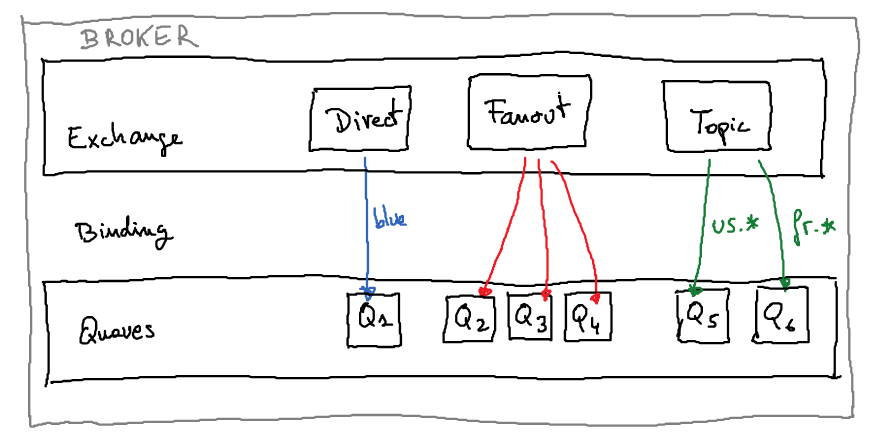
The basic architecture is simple, there are a client applications called producers that create messages and deliver it to a AMQP server also called broker. Inside the broker the messages are routed and filtered until arrive to queues where another applications called consumers are connected and get the messages to be processed.

When we have understood this maybe is the time to deep inside the broker where there are AMQP magic. The broker has three parts:
- Exchange: where the producer applications delivers the messages, messages have a routing key and exchange uses it to route messages.
- Queues: where messages are stored and then consumers get the messages from queues.
- Bindings: makes relations between exchanges and queues.
When exchange have a message uses their routing key and three different exchange methods to choose where the message goes:
- Direct Exchange: routing key matches the queue name.
- Fanout Exchange: the message is cloned and sent to all queues connected to this exchange.
- Topic Exchange: using wildcards the message can be routed to some of connected queues.
This is the internal schema of a broker:
http://oriolrius.cat/blog/2012/03/15/what-is-amqp-and-the-architecure/
https://www.cnblogs.com/ASPNET2008/p/6414145.html
Understanding AMQP, the protocol used by RabbitMQ
Update I changed the first paragraph to clarify the relationship between RabbitMQ and JMS.
RabbitMQ is a lightweight, reliable, scalable and portable message broker. But unlike many message brokers familiar to Java developers, it's not based on JMS. Instead, your applications communicate with it via a platform-neutral, wire-level protocol: the Advanced Message Queuing Protocol (AMQP). Fortunately there's already a Java client library and SpringSource is working on first class Spring and Grails integration - so don't worry about having to do low-level stuff to use RabbitMQ. You can even find AMQP client libraries that expose a JMS interface. But AMQP is sufficiently different in operation from JMS that it might cause headaches for Java developers that are used to the JMS model.
In order to ease the transition, I'll be looking in this post at the basic concepts that underpin AMQP along with three common usage scenarios. By the end, you will hopefully have a good enough understanding to configure RabbitMQ and use it via the APIs provided by Spring and Grails.
Exchanges, queues, and bindings
Like any messaging system, AMQP is a message protocol that deals with publishers and consumers. The publishers produce the messages, the consumers pick them up and process them. It's the job of the message broker (such as RabbitMQ) to ensure that the messages from a publisher go to the right consumers. In order to do that, the broker uses two key components: exchanges and queues. The following diagram shows how they connect a publisher to a consumer:
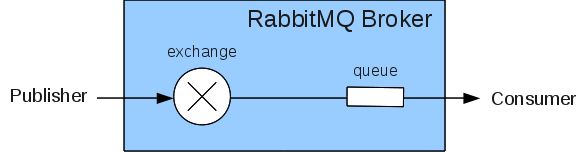
As you can see, the setup is pretty straightforward. A publisher sends messages to a named exchange and a consumer pulls messages from a queue (or the queue pushes them to the consumer depending on the configuration). Of course, the connections have to be made in the first place, so how do publishers and consumers discover each other? Via the name of the exchange. Usually, either the publisher or consumer creates the exchange with a given name and then makes that name public. How that publication happens depends on the circumstances, but one might put it in public API documentation or send it to known clients.
How are the messages routed from the exchange to the queue? Good question. First, the queue has to be attached to the given exchange. Typically, a consumer creates a queue and attaches it to an exchange at the same time. Second, messages received by the exchange have to be matched to the queue - a process called "binding".
To understand binding, it's useful to understand the structure of an AMQP message:
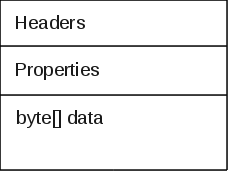
The headers and properties of the message are basically key/value pairs. The difference between them is that headers are defined by the AMQP specification whereas properties can contain arbitrary, application-specific information. The actual message content is just a sequence of bytes, so if you want to pass text around in your messages, then you should standardise on an encoding. UTF-8 is a good bet. You can specify a content type and encoding in the message headers if you want, but that's apparently not particularly common.
What does this have to do with binding? One of the standard headers is called routing-key and it is this that the broker uses to match messages to queues. Each queue specifies a "binding key" and if that key matches the value of the routing-key header, the queue receives the message.
Things are slightly complicated by the concept of exchange types. The AMQP spec. defines the following four types:
| EXCHANGE TYPE | BEHAVIOUR |
|---|---|
| Direct | The binding key must match the routing key exactly - no wildcard support. |
| Topic | Same as Direct, but wildcards are allowed in the binding key. '#' matches zero or more dot-delimited words and '*' matches exactly one such word. |
| Fanout | The routing and binding keys are ignored - all published messages go to all bound queues. |
| Headers |
Update I corrected the information on wildcards, which work on the basis of dot-delimited words or terms.
For example, say a publisher sends a message with a routing key of "NYSE" to a topic exchange called "Stocks". If a consumer creates a queue attached to "Stocks" with a binding key of "#", "*", or "NYSE", then that consumer will get the message because all three binding keys match "NYSE". However, if the message is published to a direct exchange, then the consumer will not get the message if the binding key is "#" or "*" since those characters are treated as literals, not wildcards. Interestingly, "#.#" will also match "NYSE" despite the routing key not having a dot.
Now consider a message with a routing key of "NYSE.TECH.MSFT". What binding keys will match it given that the message is going to a topic exchange?
| BINDING KEY | MATCH? |
|---|---|
| NYSE.TECH.MSFT | Yes |
| # | Yes |
| NYSE.# | Yes |
| *.* | No |
| NYSE.* | No |
| NYSE.TECH.* | Yes |
| NYSE.*.MSFT | Yes |
That's really all there is to it. Flexibility is provided by support for multiple consumers per queue and multiple queues per exchange. In fact, a single queue can even be bound to multiple exchanges. Now let's look at some of those scenarios.
RPC
An AMQP broker can act as an RPC mechanism between a client and a service. The general setup is like this, using a direct exchange:

The general sequence goes:
- Client sends message to the queue, specifying: (a) a routing key that matches the service; and (b) the name of a queue to pick the response up from.
- Exchange passes the message to the service's queue ("ops_q" in this case).
- The queue pushes the message to the service, which then does some work and sends a response message back to the exchange, specifying a routing_key that matches the reply queue.
- The client picks the response message off the reply queue.
From the perspective of the client, the call could either be blocking or non-blocking. How easy it is to do one or the other, though, depends on the client library in use.
The key to the RPC scenario is making sure that the client and service are using the same exchange for the initial request and that the client knows what to specify for the routing key.
As for the reply queue, it's typically created by the client, which then populates the reply_toheader appropriately. Also, although you can use a different exchange for the replies compared to the requests, it's much more common to use the same exchange for both requests and replies.
Pub(lish)/Sub(scribe)
JMS has the concept of topic queues that ensure that messages from a publisher go to all subscribers. You can easily achieve the same behaviour in AMQP by binding multiple queues to an exchange like so:
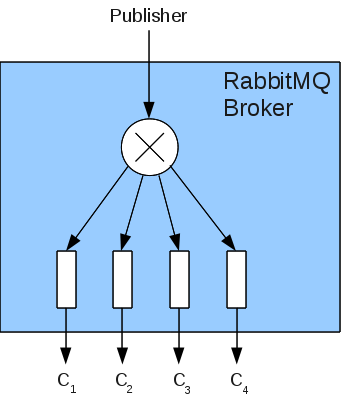
Even better, the queues can filter which messages they receive via the binding key. If a consumer wants to receive all messages, then it can specify a binding key of "#" - the "match any number of words" wildcard. Rather confusingly for your average developer, "*" matches zero or one (dot-delimited) words as mentioned earlier.
Work distribution
Imagine you have an application that has a bunch of jobs that need executing. With AMQP, you can hook up multiple consumers such that each job goes to one, and only one, of those consumers. The publisher doesn't care which consumer does the work, just that the work is done. This is work distribution.
Configuring it is pretty straightforward, as shown in this diagram:
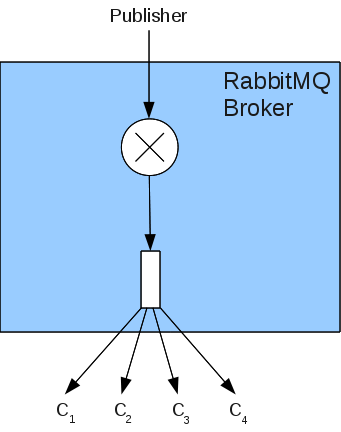
So you have one queue bound to the exchange with multiple consumers sharing that queue. This setup guarantees that only one consumer processes a given message, no matter how many consumers there are.
Those are the three main usage patterns for AMQP brokers. Although I have described each individually, it's fairly common to combine them. For example, you could have multiple services sharing the same queue (work distribution) in the RPC pattern. It's really up to you to decide how to configure the exchanges and queues, and now you should have a good enough understanding to work out the appropriate setup for your situation.
If you want to go further into AMQP, then check out the specification itself, particularly the section on General Architecture. And to get started with RabbitMQ, just go to its website.
https://spring.io/blog/2010/06/14/understanding-amqp-the-protocol-used-by-rabbitmq/
What is AMQP? and the architecture的更多相关文章
- Understanding AMQP, the protocol used by RabbitMQ--reference
RabbitMQ is a lightweight, reliable, scalable and portable message broker. But unlike many message b ...
- Pattern: Microservice Architecture
Microservice Architecture pattern http://microservices.io/patterns/microservices.html Context You ar ...
- RabbitMQ + PHP (二)AMQP拓展安装
上篇说到了 RabbitMQ 的安装. 这次要在讲案例之前,需要安装PHP的AMQP扩展.不然可能会报以下两个错误. 1.Fatal error: Class 'AMQPConnection' not ...
- Undefined symbols for architecture arm64解决方案
在iOS开发中经常遇到的一个错误是Undefined symbols for architecture arm64,这个错误表示工程某些地方不支持arm64指令集.那我们应该怎么解决这个问题了?我们不 ...
- Optimal Flexible Architecture(最优灵活架构)
来自:Oracle® Database Installation Guide 12_c_ Release 1 (12.1) for Linux Oracle base目录命名规范: /pm/s/u 例 ...
- EF框架组件详述【Entity Framework Architecture】(EF基础系列篇3)
我们来看看EF的框架设计吧: The following figure shows the overall architecture of the Entity Framework. Let us n ...
- [Architecture] 系统架构正交分解法
[Architecture] 系统架构正交分解法 前言 随着企业成长,支持企业业务的软件,也会越来越庞大与复杂.当系统复杂到一定程度,开发人员会发现很多系统架构的设计细节,很难有条理.有组织的用一张大 ...
- Stack Overflow: The Architecture - 2016 Edition
To get an idea of what all of this stuff “does,” let me start off with an update on the average day ...
- ios build时,Undefined symbols for architecture xxx问题的总结
简单来说,Undefined symbols基本上等于JAVA的ClassNotFoundException,最常见的原因有这几种: build的时候没有加framework 比如说,有一段代码我用了 ...
随机推荐
- 1.mybatis入门
一:创建表 CREATE TABLE `country` ( `id` ) NOT NULL AUTO_INCREMENT, `countryname` varchar() DEFAULT NULL, ...
- 关于使用java自动发邮件--找不到smtphost
今天解决报的第二个异常:Unknown SMTP host: smtp.qq.com;在找了网上的一些资料后,有看到是因为使用了代理服务器,所以无法访问.我试着用了telnet去访问,确实不行.最近都 ...
- 常用下载方式的区别-BT下载、磁力链接、电驴
出处:https://www.jianshu.com/p/72b7a64e5be1 打开 115 离线下载的窗口,看到支持这么多种链接,你都清楚他们是什么原理嘛?接下来我们一个一个说. 一.HTTP( ...
- 实现域名访问网站—nginx反向代理
今天在跟项目的时候,是否被耍了三个多小时,最后在我准备号材料准备他人求助的时候,在收集材料的时候,居然访问通了, 别问我为什么,我也不知道 ,哈哈哈哈(苦逼脸...) 分享出来,大家共同学习: 这个是 ...
- JavaScript基础(1)-ECMAScript
一.JavaScript简介 1.JavaScript历史背景 布兰登 • 艾奇(Brendan Eich,1961年-),1995年在网景公司,发明的JavaScript. 刚开始JavaScrip ...
- 深入字节码理解invokeSuper无限循环的原因
来一段简单的cglib代码 public class SampleClass { public void test(){ System.out.println("hello world&qu ...
- joi库 学习笔记
零.背景 node.js 应用中,req.query / req.body 传来的参数需要做 valication( 合法性验证 ) 一.安装 https://github.com/hapijs/jo ...
- DNS 预解析
DNS 解析也是需要时间的,可以通过预解析的方式来预先获得域名所对应的 IP. <link rel="dns-prefetch" href="//yuchengka ...
- 使用IST重新加入节点(5.7.20)
IST不是SST用于节点重新加入吗?我们有解决方案! 鉴于上述痛点,我们将介绍 gcache.freeze_purge_at_seqno Percona XtraDB Cluster 5.7.20.这 ...
- ASP.NET 上传大文件(原创)
问题描述 需要在网站中上传文件,但是当文件大小太大的时候IIS会拒绝连接,导致用户看到不友好的错误界面. 解决方法 1.服务器端处理 在globle.asax中的protected void Appl ...