
Pattern: Microservice Architecture
Microservice Architecture pattern http://microservices.io/patterns/microservices.html
Context
You are developing a server-side enterprise application. It must support a variety of different clients including desktop browsers, mobile browsers and native mobile applications. The application might also expose an API for 3rd parties to consume. It might also integrate with other applications via either web services or a message broker. The application handles requests (HTTP requests and messages) by executing business logic; accessing a database; exchanging messages with other systems; and returning a HTML/JSON/XML response. There are logical components corresponding to different functional areas of the application.
Problem
What’s the application’s deployment architecture?
Forces
- There is a team of developers working on the application
- New team members must quickly become productive
- The application must be easy to understand and modify
- You want to practice continuous deployment of the application
- You must run multiple copies of the application on multiple machines in order to satisfy scalability and availability requirements
- You want to take advantage of emerging technologies (frameworks, programming languages, etc)
Solution
Define an architecture that structures the application as a set of loosely coupled, collaborating services. This approach corresponds to the Y-axis of the Scale Cube. Each service implements a set of narrowly, related functions. For example, an application might consist of services such as the order management service, the customer management service etc.
Services communicate using either synchronous protocols such as HTTP/REST or asynchronous protocols such as AMQP. Services can be developed and deployed independently of one another. Each service has its own database in order to be decoupled from other services. Data consistency between services is maintained using the Saga pattern
Examples
Fictitious e-commerce application
Let’s imagine that you are building an e-commerce application that takes orders from customers, verifies inventory and available credit, and ships them. The application consists of several components including the StoreFrontUI, which implements the user interface, along with some backend services for checking credit, maintaining inventory and shipping orders. The application consists of a set of services.
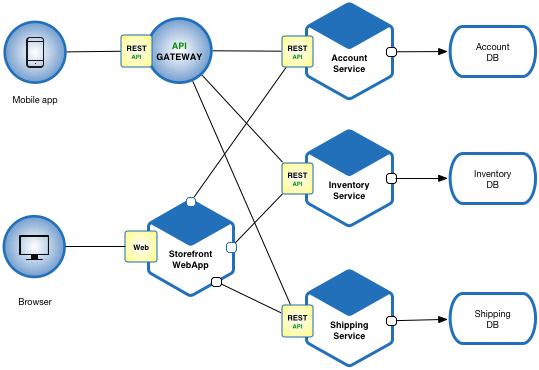
Show me the code
Please see the example applications developed by Chris Richardson. These examples on github.com illustrate various aspects of the microservice architecture.
Resulting context
Benefits
This solution has a number of benefits:
- Enables the continuous delivery and deployment of large, complex applications.
- Better testability - services are smaller and faster to test
- Better deployability - services can be deployed independently
- It enables you to organize the development effort around multiple, auto teams. It enables you to organize the development effort around multiple teams. Each (two pizza) team is owns and is responsible for one or more single service. Each team can develop, deploy and scale their services independently of all of the other teams.
- Each microservice is relatively small
- Easier for a developer to understand
- The IDE is faster making developers more productive
- The application starts faster, which makes developers more productive, and speeds up deployments
- Improved fault isolation. For example, if there is a memory leak in one service then only that service will be affected. The other services will continue to handle requests. In comparison, one misbehaving component of a monolithic architecture can bring down the entire system.
- Eliminates any long-term commitment to a technology stack. When developing a new service you can pick a new technology stack. Similarly, when making major changes to an existing service you can rewrite it using a new technology stack.
Drawbacks
This solution has a number of drawbacks:
- Developers must deal with the additional complexity of creating a distributed system.
- Developer tools/IDEs are oriented on building monolithic applications and don’t provide explicit support for developing distributed applications.
- Testing is more difficult
- Developers must implement the inter-service communication mechanism.
- Implementing use cases that span multiple services without using distributed transactions is difficult
- Implementing use cases that span multiple services requires careful coordination between the teams
- Deployment complexity. In production, there is also the operational complexity of deploying and managing a system comprised of many different service types.
- Increased memory consumption. The microservice architecture replaces N monolithic application instances with NxM services instances. If each service runs in its own JVM (or equivalent), which is usually necessary to isolate the instances, then there is the overhead of M times as many JVM runtimes. Moreover, if each service runs on its own VM (e.g. EC2 instance), as is the case at Netflix, the overhead is even higher.
Issues
There are many issues that you must address.
When to use the microservice architecture?
One challenge with using this approach is deciding when it makes sense to use it. When developing the first version of an application, you often do not have the problems that this approach solves. Moreover, using an elaborate, distributed architecture will slow down development. This can be a major problem for startups whose biggest challenge is often how to rapidly evolve the business model and accompanying application. Using Y-axis splits might make it much more difficult to iterate rapidly. Later on, however, when the challenge is how to scale and you need to use functional decomposition, the tangled dependencies might make it difficult to decompose your monolithic application into a set of services.
How to decompose the application into services?
Another challenge is deciding how to partition the system into microservices. This is very much an art, but there are a number of strategies that can help:
- Decompose by business capability and define services corresponding to business capabilities.
- Decompose by domain-driven design subdomain.
- Decompose by verb or use case and define services that are responsible for particular actions. e.g. a
Shipping Servicethat’s responsible for shipping complete orders. - Decompose by by nouns or resources by defining a service that is responsible for all operations on entities/resources of a given type. e.g. an
Account Servicethat is responsible for managing user accounts.
Ideally, each service should have only a small set of responsibilities. (Uncle) Bob Martin talks about designing classes using the Single Responsibility Principle (SRP). The SRP defines a responsibility of a class as a reason to change, and states that a class should only have one reason to change. It make sense to apply the SRP to service design as well.
Another analogy that helps with service design is the design of Unix utilities. Unix provides a large number of utilities such as grep, cat and find. Each utility does exactly one thing, often exceptionally well, and can be combined with other utilities using a shell script to perform complex tasks.
How to maintain data consistency?
In order to ensure loose coupling, each service has its own database. Maintaining data consistency between services is a challenge because 2 phase-commit/distributed transactions is not an option for many applications. An application must instead use the Saga pattern. A service publishes an event when its data changes. Other services consume that event and update their data. There are several ways of reliably updating data and publishing events including Event Sourcing and Transaction Log Tailing.
How to implement queries?
Another challenge is implementing queries that need to retrieve data owned by multiple services.
- The API Composition and Command Query Responsibility Segregation (CQRS) patterns.
Related patterns
There are many patterns related to the microservices pattern. The Monolithic architecture is an alternative to the microservice architecture. The other patterns address issues that you will encounter when applying the microservice architecture.
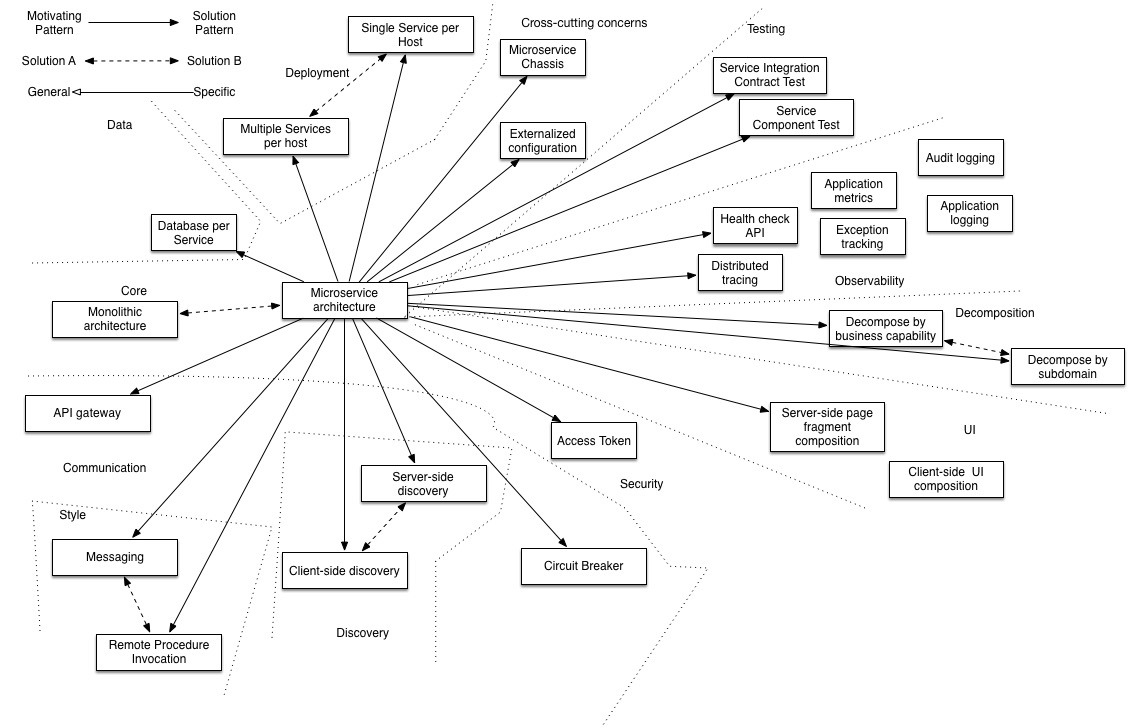
- Decomposition patterns
- The Database per Service pattern describes how each service has its own database in order to ensure loose coupling.
- The API Gateway pattern defines how clients access the services in a microservice architecture.
- The Client-side Discovery and Server-side Discovery patterns are used to route requests for a client to an available service instance in a microservice architecture.
- The Messaging and Remote Procedure Invocation patterns are two different ways that services can communicate.
- The Single Service per Host and Multiple Services per Host patterns are two different deployment strategies.
- Cross-cutting concerns patterns: Microservice chassis pattern and Externalized configuration
- Testing patterns: Service Component Test and Service Integration Contract Test
- Circuit Breaker
- Access Token
- Observability patterns:
- UI patterns:
Known uses
Most large scale web sites including Netflix, Amazon and eBay have evolved from a monolithic architecture to a microservice architecture.
Netflix, which is a very popular video streaming service that’s responsible for up to 30% of Internet traffic, has a large scale, service-oriented architecture. They handle over a billion calls per day to their video streaming API from over 800 different kinds of devices. Each API call fans out to an average of six calls to backend services.
Amazon.com originally had a two-tier architecture. In order to scale they migrated to a service-oriented architecture consisting of hundreds of backend services. Several applications call these services including the applications that implement the Amazon.com website and the web service API. The Amazon.com website application calls 100-150 services to get the data that used to build a web page.
The auction site ebay.com also evolved from a monolithic architecture to a service-oriented architecture. The application tier consists of multiple independent applications. Each application implements the business logic for a specific function area such as buying or selling. Each application uses X-axis splits and some applications such as search use Z-axis splits. Ebay.com also applies a combination of X-, Y- and Z-style scaling to the database tier.
There are numerous other examples of companies using the microservice architecture.
Examples
Chris Richardson has examples of microservices-based applications.
See also
See my Code Freeze 2018 keynote, which provides a good introduction to the microservice architecture.
Pattern: Microservice Architecture的更多相关文章
- 传统OGG与Microservice Architecture OGG的通信
针对当前新出的ogg microservice architect(MA),现在只支持oracle 11g/12c的数据复制和投递.如果有其它版本的oracle或其它数据库,比如 mysql, db2 ...
- 有状态 无状态 stateful stateless monolithic architecture microservice architecture 单体架构
为什么游戏公司的server不愿意微服务化? - 知乎 https://www.zhihu.com/question/359630395 我大概说了,方便测试,方便维护,方便升级,服务之间松耦合,可多 ...
- Microservices
Microservices What are Microservices? What are Microservices - microservices.io Microservices - mart ...
- [Architecture Pattern] Singleton Locator
[Architecture Pattern] Singleton Locator 目的 组件自己提供Service Locator模式,用来降低组件的耦合度. 情景 在开发系统时,底层的Infrast ...
- Architecture pattern & Architecture style
Architecture pattern: context + problem -> solution Architecture style: solution part of architec ...
- Pattern: API Gateway / Backend for Front-End
http://microservices.io/patterns/apigateway.html Pattern: API Gateway / Backend for Front-End Contex ...
- [转]微服务(Microservice)那点事
WHAT – 什么是微服务 微服务简介 这次参加JavaOne2015最大的困难就是听Microservice相关的session,无论内容多么水,只要题目带microservice,必定报不上名,可 ...
- MicroService 微服务架构模式简述
开源地址: https://github.com/TheCodeCleaner/MicroService4Net 本文内容 微服务 微服务风格的特性 组件化(Componentization )与服务 ...
- 微服务(Microservice)那点事
WHAT - 什么是微服务 微服务简介 这次参加JavaOne2015最大的困难就是听Microservice相关的session,无论内容多么水,只要题目带microservice,必定报不上名,可 ...
随机推荐
- 【Android】页面迁移时先弹出键盘问题解决
android自动弹出软键盘(输入键盘) 在AndroidMainfest.xml内容无法更改情况下,也就是键盘非要弹出情况下,进入此页面时先关闭软键盘不让其弹出 InputMethodManager ...
- vue 使用Echarts 环形图 自定义legend formatter 富文本标签
main.js 引入echarts // 引入echarts import Echarts from 'echarts' Vue.prototype.$echarts = Echarts < ...
- 【NOIP2014】伤感·伤感·伤感
Day <0 虽说初三的时候考过一次提高组,而且还考得不错,但自己还是挺看重这次NOIP的[你想想旁边两大神级别人物在死命刷题,蒟蒻怎敢颓废]于是切完所有复赛题后又做了好多好多次模拟赛,状态自己 ...
- 基于注解的 Spring MVC(上)
什么是Spring MVC Spring MVC框架是一个MVC框架,通过实现Model-View-Controller模式来很好地将数据.业务与展现进行分离.从这样一个角度来说,Spring MVC ...
- Codevs 2602 最短路径问题
时间限制: 1 s 空间限制: 32000 KB 题目等级 : 黄金 Gold 题目描述 Description 平面上有n个点(n<=100),每个点的坐标均在-10000~10000之间. ...
- angular中关于自定义指令——repeat渲染完成后执行动作
业务中有时需要在异步获取数据并用ng-repeat遍历渲染完页面后执行某个操作,angular本身并没有提供监听ng-repeat渲染完成的指令,所以需要自己动手写.有经验的同学都应该知道,在ng-r ...
- 【黑科技】读写优化 orz bdd
转自 bdd :http://www.cnblogs.com/kevince/p/3924688.html 读入优化: inline int read() { char ch; bool flag = ...
- linux网络性能评估
Linux网络性能评估 参考自:自学it网,http://www.zixue.it/. 网络性能评估(1)通过ping命令检测网络的连通性.(2)通过netstat -i 组合检测网络接口状况.(3) ...
- elasticsearch入门使用(五) kibana&x-pack安装使用
Kibana User Guide 一.UI安装 https://www.elastic.co/downloads/kibana 下载rpm直接运行即可 二.参数配置 find / -name kib ...
- HDU 1394 线段树求逆序对
Minimum Inversion Number Time Limit: 2000/1000 MS (Java/Others) Memory Limit: 65536/32768 K (Java ...