
Holm–Bonferroni method
python机器学习-乳腺癌细胞挖掘(博主亲自录制视频)https://study.163.com/course/introduction.htm?courseId=1005269003&utm_campaign=commission&utm_source=cp-400000000398149&utm_medium=share

项目合作:QQ231469242
# -*- coding: utf-8 -*-

# Import standard packages

import numpy as np

from scipy import stats

import pandas as pd

import os

# Other required packages

from statsmodels.stats.multicomp import (pairwise_tukeyhsd,

                                         MultiComparison)

from statsmodels.formula.api import ols

from statsmodels.stats.anova import anova_lm

#数据excel名

excel="sample.xlsx"

#读取数据

df=pd.read_excel(excel)

#获取第一组数据,结构为列表

group_mental=list(df.StressReduction[(df.Treatment=="mental")])

group_physical=list(df.StressReduction[(df.Treatment=="physical")])

group_medical=list(df.StressReduction[(df.Treatment=="medical")])

multiComp = MultiComparison(df['StressReduction'], df['Treatment'])

def Holm_Bonferroni(multiComp):

    ''' Instead of the Tukey's test, we can do pairwise t-test

    通过均分a=0.05,矫正a,得到更小a'''

    # First, with the "Holm" correction

    rtp = multiComp.allpairtest(stats.ttest_rel, method='Holm')

    print((rtp[0]))

    # and then with the Bonferroni correction

    print((multiComp.allpairtest(stats.ttest_rel, method='b')[0]))

    # Any value, for testing the program for correct execution

    checkVal = rtp[1][0][0,0]

    return checkVal

Holm_Bonferroni(multiComp)
数据sample.xlsx


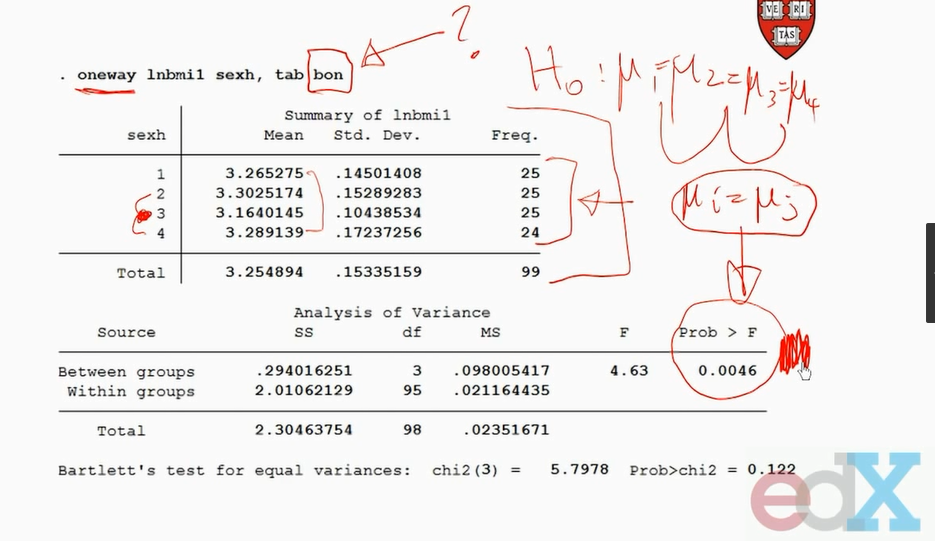
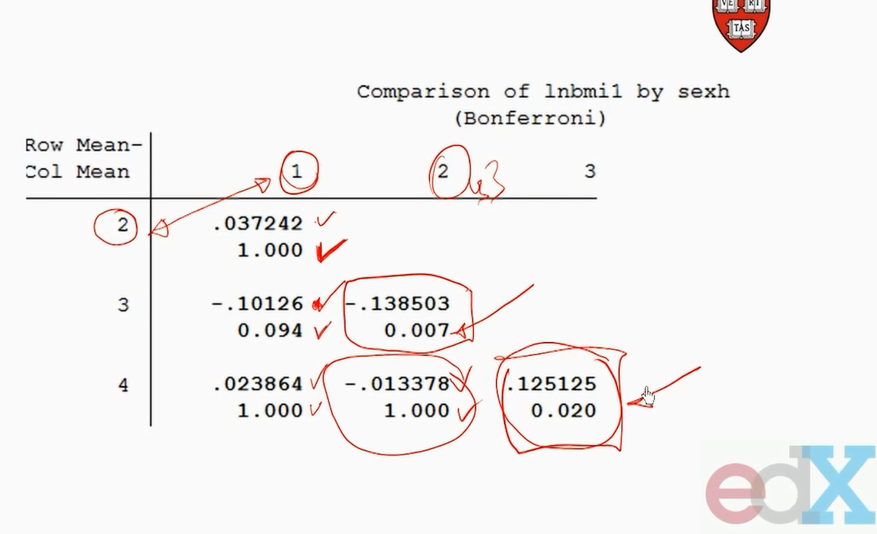
因为反复比较,一型错误概率会增加。
bonferroni 矫正一型错误的公式,它减少了a=0.05关键值
例如有5组数比较,比较的配对结果有10个
所以矫正的a=0.05/10=0.005


https://en.wikipedia.org/wiki/Holm%E2%80%93Bonferroni_method
In statistics, the Holm–Bonferroni method[1] (also called the Holm method or Bonferroni-Holm method) is used to counteract the problem of multiple comparisons. It is intended to control the familywise error rate and offers a simple test uniformly more powerful than the Bonferroni correction. It is one of the earliest usages of stepwise algorithms in simultaneous inference. It is named after Sture Holm, who codified the method, and Carlo Emilio Bonferroni.
Contents
Motivation
When considering several hypotheses, the problem of multiplicity arises: the more hypotheses we check, the higher the probability of a Type I error (false positive). The Holm–Bonferroni method is one of many approaches that control the family-wise error rate (the probability that one or more Type I errors will occur) by adjusting the rejection criteria of each of the individual hypotheses or comparisons.
Formulation
The method is as follows:
- Let H 1 , . . . , H m {\displaystyle H_{1},...,H_{m}}
be a family of hypotheses and P 1 , . . . , P m {\displaystyle P_{1},...,P_{m}}
the corresponding P-values.
- Start by ordering the p-values (from lowest to highest) P ( 1 ) … P ( m ) {\displaystyle P_{(1)}\ldots P_{(m)}}
and let the associated hypotheses be H ( 1 ) … H ( m ) {\displaystyle H_{(1)}\ldots H_{(m)}}
- For a given significance level α {\displaystyle \alpha }
, let k {\displaystyle k}
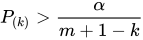
be the minimal index such that P ( k ) > α m + 1 − k {\displaystyle P_{(k)}>{\frac {\alpha }{m+1-k}}}
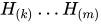
- Reject the null hypotheses H ( 1 ) … H ( k − 1 ) {\displaystyle H_{(1)}\ldots H_{(k-1)}}
and do not reject H ( k ) … H ( m ) {\displaystyle H_{(k)}\ldots H_{(m)}}
- If k = 1 {\displaystyle k=1}
then do not reject any of the null hypotheses and if no such k {\displaystyle k}
The Holm–Bonferroni method ensures that this method will control the F W E R ≤ α {\displaystyle FWER\leq \alpha } 

Proof
Holm-Bonferroni controls the FWER as follows. Let H ( 1 ) … H ( m ) {\displaystyle H_{(1)}\ldots H_{(m)}} 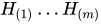



Let us assume that we wrongly reject a true hypothesis. We have to prove that the probability of this event is at most α {\displaystyle \alpha } 


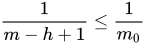
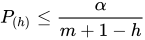

So let us define A = { P i ≤ α m 0 for some i ∈ I 0 } {\displaystyle A=\left\{P_{i}\leq {\frac {\alpha }{m_{0}}}{\text{ for some }}i\in I_{0}\right\}} 

Alternative proof
The Holm–Bonferroni method can be viewed as closed testing procedure,[2] with Bonferroni method applied locally on each of the intersections of null hypotheses. As such, it controls the familywise error rate for all the k hypotheses at level α in the strong sense. Each intersection is tested using the simple Bonferroni test.
It is a shortcut procedure since practically the number of comparisons to be made equal to m {\displaystyle m} 

The closure principle states that a hypothesis H i {\displaystyle H_{i}} 
In Holm-Bonferroni procedure, we first test H ( 1 ) {\displaystyle H_{(1)}} 

If H ( 1 ) {\displaystyle H_{(1)}} 

The same rationale applies for H ( 2 ) {\displaystyle H_{(2)}} 

The same applies for each 1 ≤ i ≤ m {\displaystyle 1\leq i\leq m} 
Example
Consider four null hypotheses H 1 , . . . , H 4 {\displaystyle H_{1},...,H_{4}} 







Extensions
Holm–Šidák method
When the hypothesis tests are not negatively dependent, it is possible to replace α m , α m − 1 , . . . , α 1 {\displaystyle {\frac {\alpha }{m}},{\frac {\alpha }{m-1}},...,{\frac {\alpha }{1}}} 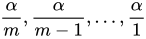
- 1 − ( 1 − α ) 1 / m , 1 − ( 1 − α ) 1 / ( m − 1 ) , . . . , 1 − ( 1 − α ) 1 {\displaystyle 1-(1-\alpha )^{1/m},1-(1-\alpha )^{1/(m-1)},...,1-(1-\alpha )^{1}}

resulting in a slightly more powerful test.
Weighted version
Let P ( 1 ) , . . . , P ( m ) {\displaystyle P_{(1)},...,P_{(m)}} 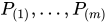


- P ( j ) ≤ w ( j ) ∑ k = j m w ( k ) α , j = 1 , . . . , i {\displaystyle P_{(j)}\leq {\frac {w_{(j)}}{\sum _{k=j}^{m}{w_{(k)}}}}\alpha ,\quad j=1,...,i}

Adjusted p-values
The adjusted p-values for Holm–Bonferroni method are:
- p ~ ( i ) = max j ≤ i { ( m − j + 1 ) p ( j ) } 1 {\displaystyle {\widetilde {p}}_{(i)}=\max _{j\leq i}\left\{(m-j+1)p_{(j)}\right\}_{1}}
, where { x } 1 ≡ min ( x , 1 ) {\displaystyle \{x\}_{1}\equiv \min(x,1)}
.
In the earlier example, the adjusted p-values are p ~ 1 = 0.03 {\displaystyle {\widetilde {p}}_{1}=0.03} 


The weighted adjusted p-values are:[citation needed]
- p ~ ( i ) = max j ≤ i { ∑ k = j m w ( k ) w ( j ) p ( j ) } 1 {\displaystyle {\widetilde {p}}_{(i)}=\max _{j\leq i}\left\{{\frac {\sum _{k=j}^{m}{w_{(k)}}}{w_{(j)}}}p_{(j)}\right\}_{1}}
, where { x } 1 ≡ min ( x , 1 ) {\displaystyle \{x\}_{1}\equiv \min(x,1)}
A hypothesis is rejected at level α if and only if its adjusted p-value is less than α. In the earlier example using equal weights, the adjusted p-values are 0.03, 0.06, 0.06, and 0.02. This is another way to see that using α = 0.05, only hypotheses one and four are rejected by this procedure.
Alternatives and usage
The Holm–Bonferroni method is uniformly more powerful than the classic Bonferroni correction. There are other methods for controlling the family-wise error rate that are more powerful than Holm-Bonferroni.
In the Hochberg procedure, rejection of H ( 1 ) … H ( k ) {\displaystyle H_{(1)}\ldots H_{(k)}} 
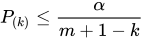
A similar step-up procedure is the Hommel procedure.[3]
Naming
Carlo Emilio Bonferroni did not take part in inventing the method described here. Holm originally called the method the "sequentially rejective Bonferroni test", and it became known as Holm-Bonferroni only after some time. Holm's motives for naming his method after Bonferroni are explained in the original paper: "The use of the Boole inequality within multiple inference theory is usually called the Bonferroni technique, and for this reason we will call our test the sequentially rejective Bonferroni test."
Bonferroni校正:如果在同一数据集上同时检验n个独立的假设,那么用于每一假设的统计显著水平,应为仅检验一个假设时的显著水平的1/n。
简介
维基百科原文
参考文献
- 参考资料
https://study.163.com/provider/400000000398149/index.htm?share=2&shareId=400000000398149( 欢迎关注博主主页,学习python视频资源,还有大量免费python经典文章)

Holm–Bonferroni method的更多相关文章
- SAGE|DNA微阵列|RNA-seq|lncRNA|scripture|tophat|cufflinks|NONCODE|MA|LOWESS|qualitile归一化|permutation test|SAM|FDR|The Bonferroni|Tukey's|BH|FWER|Holm's step-down|q-value|
生物信息学-基因表达分析 为了丰富中心法则,研究人员使用不断更新的技术研究lncRNA的方方面面,其中技术主要是生物学上的微阵列芯片技术和表达数据分析方法,方方面面是指lncRNA的位置特征. Bac ...
- jsp中出现onclick函数提示Cannot return from outside a function or method
在使用Myeclipse10部署完项目后,原先不出错的项目,会有红色的叉叉,JSP页面会提示onclick函数错误 Cannot return from outside a function or m ...
- Apply Newton Method to Find Extrema in OPEN CASCADE
Apply Newton Method to Find Extrema in OPEN CASCADE eryar@163.com Abstract. In calculus, Newton’s me ...
- 设计模式(九): 从醋溜土豆丝和清炒苦瓜中来学习"模板方法模式"(Template Method Pattern)
今天是五.四青年节,祝大家节日快乐.看着今天这标题就有食欲,夏天到了,醋溜土豆丝和清炒苦瓜适合夏天吃,好吃不上火.这两道菜大部分人都应该吃过,特别是醋溜土豆丝,作为“鲁菜”的代表作之一更是为大众所熟知 ...
- HTTP Method详细解读(`GET` `HEAD` `POST` `OPTIONS` `PUT` `DELETE` `TRACE` `CONNECT`)
前言 HTTP Method的历史: HTTP 0.9 这个版本只有GET方法 HTTP 1.0 这个版本有GET HEAD POST这三个方法 HTTP 1.1 这个版本是当前版本,包含GET HE ...
- IIS7.5上的REST服务的Put,Delete操作发生HTTP Error 405.0 - Method Not Allowed 解决方法
WebDAV 是超文本传输协议 (HTTP) 的一组扩展,为 Internet 上计算机之间的编辑和文件管理提供了标准.利用这个协议用户可以通过Web进行远程的基本文件操作,如拷贝.移动.删除等.在I ...
- The method getJspApplicationContext(ServletContext) is undefined for the type JspFactory
The method getJspApplicationContext(ServletContext) is undefined for the type JspFactory 这是由于项目里面的一些 ...
- Spring boot: Request method 'DELETE' not supported, Request method 'PUT' not supported, Request method 'POST' not supported
GET,POST,PUT,DELETE, Spring都支持,不要怀疑Spring, 一定是前端发送的rest 请求和后端的响应不匹配, 查找原因以及解决办法, 很简单 用chrome打开F12控制台 ...
- 异常:java.lang.LinkageError: loader constraint violation: when resolving interface method
异常:java.lang.LinkageError: loader constraint violation: when resolving interface method "javax. ...
随机推荐
- 简单主机批量管理工具(这里实现了paramiko 用su切换到root用户)
项目名:简单主机批量管理工具 一.需求 1.主机分组 2.可批量执行命令.发送文件,结果实时返回,执行格式如下 batch_run -h h1,h2,h3 -g web_clusters,db_ ...
- Java:类集框架中集合的学习
Java:类集框架中集合的学习 集合 Java:Set的学习 Set是类集框架中的集合类.集合是不按特定的方式排序,并且没有重复对象的一种类. Q:Set如何操作?Set中的不按特定方式排序是怎么排序 ...
- 四则运算3+psp0
题目要求: 1.程序可以判断用户的输入答案是否正确,如果错误,给出正确答案,如果正确,给出提示. 2.程序可以处理四种运算的混合算式. 3.要求两人合作分析,合作编程,单独撰写博客. 团队成员:张绍佳 ...
- 按照Right-BICEP要求设计四则运算3程序的单元测试用例
按照Right-BICEP要求: Right——结果是否正确? B——是否所有的边界条件都是正确的? I——能查一下反响关联吗? C——能用其它手段交叉检查一下吗? E——你是否可以强制错误条件发生? ...
- Spring1()
目的: 降低Java开发的复杂性 使用策略: 基于POJO的轻量级和最小侵入式的编程 通过依赖注入和面向接口实现松耦合 基于切面和惯例进行声明式编程 通过切面和模版减少样式代码 依赖注入:由Sprin ...
- Centos7更改默认启动桌面(或命令行)模式
centos7以后是这样的,7以前就是别的版本了 1.systemctl get-default命令获取当前模式 2.systemctl set-default graphical.target 修改 ...
- session的基本原理
转载:http://blog.sina.com.cn/s/blog_8155e74d0101iqmh.html 如何严格限制session在30分钟后过期! 1.设置客户端cookie的lifetim ...
- 第115天:Ajax 中artTemplate模板引擎(一)
一.不分离与分离的比较 1.前后端不分离,以freemarker模板引擎为例,看一下不分离的前后端请求的流程是什么样的? 从上图可以看出,前后端开发人员的工作耦合主要在(3)Template的使用.后 ...
- android面试(4)---文件存储
1.sharePreference? SharedPreferences类,它是一个轻量级的存储类,特别适合用于保存软件配置参数. SharedPreferences保存数据,其背后是用xml文件存放 ...
- 命令行下django-admin.py参数不起作用的问题解决
django官方turial中创建本地web站点时,使用如下命令 django-admin.py startproject mysite 说一下我在使用时碰到的几个问题: 1.无法找到django-a ...