
Ternary weight networks
Introduction
这两天看了一下这篇文章,我就这里分享一下,不过我还是只记录一下跟别人blog上没有,或者自己的想法(ps: 因为有时候翻blog时候发现每篇都一样还是挺烦的= =) 。为了不重复前人的工作,我post一个不小心翻到的博客权值简化(1):三值神经网络(Ternary Weight Networks),整个论文内容及实现都讲的很全面了,可以翻阅一下,我也借鉴一下。
文中主要工作的点在三个方面:
- 增加了网络的表达力(expressive ability)。在{1,0,1}基础上增加了 \(\alpha\) 作为scaled factor;
- 压缩模型大小。当然主要是weight的压缩。比起FPWN(full precision weight network)有16~32x的提升,但是BPWN(binary precision weight network)的2x大小(ps:当然在TWN的caffe代码里面,都由float double类型存储,因为这需要在应该上方面来实现);
- 减少计算需求。主要相比于BPWN增多了0,当然这方面也需硬件来获得提升,在该caffe代码里面并没有;
Ternary Quantization
在我的理解看来,文中最核心的内容是:将有约束的并且两变量之间互相依赖的优化问题,逐步拆分最后用具有先验的统计方法来近视解决。
最初的优化问题:

将\(W^{t}\)的约束具体化为:

并将其带入公式(1),将\(W^{t*}\)的优化转化为\(\Delta^*\)的优化:

然后对公式(4)中的\(\alpha\)求偏导,得到:

因为\(\alpha\)和\(\Delta\)相互依赖,将(5)代入(4)消去\(\alpha\):

但问题来了,公式(6)依然没法求,而文中就根据先验知识,假设\(W_i\)服从\(N(0,\sigma^2)\)分布,近视的\(\Delta^*\)为\(0.6\sigma\)(\(0.6\sigma\)等于\(0.75E(|W|)\))。因此作者采用粗暴的方法,把\(\Delta^*\)设为\(\Delta^*\approx0.7E(|W|)\approx\frac{n}{0.7}\sum_{i=1}^n|W_i|\)
//caffe-twns

//blob.cpp

template <typename Dtype>

void Blob<Dtype>::set_delta(){

  float scale_factor = TERNARY_DELTA * 1.0 / 10; //delta = 0.7

  Dtype delta = (Dtype) scale_factor * this->asum_data() / this->count(); // 0.7*(E|W_i|)/num

  delta = (delta <= 100) ? delta : 100;

  delta = (delta >= -100) ? delta : -100;

  this->delta_ = delta;

}

template <typename Dtype>

void Blob<Dtype>::set_delta(Dtype delta){

  delta = (delta <= 100) ? delta : 100;

  delta = (delta >= -100) ? delta : -100;

  this->delta_ = delta;

}
Implement
我借用一张图
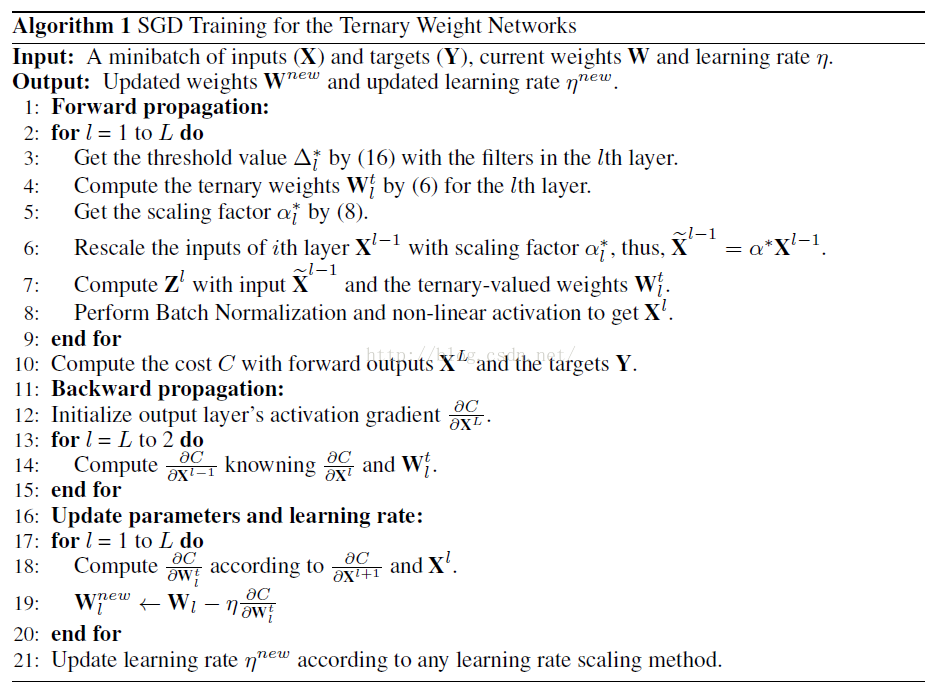
步骤3~5,其中第5步代码在上面:
template <typename Dtype>

void Blob<Dtype>::ternarize_data(Phase phase){

if(phase == RUN){

// if(DEBUG) print_head();

 //LOG(INFO) << "RUN phase...";

 // caffe_sleep(3);

 return; // do nothing for the running phase

}else if(phase == TRAIN){

 //LOG(INFO) << "TRAIN phase ...";

 // caffe_sleep(3);

}else{

 //LOG(INFO) << "TEST phase ...";

 // caffe_sleep(3);

}

  // const Dtype delta = 0; // default value;

  // const Dtype delta = (Dtype) 0.8 * this->asum_data() / this->count();

  this->set_delta();  //defualt 0.7*(E|W_i|)/num or set by user

  const Dtype delta = this->get_delta();

  Dtype alpha = 1;

  if (!data_) { return; }

  switch (data_->head()) {

  case SyncedMemory::HEAD_AT_CPU:

{

	caffe_cpu_ternary<Dtype>(this->count(), delta, this->cpu_data(), this->mutable_cpu_binary()); //quantized weight to ternary

	alpha = caffe_cpu_dot(this->count(), this->cpu_binary(), this->cpu_data());  //scale-alpha: (E |W_i|)   i belong to I_delta

	alpha /= caffe_cpu_dot(this->count(), this->cpu_binary(), this->cpu_binary()); //(1/num_binary)*alpha

	caffe_cpu_scale(this->count(), alpha, this->cpu_binary(), this->mutable_cpu_binary());

	// this->set_alpha(alpha);

}

    return;

  case SyncedMemory::HEAD_AT_GPU:

  case SyncedMemory::SYNCED:

#ifndef CPU_ONLY

{

    caffe_gpu_ternary<Dtype>(this->count(), delta, this->gpu_data(), this->mutable_gpu_binary());

	Dtype* pa = new Dtype(0);

	caffe_gpu_dot(this->count(), this->gpu_binary(), this->gpu_data(), pa);

	Dtype* pb = new Dtype(0);

	caffe_gpu_dot(this->count(), this->gpu_binary(), this->gpu_binary(), pb);

	alpha = (*pa) / ((*pb) + 1e-6);

	this->set_alpha(alpha);

	caffe_gpu_scale(this->count(), alpha, this->gpu_binary(), this->mutable_gpu_binary());

	// this->set_alpha((Dtype)1);

    // LOG(INFO) << "alpha = " << alpha;

	// caffe_sleep(3);

}

    return;

#else

    NO_GPU;

#endif

  case SyncedMemory::UNINITIALIZED:

    return;

  default:

    LOG(FATAL) << "Unknown SyncedMemory head state: " << data_->head();

  }

}
步骤6~7,其中在第6步作者在caffe-twns直接采用传统caffe的方法,而$Z=XW\approx X(\alpha W^t)=(\alpha X)\bigoplus W^t $更偏向与在硬件加速的优化(因为本身在caffe-twns的ternary就采用float或者double,并且用blas或cudnn加速也无法直接跳过0值):
//conv_layer.cpp

template <typename Dtype>

void ConvolutionLayer<Dtype>::Forward_cpu(const vector<Blob<Dtype>*>& bottom,

      const vector<Blob<Dtype>*>& top) {

  // const Dtype* weight = this->blobs_[0]->cpu_data();

if(BINARY){

  this->blobs_[0]->binarize_data();

}

if(TERNARY){

  this->blobs_[0]->ternarize_data(this->phase_);  //quantized from blob[0] to ternary sand stored in cpu_binary()

/*

    Dtype alpha = (Dtype) this->blobs_[0]->get_alpha();

for(int i=0; i<bottom.size(); i++){

  Blob<Dtype>* blob = bottom[i];

  caffe_cpu_scale(blob->count(), alpha, blob->cpu_data(), blob->mutable_cpu_data());

}

*/

}

  const Dtype* weight = (BINARY || TERNARY) ? this->blobs_[0]->cpu_binary() : this->blobs_[0]->cpu_data();

...

}
步骤11~19,weight的Update是在full precision上,而计算gradient则是用ternary weight:
//conv_layer.cpp

template <typename Dtype>

void ConvolutionLayer<Dtype>::Backward_cpu(const vector<Blob<Dtype>*>& top,

      const vector<bool>& propagate_down, const vector<Blob<Dtype>*>& bottom) {

  const Dtype* weight = this->blobs_[0]->cpu_data();

  Dtype* weight_diff = this->blobs_[0]->mutable_cpu_diff();

  for (int i = 0; i < top.size(); ++i) {

    ...

    if (this->param_propagate_down_[0] || propagate_down[i]) {

      for (int n = 0; n < this->num_; ++n) {

        // gradient w.r.t. weight. Note that we will accumulate diffs.

        if (this->param_propagate_down_[0]) {

          this->weight_cpu_gemm(bottom_data + n * this->bottom_dim_,

              top_diff + n * this->top_dim_, weight_diff);

        }

        // gradient w.r.t. bottom data, if necessary.

        if (propagate_down[i]) {

          this->backward_cpu_gemm(top_diff + n * this->top_dim_, weight,

              bottom_diff + n * this->bottom_dim_);

        }

      }

    }

  }

}
Ternary weight networks的更多相关文章
- 论文翻译:Ternary Weight Networks
目录 Abstract 1 Introduction 1.1 Binary weight networks and model compression 2 Ternary weight network ...
- [综述]Deep Compression/Acceleration深度压缩/加速/量化
Survey Recent Advances in Efficient Computation of Deep Convolutional Neural Networks, [arxiv '18] A ...
- zz神经网络模型量化方法简介
神经网络模型量化方法简介 https://chenrudan.github.io/blog/2018/10/02/networkquantization.html 2018-10-02 本文主要梳理了 ...
- deeplearning模型量化实战
deeplearning模型量化实战 MegEngine 提供从训练到部署完整的量化支持,包括量化感知训练以及训练后量化,凭借"训练推理一体"的特性,MegEngine更能保证量化 ...
- Understanding the Effective Receptive Field in Deep Convolutional Neural Networks
Understanding the Effective Receptive Field in Deep Convolutional Neural Networks 理解深度卷积神经网络中的有效感受野 ...
- [C6] Andrew Ng - Convolutional Neural Networks
About this Course This course will teach you how to build convolutional neural networks and apply it ...
- [CS231n-CNN] Training Neural Networks Part 1 : activation functions, weight initialization, gradient flow, batch normalization | babysitting the learning process, hyperparameter optimization
课程主页:http://cs231n.stanford.edu/ Introduction to neural networks -Training Neural Network ________ ...
- 【转】Artificial Neurons and Single-Layer Neural Networks
原文:written by Sebastian Raschka on March 14, 2015 中文版译文:伯乐在线 - atmanic 翻译,toolate 校稿 This article of ...
- 一天一经典Reducing the Dimensionality of Data with Neural Networks [Science2006]
别看本文没有几页纸,本着把经典的文多读几遍的想法,把它彩印出来看,没想到效果很好,比在屏幕上看着舒服.若用蓝色的笔圈出重点,这篇文章中几乎要全蓝.字字珠玑. Reducing the Dimensio ...
随机推荐
- JVM 专题十九:垃圾回收(三)垃圾回收相关概念
1. System.gc()的理解 在默认情況下,通过System.gc()或者Runtime. getRuntime().gc()的调用,会显式触发Full GC,同时对老年代和新生代进行回收,尝试 ...
- python--动态网页渲染pyqt5
原文:https://blog.csdn.net/tymatlab/article/details/78647543 PyQt5 渲染动态网页 示例代码: # -*- coding: UTF-8 -* ...
- C#数据结构与算法系列(二十二):快速排序算法(QuickSort)
1.介绍 快速排序(QuickSort)是对冒泡排序的一种改进,基本思想是:通过一趟排序将要排序的数据分割成独立的两部分, 其中一部分的所有数据都比另一部分的所有数据都要小,然后再按此方法对这两部分数 ...
- RAC环境上搭建DG
首先RAC要确实是开归档的状态archive log list;如果是非归档状态,需要执行下面几步srvctl stop database -d +数据库实例名 关闭数据库--节点1(要做DG主库的) ...
- 少儿编程:python趣味编程第二课,如何在pygame中写文字
python趣味编程第二课:本文仅针对8-16岁的青少年,所以流程是按如何去教好中小学生走的,并不适合成人找工作学习,因为进度也是按照青少年走的 大家好,我是C大叔,上一篇文章已经跟大家介绍了一款开发 ...
- C++语法小记---重载逗号操作符
重载逗号操作符 逗号操作符算法:从左到右依次计算每一个表达式的值,整个逗号表达式的值等于最右边表达式的值,前面n-1个表达式可以没有返回值 重载逗号操作符: 参数必须有一个class成员 重载函数返回 ...
- vue传参方式
//query传参,使用name跳转 this.$router.push({ name:'second', query: { queryId:'201808 ...
- 分布式锁(3) ----- 基于zookeeper的分布式锁
分布式锁系列文章 分布式锁(1) ----- 介绍和基于数据库的分布式锁 分布式锁(2) ----- 基于redis的分布式锁 分布式锁(3) ----- 基于zookeeper的分布式锁 代码:ht ...
- nmap加快扫描速度(转载)
实测有效 nmap -sS -Pn -p 80 -n --open --min-hostgroup 1024 --min-parallelism 10 --host-timeout 30 -T4 -v ...
- [leetcode/lintcode 题解] 微软面试题:股票价格跨度
编写一个 StockSpanner 类,它收集某些股票的每日报价,并返回该股票当日价格的跨度. 今天股票价格的跨度被定义为股票价格小于或等于今天价格的最大连续日数(从今天开始往回数,包括今天). 例如 ...