
POJ 1655 Balancing Act(求树的重心)
Description
For example, consider the tree:
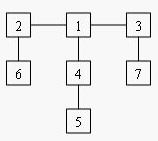
Deleting node 4 yields two trees whose member nodes are {5} and {1,2,3,6,7}. The larger of these two trees has five nodes, thus the balance of node 4 is five. Deleting node 1 yields a forest of three trees of equal size: {2,6}, {3,7}, and {4,5}. Each of these trees has two nodes, so the balance of node 1 is two.
For each input tree, calculate the node that has the minimum balance. If multiple nodes have equal balance, output the one with the lowest number.
Input
Output
 #include <cstdio>

 #include <iostream>

 #include <algorithm>

 #include <cstring>

 using namespace std;

 const int MAXN = ;

 const int MAXE = ;

 const int INF = 0x7fff7fff;

 int head[MAXN], size[MAXN], maxSize[MAXN], f[MAXN];

 int to[MAXE], next[MAXE];

 int n, ecnt;

 void init() {

     memset(head, -, sizeof(head));

     ecnt = ;

 }

 void add_edge(int u, int v) {

     to[ecnt] = v; next[ecnt] = head[u]; head[u] = ecnt++;

     to[ecnt] = u; next[ecnt] = head[v]; head[v] = ecnt++;

 }

 void dfs(int u) {

     maxSize[u] = ;

     size[u] = ;

     for(int p = head[u]; ~p; p = next[p]) {

         int &v = to[p];

         if(v == f[u]) continue;

         f[v] = u;

         dfs(v);

         size[u] += size[v];

         maxSize[u] = max(maxSize[u], size[v]);

     }

 }

 int main() {

     int T;

     scanf("%d", &T);

     while(T--) {

         init();

         scanf("%d", &n);

         int u, v;

         for(int i = ; i < n; ++i) {

             scanf("%d%d", &u, &v);

             add_edge(u, v);

         }

         dfs();

         int pos, maxd = INF;

         for(int i = ; i <= n; ++i) {

             if(max(maxSize[i], n - size[i]) < maxd) {

                 pos = i;

                 maxd = max(maxSize[i], n - size[i]);

             }

         }

         printf("%d %d\n", pos, maxd);

     }

 }
POJ 1655 Balancing Act(求树的重心)的更多相关文章
- poj 1655 Balancing Act 求树的重心【树形dp】
poj 1655 Balancing Act 题意:求树的重心且编号数最小 一棵树的重心是指一个结点u,去掉它后剩下的子树结点数最少. (图片来源: PatrickZhou 感谢博主) 看上面的图就好 ...
- POJ 1655 Balancing Act(求树的重心--树形DP)
题意:求树的重心的编号以及重心删除后得到的最大子树的节点个数size,假设size同样就选取编号最小的. 思路:随便选一个点把无根图转化成有根图.dfs一遍就可以dp出答案 //1348K 125MS ...
- POJ 1655 Balancing Act (求树的重心)【树形DP】(经典)
<题目链接> 题目大意:给你一棵树,任意去除某一个点后,树被分成了几个联通块,则该点的平衡值为所有分成的连通块中,点数最大的那个,问你:该树所有点中,平衡值最小的那个点是什么? 解题分析: ...
- POJ 1655 Balancing Act (树的重心,常规)
题意:求树的重心,若有多个重心,则输出编号较小者,及其子树中节点最多的数量. 思路: 树的重心:指的是一个点v,在删除点v后,其子树的节点数分别为:u1,u2....,设max(u)为其中的最大值,点 ...
- POJ 1655 Balancing Act【树的重心】
Balancing Act Time Limit: 1000MS Memory Limit: 65536K Total Submissions: 14251 Accepted: 6027 De ...
- POJ 1655 Balancing Act【树的重心模板题】
传送门:http://poj.org/problem?id=1655 题意:有T组数据,求出每组数据所构成的树的重心,输出这个树的重心的编号,并且输出重心删除后得到的最大子树的节点个数,如果个数相同, ...
- POJ 1655 - Balancing Act - [DFS][树的重心]
链接:http://poj.org/problem?id=1655 Time Limit: 1000MS Memory Limit: 65536K Description Consider a tre ...
- POJ 1655 Balancing Act ( 树的重心板子题,链式前向星建图)
题意: 给你一个由n个节点n-1条边构成的一棵树,你需要输出树的重心是那个节点,以及重心删除后得到的最大子树的节点个数size,如果size相同就选取编号最小的 题解: 树的重心定义:找到一个点,其所 ...
- POJ 1655 Balancing Act 焦点树
标题效果:鉴于一棵树.除去一个点之后,这棵树将成为一些中国联通的块.之后该点通过寻求取消最低形成块的最大数目. 思维:树DP思维.通过为每个子树尺寸的根节点深搜索确定.之后该节点然后除去,,还有剩下的 ...
- POJ 1655 Balancing Act (树状dp入门)
Description Consider a tree T with N (1 <= N <= 20,000) nodes numbered 1...N. Deleting any nod ...
随机推荐
- golang刷Leetcode系列 --- 实现strStr()
实现 strStr() 函数. 给定一个 haystack 字符串和一个 needle 字符串,在 haystack 字符串中找出 needle 字符串出现的第一个位置 (从0开始).如果不存在,则返 ...
- MySQL常用参数说明(持续更新)
##innodb correlate innodb_flush_log_at_trx_commit value: 0,[1],2 effect: control the flush opera ...
- 【补】英语对IT工作者的重要性
浅谈程序员的英语学习 作为在中国工作的程序员,不懂得英语似乎也不妨碍找到好工作,升职加薪.但程序员这个工种则稍有不同,因为程序,尤其是高级语言,基本上都是由英语和数字表达式构成的.英语对于程序员十 ...
- CentOS 7.x eth0
1:Test Environment [root@linux-node1 ~]# cat /etc/redhat-release Red Hat Enterprise Linux Server rel ...
- Vue项目用webpack打包后,预览时资源路径出错(文末有vue项目链接分享)
最近用vue写了一些项目,项目写完之后需要打包之后才能放到网上展示,所以在这里记录一下项目打包的过程以及遇到的一些问题. --------------------------------------- ...
- Tornado用户指引(一)-----------异步和非阻塞I/O
摘要:异步和非阻塞I/O实时WEB的特性是经常需要为每个用户端维持一个长时间存活但是大部分时候空闲的连接.在传统的同步式web服务器中,这主要通过为每个用户创建一个线程来实现,这样的代价是十分昂贵的. ...
- nginx知识总结
nginx知识总结 一.功能 负载均衡 反向代理 静态资源服务器 二.来源 nginx 俄罗斯第二网站开源项目 tengine 淘宝团队基于nginx开发的 区别:nginx安装之后还得装第三方软件包 ...
- Redis,传统数据库,HBase,Hive区别联系
首先介绍各个数据库: Redis: 传统数据库: HBase: Hive:
- Arduino UNO仿真开发环境设置和仿真运行
一. Proteus仿真平台简介 Proteus软件是英国Labcenter electronics公司出版的EDA工具软件(该软件中国总代理为广州风标电子技术有限公司).它不仅具有其它EDA工具软件 ...
- 我和Python的Py交易》》》》》》函数
一 函数是什么? 是数学中的函数? Python中 函数是指将一组语句的集合通过一个名字(函数名)封装起来的一段代码.(所以这里的函数是subroutine子程序) 那要函数干嘛.不都是代码吗?只不 ...