
十八般武艺玩转GaussDB(DWS)性能调优:Plan hint运用
摘要:本文介绍GaussDB(DWS)另一种可以人工干预计划生成的功能--plan hint。
前言
数据库的使用者在书写SQL语句时,会根据自己已知的情况尽力写出性能很高的SQL语句。但是当需要写大量SQL语句,且有些SQL语句的逻辑极为复杂时,数据库使用者就很难写出性能较高的SQL语句。
而每个数据库都有一个类似人的大脑的查询优化器模块,它接收来自语法分析模块传递过来的查询树,在这个查询树的基础上进行逻辑上的等价变换、物理执行路径的筛选,并且把选择出的最优的执行路径传递给数据库的执行器模块。查询优化器是提升查询效率非常重要的一个手段。
数据库查询优化器的分类详见博文《GaussDB(DWS)性能调优系列基础篇一:万物之始analyze统计信息》。
Plan hint的引入
由于优化器基于统计信息和估算模型生成计划,当估算出现偏差时,计划可能出现问题,性能较差,使语句的执行变得奇慢无比。
通常,查询优化器的优化过程对数据库使用者是透明的。在上一篇博文《GaussDB(DWS)性能调优系列实战篇五:十八般武艺之路径干预》中,Gauss DB(DWS)提供了可通过配置GUC参数的方式,全局的干预查询计划的路径生成。本次,将介绍另一种可以人工干预计划生成的功能--plan hint。Hint是一种通过SQL语句中的注释传递给优化器的指令,优化器使用hint为语句选择执行计划。在测试或开发环境中,hint对于测试特定访问路径的性能非常有用。例如,您可能知道某些表优先进行连接,可以有效减少中间结果集大小,在这种情况下,可以使用提示来指示优化器使用更好的执行计划。
Plan hint功能属于语句级的调控,仅对当前语句的当前层次生效,可以帮助我们在调优的过程中,针对特定的语句,通过plan hint进行人工干预,选择更高效的执行计划。
GaussDB(DWS)的Plan hint有以下种类:
- Join顺序的hint:调整join顺序
- Scan/Join方法的hint:指定或避免scan/join的方法
- Stream方法的hint:指定或避免redistribute/broadcast
- 行数hint:对于给定结果集,指定行数,或对原有估算值进行计算调整
- 倾斜值hint:在倾斜优化时,指定需要倾斜处理的特殊值
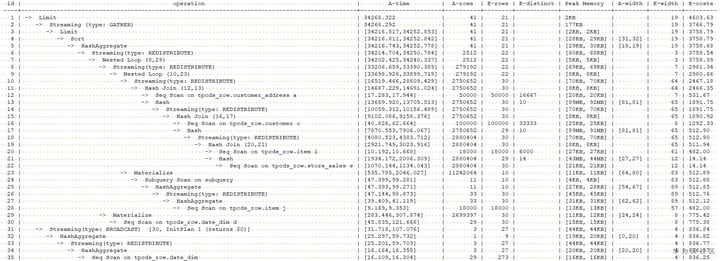
下面分别对以上几种plan hint的功能及其在实际中的运用做一下介绍。在下面几节的介绍中,除倾斜值hint外,都以tpcds中的Q6作为示例。为了能明显看到hint在查询优化过程中的作用,我们将store_sales表的统计信息删除。原始语句和生成的初始计划如下。
示例语句:
explain performance

select a.ca_state state, count(*) cnt

 from customer_address a

     ,customer c

     ,store_sales s

     ,date_dim d

     ,item i

 where a.ca_address_sk = c.c_current_addr_sk

 and c.c_customer_sk = s.ss_customer_sk

 and s.ss_sold_date_sk = d.d_date_sk

 and s.ss_item_sk = i.i_item_sk

 and d.d_month_seq =

      (select distinct (d_month_seq)

       from date_dim

               where d_year = 2000

         and d_moy = 2 )

 and i.i_current_price > 1.2 *

             (select avg(j.i_current_price)

      from item j

      where j.i_category = i.i_category)

 group by a.ca_state

 having count(*) >= 10

 order by cnt

 limit 100;
Plan hint的应用
Join 顺序的hint
语法:
格式1:
leading(table_list)
仅指定join顺序,不指定内外表顺序
格式2:
leading((table_list))
同时指定join顺序和内外表顺序,内外表顺序仅在最外层生效
说明:
table_list为要调整join顺序的表名列表,表之间使用空格分隔。可以包含当前层的任意个表(别名),或对于子查询提升的场景,也可以包含子查询的hint别名,同时任意表可以使用括号指定优先级。
注意:
- 表只能用单个字符串表示,不能带schema。
- 表如果存在别名,需要优先使用别名来表示该表。
- list中的表在当前层或提升的子查询中必须是唯一的。如果不唯一,需要使用不同的别名进行区分。
- 同一个表只能在list里出现一次。
示例1:
对于示例中的计划,可以看出,17-22号算子时store_sales表和item表join后生成hash表,store_sales表的数据量很大,store_sales和item表join后未过滤掉任何数据,所以这两个表join并生成hash表的时间都比较长。根据对tpcds各表中数据分布的了解,我们知道,store_sales表和date_dim进行join,可以过滤掉较多数据,所以,可以使用hint来提示优化器优将store_sales表和date_dim表先进行join,store_sales作为外表,date_dim作为内表,减少中间结果集大小。语句改写如下:
explain performance

select /*+ leading((s d)) */ a.ca_state state, count(*) cnt

 from customer_address a

     ,customer c

     ,store_sales s

     ,date_dim d

     ,item i

 where a.ca_address_sk = c.c_current_addr_sk

   and c.c_customer_sk = s.ss_customer_sk

   and s.ss_sold_date_sk = d.d_date_sk

   and s.ss_item_sk = i.i_item_sk

   and d.d_month_seq =

      (select distinct (d_month_seq)

       from date_dim

      where d_year = 2000

        and d_moy = 2 )

 and i.i_current_price > 1.2 *

             (select avg(j.i_current_price)

              from item j

             where j.i_category = i.i_category)

 group by a.ca_state

 having count(*) >= 10

 order by cnt

 limit 100;
增加了join顺序hint的查询计划如下:
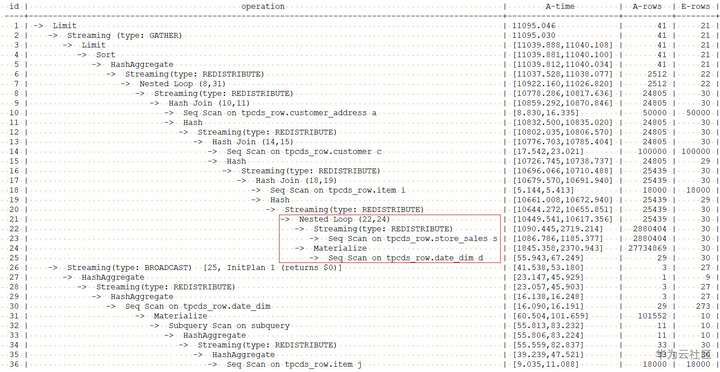
通过调整join顺序,使得之后各join的中间结果集都大幅减少,执行时间由34268.322ms降为11095.046ms。
Scan/Join方法的hint
用于指示优化器使用那种scan方法或join方法。
语法:
Join方法的hint格式:
[no] nestloop|hashjoin|mergejoin(table_list)
Scan方法的hint格式:
[no] tablescan|indexscan|indexonlyscan(table [index])
说明:
- no表示提示优化器不使用这种方法。
- table表示hint指定的表,只能指定一个表,如果表存在别名应优先使用别名进行hint。
- index表示使用indexscan或indexonlyscan的hint时,指定的索引名称,当前只能指定一个。
示例2-1:
示例1中得到的执行计划,由于store_sales表的行数估算不准,store_sales和date_dim采用了效率不好的nestloop方式进行join。现在通过本节的hint方法来指示优化器不使用nestloop方式进行join。
explain performance

select /*+ leading((s d)) no nestloop(s d) */ a.ca_state state, count(*) cnt

 from customer_address a

     ,customer c

     ,store_sales s

     ,date_dim d

     ,item i

 where a.ca_address_sk = c.c_current_addr_sk

   and c.c_customer_sk = s.ss_customer_sk

   and s.ss_sold_date_sk = d.d_date_sk

   and s.ss_item_sk = i.i_item_sk

   and d.d_month_seq =

      (select distinct (d_month_seq)

       from date_dim

      where d_year = 2000

        and d_moy = 2 )

 and i.i_current_price > 1.2 *

             (select avg(j.i_current_price)

              from item j

             where j.i_category = i.i_category)

 group by a.ca_state

 having count(*) >= 10

 order by cnt

 limit 100;
增加了join方式hint后的计划如下:
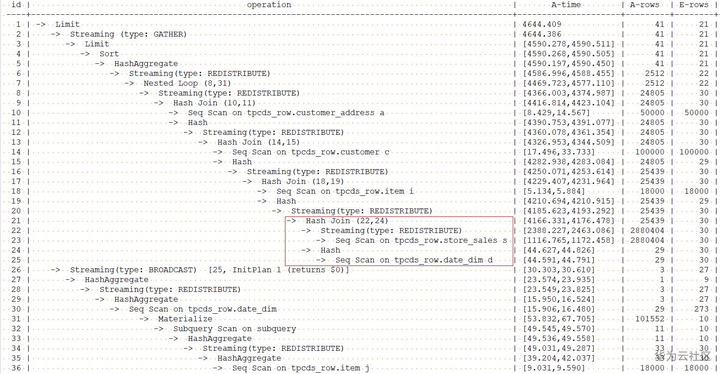
从上面的计划中可以看到,优化器对store_sales和date_dim表之间的join方法已经由nestloop改为了hashjoin,且这条语句的执行时间也由11095.046ms降为4644.409ms。
示例2-2:
为了演示scan方式的hint使用,如下在item表的i_item_sk列上创建一个名称为i_item的索引。
create index i_item on item(i_item_sk);
通过下面的语句指示优化器访问别名为i的item表时,使用索引i_item做索引扫描。
explain performance

select /*+ leading((s d)) no nestloop(s d) indexscan(i i_item) */ a.ca_state state, count(*) cnt

 from customer_address a

     ,customer c

     ,store_sales s

     ,date_dim d

     ,item i

 where a.ca_address_sk = c.c_current_addr_sk

 and c.c_customer_sk = s.ss_customer_sk

 and s.ss_sold_date_sk = d.d_date_sk

 and s.ss_item_sk = i.i_item_sk

 and d.d_month_seq =

      (select distinct (d_month_seq)

       from date_dim

      where d_year = 2000

        and d_moy = 2 )

 and i.i_current_price > 1.2 *

             (select avg(j.i_current_price)

              from item j

             where j.i_category = i.i_category)

 group by a.ca_state

 having count(*) >= 10

 order by cnt

 limit 100;
使用scan的hint指示扫描item表时采用indexscan后的查询计划如下:
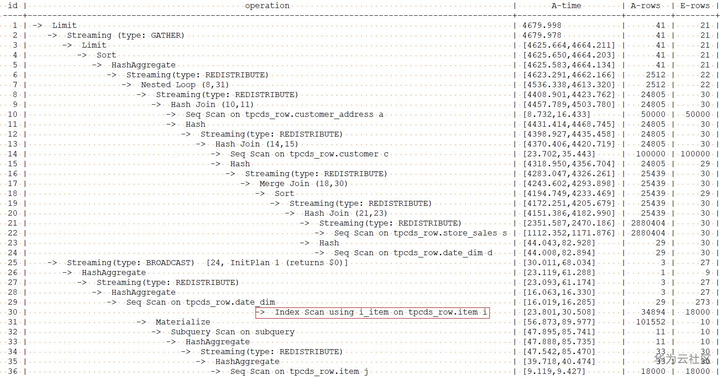
从上面的执行结果看,使用索引扫描后(s 和 d join后,再和item的join采用了mergejoin方式)反而使性能略有下降,所以后面的用例中,我们将不对item表采用索引扫描的方法。
Stream方法的hint
用于指示优化器采用哪种stream方法,可以为broadcast和redistribute。
语法:
[no] broadcast|redistribute(table_list)
说明:
- no表示不使用hint的stream方式。
- table_list为进行stream操作的单表或多表join结果集
示例3:
此处作为演示,修改语句如下,通过hint指示优化器对item表扫描的结果使用broadcast方式进行分布。
explain performance

select /*+ leading((s d)) no nestloop(s d) broadcast(i) */ a.ca_state state, count(*) cnt

 from customer_address a

     ,customer c

     ,store_sales s

     ,date_dim d

     ,item i

 Where a.ca_address_sk = c.c_current_addr_sk

   and c.c_customer_sk = s.ss_customer_sk

   and s.ss_sold_date_sk = d.d_date_sk

   and s.ss_item_sk = i.i_item_sk

 and d.d_month_seq =

      (select distinct (d_month_seq)

       from date_dim

      where d_year = 2000

        and d_moy = 2 )

 and i.i_current_price > 1.2 *

             (select avg(j.i_current_price)

               from item j

              where j.i_category = i.i_category)

 group by a.ca_state

 having count(*) >= 10

 order by cnt

 limit 100;
指示优化器使用broadcast方式分布item结果的查询计划如下:
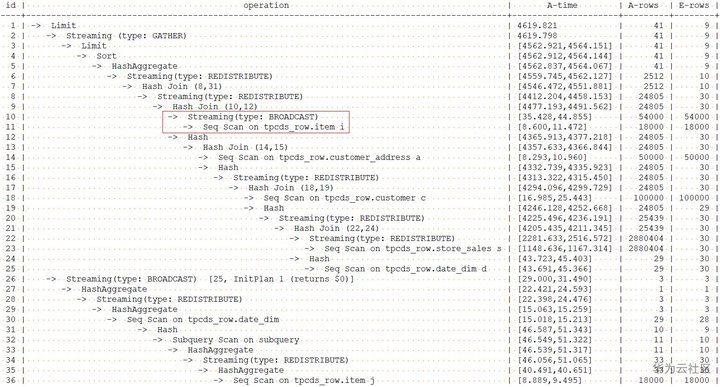
可以看出,之前在item扫描后的结果上是redistribute分布方式,现在已经变为了broadcast分布方式。Broadcast分布方式一般用于数据量比较小的结果集上,相反redistribute用于数据量比较大的结果集上。所以,根据执行计划中单表或表join后的结果集大小,可以通过这种方式,调整结果集的分布方式,从而提升查询的性能。
行数hint
用于指明中间结果集的大小,支持绝对值和相对值的hint。
语法:
rows(table_list #|+|-|* const)
说明:
- #,+,-,*,进行行数估算hint的四种操作符号。#表示直接使用后面的行数进行hint。+,-,*表示对原来估算的行数进行加、减、乘操作,运算后的行数最小值为1行。
- const可以是任意非负数,支持科学计数法。
由于store_sales表没有统计信息,所以在上面的各个计划中可以看到,store_sales表的估计行数和实际行数相差非常大,这就会导致生成了最初的效率比较低的计划。下面我们看看使用行数hint的效果。
示例4:
explain performance

select /*+ rows(s #2880404) */ a.ca_state state, count(*) cnt

 from customer_address a

     ,customer c

     ,store_sales s

     ,date_dim d

     ,item i

 Where a.ca_address_sk = c.c_current_addr_sk

 and c.c_customer_sk = s.ss_customer_sk

 and s.ss_sold_date_sk = d.d_date_sk

 and s.ss_item_sk = i.i_item_sk

 and d.d_month_seq =

      (select distinct (d_month_seq)

       from date_dim

      where d_year = 2000

         and d_moy = 2 )

 and i.i_current_price > 1.2 *

             (select avg(j.i_current_price)

               from item j

              where j.i_category = i.i_category)

 group by a.ca_state

 having count(*) >= 10

 order by cnt

 limit 100;
具体查询计划如下:
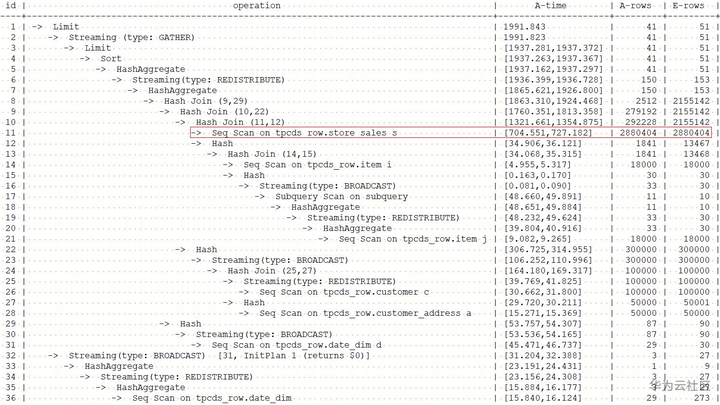
指定了store_sales表的准确行数后,优化器生成的计划执行时间直接从最初的34268.322ms将为1991.843ms,提升了17倍。这也充分的说明了优化器对统计信息准确性的强烈依赖。
除了可以指明单表的行数,还可指明中间结果集的行数。比如上例中8号算子的实际行数和估计行数也相差较大,我们指明8号算子的结果集行数看看效果。在下面这个例子中,还使用了子链接块名的hint,为子链接指定了一个别名,便于在行数hint中指定子链接。
explain performance

select /*+ rows(s #2880404) rows(s i tt c a d #2512) */ a.ca_state state, count(*) cnt

 from customer_address a

     ,customer c

     ,store_sales s

     ,date_dim d

     ,item i

 where       a.ca_address_sk = c.c_current_addr_sk

 and c.c_customer_sk = s.ss_customer_sk

 and s.ss_sold_date_sk = d.d_date_sk

 and s.ss_item_sk = i.i_item_sk

 and d.d_month_seq =

      (select distinct (d_month_seq)

       from date_dim

               where d_year = 2000

         and d_moy = 2 )

 and i.i_current_price > 1.2 *

             (select /*+ blockname (tt)*/ avg(j.i_current_price)

      from item j

      where j.i_category = i.i_category)

 group by a.ca_state

 having count(*) >= 10

 order by cnt

 limit 100;
查询计划如下:
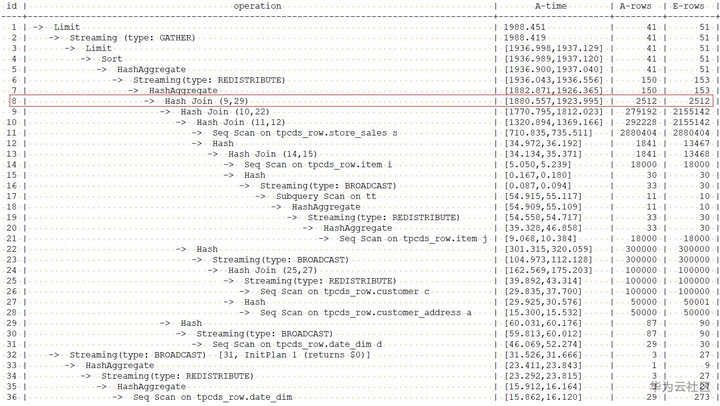
8号算子的估计行数已经和实际行数一致。由于8号算子不是计划的瓶颈点,所以性能提升并不明显。
倾斜值hint
用于指明查询运行时重分布过程中存在倾斜的重分布键和倾斜值,针对Join和HashAgg运算中的重分布进行优化。
语法:
指定单表倾斜
skew(table (column) [(value)])
指定中间结果倾斜
skew((join_rel) (column) [(values)])
说明:
- table表示存在倾斜的单个表名。
- join_rel表示参与join的两个或多个表,如(t1 t2)表示t1和t2 join后的结果存在倾斜。
- column表示倾斜表中存在倾斜的一个或多个列。
- value表示倾斜的列中存在倾斜的一个或多个值。
示例5:
本节,我们用tpcds中的Q1作为示例,未使用hint前的查询及计划如下:
explain performance

with customer_total_return as

    (select sr_customer_sk as ctr_customer_sk

          ,sr_store_sk as ctr_store_sk

          ,sum(SR_FEE) as ctr_total_return

     from store_returns

         ,date_dim

     where sr_returned_date_sk = d_date_sk

       and d_year =2000

     group by sr_customer_sk

             ,sr_store_sk)

select  c_customer_id

  from customer_total_return ctr1

      ,store

      ,customer

where ctr1.ctr_total_return > (select avg(ctr_total_return)*1.2

                                 from customer_total_return ctr2

                                where ctr1.ctr_store_sk = ctr2.ctr_store_sk)

  and s_store_sk = ctr1.ctr_store_sk

  and s_state = 'NM'

  and ctr1.ctr_customer_sk = c_customer_sk

order by c_customer_id

limit 100;
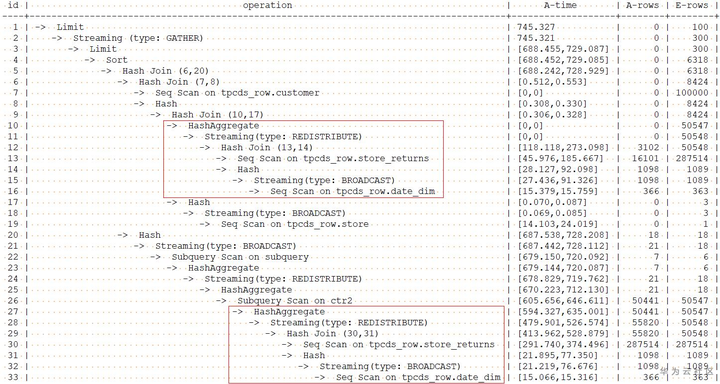
with表达式中group by在做HashAgg中进行重分布时存在倾斜,对应上图中的10和27号算子。对with表达式中的hashagg进行hint指定,查询和计划如下:
explain performance

with customer_total_return as

    (select /*+ skew(store_returns(sr_store_sk sr_customer_sk)) */sr_customer_sk as ctr_customer_sk

          ,sr_store_sk as ctr_store_sk

          ,sum(SR_FEE) as ctr_total_return

     from store_returns

         ,date_dim

     where sr_returned_date_sk = d_date_sk

       and d_year =2000

     group by sr_customer_sk

             ,sr_store_sk)

select  c_customer_id

  from customer_total_return ctr1

      ,store

      ,customer

where ctr1.ctr_total_return > (select avg(ctr_total_return)*1.2

                                 from customer_total_return ctr2

                                where ctr1.ctr_store_sk = ctr2.ctr_store_sk)

  and s_store_sk = ctr1.ctr_store_sk

  and s_state = 'NM'

  and ctr1.ctr_customer_sk = c_customer_sk

order by c_customer_id

limit 100;
作了倾斜hint的查询计划如下:
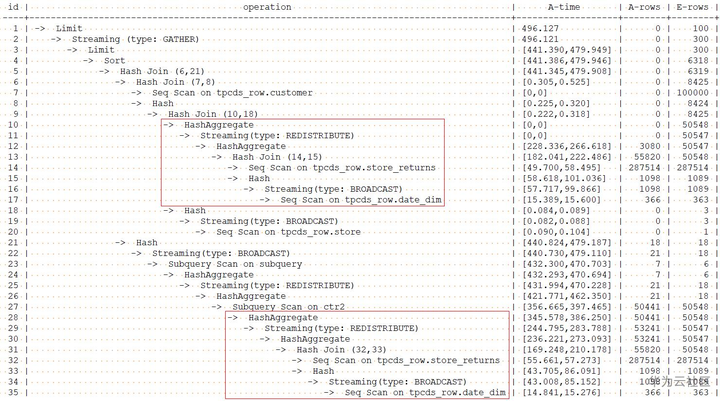
从优化后的计划可以看出:对于HashAgg,由于其重分布存在倾斜,所以优化为双层Agg。
结语
通过上面各节中的示例,展示了Gauss DB(DWS)中plan hint的使用方法,及其对执行计划的影响。数据库使用者结合自己对数据库对象、数据分布情况及数据量等信息的了解,或者根据SQL语句的查询计划分析出其中采用了不正确计划的部分,正确的利用plan hint,提示优化器采用更高效的计划,可以使查询执行的性能获得大幅的提升,成为性能调优的一件有利的工具。
本文分享自华为云社区《GaussDB(DWS)性能调优系列实现篇六:十八般武艺Plan hint运用》,原文作者:wangxiaojuan8 。
十八般武艺玩转GaussDB(DWS)性能调优:Plan hint运用的更多相关文章
- 十八般武艺玩转GaussDB(DWS)性能调优:SQL改写
摘要:本文将系统介绍在GaussDB(DWS)系统中影响性能的坏味道SQL及SQL模式,帮助大家能够从原理层面尽快识别这些坏味道SQL,在调优过程中及时发现问题,进行整改. 数据库的应用中,充斥着坏味 ...
- 十八般武艺玩转GaussDB(DWS)性能调优:路径干预
摘要:路径生成是表关联方式确定的主要阶段,本文介绍了几个影响路径生成的要素:cost_param, scan方式,join方式,stream方式,并从原理上分析如何干预路径的生成. 一.cost模型选 ...
- 十八般武艺玩转GaussDB(DWS)性能调优(三):好味道表定义
摘要:表结构设计是数据库建模的一个关键环节,表定义好坏直接决定了集群的有效容量以及业务查询性能,本文从产品架构.功能实现以及业务特征的角度阐述在GaussDB(DWS)的中表定义时需要关注的一些关键因 ...
- 数据库性能调优之始: analyze统计信息
摘要:本文简单介绍一下什么是统计信息.统计信息记录了什么.为什么要收集统计信息.怎么收集统计信息以及什么时候收集统计信息. 1 WHY:为什么需要统计信息 1.1 query执行流程 下图描述了Gau ...
- JVM 性能调优实战之:一次系统性能瓶颈的寻找过程
玩过性能优化的朋友都清楚,性能优化的关键并不在于怎么进行优化,而在于怎么找到当前系统的性能瓶颈.性能优化分为好几个层次,比如系统层次.算法层次.代码层次…JVM 的性能优化被认为是底层优化,门槛较高, ...
- MySQL性能调优与架构设计——第 15 章 可扩展性设计之Cache与Search的利用
第 15 章 可扩展性设计之Cache与Search的利用 前言: 前面章节部分所分析的可扩展架构方案,基本上都是围绕在数据库自身来进行的,这样是否会使我们在寻求扩展性之路的思维受到“禁锢”,无法更为 ...
- sql server性能调优
转自:https://www.cnblogs.com/woodytu/tag/%E6%80%A7%E8%83%BD%E8%B0%83%E4%BC%98%E5%9F%B9%E8%AE%AD/defaul ...
- 大厂运维必备技能:PB级数据仓库性能调优
摘要:众所周知,数据量大了之后,性能是大家关注的一点,所以我们在业务开发的时候,特别关注性能,做为一个架构师,必须对性能要了解,要懂.才能设计出高性能的业务系统. 一.GaussDB分布式架构 所谓集 ...
- String 既然能做性能调优,我直呼内行
码哥,String 还能优化啥?你是不是框我? 莫慌,今天给大家见识一下不一样的 String,从根上拿捏直达 G 点. 并且码哥分享一个例子:通过性能调优我们能实现百兆内存轻松存储几十 G 数据. ...
- 京东小程序接入ARVR的技术方案和性能调优
作者:京东零售 戴旭 京东小程序是一个开放技术平台,正在被越来越多的头部品牌选择,用于站内私域流量的营销和运营.诸如各种日化.奢侈品等品牌对ARVR有较多的诉求,希望京东小程序引擎提供一些底层能力,叠 ...
随机推荐
- OTOCI 题解
OTOCI 题目大意 给定 \(n\) 个带权的点,需要进行四种操作:查询两点连通性:加边:修改点权:查询两点路径的权值和. 思路分析 首先观察题目,我们会发现,在所有的操作结束后,所有的点构成一个森 ...
- Sell Pigs 题解
Sell Pigs 双倍经验 题目大意 有 \(n\) 个顾客前来买猪,共有 \(m\) 个猪圈,每个顾客携带着某一些猪圈的钥匙,需要买一定数量的猪.在顾客买完后,我们可以将打开的猪圈中的猪随意移动, ...
- 基于LangChain的LLM应用开发2——模型、提示和输出解析
本次会讲解LangChain的三个基本组件:模型.提示和解析器. 名词解析 模型(Models):是指作为基础的大语言模型.LangChain中通过ChatOpenAI或者AzureChatOpenA ...
- c#中责任链模式详解
基本介绍: "责任链"顾名思义,是指一个需要负责处理请求的链条. 每个链条节点都是一个单独的责任者,由责任者自己决定是否处理请求或交给下一个节点. 在设计模式中的解释则 ...
- 2022.7.13 tongyf 讲课纪要
前言 这个笔记记晚了,主要是都在跟 \(LCT\) 进行殊死搏斗,所以博客这方面就挂了很久. tongyf 学长当年是拿到省一之后省选炸了,之后暴切高考.ORZ%%% 这节课讲的是线性dp和背包dp, ...
- C#12中的Collection expressions(集合表达式语法糖)
C#12中引入了新的语法糖来创建常见的集合.并且可以使用..来解构集合,将其内联到另一个集合中. 支持的类型 数组类型,例如 int[]. System.Span<T> 和 System. ...
- 手撕Vue-Router-添加全局$router属性
前言 经过上一篇文章的介绍,完成了初始化路由相关信息的内容,接下来我们需要将路由信息挂载到Vue实例上,这样我们就可以在Vue实例中使用路由信息了. 简而言之就是给每一个Vue实例添加一个$route ...
- 小米二面:Redis 如何保证数据不丢失?
前段时间表妹收到了小米秋招补录的面试邀请,一面还算顺利,很快就通过了,但在看二面面试录屏的时候,我发现了一个问题,回答的不是很好,也就是我们今天要聊的这个问题:Redis 如何保证数据不丢失? 很多人 ...
- Grid 拖拽布局实现
最近有个需求需要实现自定义首页布局,需要将屏幕按照 6 列 4 行进行等分成多个格子,然后将组件可拖拽对应格子进行渲染展示. 示例 对比一些已有的插件,发现想要实现产品的交互效果,没有现成可用的.本身 ...
- QT最小化程序到托盘运行
MinTray 说明 实现程序关闭时最小化托盘的功能 托盘实现显示主页面和退出的功能 支持扩展,直接引用TrayIcon类即可,对外暴露接口 单例实现,可复用 警告 注:博主所有资源永久免费,若有帮助 ...