
论文解读(SAGPool)《Self-Attention Graph Pooling》
论文信息
论文标题:Self-Attention Graph Pooling
论文作者:Junhyun Lee, Inyeop Lee, Jaewoo Kang
论文来源:2019, ICML
论文地址:download
论文代码:download
1 Introduction
图池化三种类型:
- Topology based pooling;
- Hierarchical pooling;(使用所有从 GNN 获得的节点表示)
- Hierarchical pooling;
关于 Hierarchical pooling 聚类分配矩阵:
$\begin{array}{j}S^{(l)}=\operatorname{softmax}\left(\mathrm{GNN}_{l}\left(A^{(l)}, X^{(l)}\right)\right) \\A^{(l+1)}=S^{(l) \top} A^{(l)} S^{(l)}\end{array} \quad\quad\quad\quad(1)$
gPool 取得了与 DiffPool 相当的性能,gPool 需要的存储复杂度为 $\mathcal{O}(|V|+|E|)$,而 DiffPool 需要 $\mathcal{O}\left(k|V|^{2}\right)$,其中 $V$、$E$ 和 $k$ 分别表示顶点、边和池化率。gPool 使用一个可学习的向量 $p$ 来计算投影分数,然后使用这些分数来选择排名靠前的节点。投影得分由 $p$ 与所有节点的特征之间的点积得到。这些分数表示可以保留的节点的信息量。下面的公式大致描述了 gPool 中的池化过程:
$\begin{array}{l} y=X^{(l)} \mathbf{p}^{(l)} /\left\|\mathbf{p}^{(l)}\right\|\\ \mathrm{idx}=\operatorname{top}-\operatorname{rank}(y,\lceil k N\rceil)\\A^{(l+1)}=A_{\mathrm{idx}, \mathrm{idx}}^{(l)}\end{array} \quad\quad\quad\quad(2)$
2 Method
框架如下:
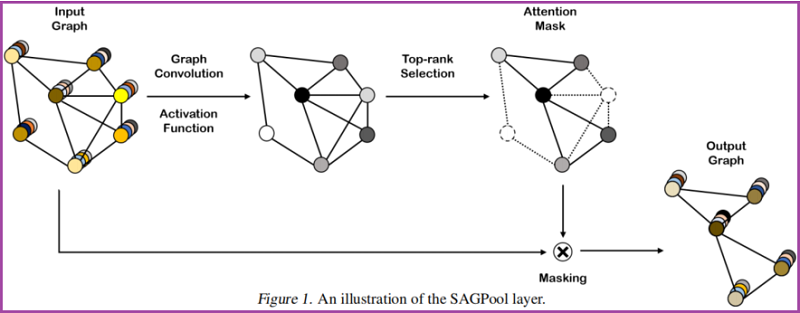
2.1. Self-Attention Graph Pooling
Self-attention mask
本文使用图卷积来获得自注意分数:
$Z=\sigma\left(\tilde{D}^{-\frac{1}{2}} \tilde{A} \tilde{D}^{-\frac{1}{2}} X \Theta_{a t t}\right) \quad\quad\quad\quad(3)$
其中,自注意得分 $Z \in \mathbb{R}^{N \times 1}$、邻接矩阵 $\tilde{A} \in \mathbb{R}^{N \times N}$、注意力参数矩阵 $\Theta_{a t t} \in \mathbb{R}^{F \times 1}$、特征矩阵 $X \in \mathbb{R}^{N \times F}$、度矩阵 $\tilde{D} \in \mathbb{R}^{N \times N}$。
这里考虑节点选择方法,即使输入不同大小和结构的图,也会保留输入图的部分节点。
$\begin{array}{l} \mathrm{idx}=\operatorname{top}-\operatorname{rank}(Z,\lceil k N\rceil)\\Z_{\text {mask }}=Z_{\mathrm{idx}}\end{array} \quad\quad\quad\quad(4)$
基于自注意得分 $Z$ ,选择保留前 $ \lceil k N\rceil$ 个节点,其中 $k \in(0,1]$ 代表着池化率(pooling ratio),$Z_{\text{mask}}$ 是 feature attention mask。。
Graph pooling
接着获得新特征矩阵和邻接矩阵:
$\begin{array}{l} X^{\prime}=X_{\mathrm{idx},:}\\X_{\text {out }}=X^{\prime} \odot Z_{\text {mask }}\\A_{\text {out }}=A_{\mathrm{idx}, \mathrm{idx}}\end{array} \quad\quad\quad\quad(5)$
其中,$\odot$ is the broadcasted elementwise product。
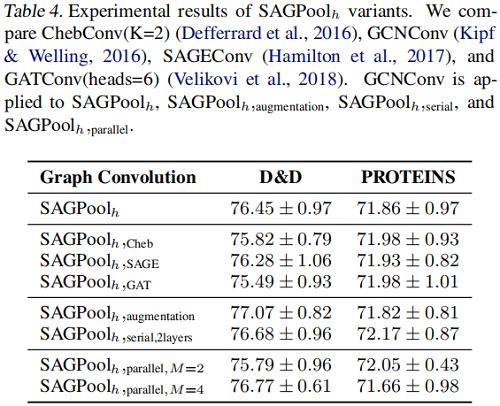
Variation of SAGPool
$Z=\sigma(\operatorname{GNN}(X, A)) \quad\quad\quad\quad(6)$
$Z=\sigma\left(\operatorname{GNN}\left(X, A+A^{2}\right)\right) \quad\quad\quad\quad(7)$
$Z=\sigma\left(\mathrm{GNN}_{2}\left(\sigma\left(\mathrm{GNN}_{1}(X, A)\right), A\right)\right) \quad\quad\quad\quad(8)$
$Z=\frac{1}{M} \sum_{m} \sigma\left(\mathrm{GNN}_{m}(X, A)\right) \quad\quad\quad\quad(9)$
2.2 Model Architecture
本节用来验证模块的有效性。
Convolution layer
图卷积 GCN:
$h^{(l+1)}=\sigma\left(\tilde{D}^{-\frac{1}{2}} \tilde{A} \tilde{D}^{-\frac{1}{2}} h^{(l)} \Theta\right) \quad\quad\quad\quad(10)$
与 $\text{Eq.3}$ 不同的是,$\Theta \in \mathbb{R}^{F \times F^{\prime}}$ 。
Readout layer
根据 JK-net architecture 的思想:
$s=\frac{1}{N} \sum_{i=1}^{N} x_{i} \| \max _{i=1}^{N} x_{i} \quad\quad\quad\quad(11)$
其中:
- $N$ 代表着节点的个数;
- $x_{i}$ 代表着第 $i$ 个节点的特征向量;
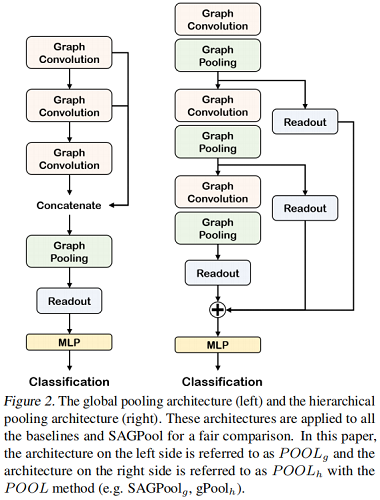
Global pooling architecture & Hierarchical pooling architecture
对比如下:
3 Experiments
数据集

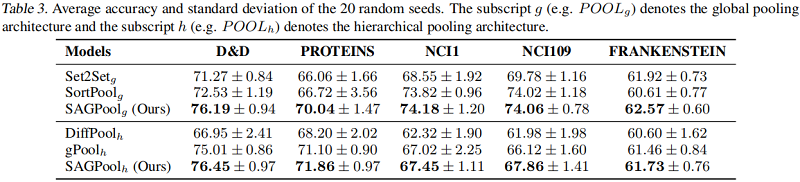
基线实验
SAGPool 的变体
4 Conclusion
本文提出了一种基于自注意的SAGPool图池化方法。我们的方法具有以下特征:分层池、同时考虑节点特征和图拓扑、合理的复杂度和端到端表示学习。SAGPool使用一致数量的参数,而不管输入图的大小如何。我们工作的扩展可能包括使用可学习的池化比率来获得每个图的最优聚类大小,并研究每个池化层中多个注意掩模的影响,其中最终的表示可以通过聚合不同的层次表示来获得。
论文解读(SAGPool)《Self-Attention Graph Pooling》的更多相关文章
- 论文解读《Deep Attention-guided Graph Clustering with Dual Self-supervision》
论文信息 论文标题:Deep Attention-guided Graph Clustering with Dual Self-supervision论文作者:Zhihao Peng, Hui Liu ...
- 论文解读GALA《Symmetric Graph Convolutional Autoencoder for Unsupervised Graph Representation Learning》
论文信息 Title:<Symmetric Graph Convolutional Autoencoder for Unsupervised Graph Representation Learn ...
- 论文解读(ChebyGIN)《Understanding Attention and Generalization in Graph Neural Networks》
论文信息 论文标题:Understanding Attention and Generalization in Graph Neural Networks论文作者:Boris Knyazev, Gra ...
- 论文解读(GraphMAE)《GraphMAE: Self-Supervised Masked Graph Autoencoders》
论文信息 论文标题:GraphMAE: Self-Supervised Masked Graph Autoencoders论文作者:Zhenyu Hou, Xiao Liu, Yukuo Cen, Y ...
- 论文解读(KP-GNN)《How Powerful are K-hop Message Passing Graph Neural Networks》
论文信息 论文标题:How Powerful are K-hop Message Passing Graph Neural Networks论文作者:Jiarui Feng, Yixin Chen, ...
- 论文解读(SR-GNN)《Shift-Robust GNNs: Overcoming the Limitations of Localized Graph Training Data》
论文信息 论文标题:Shift-Robust GNNs: Overcoming the Limitations of Localized Graph Training Data论文作者:Qi Zhu, ...
- 论文解读(LG2AR)《Learning Graph Augmentations to Learn Graph Representations》
论文信息 论文标题:Learning Graph Augmentations to Learn Graph Representations论文作者:Kaveh Hassani, Amir Hosein ...
- 论文解读(GCC)《Efficient Graph Convolution for Joint Node RepresentationLearning and Clustering》
论文信息 论文标题:Efficient Graph Convolution for Joint Node RepresentationLearning and Clustering论文作者:Chaki ...
- 论文解读(AGC)《Attributed Graph Clustering via Adaptive Graph Convolution》
论文信息 论文标题:Attributed Graph Clustering via Adaptive Graph Convolution论文作者:Xiaotong Zhang, Han Liu, Qi ...
随机推荐
- Django的models中filter的各种用法及官方手册的网址
__exact 精确等于 like 'aaa' __iexact 精确等于 忽略大小写 ilike 'aaa' __contains 包含 like '%aaa%' __icontains 包含 忽略 ...
- BeanFactory – BeanFactory 实现举例?
Bean 工厂是工厂模式的一个实现,提供了控制反转功能,用来把应用的配置和依赖从正真的应用代码中分离. 最常用的BeanFactory 实现是XmlBeanFactory 类.
- java-字节流-字符流
I/O叙述 FileOutputStream类字节输出流的介绍: 写入数据的原理 java程序-->JVM(java虚拟机)--->OS(操作系统)---->OS调用写数据的方法-- ...
- java中的VO、PO、BO、DAO、POJO
针对java工程里的各种带O的对象,进行分析,了解各自的作用. PO: persistent object,持久对象.与数据库里表字段一一对应.PO是一些属性,以及set和get方法组成.一般情况下 ...
- My模板设计模式
模板模式 目标: 第一个设计模式:模板模式 步骤: 第一个设计模式:模板模式 讲解: 我们现在使用抽象类设计一个模板模式的应用, 例如在小学的时候,我们经常写作文,通常都是有模板可以套用的. 假如我现 ...
- 数据结构:DHUOJ 删除链表的顺数及倒数第N个节点
删除链表的顺数及倒数第N个节点 作者: turbo时间限制: 1S章节: DS:数组和链表 题目描述: 可使用以下代码,完成其中的removeNth函数,其中形参head指向无头结点单链表,n为要删除 ...
- TOP 10 开源的推荐系统简介
最 近这两年推荐系统特别火,本文搜集整理了一些比较好的开源推荐系统,即有轻量级的适用于做研究的SVDFeature.LibMF.LibFM等,也有重 量级的适用于工业系统的 Mahout.Oryx ...
- getch()函数的使用方法及其返回值问题
getch()函数依赖于头文件 conio.h .会在windows平台下从控制台无回显地取一个字符,并且返回读取到的字符. 然而,我在实际用这个函数才发现getch()这个函数并不简单. getch ...
- ES6-11学习笔记--解构赋值
解构赋值:按照一定模式,从数组和对象中提取值,对变量进行赋值. 数组解构 对象解构 字符串解构 应用场景 曾经的赋值噩梦,非解构赋值数组: let arr = [1, 2, 3]; let ...
- Canvas 制作海报
HTML <template> <view class="content"> <view class="flex_row_c_c mod ...