
【SCALA】3、模拟电路
Simulation
package demo17

abstract class Simulation {

  type Action = () => Unit

  case class WorkItem(time: Int, action: Action)

  private var curtime = 0

  def currentTime: Int = curtime

  //日程,记录所有未执行的工作项目

  private var agenda: List[WorkItem] = List()

  //更新排序

  private def insert(ag: List[WorkItem], item: WorkItem): List[WorkItem] = {

    //如果头部时间大于当前时间,那么直接头插

    if(ag.isEmpty || item.time < ag.head.time) {

      item :: ag

    } else {

      //否则遍历递归到合适位置

      ag.head :: insert(ag.tail, item)

    }

  }

  //向日程添加工作项,第二个参数是传名参数

  def afterDelay(delay: Int)(block: => Unit) = {

    val item = WorkItem(currentTime + delay, () => block)

    agenda = insert(agenda, item)

  }

  private def next() = {

    (agenda: @unchecked) match {

      case item :: rest =>

        agenda = rest

        curtime = item.time

        //执行这个工作项的操作

        //这里一定要带括号,不然就是相当于get操作

        item.action()

    }

  }

  def run() = {

    //插入方法

    afterDelay(0) {

      println("*** simulation started, time = " + currentTime + " ***")

    }

    //执行所有的操作

    while(!agenda.isEmpty) next()

  }

}
BasicCircuitSimulation
package demo17

abstract class BasicCircuitSimulation extends Simulation {

  //用来做门的延迟

  def InverterDelay: Int

  def AndGateDelay: Int

  def OrGateDelay: Int

  //线

  class Wire {

    private var sigVal = false

    private var actions: List[Action] = List()

    def getSignal = sigVal

    def setSignal(s: Boolean) = {

      if(s != sigVal) {

        sigVal = s

        //这里是对actions每一个元素应用=》_ () 操作也就是f => f(),每次线的状态变化的时候,执行actions

        actions foreach (_ ())

      }

    }

    def addAction(a: Action) = {

      //加入载头部

      actions = a :: actions

      //并执行一次a

      a()

    }

  }

  //非门,也就是翻转器,在uinput和output之间建立饭庄器

  def inverter(input: Wire, output: Wire) = {

    def invertAction() = {

      val inputSig = input.getSignal

      //在制定的延迟之后执行对应的方法

      afterDelay(InverterDelay) {

        //设置输出线信号为input相反

        output setSignal !inputSig

      }

      //test

//      output setSignal !inputSig

    }

    //添加动作到input线

    input addAction invertAction

  }

  //与门,输入两个线信号的&操作

  def andGate(a1: Wire, a2: Wire, output: Wire) = {

    def andAction() = {

      val a1Sig = a1.getSignal

      val a2Sig = a2.getSignal

      afterDelay(AndGateDelay) {

        output setSignal (a1Sig & a2Sig)

      }

      //test

//      output setSignal (a1Sig & a2Sig)

    }

    a1 addAction andAction

    a2 addAction andAction

  }

  def orGate(o1: Wire, o2: Wire, output: Wire) = {

    def orAction() = {

      val o1Sig = o1.getSignal

      val o2Sig = o2.getSignal

      afterDelay(OrGateDelay) {

        output setSignal (o1Sig | o2Sig)

      }

      //test

//      output setSignal (o1Sig | o2Sig)

    }

    o1 addAction orAction

    o2 addAction orAction

  }

  //用来观察线的型号变化

  def probe(name: String, wire: Wire) = {

    def probeAction() = {

      println(name + " " + currentTime + " new-value = " + wire.getSignal)

    }

    wire addAction probeAction

  }

}
CircuitSimulation
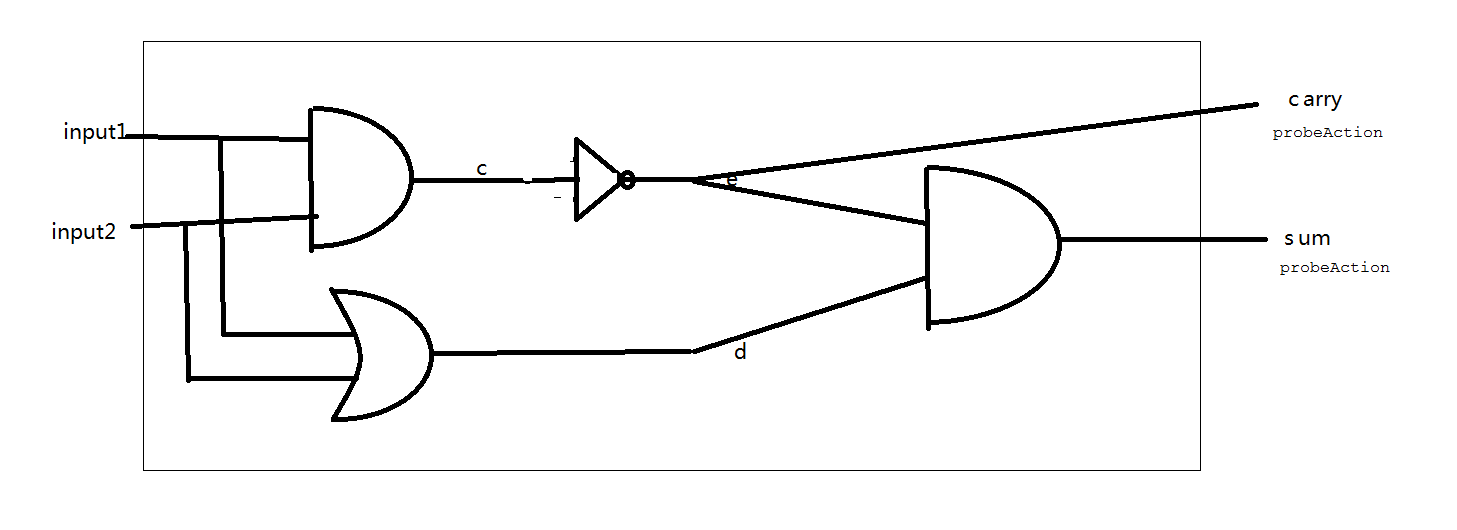
package demo17

abstract class CircuitSimulation extends BasicCircuitSimulation {

  def halfAdder(a: Wire, b: Wire, s: Wire, c: Wire) = {

    val d, e = new Wire

    orGate(a, b, d)

    andGate(a, b, c)

    inverter(c, e)

    andGate(d, e, s)

  }

  def fullAdder(a: Wire, b: Wire, cin: Wire, sum: Wire, cout: Wire) = {

    val s, c1, c2 = new Wire

    halfAdder(a, cin, s, c1)

    halfAdder(b, s, sum, c2)

    orGate(c1, c2, cout)

  }

}
MySimulation
package demo17

object MySimulation extends CircuitSimulation {

  def InverterDelay: Int = 1

  def AndGateDelay: Int = 3

  def OrGateDelay: Int = 5

}
测试结果:
package demo17

import demo17.MySimulation._

object Demo18Test {

  def main(args: Array[String]): Unit = {

    val input1, input2, sum, carry = new Wire

    probe("sum", sum)

    probe("carry", carry)

    halfAdder(input1, input2, sum, carry)

    input1 setSignal true

    run()

    input2 setSignal true

    run()

    println("over")

  }

}
测试结果:

模拟电路的半加器
【SCALA】3、模拟电路的更多相关文章
- 模拟电路"虚短" & "虚断"
<虚短 & 虚断> 运算放大器组成的电路五花八门,令人眼花瞭乱,是模拟电路中学习的重点.遍观所有模拟电子技朮的书籍和课程,在介绍运算放大器电路的时候,无非是先给电路来个定性,比如这 ...
- 初级模拟电路:3-1 BJT概述
回到目录 1. 名称由来 BJT的全称是双极性结型晶体管(Bipolar Junction Transistor),国内俗称三极管.其实,在英语中,三极管(triode)特指以前的真空电子管形式的 ...
- 初级模拟电路:4-1 BJT交流分析概述
回到目录 BJT晶体管的交流分析(也叫小信号分析)是模拟电路中的一个难点,也可以说是模电中的一个分水岭.如果你能够把BJT交流分析的原理全都搞懂,那之后的学习就是一马平川了.后面的大部分内容,诸如:场 ...
- [模拟电路] 2、Passive Band Pass Filter
note: Some articles are very good in http://www.electronics-tutorials.ws/,I share them in the Cnblog ...
- 初级模拟电路:1-2 PN结与二极管
回到目录 1. 掺杂半导体 上面我们分析了本征半导体的导电情况,但由于本征半导体的导电能力很低,没什么太大用处.所以,一般我们会对本征半导体材料进行掺杂,即使只添加了千分之一的杂质,也足以改变半导 ...
- 初级模拟电路:4-3 BJT晶体管的交流建模
回到目录 1. 四种BJT模型概述 对BJT晶体管建模的基本思路就是,用电路原理中的五大基本元件(电阻.电容.电感.电源.受控源)构建一个电路,使其在一定工作条件下能等效非线性半导体器件的实际工作.一 ...
- 初级模拟电路:3-11 BJT实现电流源
回到目录 1. 恒流源 (1)简易恒流源 用BJT晶体管可以构造一个简易的恒流源,实现电路如下: 图3-11.01 前面我们在射极放大电路的分压偏置时讲过,分压偏置具有非常好的稳定性,几乎不受晶体管的 ...
- 初级模拟电路:3-2 BJT的工作原理
回到目录 和前面介绍二极管的PN结的工作原理一样,BJT的量子级工作机制也非常复杂,一般教科书上为了帮助学习者能快速理解,也都是用一种简化模型的方法来介绍BJT的工作机理,一般只需大致了解即可.只要记 ...
- 初级模拟电路:3-8 BJT数据规格书(直流部分)
回到目录 本小节我们以2N4123通用型BJT硅基晶体管为例,来介绍如何阅读BJT的数据规格书,点此链接可以阅读和下载2N4123的数据规格书. 1. 总体性能 打开datasheet后,首先看标题: ...
随机推荐
- Mybatis传参- 被逗号分割的字符串
String ids = "1,2,3,4,5,6",如ids作为参数传递,查询list返回.mybatis用foreach处理并返回. SELECT * FROM yp_popu ...
- eclipse如何配置tomcat
依次点击Window->Show View->Other 找到Server,点击OK,看到控制台旁边已有Server了. 点击server下面的链接,依次选择Apache,根据自己 ...
- Qt动画框架The Animation Framework
动画框架是Kinetic(运动)项目的一部分,它的目标是提供一中简单的方法创建动画的和流畅的GUI.借助Qt动画属性,可以提供非常自由的动画窗体组件和其他对象(QObjects).动画框架也能被用于图 ...
- Springmvc & Report: FineReport vs BIRT vs Jasperreport
Springmvc与jasperreport结合生成报表的一种方法 - OneThin的个人空间 - OSCHINAhttps://my.oschina.net/onethin/blog/14360 ...
- openresty开发系列2--nginx的简单安装,正向、反向代理及常用命令和信号控制介绍
openresty开发系列2--nginx的简单安装,正向.反向代理及常用命令和信号控制介绍 一.nginx的安装下载及编译安装1.Nginx下载:nginx-1.13.0.tar.gz,下载到:/u ...
- django实战总结
1.创建app命令 django-admin.py startapp app_name 2.数据库脚本命令 # 1. 创建更改的文件 python manage.py makemigrations # ...
- OMPL 在windows下的安装
博客参考:https://blog.csdn.net/shitanding/article/details/82562702 和 https://bitbucket.org/ompl/omplapp/ ...
- PLSQL流函数代码 540页 【我】
540页 流函数代码 -- Create table create table STOCKTABLE ( TICKER ), TRADE_DATE DATE, OPEN_PRICE NUMBER, C ...
- xml文档操作
/** * */package com.gootrip.util; import java.io.ByteArrayOutputStream;import java.io.File;import ja ...
- Spring 定时任务 注解版
Task类: ManageSql.Java对应代码: package com.axb.cheney.task; import java.sql.ResultSet; import java.sql.S ...