
Iterator、Iterable接口的使用及详解
Java集合类库将集合的接口与实现分离。同样的接口,可以有不同的实现。
Java集合类的基本接口是Collection接口。而Collection接口必须继承java.lang.Iterable接口。
以下图表示集合框架的接口,java.lang以及java.util两个包里的。其他部分可以从左向右看,比如Collection的Subinterfaces有List,Set以及Queue等。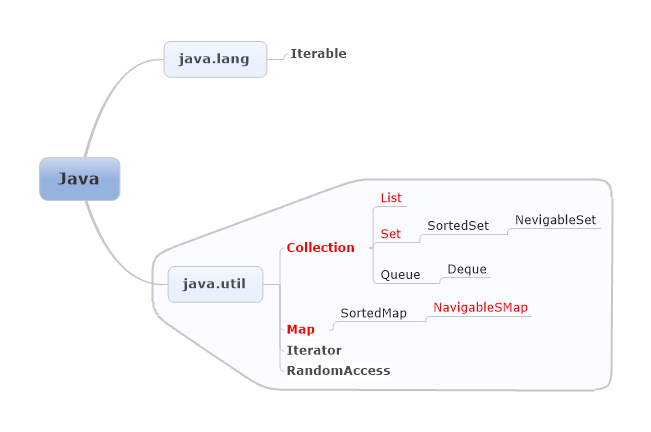
package java.util;

/**

 * An iterator over a collection.  Iterator takes the place of Enumeration in

 * the Java collections framework.  Iterators differ from enumerations in two

 * ways: <ul>

 *    <li> Iterators allow the caller to remove elements from the

 *         underlying collection during the iteration with well-defined

 *          semantics.

 *    <li> Method names have been improved.

 * </ul><p>

 *

 * This interface is a member of the

 * <a href="{@docRoot}/../technotes/guides/collections/index.html">

 * Java Collections Framework</a>.

 *

 * @author  Josh Bloch

 * @version %I%, %G%

 * @see Collection

 * @see ListIterator

 * @see Enumeration

 * @since 1.2

 */

public interface Iterator<E> {

    /**

     * Returns <tt>true</tt> if the iteration has more elements. (In other

     * words, returns <tt>true</tt> if <tt>next</tt> would return an element

     * rather than throwing an exception.)

     *

     * @return <tt>true</tt> if the iterator has more elements.

     */

    boolean hasNext();

    /**

     * Returns the next element (每一次迭代,the next element就是index为0的元素)in the iteration.

     *

     * @return the next element in the iteration.

     * @exception NoSuchElementException iteration has no more elements.

     */

    E next();

    /**

     *

     * Removes from the underlying collection the last element returned by the

     * iterator (optional operation).  This method can be called only once per

     * call to <tt>next</tt>.  The behavior of an iterator is unspecified if

     * the underlying collection is modified while the iteration is in

     * progress in any way other than by calling this method.

     *

     * @exception UnsupportedOperationException if the <tt>remove</tt>

     *          operation is not supported by this Iterator.

     * @exception IllegalStateException if the <tt>next</tt> method has not

     *          yet been called, or the <tt>remove</tt> method has already

     *          been called after the last call to the <tt>next</tt>

     *          method.

     */

    void remove();

}
以下例子是利用了Iterator接口的着三个方法,实现遍历ArrayList<String>类型。
一开始迭代器在所有元素的左边,调用next()之后,迭代器移到第一个和第二个元素之间,next()方法返回迭代器刚刚经过的元素。
hasNext()若返回True,则表明接下来还有元素,迭代器不在尾部。
remove()方法必须和next方法一起使用,功能是去除刚刚next方法返回的元素。
import java.util.ArrayList;

import java.util.Collection;

import java.util.Iterator;

public class ForEachDemo {

    public static void main(String... arg) {

        Collection<String> a = new ArrayList<String>();

        a.add("Bob");

        a.add("Alice");

        a.add("Lisy");

        Iterator<String> iterator = a.iterator();

        while (iterator.hasNext()) {

            String ele = iterator.next();

            System.out.println(ele);//Bob  Alice  Lisy

        }

        System.out.println(a);//[Bob, Alice, Lisy]

        iterator = a.iterator();

        iterator.next();

        iterator.remove();

        System.out.println(a);//[Alice, Lisy]

    }

}
package java.lang;

import java.util.Iterator;

/** Implementing this interface allows an object to be the target of

 *  the "foreach" statement.

 * @since 1.5

 */

public interface Iterable<T> {

    /**

     * Returns an iterator over a set of elements of type T.

     *

     * @return an Iterator.

     */

    Iterator<T> iterator();

}
for-each循环可以与任何实现了Iterable接口的对象一起工作。
而java.util.Collection接口继承java.lang.Iterable,故标准类库中的任何集合都可以使用for-each循环。
Collection接口
此接口的方法
public interface Collection<E>{......}
| Modifier and Type | Method and Description |
|---|---|
boolean |
add(E e)
Ensures that this collection contains the specified element (optional operation).
|
boolean |
addAll(Collection<? extends E> c)
Adds all of the elements in the specified collection to this collection (optional operation).
|
void |
clear()
Removes all of the elements from this collection (optional operation).
|
boolean |
contains(Object o)
Returns true if this collection contains the specified element.
|
boolean |
containsAll(Collection<?> c)
Returns true if this collection contains all of the elements in the specified collection.
|
boolean |
equals(Object o)
Compares the specified object with this collection for equality.
|
int |
hashCode()
Returns the hash code value for this collection.
|
boolean |
isEmpty()
Returns true if this collection contains no elements.
|
Iterator<E> |
iterator()
Returns an iterator over the elements in this collection.
|
boolean |
remove(Object o)
Removes a single instance of the specified element from this collection, if it is present (optional operation).
|
boolean |
removeAll(Collection<?> c)
Removes all of this collection's elements that are also contained in the specified collection (optional operation).
|
boolean |
retainAll(Collection<?> c)
Retains only the elements in this collection that are contained in the specified collection (optional operation).
|
int |
size()
Returns the number of elements in this collection.
|
Object[] |
toArray()
Returns an array containing all of the elements in this collection.
|
<T> T[] |
toArray(T[] a)
Returns an array containing all of the elements in this collection; the runtime type of the returned array is that of the specified array.
|
因为其中有一个返回值为Iterator<E>类型的iterator()方法,所以,java.util.Collection接口必须继承java.lang.Iterable接口
实现Collection接口的每一个类都要实现以上众多方法,但开发者自己实现很麻烦。所以java提供了AbstractCollection类来编写具体的类。
java.util
Interface Collection<E>
- All Superinterfaces:
- Iterable<E>
- All Known Subinterfaces:
- BeanContext, BeanContextServices,
BlockingDeque<E>,
BlockingQueue<E>,
Deque<E>, List<E>, NavigableSet<E>, Queue<E>, Set<E>,
SortedSet<E>
- All Known Implementing Classes:
- AbstractCollection, AbstractList, AbstractQueue, AbstractSequentialList,
AbstractSet, ArrayBlockingQueue,
ArrayDeque, ArrayList,
AttributeList, BeanContextServicesSupport,
BeanContextSupport,
ConcurrentLinkedQueue,
ConcurrentSkipListSet,
CopyOnWriteArrayList,
CopyOnWriteArraySet,
DelayQueue, EnumSet, HashSet, JobStateReasons,
LinkedBlockingDeque,
LinkedBlockingQueue,
LinkedHashSet, LinkedList, PriorityBlockingQueue,
PriorityQueue, RoleList, RoleUnresolvedList,
Stack, SynchronousQueue, TreeSet, Vector
Collection接口有三个常用的子接口,分别是List,Set,Queue。
http://blog.csdn.net/xujinsmile/article/details/8543544
看一下JDK中的集合类,比如List一族或者Set一族,
都是继承了Iterable接口,但并不直接继承Iterator接口。
仔细想一下这么做是有道理的。因为Iterator接口的核心方法next()或者hasNext()
是依赖于迭代器的当前迭代位置的。
如果Collection直接继承Iterator接口,势必导致集合对象中包含当前迭代位置的数据(指针)。
当集合在不同方法间被传递时,由于当前迭代位置不可预置,那么next()方法的结果会变成不可预知。
除非再为Iterator接口添加一个reset()方法,用来重置当前迭代位置。
但即时这样,Collection也只能同时存在一个当前迭代位置。
而Iterable则不然,每次调用都会返回一个从头开始计数的迭代器。
多个迭代器是互不干扰的。
http://www.cnblogs.com/highriver/archive/2011/07/27/2077913.html
import java.util.Iterator;

public class ForEachAPIDemo {

    public static void main(String[] args) throws Exception {

        Students students = new Students(10);

        for (Student student : students) {

            System.out.println(student.getSid() + ":" + student.getName());

        }

    }

}

// 支持for each迭代循环的学生集合类

class Students implements Iterable<Student> {

    // 存储所有学生类的数组

    private Student[] students;

    // 该构造函数可以生成指定大小的学生类变量数组,并初始化该学生类变量数组

    public Students(int size) {

        students = new Student[size];

        for (int i = 0; i < size; i++) {

            students[i] = new Student(String.valueOf(i), "学生" + String.valueOf(i));

        }

    }

    @Override

    public Iterator<Student> iterator() {

        return new StudentIterator();

    }

    // 实现Iterator接口的私有内部类,外界无法直接访问

    private class StudentIterator implements Iterator<Student> {

        // 当前迭代元素的下标

        private int index = 0;

        // 判断是否还有下一个元素,如果迭代到最后一个元素就返回false

        public boolean hasNext() {

            return index != students.length;

        }

        @Override

        public Student next() {

            return students[index++];

        }

        // 这里不支持,抛出不支持操作异常

        public void remove() {

            throw new UnsupportedOperationException();

        }

    }

}

class Student {

    private String sid;

    private String name;

    public Student(String sid, String name) {

        setSid(sid);

        setName(name);

    }

    public String getSid() {

        return sid;

    }

    public void setSid(String sid) {

        this.sid = sid;

    }

    public String getName() {

        return name;

    }

    public void setName(String name) {

        this.name = name;

    }

    @Override

    public String toString() {

        return "Student{" +

                "sid='" + sid + '\'' +

                ", name='" + name + '\'' +

                '}';

    }

}
What hurts more? The pain of hard work or the pain of regret?
Iterator、Iterable接口的使用及详解的更多相关文章
- 【python3+request】python3+requests接口自动化测试框架实例详解教程
转自:https://my.oschina.net/u/3041656/blog/820023 [python3+request]python3+requests接口自动化测试框架实例详解教程 前段时 ...
- OpenCV学习C++接口 Mat像素遍历详解
OpenCV学习C++接口 Mat像素遍历详解
- 微信JS接口汇总及使用详解
这篇文章主要介绍了微信JS接口汇总及使用详解,十分的全面.详尽,包含分享到朋友圈,分享给朋友,分享到QQ,拍照或从手机相册中选图,识别音频并返回识别结果,使用微信内置地图查看位置等接口,有需要的小伙伴 ...
- “全栈2019”Java第六十五章:接口与默认方法详解
难度 初级 学习时间 10分钟 适合人群 零基础 开发语言 Java 开发环境 JDK v11 IntelliJ IDEA v2018.3 文章原文链接 "全栈2019"Java第 ...
- python+requests接口自动化测试框架实例详解
python+requests接口自动化测试框架实例详解 转自https://my.oschina.net/u/3041656/blog/820023 摘要: python + requests实 ...
- STM32接口FSMC/FMC难点详解
STM32接口FSMC/FMC难点详解 转载 http://blog.sina.com.cn/s/blog_808bca130102x94k.html STM32F767的FMC将外部存储器划分为 ...
- Jmeter接口之响应断言详解
响应断言 : 对服务器的响应进行断言校验 Apply to 应用范围: main sample and sub sample, main sample only , sub-sample only , ...
- 接口测试之HTTP协议详解
引言 HTTP是一个属于应用层的面向对象的协议,由于其简捷.快速的方式,适用于分布式超媒体信息系统.它于1990年提出,经过几年的使用与发展,得到不断地完善和扩展.目前在WWW中使用的是HTTP/1. ...
- python+requests接口自动化测试框架实例详解教程
1.首先,我们先来理一下思路. 正常的接口测试流程是什么? 脑海里的反应是不是这样的: 确定测试接口的工具 —> 配置需要的接口参数 —> 进行测试 —> 检查测试结果(有的需要数据 ...
随机推荐
- Android中Broadcast Receiver组件具体解释
BroadcastReceiver(广播接收器)是Android中的四大组件之中的一个. 以下是Android Doc中关于BroadcastReceiver的概述: ①广播接收器是一个专注于接收广播 ...
- Hadoop-2.4.0安装和wordcount执行验证
Hadoop-2.4.0安装和wordcount执行验证 下面描写叙述了64位centos6.5机器下,安装32位hadoop-2.4.0,并通过执行 系统自带的WordCount样例来验证服务正确性 ...
- PV FV PMT
- HDU5015 233 Matrix(矩阵高速幂)
HDU5015 233 Matrix(矩阵高速幂) 题目链接 题目大意: 给出n∗m矩阵,给出第一行a01, a02, a03 ...a0m (各自是233, 2333, 23333...), 再给定 ...
- OCP读书笔记(17) - 计划任务
轻量级作业: 也称为持久性轻量级作业,如果当我们的数据库每秒钟需要创建.删除或修改数十个或数百个作业时,使用轻量级作业是降低开销的最佳方法 常规作业:是由oracle 11g Scheduler 所支 ...
- js中 正則表達式
正則表達式使用具体解释 简单介绍 简单的说,正則表達式是一种能够用于模式匹配和替换的强有力的工具.其作用例如以下: 測试字符串的某个模式.比如,能够对一个输入字符串进行測试,看在该字符串是否存在一个电 ...
- Caused by: com.mysql.jdbc.MysqlDataTruncation: Data truncation: Truncated incorrect DOUBLE value: 'L
1.错误叙述性说明 [ERROR:]2015-06-08 09:49:42,523 [异常拦截] org.hibernate.exception.DataException: error execut ...
- QQ旅程server分析01-网关server
网关server网络进程: s1.连接网关管理器 s2.上报自身信息给网关管理器 s3.从网关管理器获取自己的管理信息 *s4.依照管理信息预分配好须要的资源 s5.网关server打开client监 ...
- MySQL和Oracle开发差异
1) 数据类型差异 Oracle MySQL 注释 单独创建序列来实现 自动增长的数据类型 varchar2 varchar number tinyint,smallint,mediumint,in ...
- [转载] 创建为ClickOnce清单签名的.pfx格式数字证书
使用vs2013自动创建的.pfx数字证书默认有效期只有一年,并且“颁发者”.“颁发给”均为当前机器名和当前登陆用户名的组合,其实我们完全可以创建更友好的.pfx数字证书. 打开Microsoft . ...