
MyBatis的demo
把以前写的关于mybatis的demo放在这边,以便查看。
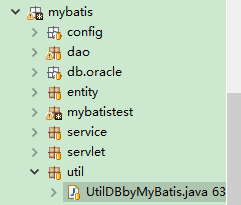
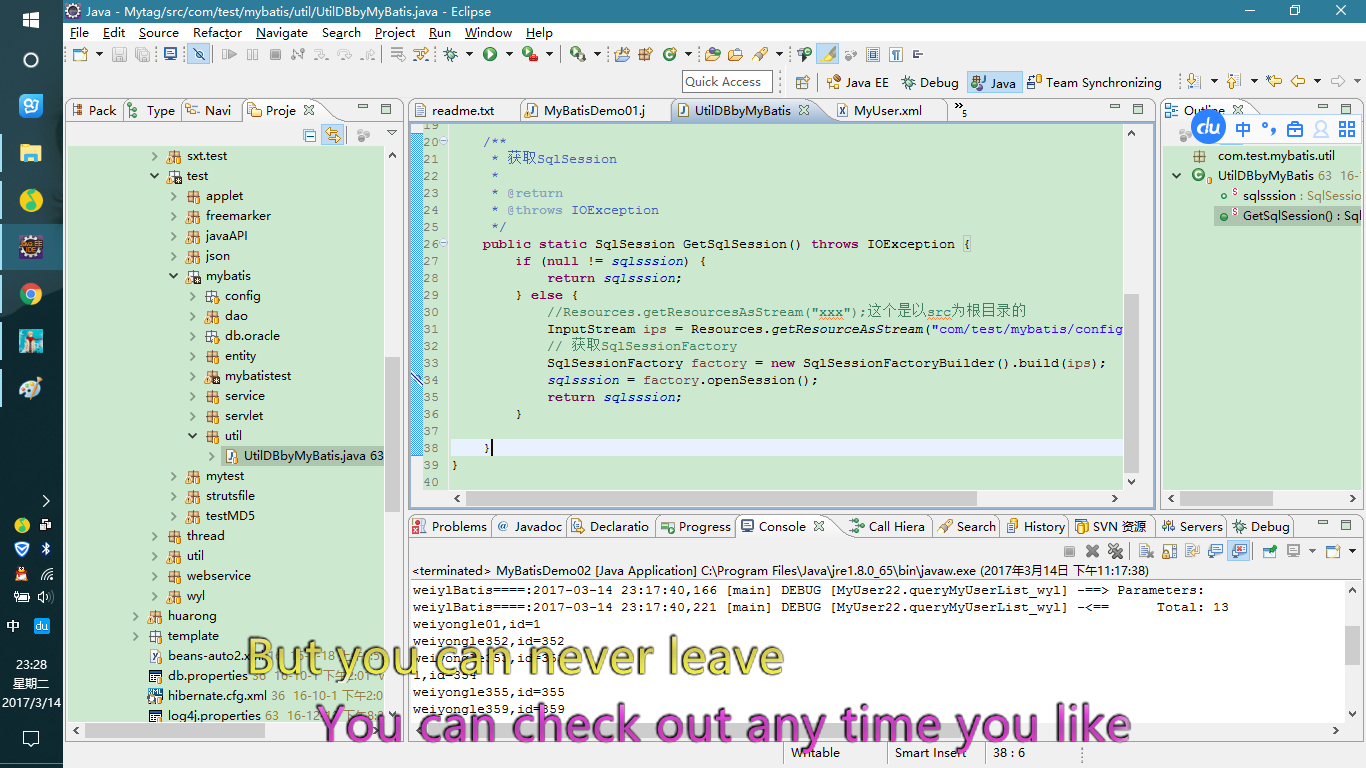
目录结构:
 package com.test.mybatis.util;

 import java.io.IOException;

 import java.io.InputStream;

 import org.apache.ibatis.io.Resources;

 import org.apache.ibatis.session.SqlSession;

 import org.apache.ibatis.session.SqlSessionFactory;

 import org.apache.ibatis.session.SqlSessionFactoryBuilder;

 /**

  * 数据库连接工具类(MyBatis框架相关)

  *

  * @author Wei

  * @time 2016年11月6日 下午5:08:33

  */

 public class UtilDBbyMyBatis {

     public static SqlSession sqlsssion;

     /**

      * 获取SqlSession

      *

      * @return

      * @throws IOException

      */

     public static SqlSession GetSqlSession() throws IOException {

         if (null != sqlsssion) {

             return sqlsssion;

         } else {

             //Resources.getResourcesAsStream("xxx");这个是以src为根目录的

             InputStream ips = Resources.getResourceAsStream("com/test/mybatis/config/Configuration.xml");

             // 获取SqlSessionFactory

             SqlSessionFactory factory = new SqlSessionFactoryBuilder().build(ips);

             sqlsssion = factory.openSession();

             return sqlsssion;

         }

     }

 }
Configuration.xml:
 <?xml version="1.0" encoding="UTF-8" ?>

 <!-- Copyright 2009-2016 the original author or authors. Licensed under the

     Apache License, Version 2.0 (the "License"); you may not use this file except

     in compliance with the License. You may obtain a copy of the License at http://www.apache.org/licenses/LICENSE-2.0

     Unless required by applicable law or agreed to in writing, software distributed

     under the License is distributed on an "AS IS" BASIS, WITHOUT WARRANTIES

     OR CONDITIONS OF ANY KIND, either express or implied. See the License for

     the specific language governing permissions and limitations under the License. -->

 <!DOCTYPE configuration

     PUBLIC "-//mybatis.org//DTD Config 3.0//EN"

     "http://mybatis.org/dtd/mybatis-3-config.dtd">

 <configuration>

     <settings>

         <setting name="useGeneratedKeys" value="false" />

         <setting name="useColumnLabel" value="true" />

     </settings>

     <!-- <typeAliases> <typeAlias alias="UserAlias" type="org.apache.ibatis.submitted.complex_property.User"/>

         </typeAliases> -->

     <environments default="development">

         <environment id="development">

             <transactionManager type="JDBC">

                 <property name="" value="" />

             </transactionManager>

             <dataSource type="UNPOOLED">

                 <!-- Oracle数据库配置 -->

                 <property name="driver" value="oracle.jdbc.driver.OracleDriver" />

                 <property name="url" value="jdbc:oracle:thin:@localhost:1521:orcl2" />

                 <property name="username" value="hr" />

                 <property name="password" value="hr" />

             </dataSource>

         </environment>

     </environments>

     <!-- 配置的实体类 20161106添加 -->

     <mappers>

         <!-- <mapper resource="org/apache/ibatis/submitted/complex_property/User.xml" /> -->

         <!-- 这个路径是从src下开始的,即以src作为根目录的,

             这点和Resources.getResourcesAsStream("xx")里的xx一样,都是指向的具体文件的路径

             ,都是以src为根目录 -->

         <mapper resource="com/test/mybatis/config/MyUser.xml" />

     </mappers>

 </configuration>
MyUser.xml:
<?xml version="1.0" encoding="UTF-8"?>
<!-- Copyright 2009-2016 the original author or authors. Licensed under the
Apache License, Version 2.0 (the "License"); you may not use this file except
in compliance with the License. You may obtain a copy of the License at http://www.apache.org/licenses/LICENSE-2.0
Unless required by applicable law or agreed to in writing, software distributed
under the License is distributed on an "AS IS" BASIS, WITHOUT WARRANTIES
OR CONDITIONS OF ANY KIND, either express or implied. See the License for
the specific language governing permissions and limitations under the License. -->
<!DOCTYPE mapper
PUBLIC "-//mybatis.org//DTD Mapper 3.0//EN"
"http://mybatis.org/dtd/mybatis-3-mapper.dtd"> <mapper namespace="MyUser22">
<!-- 配置返回结果所属类 -->
<resultMap type="com.test.mybatis.entity.MyUser" id="UserResult">
<!-- 在数据库里如果是主键,那么就用<id>标签,其他字段用<column>标签 ,
这里的type对应着java代码中的例如: java.sql.Types.BOOLEAN -->
<id column="id" jdbcType="INTEGER" property="id" />
<!-- column的值对应的是数据库里的字段名,property对应着实体类的属性 -->
<result column="username" jdbcType="VARCHAR" property="username" />
<!-- <result column="password" jdbcType="VARCHAR" property="password.encrypted" /> -->
<result column="administrator" jdbcType="VARCHAR" property="administrator" />
</resultMap>
<!--Java代码使用示例: SqlSession.selectList("queryMyUserList_wyl"); -->
<select id="queryMyUserList_wyl" resultMap="UserResult">
SELECT * FROM MyUser
WHERE 1=1
</select> <select id="queryMyUserListbyName_wyl" parameterType="com.test.mybatis.entity.MyUser" resultMap="UserResult">
SELECT ID,USERNAME,PASSWORD,ADMINISTRATOR FROM MyUser
WHERE 1=1
<!-- <if test="username !=null and !"".equals(username.trim())"> -->
<if test="username !=null ">
and USERNAME like '%'||#{username}||'%'
</if>
</select> <!--同一个Mapper文件下, 不能有重复的id -->
<!-- <select id="queryMyUserList_wyl" resultMap="UserResult"> SELECT * FROM
MyUser WHERE 1=1 </select> --> <select id="find" parameterType="long" resultMap="UserResult">
SELECT * FROM
MyUser WHERE id = #{id:INTEGER}
</select>
<delete id="deleteOne" parameterType="int">
<!-- where 条件携程 #{_parameter}的形式具体 详见:http://www.imooc.com/video/4350, -->
delete from MyUser where ID = #{_parameter}
</delete> <!-- 批量删除 -->
<delete id="deleteBatch" parameterType="java.util.List">
delete from MyUser where id in (
<!-- 用逗号隔开item属性值代表list集合中的每一项 -->
<foreach collection="list" item="theitem" >
${theitem}
</foreach>
)
</delete>
</mapper>
MyUser.java:
 package com.test.mybatis.entity;

 public class MyUser {

     private Long id;

     /*

      * user specified user ID

      */

     private String username;

     /*

      * encrypted password

      */

     private EncryptedString password;

     String administrator;

     public MyUser() {

         setUsername(new String());

         setPassword(new EncryptedString());

         setAdministrator("我是admin");

     }

     public Long getId() {

         return id;

     }

     public void setId(Long id) {

         this.id = id;

     }

     public String getUsername() {

         return username;

     }

     public void setUsername(String username) {

         this.username = username;

     }

     public EncryptedString getPassword() {

         return password;

     }

     public void setPassword(EncryptedString password) {

         this.password = password;

     }

     public String getAdministrator() {

         return administrator;

     }

     public void setAdministrator(String administrator) {

         this.administrator = administrator;

     }

 }
MyBatisDemo01.java
 package com.test.mybatis.mybatistest;

 import java.io.IOException;

 import java.util.ArrayList;

 import java.util.List;

 import org.apache.ibatis.session.SqlSession;

 import org.apache.log4j.Logger;

 import com.test.mybatis.entity.EncryptedString;

 import com.test.mybatis.entity.MyUser;

 import com.test.mybatis.service.MaintainService;

 import com.test.mybatis.util.UtilDBbyMyBatis;

 /**

  * MyBatis测试类

  *

  * @author Wei

  * @time 2016年11月6日 下午5:13:18

  */

 public class MyBatisDemo01 {

     public static void main(String[] args) throws IOException {

         SqlSession sqlSession = UtilDBbyMyBatis.GetSqlSession();

         /*

          * SqlSession.selectList(String str);里的str是根据实体类映射文件里的id来寻找的,

          * 实际上框架内部是通过"命名空间.str"的形式来查找对应的sql语句的(这个命名空间就是

          * 映射文件的namespace的值,具体到这个例子中就是<mapper namespace="MyUser22">),比如

          * sqlSession.selectList("queryMyUserList_wyl");这行代码,框架内部是根据

          * sqlSession.selectList("MyUser22.queryMyUserList_wyl");来寻找的,

          */

         List<MyUser> list = sqlSession.selectList("queryMyUserList_wyl");

         int len = list.size();

         for (int i = 0; i < len; i++) {

             System.out.println(list.get(i).getUsername() + ",id=" + list.get(i).getId());

         }

         System.out.println("==============分割线==============");

         MyUser user = new MyUser();

         user.setUsername("weiyongle359");

         user.setAdministrator("hr");

 //        user.setId(new Long(359));

         user.setPassword(new EncryptedString());

         System.out.println("==111111111111111111============分割线==============");

         Logger log = Logger.getRootLogger();

 //        log.debug("");

 //        log.info("");

 //        log.warn("xxxx");

 //        log.error("");

         List<MyUser> list2 = sqlSession.selectList("queryMyUserListbyName_wyl",user);

         System.out.println("==22222222222222222============分割线==============");

         int len2 = list2.size();

         for (int i = 0; i < len2; i++) {

             System.out.println(list2.get(i).getUsername() + ",id=" + list2.get(i).getId());

         }

         System.out.println("测试删除");

         int num = new MaintainService().delete("358");

         System.out.println("删除了"+num+"条数据");

         System.out.println("测试批量删除");

         List<String> idlist = new ArrayList<String>();

         idlist.add("342");

         idlist.add("356");

         idlist.add("357");

         int num2 = new MaintainService().deleteBatch(idlist);

     }

 }
Oracle的建表语句:
 --select * from MyUser for update;

 --建表语句

 create table MyUser (

 id number,

 username varchar2(32) not null,

 password varchar2(128) not null,

 administrator varchar2(5),

 primary key (id)

 );

 --插入数据

 insert into MyUser

   (ID, USERNAME, PASSWORD, ADMINISTRATOR)

 values

   (BXGX_SEQ_AAZ611.Nextval,

    'weiyongle' || BXGX_SEQ_AAZ611.Nextval,

    'hr',

    'hr');
MyBatis的demo的更多相关文章
- MyBatis使用DEMO及cache的使用心得
下面是一个简单的MyBatis使用DEMO. 整体结构 整体代码大致如下: POM依赖 需要引用两个jar包,一个是mybatis,另一个是mysql-connector-java,如果是maven工 ...
- Mybatis入门DEMO
下面将通过以下步骤说明如何使用MyBatis开发一个简单的DEMO: 步骤一:新建表STUDENTS 字段有: Stu_Id.Stu_Name.Stu_Age.Stu_Birthday CREATE ...
- mybatis写demo时遇到的问题
写demo的时候,用mybatis的配置文件链接数据库,始终链接不上,太急人了.仔细查阅,发现在mysql中新增的表没有事务支持.还有就是mysql搜索引擎支持的不对.我换了一下 innodb的引擎, ...
- 最基础的mybatis入门demo
demo结构 数据库情况 (不会转sql语句 骚瑞) 数据库连接信息 jdbc.properties jdbc.driver=com.mysql.jdbc.Driver jdbc.url=jdbc:m ...
- MyBatis 入门Demo
新建数据库my_db,新建表student_tb id为主键,不自动递增. 不必插入数据. 下载MyBatis https://github.com/mybatis/mybatis-3/release ...
- Mybatis入门Demo(单表的增删改查)
1.Mybatis 什么是Mybatis: mybatis是一个持久层框架,用java编写的 它封装了jdbc操作的很多细节,使开发者只需要关注sql语句本身,而无需关注注册驱动.创建连接等繁杂过程 ...
- 3.springMVC+spring+Mybatis整合Demo(单表的增删该查,这里主要是贴代码,不多解释了)
前面给大家讲了整合的思路和整合的过程,在这里就不在提了,直接把springMVC+spring+Mybatis整合的实例代码(单表的增删改查)贴给大家: 首先是目录结构: 仔细看看这个目录结构:我不详 ...
- mybatis框架demo first
SqlMapConfig.xml: <?xml version="1.0" encoding="UTF-8" ?> <!DOCTYPE con ...
- MyBatis入门级Demo
1.创建Java工程MyBatisTest001,导入jar包(mybatis-3.2.1/mysql-connector-java-5.1.24-bin); 2.创建User表,数据库(MySql) ...
随机推荐
- 在 Linux 中自动配置 IPv6 地址
在 Linux 中自动配置 IPv6 地址 在本文中,我们将学习如何为 ULA 自动配置 IP 地址. 何时使用唯一本地地址 唯一本地地址unique local addresses(ULA)使用 f ...
- docker swarm:Error response from daemon: rpc error: code = Unavailable desc = grpc: the connection is unavailable
环境:cetos7 描述:创建完docker swarm,想把node主机加入swarm中,执行以下命令时,报错 无法连接! 原因是:防火墙!!!!!!!没关!!!! 解决办法是:关闭防火墙
- 【适合核显电脑的环境配置】Tensorflow教程-Windows 10下安装tensorflow CPU with Anaconda
安装TensorFlow 1.5.0 CPU版本 :仅支持CPU的TensorFlow. 如果您的系统没有NVIDIA GPU,则必须安装此版本. 1.首先下载和安装Anaconda TensorFl ...
- 转://Oracle PL/SQL 优化与调整 -- Bulk 说明
一. Bulk 概述 本来只想测试一下Bulk Collect 和update性能的,但发现Bulk 的东西还是很多的,在OTN上搜了一些,整理如下. 1.1 Bulk Binding 和 Bulk ...
- ORA-4031 错误故障排除与诊断[视频] (Doc ID 2016002.1)
Copyright (c) 2019, Oracle. All rights reserved. Oracle Confidential. ORA-4031 错误故障排除与诊断[视频] (Do ...
- 如何理解render: h => h(App)
学习vuejs的时候对这句代码不理解 new Vue({ el: '#app', router, store, i18n, render: h => h(App) }) 查找了有关资料,以下为结 ...
- 图片完全填充CardView区域
在Android开发中,使用CardView来显示我们需要展示的图片,但是有时候显示出来的图片并没有填充整个CardView区域,为了让需要展示的图片填充整个CardView区域,只需要在ImageV ...
- IOException: Sharing violation on path *****
Unity代码中删除文件或者文件夹时,可能会报这个错.翻译成白话文就是:你在其它地方打开了这个文件/文件夹 把打开的地方关了就是了.
- 自己写一个分页PageHelper
每次写分页导航的时候都要在html页面写一堆标签和样式,太麻烦了,所以干脆自己动手封装一个自己喜欢的类直接生成. 一.PageHelper类: /// <summary> /// 分页导航 ...
- Quartz.NET 任务调度教程。
https://www.cnblogs.com/yaopengfei/p/9216229.html