
第七篇——Struts2的接收参数
Struts2的接收参数
1、使用Action的属性接收参数
2、使用Domain Model接收参数
3、使用ModelDriven接收参数
项目实例
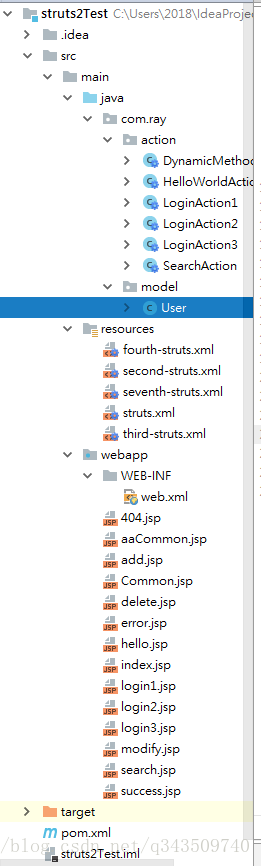
1、项目结构
2、pom.xml
<project xmlns="http://maven.apache.org/POM/4.0.0" xmlns:xsi="http://www.w3.org/2001/XMLSchema-instance"
  xsi:schemaLocation="http://maven.apache.org/POM/4.0.0 http://maven.apache.org/maven-v4_0_0.xsd">
  <modelVersion>4.0.0</modelVersion>
  <groupId>com.ray</groupId>
  <artifactId>struts2Test</artifactId>
  <packaging>war</packaging>
  <version>1.0-SNAPSHOT</version>
  <name>struts2Test Maven Webapp</name>
  <url>http://maven.apache.org</url>

  <dependencies>

    <dependency>
      <groupId>junit</groupId>
      <artifactId>junit</artifactId>
      <version>3.8.1</version>
      <scope>test</scope>
    </dependency>

    <!-- https://mvnrepository.com/artifact/org.apache.struts/struts2-core -->
    <dependency>
      <groupId>org.apache.struts</groupId>
      <artifactId>struts2-core</artifactId>
      <version>2.5.16</version>
    </dependency>

  </dependencies>

  <build>
    <finalName>struts2Test</finalName>
  </build>

</project>
3、web.xml
<web-app xmlns="http://java.sun.com/xml/ns/javaee"
         xmlns:xsi="http://www.w3.org/2001/XMLSchema-instance"
         xsi:schemaLocation="http://java.sun.com/xml/ns/javaee
                      http://java.sun.com/xml/ns/javaee/web-app_3_0.xsd"
         version="3.0" metadata-complete="true">
  <display-name>Archetype Created Web Application</display-name>

  <!-- 过滤所有请求交给Struts2处理 -->
  <filter>
    <filter-name>struts2</filter-name>
    <filter-class>
      org.apache.struts2.dispatcher.filter.StrutsPrepareAndExecuteFilter
    </filter-class>

     <!--action后缀(方法二)-->
    <!--<init-param>-->
      <!--<param-name>struts.action.extension</param-name>-->
      <!--<param-value>ray</param-value>-->
    <!--</init-param>-->
  </filter>

  <filter-mapping>
    <filter-name>struts2</filter-name>
    <url-pattern>/*</url-pattern>
  </filter-mapping>

</web-app>
4、User.java
package com.ray.model;

/**
 * Created by Ray on 2018/3/26 0026.
 **/
public class User {

    private String username;
    private String password;

    public String getUsername() {
        return username;
    }

    public void setUsername(String username) {
        this.username = username;
    }

    public String getPassword() {
        return password;
    }

    public void setPassword(String password) {
        this.password = password;
    }
}
5、LoginAction1.java
package com.ray.action;

import com.opensymphony.xwork2.ActionSupport;

/**
 * Created by Ray on 2018/3/26 0026.
 * 方式一:使用Action的属性接收参数
 **/
public class LoginAction1 extends ActionSupport {

    private String username;
    private String password;

    public String getUsername() {
        return username;
    }

    public void setUsername(String username) {
        this.username = username;
    }

    public String getPassword() {
        return password;
    }

    public void setPassword(String password) {
        this.password = password;
    }

    public String login(){
        System.out.println("username = " + username);
        System.out.println("password = " + password);

        return SUCCESS;
    }
}
6、LoginAction2.java
package com.ray.action;

import com.opensymphony.xwork2.ActionSupport;
import com.ray.model.User;

/**
 * Created by Ray on 2018/3/26 0026.
 * 方式二:使用Domain Model接收参数
 **/
public class LoginAction2 extends ActionSupport {

    private User user;

    public User getUser() {
        return user;
    }

    public void setUser(User user) {
        this.user = user;
    }

    public String login(){
        System.out.println("username = " + user.getUsername());
        System.out.println("password = " + user.getPassword());

        return SUCCESS;
    }
}
7、LoginAction3.java
package com.ray.action;

import com.opensymphony.xwork2.ActionSupport;
import com.opensymphony.xwork2.ModelDriven;
import com.ray.model.User;

/**
 * Created by Ray on 2018/3/26 0026.
 * 方式三:使用ModelDriven接收参数
 **/
public class LoginAction3 extends ActionSupport implements ModelDriven<User>{

    private User user = new User();

    public User getModel() {
        return user;
    }

    public String login(){
        System.out.println("username = " + user.getUsername());
        System.out.println("password = " + user.getPassword());

        return SUCCESS;
    }
}
8、seventh-struts.xml
<?xml version="1.0" encoding="UTF-8"?>

<!DOCTYPE struts PUBLIC
        "-//Apache Software Foundation//DTD Struts Configuration 2.5//EN"
        "http://struts.apache.org/dtds/struts-2.5.dtd">

<struts>

    <package name="login1" extends="struts-default" namespace="/">
        <action name="login1" class="com.ray.action.LoginAction1" method="login">
            <result>/success.jsp</result>
        </action>
    </package>

    <package name="login2" extends="struts-default" namespace="/">
        <action name="login2" class="com.ray.action.LoginAction2" method="login">
            <result>/success.jsp</result>
        </action>
    </package>

    <package name="login3" extends="struts-default" namespace="/">
        <action name="login3" class="com.ray.action.LoginAction3" method="login">
            <result>/success.jsp</result>
        </action>
    </package>
</struts>
9、struts.xml
<?xml version="1.0" encoding="UTF-8"?>

<!DOCTYPE struts PUBLIC
        "-//Apache Software Foundation//DTD Struts Configuration 2.5//EN"
        "http://struts.apache.org/dtds/struts-2.5.dtd">

<struts>

    <!-- action后缀(方法一) -->
    <!--<constant name="struts.action.extension" value="ra"/>-->

    <package name="default" namespace="/" extends="struts-default">
        <!-- 默认action -->
        <default-action-ref name="404"/>
        <action name="404">
            <result>/404.jsp</result>
        </action>

        <action name="helloWorld" class="com.ray.action.HelloWorldAction">
            <result name="success">/success.jsp</result>
        </action>

    </package>

    <include file="second-struts.xml"/>
    <include file="third-struts.xml"/>
    <include file="fourth-struts.xml"/>
    <include file="seventh-struts.xml"/>
</struts>
10、login1.jsp
<%@ taglib prefix="s" uri="/struts-tags" %>
<%@ page language="java" import="java.util.*" pageEncoding="UTF-8" %>
<%
    String path = request.getContextPath();
    String basePath = request.getScheme() + "://" + request.getServerName() + ":" + request.getServerPort() + path + "/";
%>

<!DOCTYPE HTML PUBLIC "-//W3C//DTD HTML 4.01 Transitional//EN">
<html>
<head>
    <base href="<%=basePath%>">

    <title>用户登录1</title>

    <meta http-equiv="pragma" content="no-cache">
    <meta http-equiv="cache-control" content="no-cache">
    <meta http-equiv="expires" content="0">
    <meta http-equiv="keywords" content="keyword1,keyword2,keyword3">
    <meta http-equiv="description" content="This is my page">
    <!--
	<link rel="stylesheet" type="text/css" href="styles.css">
	-->

</head>

<body>
    <s:form action="login1" method="POST">
        <s:textfield label="用户名:" name="username"/><br>
        <s:password label="密码:" name="password"/><br>
        <s:submit label="登录"/><s:reset label="重置"/>
    </s:form>
</body>
</html>
11、login2.jsp
<%@ taglib prefix="s" uri="/struts-tags" %>
<%@ page language="java" import="java.util.*" pageEncoding="UTF-8" %>
<%
    String path = request.getContextPath();
    String basePath = request.getScheme() + "://" + request.getServerName() + ":" + request.getServerPort() + path + "/";
%>

<!DOCTYPE HTML PUBLIC "-//W3C//DTD HTML 4.01 Transitional//EN">
<html>
<head>
    <base href="<%=basePath%>">

    <title>用户登录2</title>

    <meta http-equiv="pragma" content="no-cache">
    <meta http-equiv="cache-control" content="no-cache">
    <meta http-equiv="expires" content="0">
    <meta http-equiv="keywords" content="keyword1,keyword2,keyword3">
    <meta http-equiv="description" content="This is my page">
    <!--
	<link rel="stylesheet" type="text/css" href="styles.css">
	-->

</head>

<body>
    <s:form action="login2" method="POST">
        <s:textfield label="用户名:" name="user.username"/><br>
        <s:password label="密码:" name="user.password"/><br>
        <s:submit label="登录"/><s:reset label="重置"/>
    </s:form>
</body>
</html>
12、login3.jsp
<%@ taglib prefix="s" uri="/struts-tags" %>
<%@ page language="java" import="java.util.*" pageEncoding="UTF-8" %>
<%
    String path = request.getContextPath();
    String basePath = request.getScheme() + "://" + request.getServerName() + ":" + request.getServerPort() + path + "/";
%>

<!DOCTYPE HTML PUBLIC "-//W3C//DTD HTML 4.01 Transitional//EN">
<html>
<head>
    <base href="<%=basePath%>">

    <title>用户登录3</title>

    <meta http-equiv="pragma" content="no-cache">
    <meta http-equiv="cache-control" content="no-cache">
    <meta http-equiv="expires" content="0">
    <meta http-equiv="keywords" content="keyword1,keyword2,keyword3">
    <meta http-equiv="description" content="This is my page">
    <!--
	<link rel="stylesheet" type="text/css" href="styles.css">
	-->

</head>

<body>
    <s:form action="login3" method="POST">
        <s:textfield label="用户名:" name="username"/><br>
        <s:password label="密码:" name="password"/><br>
        <s:submit label="登录"/><s:reset label="重置"/>
    </s:form>
</body>
</html>
13、success.jsp
<%@ page language="java" import="java.util.*" pageEncoding="UTF-8" %>
<%
    String path = request.getContextPath();
    String basePath = request.getScheme() + "://" + request.getServerName() + ":" + request.getServerPort() + path + "/";
%>

<!DOCTYPE HTML PUBLIC "-//W3C//DTD HTML 4.01 Transitional//EN">
<html>
<head>
    <base href="<%=basePath%>">

    <title>success.jsp</title>

    <meta http-equiv="pragma" content="no-cache">
    <meta http-equiv="cache-control" content="no-cache">
    <meta http-equiv="expires" content="0">
    <meta http-equiv="keywords" content="keyword1,keyword2,keyword3">
    <meta http-equiv="description" content="This is my page">
    <!--
	<link rel="stylesheet" type="text/css" href="styles.css">
	-->

</head>

<body>
    Hello World~
    登录成功
</body>
</html>
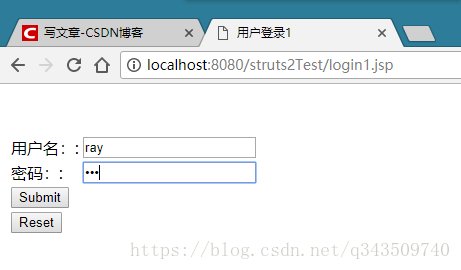
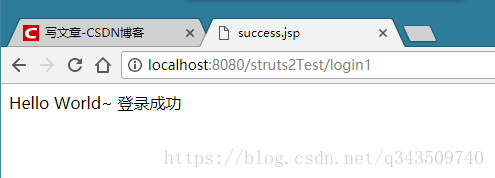
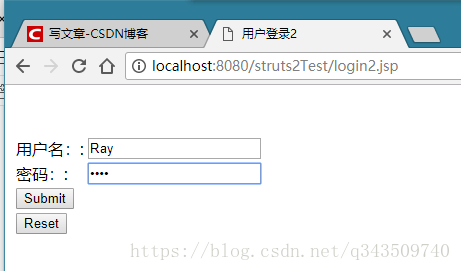
14、页面效果
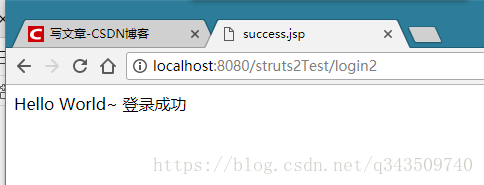
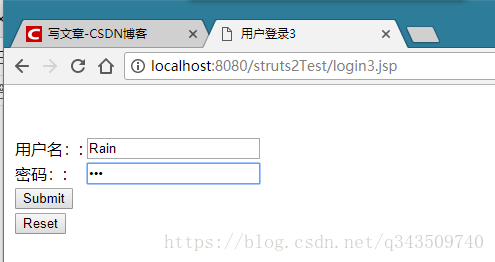
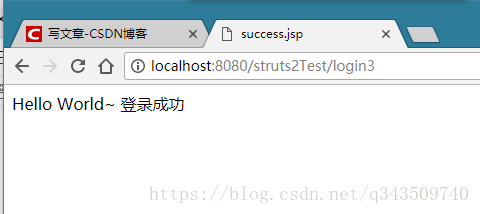
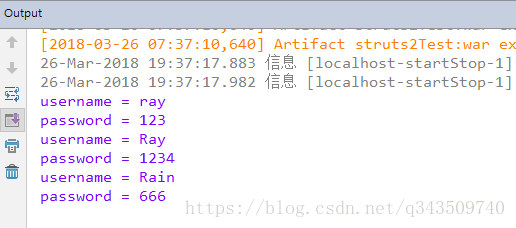
ok!
第七篇——Struts2的接收参数的更多相关文章
- 学习笔记之Struts2—浅析接收参数
最近自己通过视频与相关书籍的学习,对action里面接收参数做一些总结与自己的理解. 0.0.接收参数的(主要)方法 使用Action的属性接收参数 使用DomainModel接收参数 使用Mod ...
- struts2 Action 接收参数的三种方法
刚学Struts2 时 大家可能遇到过很多问题,这里我讲一下Action 接收参数的三种方法,我曾经在这上面摔过一回.所以要警醒一下自己..... 第一种:Action里声明属性,样例:account ...
- Request 接收参数乱码原理解析三:实例分析
通过前面两篇<Request 接收参数乱码原理解析一:服务器端解码原理>和<Request 接收参数乱码原理解析二:浏览器端编码原理>,了解了服务器和浏览器编码解码的原理,接下 ...
- Request 接收参数乱码原理解析二:浏览器端编码原理
上一篇<Request 接收参数乱码原理解析一:服务器端解码原理>,分析了服务器端解码的过程,那么浏览器是根据什么编码的呢? 1. 浏览器解码 浏览器根据服务器页面响应Header中的“C ...
- struts2接收参数——域模型、DTO
在开始介绍域模型之前我们要明白一点,为什么通过域模型我们可以把参数这么方便的在后台接收. 那是因为 通过参数拦截器(params interceptor)自动的把前台传过来的参数给域对象(domain ...
- Struts2之Action三种接收参数形式与简单的表单验证
有了前几篇的基础,相信大家对于Struts2已经有了一个很不错的认识,本篇我将为大家介绍一些关于Action接收参数的三种形式,以及简单的表单验证实现,下面进入正题,首先我们一起先来了解一下最基本的A ...
- Struts2(四)Action一接收参数
一.属性接收参数并输出 导入struts2的包,导入需要的包 和struts.xml配置文件 <?xml version="1.0" encoding="UTF-8 ...
- Struts2中Action接收参数的四种形式
1.Struts2的Action接收参数的三种形式. a. 使用Action的属性接收(直接在action中利用get方法来接收参数): login.js ...
- Struts2 DomainModel、ModelDriven接收参数
一.DomainModel(域模型) 1. 应用场景:一般我们在struts2的action中接收参数通常是如下方式 package cn.orlion.user; import com.opensy ...
随机推荐
- python定义函数时,形参前加*和**的意义
转发:https://blog.csdn.net/qq_34806812/article/details/82017839 1.加*表示接受一个tuple类型(元组),如: 2.加**表示接受一个di ...
- Ubuntu系统监控indicator-sysmonitor
参考: http://www.cnblogs.com/EasonJim/p/7130171.html 安装indicator-sysmonitor sudo add-apt-repository pp ...
- jenkins 登录远程机器并执行脚本,脚本中有后台执行的程序无法执行解决方法。
jenkins构建shell执行配置 在远程shell脚本中,需要后台执行的命令需要以$( )括起来
- [转]解决Error: That port is already in use.
ubuntu系统下,运行一个django项目,即输入python manage.py runserver后,可能出现 Error: That port is already in use.的错误. 即 ...
- [原]获取openstack-pike安装包
linux version: CentOS 7.5.1804 #进入仓库配置目录 cd /etc/yum.repo.d/ #批量重命名所有文件 for files in `ls *`; do mv $ ...
- PHP 高效导入导出Excel(csv)方法之fgetcsv()和fputcsv()函数
CSV,是Comma Separated Value(逗号分隔值)的英文缩写,通常都是纯文本文件. 一.CSV数据导入函数fgetcsv() fgetcsv() 函数从文件指针中读入一行并解析 CSV ...
- 我的C语言编程风格
前几天看别人的代码,真是的看的头昏脑涨,基本没有注释.乱起的变量名字,还要费尽心思去解读作者的意思.突然感觉高效的程序注释说明和良好的编程风格是多么的重要. 为了不让别人在看到我的代码时在背后骂我,也 ...
- nodejs electron 创建桌面应用
//首先安装cnpm npm install -g cnpm --registry=https://registry.npm.taobao.org //使用cnpm进行安装,使用方法和npm相同 cn ...
- [LeetCode] Group Anagrams 群组错位词
Given an array of strings, group anagrams together. Example: Input: ["eat", "tea" ...
- 【Java线程安全】锁
Java都有哪些锁? synchronized 和 reentranlock是最常见的,其中前者又JVM提供实现,后者有专门对应的java.util.concurrent包提供:同时后者功能更加丰富. ...