
MessagePack 学习笔记
封装和解析类似json的 key-value 示例
{"ID" = 333,"name"="zds","3333"="ende"}
    msgpack::sbuffer sBuf;

    msgpack::packer<msgpack::sbuffer> pker(&sBuf);

    pker.pack_map();

    pker.pack(std::string("ID"));

    pker.pack();

    pker.pack(std::string("name"));

    pker.pack(std::string("zds"));

    pker.pack(std::string(""));

    pker.pack(std::string("ende"));

    //unserilized

    msgpack::unpacked unpack;

    msgpack::unpack(unpack, sBuf.data(), sBuf.size());

    msgpack::object obj = unpack.get();

    std::cout << obj << std::endl;

    if (obj.type == msgpack::type::ARRAY)

        std::cout << "是array" << std::endl;

    else if (obj.type == msgpack::type::MAP)

        std::cout << "是map" << std::endl;

    if(obj.via.map.size > )

    {

        auto pkv = obj.via.map.ptr;

        auto pkv_end = obj.via.map.ptr + obj.via.map.size;

        do

        {

            auto key = pkv->key;

            auto val = pkv->val;

            std::cout << "key:" << key << " value:" << val << std::endl;

            ++pkv;

        } while (pkv < pkv_end);

    }
解析Socket示例
各类数据结构:
msgpack::object 他是一个引用,拷贝他的代价少,因为他是浅拷贝
msgpack::object_handle 他管理了一个对象的生命周期。他如果释放了,所有从他生成的object都是无效的引用
解析Socket示例
下列代码解析socke收包数据
unpacker.reserve_buffer 分配要收的数据的内存字节数
unpacker..buffer() 返回数据地址
unpacker.buffer_consumed() 设置实际收到的数据
unpacker.next(object_handle& oh) 循环解析数据
int main() {

    boost::asio::io_service ios;

    std::uint16_t const port = ;

    // Server

    std::size_t const window_size = ;

    boost::asio::ip::tcp::acceptor ac(ios, boost::asio::ip::tcp::endpoint(boost::asio::ip::tcp::v4(), port));

    boost::asio::ip::tcp::socket ss(ios);

    std::function<void()> do_accept;

    std::function<void()> do_async_read_some;

    msgpack::unpacker unp;

    do_accept = [&] {

        ac.async_accept(

            ss,

            [&]

            (boost::system::error_code const& e) {

                if (e) {

                    std::cout << __LINE__ << ":" << e.message() << std::endl;

                    return;

                }

                unp.reserve_buffer(window_size);

                do_async_read_some = [&] {

                    ss.async_read_some(

                        boost::asio::buffer(unp.buffer(), window_size),

                        [&](boost::system::error_code const& e, std::size_t bytes_transferred) {

                            if (e) {

                                std::cout << __LINE__ << ":" << e.message() << std::endl;

                                return;

                            }

                            std::cout << bytes_transferred << " bytes read." << std::endl;

                            unp.buffer_consumed(bytes_transferred);

                            msgpack::object_handle oh;

                            while (unp.next(oh)) {

                                std::cout << oh.get() << std::endl;

                                // In order to finish the program,

                                // return if one complete msgpack is processed.

                                // In actual server, don't return here.

                                return;

                            }

                            do_async_read_some();

                        }

                    );

                };

                do_async_read_some();

            }

        );

    };

    do_accept();

    // Client

    auto host = "localhost";

    boost::asio::ip::tcp::resolver r(ios);

    boost::asio::ip::tcp::resolver::query q(host, boost::lexical_cast<std::string>(port));

    auto it = r.resolve(q);

    boost::asio::ip::tcp::socket cs(ios);

    boost::asio::async_connect(

        cs,

        it,

        [&]

        (boost::system::error_code const& e, boost::asio::ip::tcp::resolver::iterator) {

            if (e) {

                std::cout << __LINE__ << ":" << e.message() << std::endl;

                return;

            }

            std::cout << __LINE__ << ":client connected" << std::endl;

            msgpack::sbuffer sb;

            msgpack::pack(sb, std::make_tuple(, false, "hello world", 12.3456));

            write(cs, boost::asio::buffer(sb.data(), sb.size()));

        }

    );

    // Start

    ios.run();

}
详解:
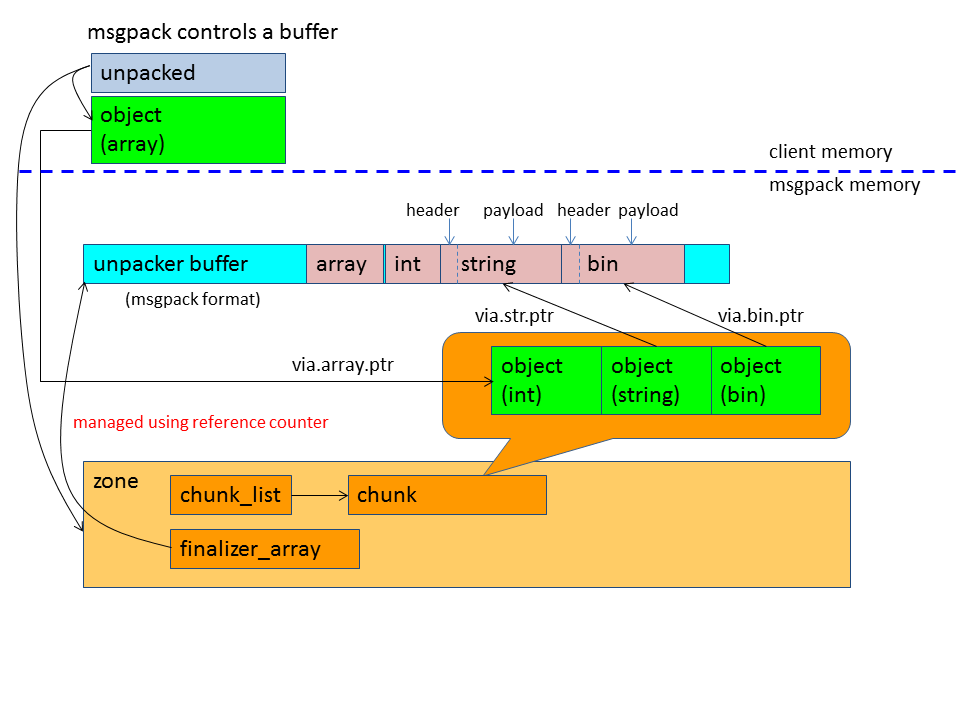
msgpack controls a buffer
msgpack provides a buffer management functionality named msgpack::unpacker. msgpack::unpacker is sutable for the following motivations:
- msgpack data is chopped, and the client doesn't know when it will complete. This is a typical situation when you develop streaming applications.
- You want to minimize copy opperations without careful memory management.
Here is the basic (not all) interface of msgpack::unpacker:
#ifndef MSGPACK_UNPACKER_INIT_BUFFER_SIZE

#define MSGPACK_UNPACKER_INIT_BUFFER_SIZE (64*1024)

#endif

#ifndef MSGPACK_UNPACKER_RESERVE_SIZE

#define MSGPACK_UNPACKER_RESERVE_SIZE (32*1024)

#endif

class unpacker {

public:

    unpacker(unpack_reference_func f = &unpacker::default_reference_func,

             void* user_data = nullptr,

             std::size_t init_buffer_size = MSGPACK_UNPACKER_INIT_BUFFER_SIZE,

             unpack_limit const& limit = unpack_limit());

    void reserve_buffer(std::size_t size = MSGPACK_UNPACKER_RESERVE_SIZE);

    char* buffer();

    void buffer_consumed(std::size_t size);

    bool next(unpacked& result);

};
Here is a basic pattern using msgpack::unpacker:
// The size may decided by receive performance, transmit layer's protocol and so on.

std::size_t const try_read_size = 100;

msgpack::unpacker unp;

// Message receive loop

while (/* block until input becomes readable */) {

    unp.reserve_buffer(try_read_size);

    // unp has at least try_read_size buffer on this point.

    // input is a kind of I/O library object.

    // read message to msgpack::unpacker's internal buffer directly.

    std::size_t actual_read_size = input.readsome(unp.buffer(), try_read_size);

    // tell msgpack::unpacker actual consumed size.

    unp.buffer_consumed(actual_read_size);

    msgpack::unpacked result;

    // Message pack data loop

    while(unp.next(result)) {

        msgpack::object obj(result.get());

        // Use obj

    }

    // All complete msgpack message is proccessed at this point,

    // then continue to read addtional message.

}
msgpack::unpacker::next() returns true if one complete msgpack messege is proccessed. If msgpack message is correct but insufficient, it returns false. However, parsing proccess is proceeded and the context information is preserved in the msgpack::unpacker. It helps leveling the load of parse.
When msgpack message contains binary data, string data, or ext data, they are not copied but referenced from msgpack::object by default. See the following implementation:
inline bool unpacker::default_reference_func(type::object_type type, uint64_t len, void*)

{

    return true;

}
You can also customize unpack_reference_func. Even if you use references, you don't need to control buffer's lifetime. The buffers' lifetime is controled by msgpack using msgpack::zone's finalizer_array and msgpack::unpacker's reference counting mechanism.
So, in most cases, the default behavior is enough. If you want to control the peak of memory consumption when receiving msgpack data patterns are predictable, customizing unpack_reference_func might be useful.
You can get a reference information from msgpack::unpacker::next() using the following function:
bool next(unpacked& result, bool& referenced);
However, mostly you don't need to use that version of next() because referenced memories are managed by unpacker.
MessagePack 学习笔记的更多相关文章
- js学习笔记:webpack基础入门(一)
之前听说过webpack,今天想正式的接触一下,先跟着webpack的官方用户指南走: 在这里有: 如何安装webpack 如何使用webpack 如何使用loader 如何使用webpack的开发者 ...
- PHP-自定义模板-学习笔记
1. 开始 这几天,看了李炎恢老师的<PHP第二季度视频>中的“章节7:创建TPL自定义模板”,做一个学习笔记,通过绘制架构图.UML类图和思维导图,来对加深理解. 2. 整体架构图 ...
- PHP-会员登录与注册例子解析-学习笔记
1.开始 最近开始学习李炎恢老师的<PHP第二季度视频>中的“章节5:使用OOP注册会员”,做一个学习笔记,通过绘制基本页面流程和UML类图,来对加深理解. 2.基本页面流程 3.通过UM ...
- 2014年暑假c#学习笔记目录
2014年暑假c#学习笔记 一.C#编程基础 1. c#编程基础之枚举 2. c#编程基础之函数可变参数 3. c#编程基础之字符串基础 4. c#编程基础之字符串函数 5.c#编程基础之ref.ou ...
- JAVA GUI编程学习笔记目录
2014年暑假JAVA GUI编程学习笔记目录 1.JAVA之GUI编程概述 2.JAVA之GUI编程布局 3.JAVA之GUI编程Frame窗口 4.JAVA之GUI编程事件监听机制 5.JAVA之 ...
- seaJs学习笔记2 – seaJs组建库的使用
原文地址:seaJs学习笔记2 – seaJs组建库的使用 我觉得学习新东西并不是会使用它就够了的,会使用仅仅代表你看懂了,理解了,二不代表你深入了,彻悟了它的精髓. 所以不断的学习将是源源不断. 最 ...
- CSS学习笔记
CSS学习笔记 2016年12月15日整理 CSS基础 Chapter1 在console输入escape("宋体") ENTER 就会出现unicode编码 显示"%u ...
- HTML学习笔记
HTML学习笔记 2016年12月15日整理 Chapter1 URL(scheme://host.domain:port/path/filename) scheme: 定义因特网服务的类型,常见的为 ...
- DirectX Graphics Infrastructure(DXGI):最佳范例 学习笔记
今天要学习的这篇文章写的算是比较早的了,大概在DX11时代就写好了,当时龙书11版看得很潦草,并没有注意这篇文章,现在看12,觉得是跳不过去的一篇文章,地址如下: https://msdn.micro ...
随机推荐
- JavaScript Math和Number对象研究
1. Math 对象 1.1 介绍 Math 对象,是数学对象,提供对数据的数学计算,如:获取绝对值.向上取整等.无构造函数,无法被初始化,只提供静态属性和方法. 1.2 构造函数 无 : ...
- LigerUI之Grid使用详解(一)——显示数据
目录: 一.概述 二.Grid使用步骤 三.使用Grid展示数据 四.源码下载 一.概述 在开发web信息管理系统时,使用Web前端框架可以帮助我们快速搭建一组风格统一的界面效果,而且能够解决大多数浏 ...
- Pycharm安装详细教程
今天小编给大家分享如何在本机上下载和安装Pycharm,具体的教程如下: 1.首先去Pycharm官网,或者直接输入网址:http://www.jetbrains.com/pycharm/downlo ...
- TensorFlow实战12:Bidirectional LSTM Classifier
https://blog.csdn.net/felaim/article/details/70300362 1.双向递归神经网络简介 双向递归神经网络(Bidirectional Recurrent ...
- 基于双向LSTM和迁移学习的seq2seq核心实体识别
http://spaces.ac.cn/archives/3942/ 暑假期间做了一下百度和西安交大联合举办的核心实体识别竞赛,最终的结果还不错,遂记录一下.模型的效果不是最好的,但是胜在“端到端”, ...
- java 从网络Url中下载文件 (转)
http://blog.csdn.net/xb12369/article/details/40543649/ /** * 从网络Url中下载文件 * @param urlStr ...
- Java归去来第4集:java实战之Eclipse中创建Maven类型的SSM项目
一.前言 如果还不了解剧情,请返回第3集的剧情 Java归去来第3集:Eclipse中给动态模块升级 二.在Eclipse中创建Maven类型的SSM项目 2.1:SSM简介 SSM ...
- 如何将.NET 4.0写的Windows service和Web API部署到docker上面
Web API. 看这篇文章: https://docs.microsoft.com/en-us/aspnet/mvc/overview/deployment/docker-aspnetmvc Win ...
- OpenGL ES 3.0片段着色器(四)
片段着色器流程图 片段着色器(fragment shader)实现了一个通用的可编程操作片段的方法.片段着色器执行由 光栅化生成的每个片段. • Shader program(着色器程序)—片段着色器 ...
- Virtualbox安装Ubuntu
每次安装虚拟机都是总要折腾一下,毕竟不是特别熟悉,几个小细节总要google半天,为了以后能愉快的玩耍.把这些问题都记录下来,免得再折腾. 此文档都来自其他人的文章,我保存在Evernote整理. 网 ...