
MyBatis基础:MyBatis数据基本操作(2)
1. MyBatis映射器
2. MyBatis数据基本操作
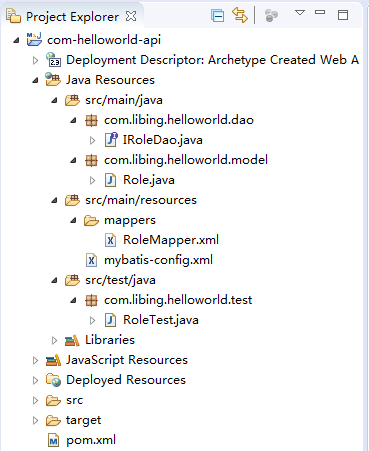
示例项目结构:
<project xmlns="http://maven.apache.org/POM/4.0.0" xmlns:xsi="http://www.w3.org/2001/XMLSchema-instance"

    xsi:schemaLocation="http://maven.apache.org/POM/4.0.0 http://maven.apache.org/maven-v4_0_0.xsd">

    <modelVersion>4.0.0</modelVersion>

    <groupId>libing</groupId>

    <artifactId>com-helloworld-api</artifactId>

    <packaging>war</packaging>

    <version>0.0.1-SNAPSHOT</version>

    <name>com-helloworld-api Maven Webapp</name>

    <url>http://maven.apache.org</url>

    <properties>

        <project.build.sourceEncoding>UTF-8</project.build.sourceEncoding>

        <project.reporting.outputEncoding>UTF-8</project.reporting.outputEncoding>

        <java.version>1.8</java.version>

    </properties>

    <dependencies>

        <dependency>

            <groupId>mysql</groupId>

            <artifactId>mysql-connector-java</artifactId>

            <version>5.1.43</version>

        </dependency>

        <dependency>

            <groupId>org.mybatis</groupId>

            <artifactId>mybatis</artifactId>

            <version>3.4.5</version>

        </dependency>

        <dependency>

            <groupId>junit</groupId>

            <artifactId>junit</artifactId>

            <version>4.12</version>

            <scope>test</scope>

        </dependency>

        <dependency>

            <groupId>javax.servlet</groupId>

            <artifactId>javax.servlet-api</artifactId>

            <version>4.0.0-b07</version>

            <scope>provided</scope>

        </dependency>

    </dependencies>

    <build>

        <finalName>com-helloworld-api</finalName>

        <plugins>

            <plugin>

                <groupId>org.apache.maven.plugins</groupId>

                <artifactId>maven-compiler-plugin</artifactId>

                <version>3.6.2</version>

                <configuration>

                    <source>1.8</source>

                    <target>1.8</target>

                </configuration>

            </plugin>

        </plugins>

    </build>

</project>
pom.xml
<?xml version="1.0" encoding="UTF-8"?>

<!DOCTYPE configuration PUBLIC "-//mybatis.org//DTD Config 3.0//EN" "http://mybatis.org/dtd/mybatis-3-config.dtd">

<configuration>

    <environments default="development">

        <environment id="development">

            <transactionManager type="JDBC" />

            <dataSource type="POOLED">

                <property name="driver" value="com.mysql.jdbc.Driver" />

                <property name="url" value="jdbc:mysql://localhost:3306/helloworld?characterEncoding=utf-8" />

                <property name="username" value="root" />

                <property name="password" value="root" />

            </dataSource>

        </environment>

    </environments>

    <mappers>

        <mapper resource="mappers/RoleMapper.xml" />

    </mappers>

</configuration>
mybatis-config.xml
package com.libing.helloworld.model;

public class Role {

    private Integer id;

    private String roleName;

    public Integer getId() {

        return id;

    }

    public void setId(Integer id) {

        this.id = id;

    }

    public String getRoleName() {

        return roleName;

    }

    public void setRoleName(String roleName) {

        this.roleName = roleName;

    }

}
Role.java
<?xml version="1.0" encoding="UTF-8"?>

<!DOCTYPE mapper PUBLIC "-//mybatis.org//DTD Mapper 3.0//EN" "http://mybatis.org/dtd/mybatis-3-mapper.dtd">

<mapper namespace="com.libing.helloworld.dao.IRoleDao">

    <resultMap id="baseResultMap" type="com.libing.helloworld.model.Role">

        <id property="id" column="id" />

        <result property="roleName" column="role_name" />

    </resultMap>

    <select id="findAll" resultMap="baseResultMap">

        SELECT

            id,

            role_name

        FROM

            role

        ORDER BY id ASC

    </select>

    <select id="findBySearchText" resultMap="baseResultMap">

        SELECT

            id,

            role_name

        FROM

            role

        WHERE

            role_name LIKE CONCAT(CONCAT('%',#{searchText,jdbcType=VARCHAR}),'%')

        ORDER BY id ASC

    </select>

    <select id="findById" resultMap="baseResultMap">

        SELECT

            id,

            role_name

        FROM

            role

        WHERE id = #{id}

    </select>

    <insert id="insert" useGeneratedKeys="true" keyProperty="id" parameterType="com.libing.helloworld.model.Role">

        INSERT role

        (

            role_name

        )

        VALUES

        (

            #{roleName}

        )

    </insert>

    <update id="update" parameterType="com.libing.helloworld.model.Role">

        UPDATE role

        SET

            role_name=#{roleName}

        WHERE

            id = #{id}

    </update>

    <delete id="deleteById">

        DELETE FROM role

        WHERE

            id = #{id}

    </delete>

    <delete id="deleteByIds" parameterType="java.util.List">

        DELETE FROM role

        WHERE

            id IN

        <foreach collection="list" index="index" item="item" open="(" separator="," close=")">

            #{item}

        </foreach>

    </delete>

</mapper>
RoleMapper.xml
package com.libing.helloworld.test;

import java.io.InputStream;

import java.util.ArrayList;

import java.util.List;

import org.apache.ibatis.session.SqlSession;

import org.apache.ibatis.session.SqlSessionFactory;

import org.apache.ibatis.session.SqlSessionFactoryBuilder;

import org.junit.Assert;

import org.junit.Before;

import org.junit.Test;

import com.libing.helloworld.dao.IRoleDao;

import com.libing.helloworld.model.Role;

public class RoleTest {

    SqlSession sqlSession = null;

    @Before

    public void init() {

        String resource = "mybatis-config.xml";

        InputStream inputStream = RoleTest.class.getClassLoader().getResourceAsStream(resource);

        SqlSessionFactory sqlSessionFactory = new SqlSessionFactoryBuilder().build(inputStream);

        sqlSession = sqlSessionFactory.openSession();

    }

    @Test

    public void findAll() {

        try {

            IRoleDao roleDao = sqlSession.getMapper(IRoleDao.class);

            List<Role> roles = roleDao.findAll();

            Assert.assertNotNull(roles);

            Assert.assertTrue(roles.size() > 0);

        } catch (Exception e) {

            e.printStackTrace();

        } finally {

            sqlSession.close();

        }

    }

    @Test

    public void findById() {

        try {

            IRoleDao roleDao = sqlSession.getMapper(IRoleDao.class);

            Role role = roleDao.findById(1);

            Assert.assertNotNull(role);

            Assert.assertNotNull(role.getRoleName());

        } catch (Exception e) {

            e.printStackTrace();

        } finally {

            sqlSession.close();

        }

    }

    @Test

    public void insert() {

        try {

            IRoleDao roleDao = sqlSession.getMapper(IRoleDao.class);

            Role role = new Role();

            role.setRoleName("测试");

            int result = roleDao.insert(role);

            // 只插入一条记录

            Assert.assertEquals(1, result);

            // id不为null

            Assert.assertNotNull(role.getId());

        } catch (Exception e) {

            e.printStackTrace();

        } finally {

            sqlSession.rollback();

            sqlSession.close();

        }

    }

    public void Update() {

        try {

            IRoleDao roleDao = sqlSession.getMapper(IRoleDao.class);

            Role role = roleDao.findById(1);

            Assert.assertNotNull(role);

            role.setRoleName("测试");

            int result = roleDao.update(role);

            // 只修改一条记录

            Assert.assertEquals(1, result);

            // 修改后的值

            Assert.assertEquals("测试", roleDao.findById(1).getRoleName());

        } catch (Exception e) {

            e.printStackTrace();

        } finally {

            sqlSession.rollback();

            sqlSession.close();

        }

    }

    @Test

    public void deleteById() {

        try {

            IRoleDao roleDao = sqlSession.getMapper(IRoleDao.class);

            Assert.assertNotNull(roleDao.findById(1));

            // 调用删除方法

            Assert.assertEquals(1, roleDao.deleteById(1));

            // 再次查询,判断是否为null

            Assert.assertNull(roleDao.findById(1));

        } catch (Exception e) {

            e.printStackTrace();

        } finally {

            // 由于sqlSessionFactory.openSession()是不自动提交的,不手动执行sqlSession.commit()不会提交到数据库

            sqlSession.rollback();

            sqlSession.close();

        }

    }

    @Test

    public void deleteByIds() {

        try {

            List<Integer> ids = new ArrayList<Integer>();

            ids.add(1);

            ids.add(2);

            IRoleDao roleDao = sqlSession.getMapper(IRoleDao.class);

            int result = roleDao.deleteByIds(ids);

            Assert.assertTrue(result > 0);

        } catch (Exception e) {

            e.printStackTrace();

        } finally {

            sqlSession.rollback();

            sqlSession.close();

        }

    }

}
RoleTest.java
package com.libing.helloworld.dao;

import java.util.List;

import org.apache.ibatis.annotations.Delete;

import org.apache.ibatis.annotations.Insert;

import org.apache.ibatis.annotations.Options;

import org.apache.ibatis.annotations.Param;

import org.apache.ibatis.annotations.Result;

import org.apache.ibatis.annotations.Results;

import org.apache.ibatis.annotations.Select;

import org.apache.ibatis.annotations.SelectKey;

import org.apache.ibatis.annotations.Update;

import com.libing.helloworld.model.Role;

public interface IRoleDao {

    @Select("SELECT id,role_name FROM role")

    @Results( value = {

        @Result(id = true, property = "id", column = "id"),

        @Result(property="roleName", column="role_name")

    })

    List<Role> findAll();

    @Select("SELECT id,role_name FROM role WHERE role_name LIKE CONCAT(CONCAT('%',#{searchText}),'%')")

    @Results( value = {

        @Result(id = true, property = "id", column = "id"),

        @Result(property="roleName", column="role_name")

    })

    List<Role> findBySearchText(@Param("searchText") String searchText);

    @Select("SELECT id,role_name FROM role WHERE id = #{id}")

    @Results( value = {

        @Result(id = true, property = "id", column = "id"),

        @Result(property="roleName", column="role_name")

    })

    Role findById(Integer id);

    @Insert({

        "INSERT INTO role(id,role_name)",

        " VALUES ",

        "(#{id}, #{roleName})"

    })

    @Options(useGeneratedKeys = true, keyProperty = "id")

    @SelectKey(statement="select last_insert_id()", keyProperty = "id", before = false, resultType = int.class)

    int insert(Role role);

    @Update({

        "UPDATE role SET ",

        "role_name = #{roleName} ",

        "WHERE id = #{id}"

    })

    int update(Role role);

    @Delete("DELETE FROM role WHERE id = #{id}")

    int deleteById(Integer id);

    int deleteByIds(List<Integer> ids);

}
IRoleDao.java
2.1 select
基于XML方式:
<resultMap id="baseResultMap" type="com.libing.helloworld.model.Role">

    <id property="id" column="id" />

    <result property="roleName" column="role_name" />

</resultMap>

<select id="findAll" resultMap="baseResultMap">

    SELECT

        id,

        role_name

    FROM

        role

    ORDER BY id ASC

</select>
基于注解方式:
@Select("SELECT id,role_name FROM role")

@Results( value = {

    @Result(id = true, property = "id", column = "id"),

    @Result(property="roleName", column="role_name")

})

List<Role> findAll();
单元测试:
@Test

public void findAll() {

    try {

        IRoleDao roleDao = sqlSession.getMapper(IRoleDao.class);

        List<Role> roles = roleDao.findAll();

        Assert.assertNotNull(roles);

        Assert.assertTrue(roles.size() > 0);

    } catch (Exception e) {

        e.printStackTrace();

    } finally {

        sqlSession.close();

    }

}
XML中大于符号与小于符号转义:
> >
< <
或使用 <![CDATA[ ]]>
<select id="findAll" resultMap="baseResultMap">
SELECT
id,
role_name
FROM
role
WHERE id >= 10
ORDER BY id ASC
</select>
<select id="findAll" resultMap="baseResultMap">

    SELECT

        id,

        role_name

    FROM

        role

    WHERE id <![CDATA[>=]]> 10

    ORDER BY id ASC

</select>
Role findById(Integer id);
<select id="findById" resultMap="baseResultMap">

    SELECT

        id,

        role_name

    FROM

        role

    WHERE

        id = #{id}

</select>
@Test

public void findById() {

    try {

        IRoleDao roleDao = sqlSession.getMapper(IRoleDao.class);

        Role role = roleDao.findById(1);

        Assert.assertNotNull(role);

        Assert.assertNotNull(role.getRoleName());

    } catch (Exception e) {

        e.printStackTrace();

    } finally {

        sqlSession.close();

    }

}
@Select("SELECT id,role_name FROM role WHERE id = #{id}")

@Results( value = {

    @Result(id = true, property = "id", column = "id"),

    @Result(property="roleName", column="role_name")

})

Role findById(Integer id);
传递多个参数:
1>. 使用Map传递参数
List<Role> findByMap(Map<String, String> params);
<select id="findByMap" parameterType="map" resultMap="baseResultMap">

    SELECT

        id,

        role_name

    FROM

        role

    WHERE

        id != #{id}

    AND

        role_name = #{roleName}

</select>
@Test

public void findByMap() {

    try {

        Map<String, String> params = new HashMap<String, String>();

        params.put("id", "1");

        params.put("roleName", "管理员");

        IRoleDao roleDao = sqlSession.getMapper(IRoleDao.class);

        List<Role> roles = roleDao.findByMap(params);

        Assert.assertNotNull(roles);

        Assert.assertTrue(roles.size() > 0);

    } catch (Exception e) {

        e.printStackTrace();

    } finally {

        sqlSession.close();

    }

}
2>. 使用注解方式传递参数
import org.apache.ibatis.annotations.Param;
List<Role> findByAnnotation(@Param("id") Integer id, @Param("roleName") String roleName);
<select id="findByAnnotation" resultMap="baseResultMap">

    SELECT

      id,

      role_name

    FROM

      role

    WHERE

      id != #{id}

    AND

      role_name = #{roleName}

</select>
3>. 使用JavaBean传递参数
package com.libing.helloworld.params;

public class RoleParam {

    private Integer id;

    private String roleName;

    public Integer getId() {

        return id;

    }

    public void setId(Integer id) {

        this.id = id;

    }

    public String getRoleName() {

        return roleName;

    }

    public void setRoleName(String roleName) {

        this.roleName = roleName;

    }

}
RoleParam.java
List<Role> findByRoleParam(RoleParam params);
<select id="findByRoleParam" parameterType="com.libing.helloworld.params.RoleParam" resultMap="baseResultMap">

    SELECT

        id,

        role_name

    FROM

        role

    WHERE

        id != #{id}

    AND

        role_name = #{roleName}

</select>
传递多个参数总结:
◊ 使用Map方式:Map扩展和维护困难,在实际应用中废弃这种传递参数方式。
◊ 使用@Param注解方式:参数个数<=5时是最佳的传参方式。
◊ JavaBean方式:当参数个数大于5个时,建议使用JavaBean方式。
2.2 insert
MyBatis在执行Insert语句之后返回一个整数,表示插入的记录数。
int insert(Role role);
<insert id="insert" useGeneratedKeys="true" keyProperty="id" parameterType="com.libing.helloworld.model.Role">

    INSERT role

    (

        role_name

    )

    VALUES

    (

        #{roleName}

    )

</insert>
其中,useGeneratedKeys:配置MyBatis使用JDBC的getGeneratedKeys()来获取由数据库内部生成的主键值,keyProperty:指定主键字段。
@Test

public void insert() {

    try {

        IRoleDao roleDao = sqlSession.getMapper(IRoleDao.class);

        Role role = new Role();

        role.setRoleName("测试");

        int result = roleDao.insert(role);

        // 只插入一条记录

        Assert.assertEquals(1, result);

        // id不为null

        Assert.assertNotNull(role.getId());

    } catch (Exception e) {

        e.printStackTrace();

    } finally {

        sqlSession.rollback();

        sqlSession.close();

    }

}
@Insert({

    "INSERT INTO role(id,role_name)",

    " VALUES ",

    "(#{id}, #{roleName})"

})

@Options(useGeneratedKeys = true, keyProperty = "id")

@SelectKey(statement="select last_insert_id()", keyProperty = "id", before = false, resultType = int.class)

int insert(Role role);
2.3 update
MyBatis在执行update语句之后返回一个整数,表示更新的记录数。
int update(Role role);
<update id="update" parameterType="com.libing.helloworld.model.Role">

    UPDATE role

    SET

        role_name = #{roleName}

    WHERE

        id = #{id}

</update>
@Test

public void Update() {

    try {

        IRoleDao roleDao = sqlSession.getMapper(IRoleDao.class);

        Role role = roleDao.findById(1);

        Assert.assertNotNull(role);

        role.setRoleName("测试");

        int result = roleDao.update(role);

        // 只修改一条记录

        Assert.assertEquals(1, result);

        // 修改后的值

        Assert.assertEquals("测试", roleDao.findById(1).getRoleName());

    } catch (Exception e) {

        e.printStackTrace();

    } finally {

        sqlSession.rollback();

        sqlSession.close();

    }

}
@Update({

    "UPDATE role SET ",

    "role_name = #{roleName} ",

    "WHERE id = #{id}"

})

int update(Role role);
2.4 delete
MyBatis在执行delete语句之后返回一个整数,表示删除的记录数。
int deleteById(Integer id);
<delete id="deleteById">

    DELETE FROM role

    WHERE

        id = #{id}

</delete>
@Test

public void deleteById() {

    try {

        IRoleDao roleDao = sqlSession.getMapper(IRoleDao.class);

        Assert.assertNotNull(roleDao.findById(1));

        // 调用删除方法

        Assert.assertEquals(1, roleDao.deleteById(1));

        // 再次查询,判断是否为null

        Assert.assertNull(roleDao.findById(1));

    } catch (Exception e) {

        e.printStackTrace();

    } finally {

        // 由于sqlSessionFactory.openSession()是不自动提交的,不手动执行sqlSession.commit()不会提交到数据库

        sqlSession.rollback();

        sqlSession.close();

    }

}
@Delete("DELETE FROM role WHERE id = #{id}")

int deleteById(Integer id);
删除多条记录:
int deleteByIds(List<Integer> ids);
<delete id="deleteByIds" parameterType="java.util.List">

    DELETE FROM role

    WHERE

        id IN

    <foreach collection="list" index="index" item="item" open="("

        separator="," close=")">

        #{item}

    </foreach>

</delete>
@Test

public void deleteByIds() {

    try {

        List<Integer> ids = new ArrayList<Integer>();

        ids.add(1);

        ids.add(2);

        IRoleDao roleDao = sqlSession.getMapper(IRoleDao.class);

        int result = roleDao.deleteByIds(ids);

        Assert.assertTrue(result > 0);

    } catch (Exception e) {

        e.printStackTrace();

    } finally {

        sqlSession.rollback();

        sqlSession.close();

    }

}
MyBatis基础:MyBatis数据基本操作(2)的更多相关文章
- MyBatis基础入门《十三》批量新增数据
MyBatis基础入门<十三>批量新增数据 批量新增数据方式1:(数据小于一万) xml文件 接口: 测试方法: 测试结果: =============================== ...
- MyBatis基础入门《十二》删除数据 - @Param参数
MyBatis基础入门<十二>删除数据 - @Param参数 描述: 删除数据,这里使用了@Param这个注解,其实在代码中,不使用这个注解也可以的.只是为了学习这个@Param注解,为此 ...
- MyBatis基础入门《十 一》修改数据
MyBatis基础入门<十 一>修改数据 实体类: 接口类: xml文件: 测试类: 测试结果: 数据库: 如有问题,欢迎纠正!!! 如有转载,请标明源处:https://www.cnbl ...
- MyBatis基础入门《十》添加数据
MyBatis基础入门<十>添加数据 描述: 修改了实体类:TblClient.java,将其字段:cbirthday 由String类型改成了Date类型. TblClient.java ...
- Mybatis入门 Mybatis存在的意义 解决的问题 基本操作
Mybatis入门 Mybatis的作用 解决的问题 基本操作 为什么要学MyBatis 我们链接操作数据库需要做的步骤 package Test; import java.sql.*; public ...
- JAVA之Mybatis基础入门--框架搭建与简单查询
JAVA中,操作数据库有JDBC.hibernate.Mybatis等技术,今天整理了下,来讲一讲下Mybatis.也为自己整理下文档: hibernate是一个完全的ORM框架,是完全面向对象的.但 ...
- mybatis基础系列(四)——关联查询、延迟加载、一级缓存与二级缓存
关本文是Mybatis基础系列的第四篇文章,点击下面链接可以查看前面的文章: mybatis基础系列(三)——动态sql mybatis基础系列(二)——基础语法.别名.输入映射.输出映射 mybat ...
- mybatis基础系列(一)——mybatis入门
好久不发博客了,写博文的一个好处是能让心静下来,整理下之前学习过的一些知识一起分享,大神路过~ mybatis简介 MyBatis 是一款优秀的持久层框架,它支持定制化 SQL.存储过程以及高级映射. ...
- MyBatis基础入门《十九》动态SQL(set,trim)
MyBatis基础入门<十九>动态SQL(set,trim) 描述: 1. 问题 : 更新用户表数据时,若某个参数为null时,会导致更新错误 2. 分析: 正确结果: 若某个参数为nul ...
随机推荐
- pgsql SQL复杂查询示例
每天学习一点点 编程PDF电子书.视频教程免费下载:http://www.shitanlife.com/code WITH tmp AS(SELECT sum(sessioncount) as v ...
- 第10章 RDB持久化
Redis是一种内存数据库,掉电即失,为了解决这个问题Redis提供了RDB持久化功能,该功能可以把Redis中的内容以RDB文件的形式存储在硬盘上,并且每次RedisServer启动的时候都会尝试从 ...
- 调试器GDB的基本使用方法
GDB调试的三种方式: 1. 目标板直接使用GDB进行调试. 2. 目标板使用gdbserver,主机使用xxx-linux-gdb作为客户端. 3. 目标板使用ulimit -c unlimited ...
- 关于vue的混入使用
普通使用: 定义一个 mixin.js文件 随便定一些数据 记得后面导出 然后在需要用的文件 就可以获取了. 全局混合: 引入vue 全局注册混合 main.js 入口文件引入 然后就可以在所有页面使 ...
- Unity编辑器:自定义编辑器样式——GUIStyle
通过GUIStyle,可以自定义Unity编辑器的样式. GUIStyle可以new一个全新的实例,这样,需要自己处理所有自己需要的效果. GUIStyle还可以基于已经存在的实例new一个新的实例, ...
- mongodb java3.2驱动 测试 一些记录
mongo驱动包 自带线程池的概念 获取 MongoClient mongoClient 后 通过客户端(mongoClient ) 获取 库操作 MongoDatabase 获取 表操作 Mongo ...
- 你不知道的腾讯社招面试经验(已offer)
# 你不知道的腾讯社招面试经验(已offer) ## 背景 最近一段时间换工作,成功获得了腾讯的offer.在这里有点经验跟大家分享,我觉得,比起具体的面试题,有些东西更加重要,你知道这些东西,再去准 ...
- RabbitMQ 惰性队列Lazy Queue
RabbitMQ 队列分为几种类型,按照不同维度来分,可以分为排他性队列.普通队列.延迟队列.惰性队列.发布订阅队列等. 今天我们讨论的主角是惰性队列 Lazy Queue.众所周知,队列可以存储消息 ...
- 了解可执行的NPM包
NPM是Node.js的包管理工具,随着Node.js的出现,以及前端开发开始使用gulp.webpack.rollup以及其他各种优秀的编译打包工具(大多数采用Node.js来实现),大家都开始接触 ...
- Python-正则复习-56
# 正则表达式# 字符组 [字符]# 元字符 # \w \d \s # \W \D \S # . 除了换行符以外的任意字符 # \n \t # \b # ^ $ 匹配字符串的开始和结束 # () 分组 ...