
D - Nearest Common Ancestors
A rooted tree is a well-known data structure in computer science and engineering. An example is shown below:
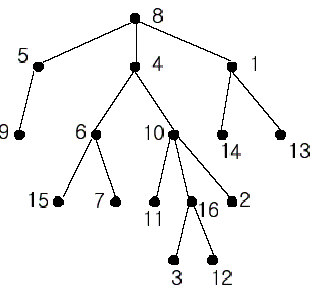
In the figure, each node is labeled with an integer from {1, 2,...,16}. Node 8 is the root of the tree. Node x is an ancestor of node y if node x is in the path between the root and node y. For example, node 4 is an ancestor of node 16. Node 10 is also an ancestor of node 16. As a matter of fact, nodes 8, 4, 10, and 16 are the ancestors of node 16. Remember that a node is an ancestor of itself. Nodes 8, 4, 6, and 7 are the ancestors of node 7. A node x is called a common ancestor of two different nodes y and z if node x is an ancestor of node y and an ancestor of node z. Thus, nodes 8 and 4 are the common ancestors of nodes 16 and 7. A node x is called the nearest common ancestor of nodes y and z if x is a common ancestor of y and z and nearest to y and z among their common ancestors. Hence, the nearest common ancestor of nodes 16 and 7 is node 4. Node 4 is nearer to nodes 16 and 7 than node 8 is.
For other examples, the nearest common ancestor of nodes 2 and 3 is node 10, the nearest common ancestor of nodes 6 and 13 is node 8, and the nearest common ancestor of nodes 4 and 12 is node 4. In the last example, if y is an ancestor of z, then the nearest common ancestor of y and z is y.
Write a program that finds the nearest common ancestor of two distinct nodes in a tree.
Input
The input consists of T test cases. The number of test cases (T) is given in the first line of the input file. Each test case starts with a line containing an integer N , the number of nodes in a tree, 2<=N<=10,000. The nodes are labeled with integers 1, 2,..., N. Each of the next N -1 lines contains a pair of integers that represent an edge --the first integer is the parent node of the second integer. Note that a tree with N nodes has exactly N - 1 edges. The last line of each test case contains two distinct integers whose nearest common ancestor is to be computed.
Output
Print exactly one line for each test case. The line should contain the integer that is the nearest common ancestor.
Sample Input
2
16
1 14
8 5
10 16
5 9
4 6
8 4
4 10
1 13
6 15
10 11
6 7
10 2
16 3
8 1
16 12
16 7
5
2 3
3 4
3 1
1 5
3 5
Sample Output
4
3
LCA模板套上去就好了
#include<iostream>

#include<stdio.h>

#include<stdlib.h>

#include <iomanip>

#include<cmath>

#include<float.h>

#include<string.h>

#include<algorithm>

#define sf scanf

#define scf(x) scanf("%d",&x)

#define pf printf

#define prf(x) printf("%d\n",x)

#define mm(x,b) memset((x),(b),sizeof(x))

#include<vector>

#include<queue>

#include<map>

#define rep(i,a,n) for (int i=a;i<n;i++)

#define per(i,a,n) for (int i=a;i>=n;i--)

typedef long long ll;

const ll mod=1e9+100;

const double eps=1e-8;

using namespace std;

const double pi=acos(-1.0);

const int inf=0xfffffff;

const int N = 1010;

int rmq[2*N];//rmq数组,就是欧拉序列对应的深度序列

struct ST

{

    int mm[2*N];

    int dp[2*N][20];//最小值对应的下标

    void init(int n)

    {

        mm[0] = -1;

        for(int i = 1;i <= n;i++)

        {

            mm[i] = ((i&(i-1)) == 0)?mm[i-1]+1:mm[i-1];

            dp[i][0] = i;

        }

        for(int j = 1; j <= mm[n];j++)

            for(int i = 1; i + (1<<j) - 1 <= n; i++)

                dp[i][j] = rmq[dp[i][j-1]] < rmq[dp[i+(1<<(j-1))][j-1]]?dp[i][j-1]:dp[i+(1<<(j-1))][j-1];

    }

    int query(int a,int b)//查询[a,b]之间最小值的下标

    {

        if(a > b) swap(a,b);

        int k = mm[b-a+1];

        return rmq[dp[a][k]] <= rmq[dp[b-(1<<k)+1][k]]?dp[a][k]:dp[b-(1<<k)+1][k];

    }

};

//边的结构体定义

struct Edge

{

    int to,next;

};

Edge edge[N*2];

int tot,head[N];

int F[N*2];//欧拉序列,就是dfs遍历的顺序,长度为2*n-1,下标从1开始

int P[N];//P[i]表示点i在F中第一次出现的位置

int cnt;

ST st;

void init()

{

    tot = 0;

    memset(head,-1,sizeof(head));

}

void addedge(int u,int v)//加边,无向边需要加两次

{

    edge[tot].to = v;

    edge[tot].next = head[u];

    head[u] = tot++;

}

void dfs(int u,int pre,int dep)

{

    F[++cnt] = u;

    rmq[cnt] = dep;

    P[u] = cnt;

    for(int i = head[u];i != -1;i = edge[i].next)

    {

        int v = edge[i].to;

        if(v == pre)continue;

        dfs(v,u,dep+1);

        F[++cnt] = u;

        rmq[cnt] = dep;

    }

}

void LCA_init(int root,int node_num)//查询LCA前的初始化

{

    cnt = 0;

    dfs(root,root,0);

    st.init(2*node_num-1);

}

int query_lca(int u,int v)//查询u,v的lca编号

{

    return F[st.query(P[u],P[v])];

}

bool root[N];

int main()

{

	int n,m,num,v,u;

	while(~scff(n,m))//n个点,m个查询点

	{

		init();

		mm(sum,0);

		mm(root,true);

		rep(i,1,n)

		{

			sf("%d %d",&u,&v);

				addedge(u,v);

				addedge(v,u);

				root[v]=false;

		}

		int temp;

		rep(i,1,n+1)

		{

			if(root[i])

			{

				temp=i;break;

			}

		}

		LCA_init(temp,n);

		while(m--)

		{

			while(getchar()!='(') ;

            scanf("%d%d",&u,&v);

            while(getchar()!=')') ;

			sum[query_lca(u,v)]++;

		}

		rep(i,1,n+1)

		{

			if(sum[i])

			pf("%d:%d\n",i,sum[i]);

		}

	}

	return 0;

}
D - Nearest Common Ancestors的更多相关文章
- POJ 1330 Nearest Common Ancestors(Targin求LCA)
传送门 Nearest Common Ancestors Time Limit: 1000MS Memory Limit: 10000K Total Submissions: 26612 Ac ...
- [最近公共祖先] POJ 1330 Nearest Common Ancestors
Nearest Common Ancestors Time Limit: 1000MS Memory Limit: 10000K Total Submissions: 27316 Accept ...
- POJ 1330 Nearest Common Ancestors
Nearest Common Ancestors Time Limit: 1000MS Memory Limit: 10000K Total Submissions: 14698 Accept ...
- POJ1330 Nearest Common Ancestors
Nearest Common Ancestors Time Limit: 1000MS Memory Limit: 10000K Total Submissions: 24587 Acce ...
- POJ 1330 Nearest Common Ancestors(Tree)
题目:Nearest Common Ancestors 根据输入建立树,然后求2个结点的最近共同祖先. 注意几点: (1)记录每个结点的父亲,比较层级时要用: (2)记录层级: (3)记录每个结点的孩 ...
- 【POJ】1330 Nearest Common Ancestors ——最近公共祖先(LCA)
Nearest Common Ancestors Time Limit: 1000MS Memory Limit: 10000K Total Submissions: 18136 Accept ...
- POJ 1330 Nearest Common Ancestors LCA题解
Nearest Common Ancestors Time Limit: 1000MS Memory Limit: 10000K Total Submissions: 19728 Accept ...
- POJ - 1330 Nearest Common Ancestors(基础LCA)
POJ - 1330 Nearest Common Ancestors Time Limit: 1000MS Memory Limit: 10000KB 64bit IO Format: %l ...
- POJ 1330 Nearest Common Ancestors / UVALive 2525 Nearest Common Ancestors (最近公共祖先LCA)
POJ 1330 Nearest Common Ancestors / UVALive 2525 Nearest Common Ancestors (最近公共祖先LCA) Description A ...
- pku 1330 Nearest Common Ancestors LCA离线
pku 1330 Nearest Common Ancestors 题目链接: http://poj.org/problem?id=1330 题目大意: 给定一棵树的边关系,注意是有向边,因为这个WA ...
随机推荐
- RestTemplate之GET和POST调用和异步回调
get方式 String url = "http://hostname:port/v1.0/data/data"; HttpHeaders headers = new HttpHe ...
- PLC是嵌入式系统吗?【转】
PLC是嵌入式系统吗? 一.PLC即Programmable Logic Controller,可编程逻辑控制器 单片机又名MCU即microprocessor control unit,微处理机控制 ...
- servlet的xx方式传值中文乱码
protected void doGet(HttpServletRequest req, HttpServletResponse resp) throws ServletException, IOEx ...
- SpringBoot2.0微信小程序支付多次回调问题
SpringBoot2.0微信小程序支付多次回调问题 WxJava - 微信开发 Java SDK(开发工具包); 支持包括微信支付.开放平台.公众号.企业微信/企业号.小程序等微信功能的后端开发. ...
- 【C#】C#线程_混合线程的同步构造
目录结构: contents structure [+] 一个简单的混合锁 FCL中的混合锁 ManualResetEventSlim类和SemaphoreSlim类 Monitor类和同步块 Rea ...
- 原创科幻短篇《Bug》
这回不是纯科幻,夹了点玄幻. 以下正文: 大一的时候,李双休谈了个女朋友,俩人学校相距不远,周末约一起看电影.那是李双休第一次自己坐公交,坐反了,绕城一周,电影开始后一个小时才到,就赶上看了个片尾彩蛋 ...
- 使用Node.js的Express框架进行文件上传
我们先创建一个Express项目,要使用文件上传的功能还需要下载multer模块. npm install --save multer 下面我们在public文件夹下创建upload.html,内容如 ...
- vim简单的移动光标
vim学习简单的光标移动 ==> 移动到行首 $ ==> 移动到行尾 ^ ==> 移动到本行第一个不是blank的位置 g_ ==> 移动到本行最后一个不是blank的位置^Z ...
- windows下telnet命令不好用解决方案;
1.按网上说的windows下打开功能,telnet客户端打钩是必须的: 2.如果还不行,找到telnet.exe:然后把此路径添加到环境变量path下即可: ps:telnet的退出:quit命令:
- python3 log 日志记录
在调试的过程中,很多地方需要用到日志 如下 import logging LOG_FORMAT = "%(asctime)s - %(levelname)s - %(message)s&qu ...