
POJ 1330 Nearest Common Ancestors(Targin求LCA)
| Time Limit: 1000MS | Memory Limit: 10000K | |
| Total Submissions: 26612 | Accepted: 13734 |
Description
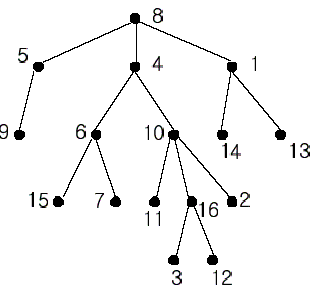
For other examples, the nearest common ancestor of nodes 2 and 3 is node 10, the nearest common ancestor of nodes 6 and 13 is node 8, and the nearest common ancestor of nodes 4 and 12 is node 4. In the last example, if y is an ancestor of z, then the nearest common ancestor of y and z is y.
Write a program that finds the nearest common ancestor of two distinct nodes in a tree.
Input
Output
Sample Input
2
16
1 14
8 5
10 16
5 9
4 6
8 4
4 10
1 13
6 15
10 11
6 7
10 2
16 3
8 1
16 12
16 7
5
2 3
3 4
3 1
1 5
3 5
Sample Output
4
3
思路
最近公共祖先模板题
#include<iostream>
#include<cstdio>
#include<cstring>
#include<vector>
using namespace std;
const int maxn = 10005;
struct Edge{
	int to,next;
}edge[maxn];
vector<int>qry[maxn];
int N,tot,fa[maxn],head[maxn],indegree[maxn],ancestor[maxn];
bool vis[maxn];

void init()
{
	tot = 0;
	for (int i = 1;i <= N;i++)	fa[i] = i,head[i] = -1,indegree[i] = 0,vis[i] = false,qry[i].clear();
}

void addedge(int u,int to)
{
	edge[tot] = (Edge){to,head[u]};
	head[u] = tot++;
}

int find(int x)
{
	int r = x;
	while (r != fa[r])	r = fa[r];
	int i = x,j;
	while (i != r)
	{
		j = fa[i];
		fa[i] = r;
		i = j;
	}
	return r;
}

void Union(int x,int y)
{
	x = find(x),y = find(y);
	if (x == y)	return;
	fa[y] = x;	//不能写成fa[x] = y,与集合合并的祖先有关系
}

void targin_LCA(int u)
{
	ancestor[u] = u;
	for (int i = head[u];i != -1;i = edge[i].next)
	{
		int v = edge[i].to;
		targin_LCA(v);
		Union(u,v);
		ancestor[find(u)] = u;
	}
	vis[u] = true;
	int size = qry[u].size();
	for (int i = 0;i < size;i++)
	{
		if (vis[qry[u][i]])	printf("%d\n",ancestor[find(qry[u][i])]);
		return;
	}
}

int main()
{
	int T;
	scanf("%d",&T);
	while (T--)
	{
		int u,v;
		scanf("%d",&N);
		init();
		for (int i = 1;i < N;i++)
		{
			scanf("%d%d",&u,&v);
			addedge(u,v);
			indegree[v]++;
		}
		scanf("%d%d",&u,&v);
		qry[u].push_back(v),qry[v].push_back(u);
		for (int i = 1;i <= N;i++)
		{
			if (!indegree[i])
			{
				targin_LCA(i);
				break;
			}
		}
	}
	return 0;
}
#include<stdio.h>
#include<string.h>
#include<iostream>
#include<algorithm>
#include<math.h>
#include<vector>
using namespace std;

const int MAXN=10010;

int F[MAXN];//并查集
int r[MAXN];//并查集中集合的个数
bool vis[MAXN];//访问标记
int ancestor[MAXN];//祖先
struct Node
{
    int to,next;
}edge[MAXN*2];

int head[MAXN];
int tol;
void addedge(int a,int b)
{
    edge[tol].to=b;
    edge[tol].next=head[a];
    head[a]=tol++;
    edge[tol].to=a;
    edge[tol].next=head[b];
    head[b]=tol++;
}

struct Query
{
    int q,next;
    int index;//查询编号
}query[MAXN*2];//查询数
int answer[MAXN*2];//查询结果
int cnt;
int h[MAXN];
int tt;
int Q;//查询个数

void add_query(int a,int b,int i)
{
    query[tt].q=b;
    query[tt].next=h[a];
    query[tt].index=i;
    h[a]=tt++;
    query[tt].q=a;
    query[tt].next=h[b];
    query[tt].index=i;
    h[b]=tt++;
}

void init(int n)
{
    for(int i=1;i<=n;i++)
    {
        F[i]=-1;
        r[i]=1;
        vis[i]=false;
        ancestor[i]=0;
        tol=0;
        tt=0;
        cnt=0;//已经查询到的个数
    }
    memset(head,-1,sizeof(head));
    memset(h,-1,sizeof(h));
}
int find(int x)
{
    if(F[x]==-1)return x;
    return F[x]=find(F[x]);
}

void Union(int x,int y)//合并
{
    int t1=find(x);
    int t2=find(y);
    if(t1!=t2)
    {
        if(r[t1]<=r[t2])
        {
            F[t1]=t2;
            r[t2]+=r[t1];
        }
        else
        {
            F[t2]=t1;
            r[t1]+=r[t2];
        }
    }
}

void LCA(int u)
{
    //if(cnt>=Q)return;//不要加这个
    ancestor[u]=u;
    vis[u]=true;//这个一定要放在前面
    for(int i=head[u];i!=-1;i=edge[i].next)
    {
        int v=edge[i].to;
        if(vis[v])continue;
        LCA(v);
        Union(u,v);
        ancestor[find(u)]=u;
    }
    for(int i=h[u];i!=-1;i=query[i].next)
    {
        int v=query[i].q;
        if(vis[v])
        {
            answer[query[i].index]=ancestor[find(v)];
            cnt++;//已经找到的答案数
        }
    }
}
bool flag[MAXN];
int main()
{
    //freopen("in.txt","r",stdin);
    //freopen("out.txt","w",stdout);
    int T;
    int N;
    int u,v;
    scanf("%d",&T);
    while(T--)
    {
        scanf("%d",&N);
        init(N);
        memset(flag,false,sizeof(flag));
        for(int i=1;i<N;i++)
        {
            scanf("%d%d",&u,&v);
            flag[v]=true;
            addedge(u,v);
        }
        Q=1;//查询只有一组
        scanf("%d%d",&u,&v);
        add_query(u,v,0);//增加一组查询
        int root;
        for(int i=1;i<=N;i++)
          if(!flag[i])
          {
              root=i;
              break;
          }
        LCA(root);
        for(int i=0;i<Q;i++)//输出所有答案
          printf("%d\n",answer[i]);
    }
    return 0;
}
POJ 1330 Nearest Common Ancestors(Targin求LCA)的更多相关文章
- POJ - 1330 Nearest Common Ancestors(基础LCA)
POJ - 1330 Nearest Common Ancestors Time Limit: 1000MS Memory Limit: 10000KB 64bit IO Format: %l ...
- poj 1330 Nearest Common Ancestors 单次LCA/DFS
Nearest Common Ancestors Time Limit: 1000MS Memory Limit: 10000K Total Submissions: 19919 Accept ...
- POJ 1330 Nearest Common Ancestors(裸LCA)
Nearest Common Ancestors Time Limit: 1000MS Memory Limit: 10000K Total Submissions: 39596 Accept ...
- POJ 1330 Nearest Common Ancestors(Tarjan离线LCA)
Description A rooted tree is a well-known data structure in computer science and engineering. An exa ...
- poj 1330 Nearest Common Ancestors 裸的LCA
#include<iostream> #include<cstdio> #include<cstring> #include<algorithm> #i ...
- POJ 1330 Nearest Common Ancestors / UVALive 2525 Nearest Common Ancestors (最近公共祖先LCA)
POJ 1330 Nearest Common Ancestors / UVALive 2525 Nearest Common Ancestors (最近公共祖先LCA) Description A ...
- POJ.1330 Nearest Common Ancestors (LCA 倍增)
POJ.1330 Nearest Common Ancestors (LCA 倍增) 题意分析 给出一棵树,树上有n个点(n-1)条边,n-1个父子的边的关系a-b.接下来给出xy,求出xy的lca节 ...
- POJ 1330 Nearest Common Ancestors(lca)
POJ 1330 Nearest Common Ancestors A rooted tree is a well-known data structure in computer science a ...
- POJ 1330 Nearest Common Ancestors 倍增算法的LCA
POJ 1330 Nearest Common Ancestors 题意:最近公共祖先的裸题 思路:LCA和ST我们已经很熟悉了,但是这里的f[i][j]却有相似却又不同的含义.f[i][j]表示i节 ...
- LCA POJ 1330 Nearest Common Ancestors
POJ 1330 Nearest Common Ancestors Time Limit: 1000MS Memory Limit: 10000K Total Submissions: 24209 ...
随机推荐
- Eclipse 反编译插件JadClipse安装
下载jadClipse地址: 链接: http://pan.baidu.com/s/1kTN4TPd 提取码: 3fvd 将net.sf.jadclipse_3.3.0.jar拷贝到eclipse的 ...
- PRML读书会第六章 Kernel Methods(核函数,线性回归的Dual Representations,高斯过程 ,Gaussian Processes)
主讲人 网络上的尼采 (新浪微博:@Nietzsche_复杂网络机器学习) 网络上的尼采(813394698) 9:16:05 今天的主要内容:Kernel的基本知识,高斯过程.边思考边打字,有点慢, ...
- 为什么我们的web前端变的越来越复杂
前端发展了也有些年头了,曾记得很多年前,聊起前端,都觉得是很简单,那个时候都没有前端工程师这个职位.可现在,前端已经逆袭了,已经不是原来的样子了,各种技术层出不穷,显的越来越高深莫测了.前端真的变得那 ...
- fdisk分区硬盘并shell脚本自动化
最近工作需要用到对硬盘进行shell脚本自动化分区和mount的操作,google了一些资料,下面做个总结. 如果硬盘没有进行分区(逻辑分区或者扩展分区,关于两者概念,自行google),我们将无法将 ...
- 在SQL Server 2012中实现CDC for Oracle
在上篇在SSIS 2012中使用CDC(数据变更捕获)中,介绍了如何在SSIS 2012中使用CDC,本文在此基础上介绍,如何通过Attunity提供的Change Data Capture Desi ...
- Http协议中的Content-Length属性
Android开发的时候需要与从服务器上获取数据,数据是通过http协议封装的.Android端使用的是Xutils第三方插件来发起http请求,但是每次只能拿到部分数据.通过仔细分析后原来是Cont ...
- [转]JS中对象与字符串的互相转换
原文地址:http://www.cnblogs.com/luminji/p/3617160.html 在使用 JSON2.JS 文件的 JSON.parse(data) 方法时候,碰到了问题: thr ...
- [转]CSS Display(显示) 与 Visibility(可见性)
CSS Display(显示) 与 Visibility(可见性) display属性设置一个元素应如何显示,visibility属性指定一个元素应可见还是隐藏. 隐藏元素 - display:non ...
- ActiveMQ_Linux安装(一)
一.下载:apache-activemq-5.14.0-bin.tar.gz http://activemq.apache.org/activemq-5140-release.html 二.安 ...
- Notes on 'Selective Search For Object Recognition'
UijlingsIJCV2013, Selective Search For Object Recognition code 算法思想 利用分割算法将图片细分成很多region, 或超像素. 在这个基 ...