
TensorFlow-谷歌深度学习库 体验一二三
一个TensorFlow的运算可以看作是一个数据流图。
一个图呢则由一组操作和数据集组成。
- 操作(operation)代表运算单元
- 数据(tensor) 代表在各运算单元流动的数据单元
要想使用一个数据流图,必须把它注册为默认的图。
注意:图这个class并不是线程安全的,它所有的方法也不是。
将一个图设为默认的图的方法:
g = tf.Graph()

with g.as_default(): # 将图设为默认

    # define operations and tensors in g

    c = tf.constant(30.0)
as_default(self)
返回一个将Graph设为默认的context manager。如果你想要在一个进程中创建多个图考虑使用。如果你不显示调用,一个全局默认图将被提供。
默认图所属当前线程,如果你创建了一个新的线程,你必须在那个线程中显示调用as_default方法。
创建常量tensor
constant(value, dtype=None, shape=None, name='Const', verify_shape=False)
'''
Args:
value: A constant value (or list) of output type `dtype`.
dtype: The type of the elements of the resulting tensor.
shape: Optional dimensions of resulting tensor.
name: Optional name for the tensor.
verify_shape: Boolean that enables verification of a shape of values.
Returns:
A Constant Tensor.
Raises:
TypeError: if shape is incorrectly specified or unsupported.
'''
传入value创建常量tensor。value可以是一个常量值或常量列表。 参数shape是可选的,如果不提供默认为传入value的shape。
同理,dtype也是可选的,不提供则默认为传入value的dtype。
```python
# Constant 1-D Tensor populated with value list.
tensor = tf.constant([1, 2, 3, 4, 5, 6, 7]) => [1 2 3 4 5 6 7]
# Constant 2-D tensor populated with scalar value -1.
tensor = tf.constant(-1.0, shape=[2, 3]) => [[-1. -1. -1.]
[-1. -1. -1.]]
```
创建变量tensor
w = tf.Variable(<initial-value>, name=<optional-name>)
一个变量维持图的状态。 变量在定义的时候要声明它的类型和shape, 在创建之后虽然值是可以改变的, 但类型和shape是固定的。
和其他tensor一样,被创建的变量可以被图中的操作当作输入使用。
当你启用已经定义好的图时,所有变量必须显示的被初始化,之后你才可以运行操作使用他们的值。你也可以从文件中读取完成初始化步骤。
创建placeholder
placeholder(dtype, shape=None, name=None)
给一个tensor插入placeholder,并且会在之后补充进去。
通过`Session.run()`的备选参数`feed_dict` 将之前的placeholder的值补进去, 如果你没有喂进任何数据就运行会话对象将报错。
    ```python

    x = tf.placeholder(tf.float32, shape=(1024, 1024))

    y = tf.matmul(x, x)

    with tf.Session() as sess:

      print(sess.run(y))  # ERROR: will fail because x was not fed.

      rand_array = np.random.rand(1024, 1024)

      print(sess.run(y, feed_dict={x: rand_array}))  # Will succeed.

    ```
计算logits tensor
logits = tf.matmul(tf_train_dataset, weights) + biases
计算softmax cross entropy,loss tensor
loss = tf.reduce_mean(

     tf.nn.softmax_cross_entropy_with_logits(labels=tf_train_labels, logits=logits))
softmax_cross_entropy_with_logits_v2(_sentinel=None, labels=None, logits=None, dim=-1, name=None)
Args:
_sentinel: Used to prevent positional parameters. Internal, do not use.
labels: Each row `labels[i]` must be a valid probability distribution.
logits: Unscaled log probabilities.
dim: The class dimension. Defaulted to -1 which is the last dimension.
name: A name for the operation (optional).
Returns:
A 1-D `Tensor` of length `batch_size` of the same type as `logits` with the
softmax cross entropy loss.
计算probability errors。 对于每一个想要预测的内容, 它必须有且只有一个标签。
参数为logits和labels,这个函数内部会自动处理soft max。

softmax: 将score转化成probability
def softmax(x):

    """Compute softmax values for each sets of scores in x."""

    return np.exp(x) / np.sum(np.exp(x), axis = 0)
one-hot-encoding: 正确的label标为1,其他均为0. 比如有a,b,c三个label,a为正确的label标为1,b和c标为0
cross-entropy(用来衡量performance):

计算所有样本的综合loss:
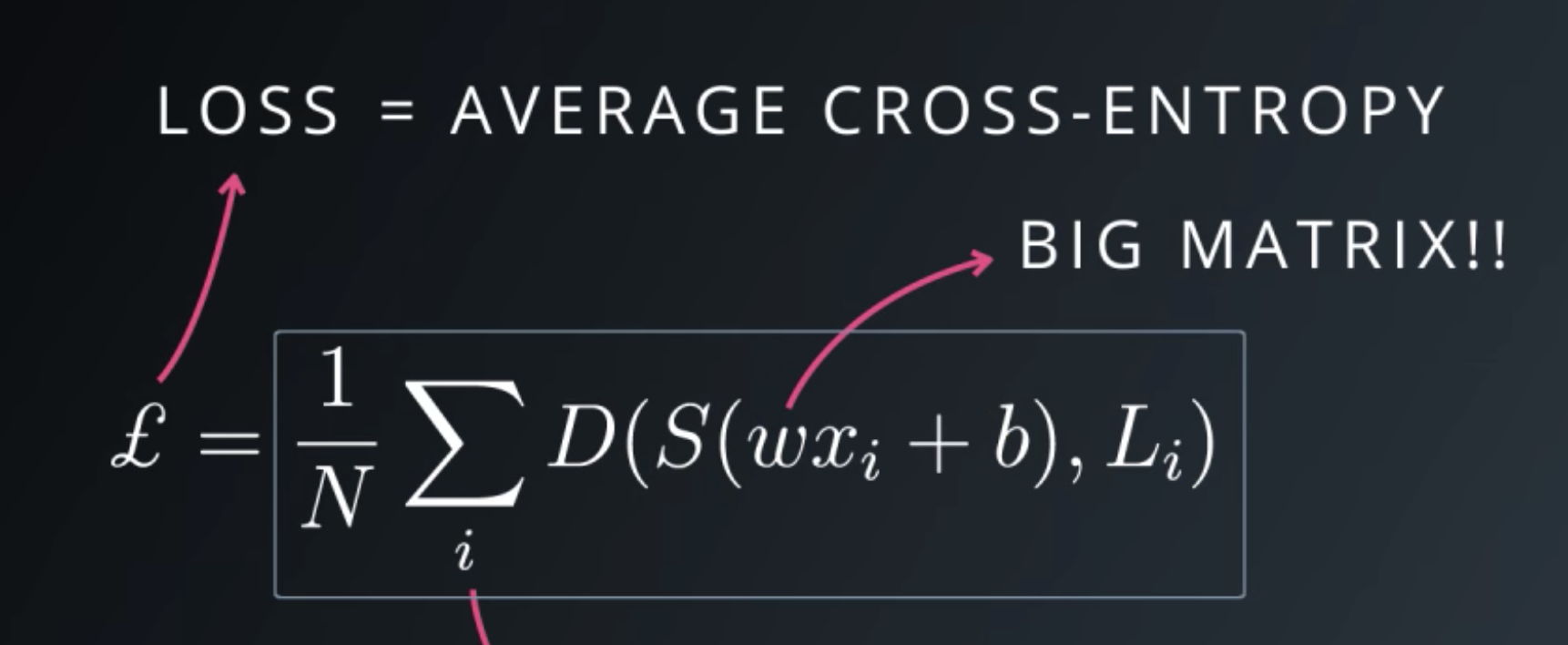
优化处理Optimizer: Gradient Descent Optimizer, 定义operation
使用梯度下降法找到最小的loss。 这个operation会更新涉及到的tensor的值。
class GradientDescentOptimizer(tensorflow.python.training.optimizer.Optimizer)
 __init__(self, learning_rate, use_locking=False, name='GradientDescent')

 Construct a new gradient descent optimizer.

 Args:

 learning_rate: A Tensor or a floating point value.  The learning rate to use.

 minimize(self, loss, global_step=None, var_list=None, gate_gradients=1,

 aggregation_method=None, colocate_gradients_with_ops=False, name=None,

 grad_loss=None)

 Add operations to minimize `loss` by updating `var_list`.

 This method simply combines calls `compute_gradients()` and `apply_gradients()`.
 If you want to process the gradient before applying them call `compute_gradients()` and `apply_gradients()` explicitly instead of using this function.

 Args:

 loss: A `Tensor` containing the value to minimize.

 global_step: Optional `Variable` to increment by one after the variables have been updated.

 Returns:

 An Operation that updates the variables in `var_list`.  If `global_step` was not `None`, that operation also increments `global_step`.

 Raises:

 ValueError: If some of the variables are not `Variable` objects.
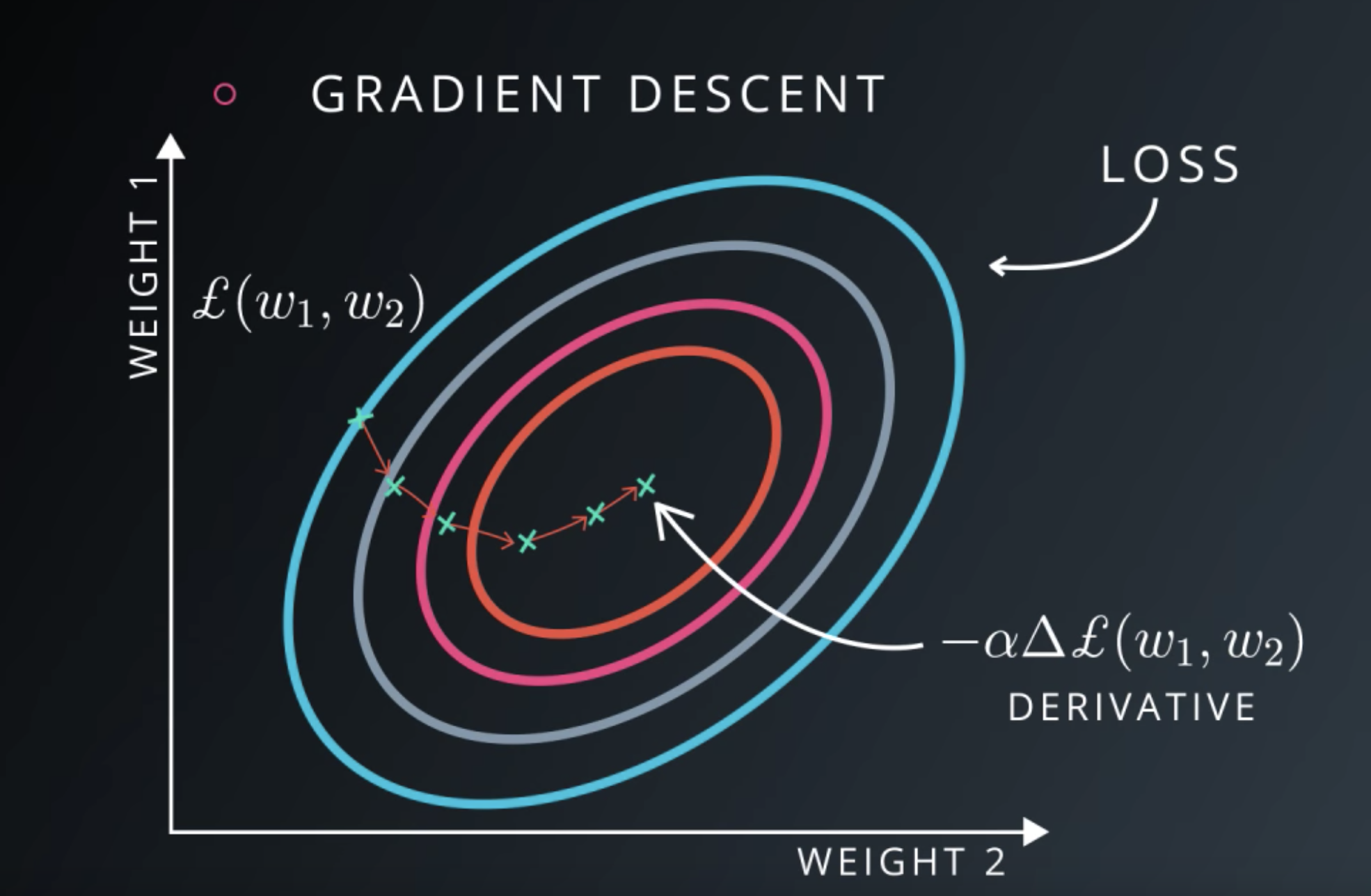
什么是梯度下降?
误差方程 (Cost Function). 用来计算预测出来的和我们实际中的值有多大差别. 在预测数值的问题中. W是我们神经网络中的参数, 假设我们初始化的 W 在一个位置. 而这个位置的斜率也就是梯度下降中的梯度. loss误差最小的时候正是这条曲线最低的地方, 不过 W 却不知道这件事情, 他目前所知道的就是梯度线为自己在这个位置指出的一个下降方向, 我们就要朝着这个梯度的方向下降一点点. 在做一条切线, 发现我还能下降, 那我就朝着梯度的方向继续下降, 这时, 再展示出现在的梯度, 因为梯度线已经躺平了, 我们已经指不出哪边是下降的方向了, 所以这时我们就找到了 W 参数的最理想值. 简而言之, 就是找到梯度线躺平的点.
Session(会话)
用来运行tensorflow operation的类
会话对象封装了一个供ops类执行并且可以评估tensor的环境。
会话类会拥有自己的资源,为确保在使用后这些资源被释放,可以使用context manager
 # Using the context manager.

 with tf.Session() as sess:

     sess.run(...)
在初始化创建一个会话对象的时候,如果没有指明图那么一个默认的图会被启用。如果你拥有多个图,那么你需要为每一个图初始化一个会话对象。
在会话类中,首先要初始化所有变量。使用global_variables_initializer()返回一个op并运行来初始化。
global_variables_initializer()
Returns an Op that initializes global variables.
Returns:
An Op that initializes global variables in the graph.
TensorFlow-谷歌深度学习库 体验一二三的更多相关文章
- Keras:基于Theano和TensorFlow的深度学习库
catalogue . 引言 . 一些基本概念 . Sequential模型 . 泛型模型 . 常用层 . 卷积层 . 池化层 . 递归层Recurrent . 嵌入层 Embedding 1. 引言 ...
- TensorFlow-谷歌深度学习库 手把手教你如何使用谷歌深度学习云平台
自己的电脑跑cnn, rnn太慢? 还在为自己电脑没有好的gpu而苦恼? 程序一跑一俩天连睡觉也要开着电脑训练? 如果你有这些烦恼何不考虑考虑使用谷歌的云平台呢?注册之后即送300美元噢-下面我就来介 ...
- windows下Anaconda3配置TensorFlow深度学习库
Anaconda3(python3.6)安装tensorflow Anaconda3中安装tensorflow3是非常简单的,仅需通过 pip install tensorflow 测试代码: imp ...
- 人工智能不过尔尔,基于Python3深度学习库Keras/TensorFlow打造属于自己的聊天机器人(ChatRobot)
原文转载自「刘悦的技术博客」https://v3u.cn/a_id_178 聊天机器人(ChatRobot)的概念我们并不陌生,也许你曾经在百无聊赖之下和Siri打情骂俏过,亦或是闲暇之余与小爱同学谈 ...
- 深度学习库 SynapseML for .NET 发布0.1 版本
2021年11月 微软开源一款简单的.多语言的.大规模并行的机器学习库 SynapseML(以前称为 MMLSpark),以帮助开发人员简化机器学习管道的创建.具体参见[1]微软深度学习库 Synap ...
- 30个深度学习库:按Python、C++、Java、JavaScript、R等10种语言分类
30个深度学习库:按Python.C++.Java.JavaScript.R等10种语言分类 包括 Python.C++.Java.JavaScript.R.Haskell等在内的一系列编程语言的深度 ...
- TensorFlow和深度学习入门教程(TensorFlow and deep learning without a PhD)【转】
本文转载自:https://blog.csdn.net/xummgg/article/details/69214366 前言 上月导师在组会上交我们用tensorflow写深度学习和卷积神经网络,并把 ...
- TensorFlow和深度学习新手教程(TensorFlow and deep learning without a PhD)
前言 上月导师在组会上交我们用tensorflow写深度学习和卷积神经网络.并把其PPT的參考学习资料给了我们, 这是codelabs上的教程:<TensorFlow and deep lear ...
- 64位Win7下安装并配置Python3的深度学习库:Theano
注:本文全原创,作者:Noah Zhang (http://www.cnblogs.com/noahzn/) 这两天在安装Python的深度学习库:Theano.尝试了好多遍,CMake.MinGW ...
随机推荐
- window7 x64 vs2015 如何编译 libqr 二维码生成库?
1.下载libqr库 下载地址:https://github.com/rsky/qrcode 注:因 libqr 依赖 zlib 库,所以首先编译 zlib库 zlib 库编译指南:http://ww ...
- MySQL基础学习笔记
一.数据库基本概念 1.1 数据库 - Database 从字面意思看,数据库就是一个存储数据的仓库.从计算机的角度来讲,数据库(Datebase)是按照数据结构来组织.存储和管理数据的仓库. 简单来 ...
- jstree树形菜单
final 用于声明属性.方法和类,分别表示属性不可变,方法不可重写,类不可继承.其实可以参考用easyui的tree 和 ztree参考: https://www.jstree.com/demo/ ...
- 微软Surface Book推送Windows 10新固件更新:增强系统和电池
微软公司最近为Surface Book推出了新的Windows 10固件系统和驱动的更新,并且以MSI的文件格式上传到了微软的下载中心里面.此次更新的内容主要是改进了Surface Book的系统的稳 ...
- file和file文件流
**io流是程序中比较常用的功能,基本上涉及到文件上传下载的都要用到这功能,比如上传头像,上传附件等等. 对于一个java程序员来说,io流也是必须掌握的,因此这里对比较常用的或者说曾经用过的方法进行 ...
- Struts2实现文件上传报错(一)
1.具体报错如下 2014-5-1 23:02:38 org.apache.catalina.core.StandardWrapperValve invoke 严重: Servlet.service( ...
- 在.Net Core中使用MongoDB的入门教程(二)
在上一篇文章中,讲到了MongoDB在导入驱动.MongoDB的连接,数据的插入等. 在.Net Core中使用MongoDB的入门教程(一) 本篇文章将接着上篇文章进行介绍MongoDB在.Net ...
- 【转】MySQL乐观锁在分布式场景下的实践
背景 在电商购物的场景下,当我们点击购物时,后端服务就会对相应的商品进行减库存操作.在单实例部署的情况,我们可以简单地使用JVM提供的锁机制对减库存操作进行加锁,防止多个用户同时点击购买后导致的库存不 ...
- I2C总线通讯协议
I2C总线通讯协议 1. I2C总线简介 I2C是Inter-Integrated Circuit的简称,读作:I-squared-C.由飞利浦公司于1980年代提出,为了让主板.嵌入式系统或手机用以 ...
- java编程思想第四版第九章总结
1. 策略设计模式 参考这篇文章:http://blog.csdn.net/chenjie19891104/article/details/6396458 讲的很清楚,策略设计模式.并且举了一个例子, ...