
ZGC gc策略及回收过程-源码分析
源码文件:/src/hotspot/share/gc/z/zDirector.cpp
一、回收策略
main入口函数:
void ZDirector::run_service() {

  // Main loop

  while (_metronome.wait_for_tick()) {

    sample_allocation_rate();

    const GCCause::Cause cause = make_gc_decision();

    if (cause != GCCause::_no_gc) {

      ZCollectedHeap::heap()->collect(cause);

    }

  }

}
GCCause::Cause ZDirector::make_gc_decision() const {

  // Rule 0: Timer

  if (rule_timer()) {

    return GCCause::_z_timer;

  }

  // Rule 1: Warmup

  if (rule_warmup()) {

    return GCCause::_z_warmup;

  }

  // Rule 2: Allocation rate

  if (rule_allocation_rate()) {

    return GCCause::_z_allocation_rate;

  }

  // Rule 3: Proactive

  if (rule_proactive()) {

    return GCCause::_z_proactive;

  }

  // No GC

  return GCCause::_no_gc;

}
bool ZDirector::rule_timer() const {

  if (ZCollectionInterval == ) {

    // Rule disabled

    return false;

  }

  // Perform GC if timer has expired.

  const double time_since_last_gc = ZStatCycle::time_since_last();

  const double time_until_gc = ZCollectionInterval - time_since_last_gc;

  log_debug(gc, director)("Rule: Timer, Interval: %us, TimeUntilGC: %.3lfs",

                          ZCollectionInterval, time_until_gc);

  return time_until_gc <= ;

}
rule 2:预热规则
is_warm函数判断gc次数是否已超过3次,是则不使用该策略。
注释说的很清楚,当gc次数少于3时,判断堆使用率达到10%/20%/30%时,使用该策略
bool ZDirector::rule_warmup() const {

  if (is_warm()) {

    // Rule disabled

    return false;

  }

  // Perform GC if heap usage passes 10/20/30% and no other GC has been

  // performed yet. This allows us to get some early samples of the GC

  // duration, which is needed by the other rules.

  const size_t max_capacity = ZHeap::heap()->current_max_capacity();

  const size_t used = ZHeap::heap()->used();

  const double used_threshold_percent = (ZStatCycle::ncycles() + ) * 0.1;

  const size_t used_threshold = max_capacity * used_threshold_percent;

  log_debug(gc, director)("Rule: Warmup %.0f%%, Used: " SIZE_FORMAT "MB, UsedThreshold: " SIZE_FORMAT "MB",

                          used_threshold_percent * , used / M, used_threshold / M);

  return used >= used_threshold;

}

bool ZDirector::is_warm() const {

  return ZStatCycle::ncycles() >= ;

}

// 位置:ZStat.cpp

uint64_t ZStatCycle::ncycles() {

  return _ncycles; // gc次数

}
rule 3:分配速率预估
is_first函数判断如果是首次gc,则直接返回false。
ZAllocationSpikeTolerance默认值为2,分配速率策略采用正态分布模型预测内存分配速率,加上ZAllocationSpikeTolerance修正因子,可以覆盖超过99.9%的内存分配速率的可能性
bool ZDirector::rule_allocation_rate() const {

  if (is_first()) {

    // Rule disabled

    return false;

  }

  // Perform GC if the estimated max allocation rate indicates that we

  // will run out of memory. The estimated max allocation rate is based

  // on the moving average of the sampled allocation rate plus a safety

  // margin based on variations in the allocation rate and unforeseen

  // allocation spikes.

  // Calculate amount of free memory available to Java threads. Note that

  // the heap reserve is not available to Java threads and is therefore not

  // considered part of the free memory.

  const size_t max_capacity = ZHeap::heap()->current_max_capacity();

  const size_t max_reserve = ZHeap::heap()->max_reserve();

  const size_t used = ZHeap::heap()->used();

  const size_t free_with_reserve = max_capacity - used;

  const size_t free = free_with_reserve - MIN2(free_with_reserve, max_reserve);

  // Calculate time until OOM given the max allocation rate and the amount

  // of free memory. The allocation rate is a moving average and we multiply

  // that with an allocation spike tolerance factor to guard against unforeseen

  // phase changes in the allocate rate. We then add ~3.3 sigma to account for

  // the allocation rate variance, which means the probability is 1 in 1000

  // that a sample is outside of the confidence interval.

  const double max_alloc_rate = (ZStatAllocRate::avg() * ZAllocationSpikeTolerance) + (ZStatAllocRate::avg_sd() * one_in_1000);

  const double time_until_oom = free / (max_alloc_rate + 1.0); // Plus 1.0B/s to avoid division by zero

  // Calculate max duration of a GC cycle. The duration of GC is a moving

  // average, we add ~3.3 sigma to account for the GC duration variance.

  const AbsSeq& duration_of_gc = ZStatCycle::normalized_duration();

  const double max_duration_of_gc = duration_of_gc.davg() + (duration_of_gc.dsd() * one_in_1000);

  // Calculate time until GC given the time until OOM and max duration of GC.

  // We also deduct the sample interval, so that we don't overshoot the target

  // time and end up starting the GC too late in the next interval.

  const double sample_interval = 1.0 / ZStatAllocRate::sample_hz;

  const double time_until_gc = time_until_oom - max_duration_of_gc - sample_interval;

  log_debug(gc, director)("Rule: Allocation Rate, MaxAllocRate: %.3lfMB/s, Free: " SIZE_FORMAT "MB, MaxDurationOfGC: %.3lfs, TimeUntilGC: %.3lfs",

                          max_alloc_rate / M, free / M, max_duration_of_gc, time_until_gc);

  return time_until_gc <= ;

}

bool ZDirector::is_first() const {

  return ZStatCycle::ncycles() == ;

}
rule 4:积极回收策略
通过ZProactive可启用积极回收策略,is_warm函数判断启用该策略必须是在预热之后(gc次数超过3次)
自上一次gc后,堆使用率达到xmx的10%或者已过了5分钟,这个参数是弥补第三个规则中没有覆盖的场景,从上述分析可以得到第三个条件更多的覆盖分配速率比较高的场景。
bool ZDirector::rule_proactive() const {

  if (!ZProactive || !is_warm()) {

    // Rule disabled

    return false;

  }

  // Perform GC if the impact of doing so, in terms of application throughput

  // reduction, is considered acceptable. This rule allows us to keep the heap

  // size down and allow reference processing to happen even when we have a lot

  // of free space on the heap.

  // Only consider doing a proactive GC if the heap usage has grown by at least

  // 10% of the max capacity since the previous GC, or more than 5 minutes has

  // passed since the previous GC. This helps avoid superfluous GCs when running

  // applications with very low allocation rate.

  const size_t used_after_last_gc = ZStatHeap::used_at_relocate_end();

  const size_t used_increase_threshold = ZHeap::heap()->current_max_capacity() * 0.10; // 10%

  const size_t used_threshold = used_after_last_gc + used_increase_threshold;

  const size_t used = ZHeap::heap()->used();

  const double time_since_last_gc = ZStatCycle::time_since_last();

  const double time_since_last_gc_threshold =  * ; // 5 minutes

  if (used < used_threshold && time_since_last_gc < time_since_last_gc_threshold) {

    // Don't even consider doing a proactive GC

    log_debug(gc, director)("Rule: Proactive, UsedUntilEnabled: " SIZE_FORMAT "MB, TimeUntilEnabled: %.3lfs",

                            (used_threshold - used) / M,

                            time_since_last_gc_threshold - time_since_last_gc);

    return false;

  }

  const double assumed_throughput_drop_during_gc = 0.50; // 50%

  const double acceptable_throughput_drop = 0.01;        // 1%

  const AbsSeq& duration_of_gc = ZStatCycle::normalized_duration();

  const double max_duration_of_gc = duration_of_gc.davg() + (duration_of_gc.dsd() * one_in_1000);

  const double acceptable_gc_interval = max_duration_of_gc * ((assumed_throughput_drop_during_gc / acceptable_throughput_drop) - 1.0);

  const double time_until_gc = acceptable_gc_interval - time_since_last_gc;

  log_debug(gc, director)("Rule: Proactive, AcceptableGCInterval: %.3lfs, TimeSinceLastGC: %.3lfs, TimeUntilGC: %.3lfs",

                          acceptable_gc_interval, time_since_last_gc, time_until_gc);

  return time_until_gc <= ;

}
最后,当所有策略都不满足时,返回_no_gc,表示不进行gc
二、回收过程
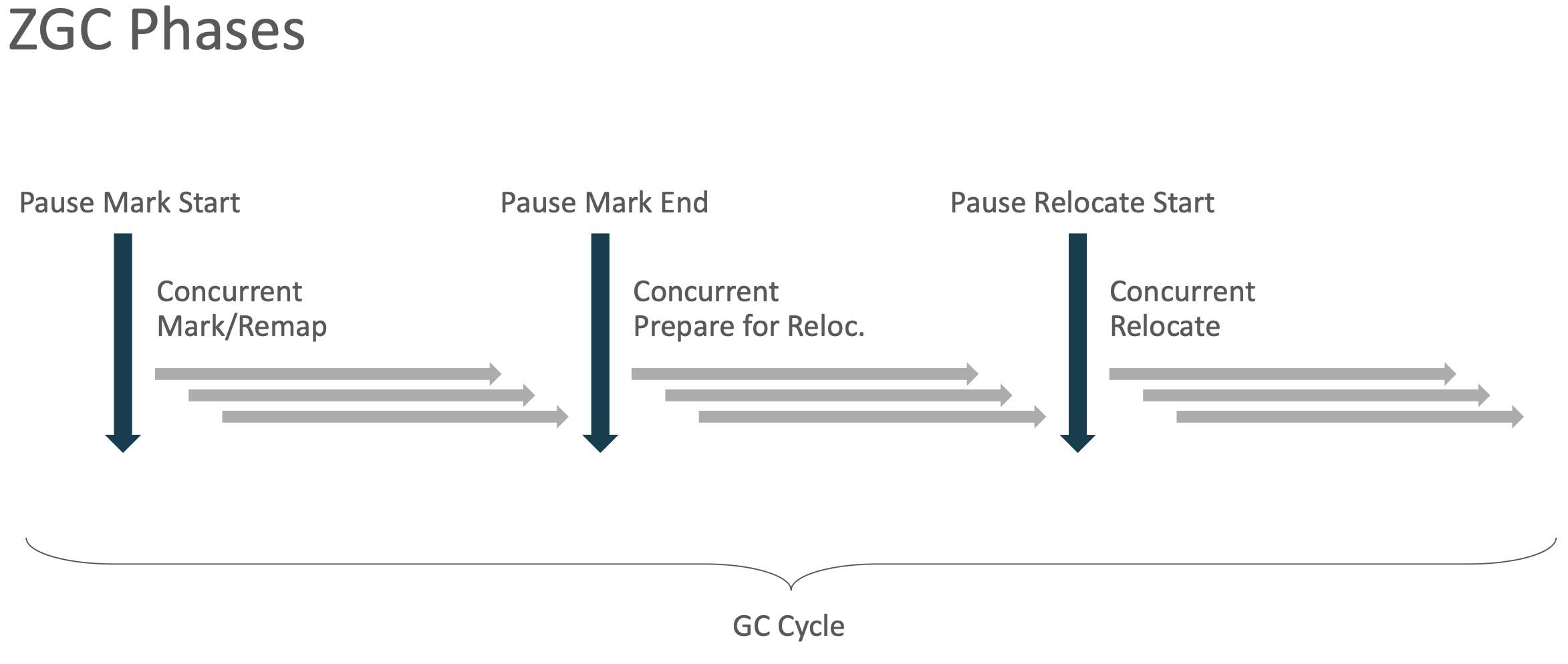
gc整个周期:
彩色指针示意图:
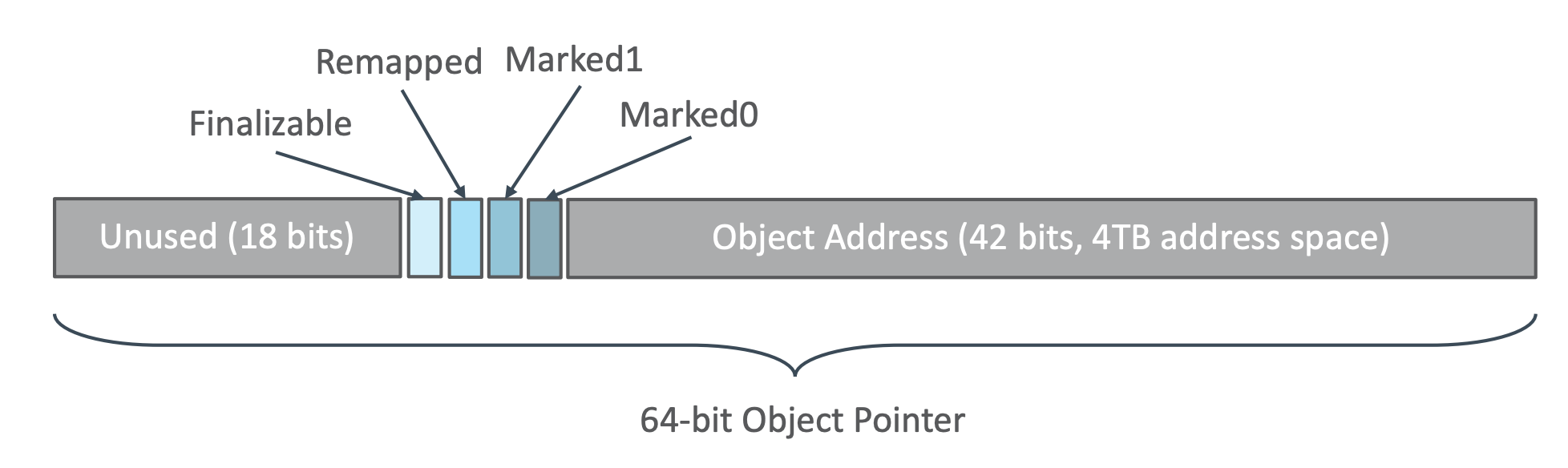
- (STW)Pause Mark Start,开始标记,这个阶段只会标记(Mark0)由root引用的object,组成Root Set
- Concurrent Mark,并发标记,从Root Set出发,并发遍历Root Set object的引用链并标记(Mark1)
- (STW)Pause Mark End,检查是否已经并发标记完成,如果不是,需要进行多一次Concurrent Mark
- Concurrent Process Non-Strong References,并发处理弱引用
- Concurrent Reset Relocation Set
- Concurrent Destroy Detached Pages
- Concurrent Select Relocation Set,并发选择Relocation Set;
- Concurrent Prepare Relocation Set,并发预处理Relocation Set
- (STW)Pause Relocate Start,开始转移对象,依然是遍历root引用
- Concurrent Relocate,并发转移,将需要回收的Page里的对象转移到Relocation Set,然后回收Page给系统重新利用
run_gc_cycle函数(/src/hotspot/share/gc/z/zDriver.cpp):
void ZDriver::run_gc_cycle(GCCause::Cause cause) {

  ZDriverCycleScope scope(cause);

  // Phase 1: Pause Mark Start

  {

    ZMarkStartClosure cl;

    vm_operation(&cl);

  }

  // Phase 2: Concurrent Mark

  {

    ZStatTimer timer(ZPhaseConcurrentMark);

    ZHeap::heap()->mark();

  }

  // Phase 3: Pause Mark End

  {

    ZMarkEndClosure cl;

    while (!vm_operation(&cl)) {

      // Phase 3.5: Concurrent Mark Continue

      ZStatTimer timer(ZPhaseConcurrentMarkContinue);

      ZHeap::heap()->mark();

    }

  }

  // Phase 4: Concurrent Process Non-Strong References

  {

    ZStatTimer timer(ZPhaseConcurrentProcessNonStrongReferences);

    ZHeap::heap()->process_non_strong_references();

  }

  // Phase 5: Concurrent Reset Relocation Set

  {

    ZStatTimer timer(ZPhaseConcurrentResetRelocationSet);

    ZHeap::heap()->reset_relocation_set();

  }

  // Phase 6: Concurrent Destroy Detached Pages

  {

    ZStatTimer timer(ZPhaseConcurrentDestroyDetachedPages);

    ZHeap::heap()->destroy_detached_pages();

  }

  // Phase 7: Concurrent Select Relocation Set

  {

    ZStatTimer timer(ZPhaseConcurrentSelectRelocationSet);

    ZHeap::heap()->select_relocation_set();

  }

  // Phase 8: Concurrent Prepare Relocation Set

  {

    ZStatTimer timer(ZPhaseConcurrentPrepareRelocationSet);

    ZHeap::heap()->prepare_relocation_set();

  }

  // Phase 9: Pause Relocate Start

  {

    ZRelocateStartClosure cl;

    vm_operation(&cl);

  }

  // Phase 10: Concurrent Relocate

  {

    ZStatTimer timer(ZPhaseConcurrentRelocated);

    ZHeap::heap()->relocate();

  }

}
未完待续
ZGC gc策略及回收过程-源码分析的更多相关文章
- (3.10)mysql基础深入——mysqld 服务器与客户端连接过程 源码分析【待写】
(3.10)mysql基础深入——mysqld 服务器与客户端连接过程 源码分析[待写]
- Netty源码分析 (七)----- read过程 源码分析
在上一篇文章中,我们分析了processSelectedKey这个方法中的accept过程,本文将分析一下work线程中的read过程. private static void processSele ...
- 设计模式(二十三)——策略模式(Arrays源码分析)
1 编写鸭子项目,具体要求如下: 1) 有各种鸭子(比如 野鸭.北京鸭.水鸭等, 鸭子有各种行为,比如 叫.飞行等) 2) 显示鸭子的信息 2 传统方案解决鸭子问题的分析和代码实现 1) 传统的设计方 ...
- YARN(MapReduce 2)运行MapReduce的过程-源码分析
这是我的分析,当然查阅书籍和网络.如有什么不对的,请各位批评指正.以下的类有的并不完全,只列出重要的方法. 如要转载,请注上作者以及出处. 一.源码阅读环境 需要安装jdk1.7.0版本及其以上版本, ...
- Flink中TaskManager端执行用户逻辑过程(源码分析)
TaskManager接收到来自JobManager的jobGraph转换得到的TDD对象,启动了任务,在StreamInputProcessor类的processInput()方法中 通过一个whi ...
- Netty源码分析 (八)----- write过程 源码分析
上一篇文章主要讲了netty的read过程,本文主要分析一下write和writeAndFlush. 主要内容 本文分以下几个部分阐述一个java对象最后是如何转变成字节流,写到socket缓冲区中去 ...
- HDFS dfsclient写文件过程 源码分析
HDFS写入文件的重要概念 HDFS一个文件由多个block构成.HDFS在进行block读写的时候是以packet(默认每个packet为64K)为单位进行的.每一个packet由若干个chunk( ...
- spring启动component-scan类扫描加载过程---源码分析
http://blog.csdn.net/xieyuooo/article/details/9089441#comments
- elasticsearch 5.5 query 过程 源码分析
(1)请求 transfer to 任意node 节点 标记为coordinate node server入口函数 transportSearchAction doExecute方法 coordin ...
随机推荐
- text2pcap: 将hex转储文本转换为Wireshark可打开的pcap文件
简介 Text2pcap是一个读取ASCII hex转储的程序,它将描述的数据写入pcap或pcapng文件.text2pcap可以读取包含多个数据包的hexdumps,并构建多个数据包的捕获文件.t ...
- springcloud(四):应用配置中心config的安全设置
springcloud应用配置中心config的安全设置 在springcloud应用开发中,为了方便在线管理我们的配置文件,通常会配一个配置中心config-server,这里托管着应用的一些配置文 ...
- Python3实战Spark大数据分析及调度 (网盘分享)
Python3实战Spark大数据分析及调度 搜索QQ号直接加群获取其它学习资料:715301384 部分课程截图: 链接:https://pan.baidu.com/s/12VDmdhN4hr7yp ...
- 小程序组件 scroll-view 横向滚动条无效
小程序组件 scroll-view 中分别有上下竖向滑动和左右横向滑动,在这次项目中刚好需要用到横向滑动,但在测试过程中发现横向滑动没有了效果(静止在那里没移动过,并且换行了),经调试发现: 1.sc ...
- 5.1、顺序队列(java实现)
1.实现代码 public class SeqQueue { private final int MaxSize = 8; private int rear; //队尾指针 private int f ...
- golang中Array与Slice
在golang中有数组和Slice两种数据结构,Slice是基于数组的实现,是长度动态不固定的数据结构,本质上是一个对数组字序列的引用,提供了对数组的轻量级访问.那么在go的函数中以数组或Slice为 ...
- 11 (OC)* CoreImage
coreimage framework 组成 apple 已经帮我们把image的处理分类好,来看看它的结构: 主要分为三部分: 1)定义部分:CoreImage 何CoreImageDefines. ...
- 关闭vue的eslint代码检测和WebStorm的代码检测
1. 在vue项目中 bulid > webpack.base.conf.js 中: 如图,在rules规则中有一条规则是校验代码的,也就是红框2那行,要取消可以直接注释掉这行,或者把红框1的函 ...
- Salesforce学习之路-admin篇(三)role hierarchy & sharing
1. Role Hierarchy 在私有或者混合模型中,如果在organization-wide defaults设置某个对象为Private,那么对象的记录只有拥有者可以查看.但是,role hi ...
- 四、springBoot 优雅的创建定时任务
前言 好几天没写了,工作有点忙,最近工作刚好做一个定时任务统计的,所以就将springboot 如何创建定时任务整理了一下. 总的来说,springboot创建定时任务是非常简单的,不用像spring ...