
机器学习:DeepDreaming with TensorFlow (二)
在前面一篇博客里,我们介绍了利用TensorFlow 和训练好的 Googlenet 来生成简单的单一通道的pattern,接下来,我们要进一步生成更为有趣的一些pattern,之前的简单的pattern都是基于单一通道,单一尺度的,现在我们来试试多尺度下生成的pattern
# 这部分代码和之前单一通道的一样

# boilerplate code

from __future__ import print_function

import os

from io import BytesIO

import numpy as np

from functools import partial

import PIL.Image

from IPython.display import clear_output, Image, display, HTML

import tensorflow as tf

# !wget https://storage.googleapis.com/download.tensorflow.org/models/inception5h.zip && unzip inception5h.zip

model_fn = 'tensorflow_inception_graph.pb'

# creating TensorFlow session and loading the model

graph = tf.Graph()

sess = tf.InteractiveSession(graph=graph)

with tf.gfile.FastGFile(model_fn, 'rb') as f:

    graph_def = tf.GraphDef()

    graph_def.ParseFromString(f.read())

t_input = tf.placeholder(np.float32, name='input') # define the input tensor

imagenet_mean = 117.0

t_preprocessed = tf.expand_dims(t_input-imagenet_mean, 0)

tf.import_graph_def(graph_def, {'input':t_preprocessed})

layers = [op.name for op in graph.get_operations() if op.type=='Conv2D' and 'import/' in op.name]

feature_nums = [int(graph.get_tensor_by_name(name+':0').get_shape()[-1]) for name in layers]

print('Number of layers', len(layers))

print('Total number of feature channels:', sum(feature_nums))

# Picking some internal layer. Note that we use outputs before applying the ReLU nonlinearity

# to have non-zero gradients for features with negative initial activations.

layer = 'mixed4d_3x3_bottleneck_pre_relu'

channel = 64

# start with a gray image with a little noise

img_noise = np.random.uniform(size=(224,224,3)) + 100.0

# Multiscale image generation

# 多尺度图像的生成

def tffunc(*argtypes):

    # Helper that transforms TF-graph generating function into a regular one.

    # See "resize" function below.

    placeholders = list(map(tf.placeholder, argtypes))

    def wrap(f):

        out = f(*placeholders)

        def wrapper(*args, **kw):

            return out.eval(dict(zip(placeholders, args)), session=kw.get('session'))

        return wrapper

    return wrap

# Helper function that uses TF to resize an image

def resize(img, size):

    img = tf.expand_dims(img, 0)

    return tf.image.resize_bilinear(img, size)[0,:,:,:]

resize = tffunc(np.float32, np.int32)(resize)

def calc_grad_tiled(img, t_grad, tile_size=512):

    # Compute the value of tensor t_grad over the image in a tiled way.

    # Random shifts are applied to the image to blur tile boundaries over

    # multiple iterations.

    sz = tile_size

    h, w = img.shape[:2]

    sx, sy = np.random.randint(sz, size=2)

    img_shift = np.roll(np.roll(img, sx, 1), sy, 0)

    grad = np.zeros_like(img)

    for y in range(0, max(h-sz//2, sz),sz):

        for x in range(0, max(w-sz//2, sz),sz):

            sub = img_shift[y:y+sz,x:x+sz]

            g = sess.run(t_grad, {t_input:sub})

            grad[y:y+sz,x:x+sz] = g

    return np.roll(np.roll(grad, -sx, 1), -sy, 0)

# octave_n 表示阶数

# octave_scale 表示尺度变化的倍数

def render_multiscale(t_obj, img0=img_noise, iter_n=10, step=1.0, octave_n=3, octave_scale=1.4):

    t_score = tf.reduce_mean(t_obj) # defining the optimization objective

    t_grad = tf.gradients(t_score, t_input)[0] # behold the power of automatic differentiation!

    img = img0.copy()

    for octave in range(octave_n):

        if octave>0:

            hw = np.float32(img.shape[:2])*octave_scale

            img = resize(img, np.int32(hw))

        for i in range(iter_n):

            g = calc_grad_tiled(img, t_grad)

            # normalizing the gradient, so the same step size should work

            g /= g.std()+1e-8         # for different layers and networks

            img += g*step

            print('.', end = ' ')

        clear_output()

        showarray(visstd(img))

render_multiscale(T(layer)[:,:,:,channel])
看看一些生成的效果图:
layer = ‘mixed4d_3x3_bottleneck_pre_relu’
channel = 100
octave_n=4, octave_scale=1.25
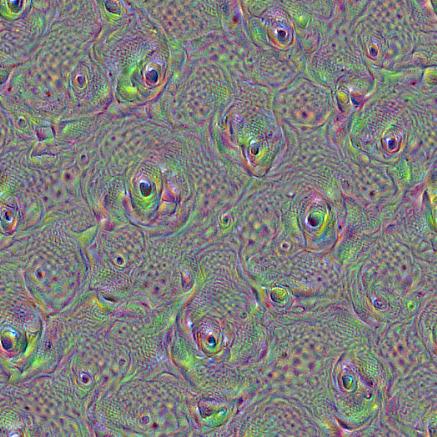
layer = ‘mixed4d_3x3_bottleneck_pre_relu’
channel = 60
octave_n=4, octave_scale=1.25
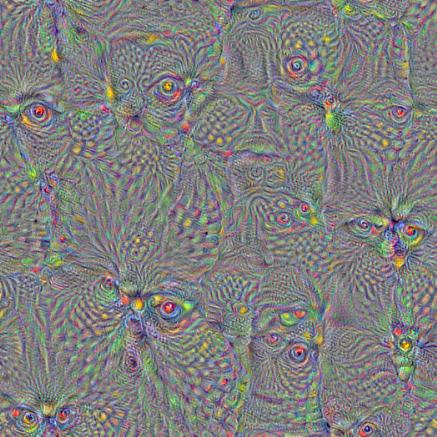
layer = ‘mixed4d_3x3_bottleneck_pre_relu’
channel = 139
octave_n=4, octave_scale=1.25
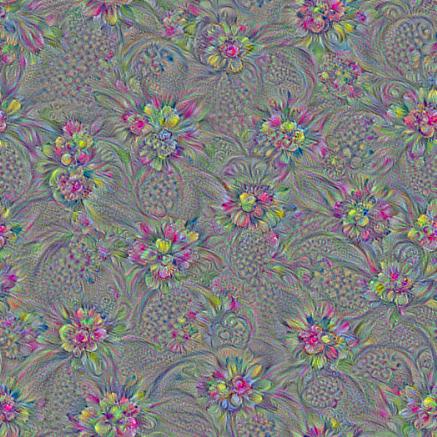
layer = ‘mixed4b_3x3_bottleneck_pre_relu’
channel = 24
octave_n=4, octave_scale=1.25
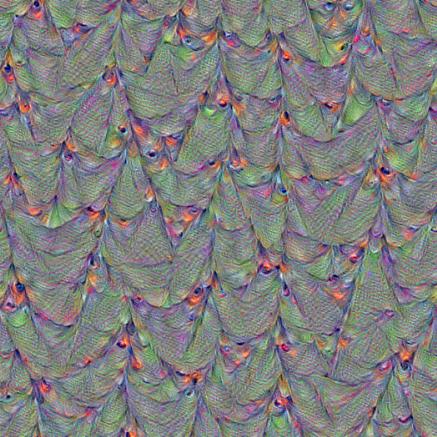
参考来源:
机器学习:DeepDreaming with TensorFlow (二)的更多相关文章
- 机器学习: DeepDreaming with TensorFlow (一)
在TensorFlow 的官网上,有一个很有趣的教程,就是用 TensorFlow 以及训练好的深度卷积神经(GoogleNet)网络去生成一些有趣的pattern,通过这些pattern,可以更加深 ...
- ng机器学习视频笔记(二) ——梯度下降算法解释以及求解θ
ng机器学习视频笔记(二) --梯度下降算法解释以及求解θ (转载请附上本文链接--linhxx) 一.解释梯度算法 梯度算法公式以及简化的代价函数图,如上图所示. 1)偏导数 由上图可知,在a点 ...
- 机器学习之支持向量机(二):SMO算法
注:关于支持向量机系列文章是借鉴大神的神作,加以自己的理解写成的:若对原作者有损请告知,我会及时处理.转载请标明来源. 序: 我在支持向量机系列中主要讲支持向量机的公式推导,第一部分讲到推出拉格朗日对 ...
- Google机器学习课程基于TensorFlow : https://developers.google.cn/machine-learning/crash-course
Google机器学习课程基于TensorFlow : https://developers.google.cn/machine-learning/crash-course https ...
- Andrew Ng机器学习课程笔记(二)之逻辑回归
Andrew Ng机器学习课程笔记(二)之逻辑回归 版权声明:本文为博主原创文章,转载请指明转载地址 http://www.cnblogs.com/fydeblog/p/7364636.html 前言 ...
- 机器学习:DeepDreaming with TensorFlow (三)
我们看到,利用TensorFlow 和训练好的Googlenet 可以生成多尺度的pattern,那些pattern看起来比起单一通道的pattern你要更好,但是有一个问题就是多尺度的pattern ...
- ML.NET 发布0.11版本:.NET中的机器学习,为TensorFlow和ONNX添加了新功能
微软发布了其最新版本的机器学习框架:ML.NET 0.11带来了新功能和突破性变化. 新版本的机器学习开源框架为TensorFlow和ONNX添加了新功能,但也包括一些重大变化, 这也是发布RC版本之 ...
- 机器学习算法总结(十二)——流形学习(Manifold Learning)
1.什么是流形 流形学习的观点:认为我们所能观察到的数据实际上是由一个低维流行映射到高维空间的.由于数据内部特征的限制,一些高维中的数据会产生维度上的冗余,实际上这些数据只要比较低的维度就能唯一的表示 ...
- Python3实现机器学习经典算法(二)KNN实现简单OCR
一.前言 1.ocr概述 OCR (Optical Character Recognition,光学字符识别)是指电子设备(例如扫描仪或数码相机)检查纸上打印的字符,通过检测暗.亮的模式确定其形状,然 ...
随机推荐
- SDI与ASI 接口具体解释介绍
分量编码 在对彩色电视信号进行数字化处理和传输是.一种经常使用的方式是分别对其3个分量(Y,R-Y.B-Y)进行数字化编码.这就是分量分量编码.另外还有全信号编码,全信号编码是对彩色全电视信号直接进行 ...
- centos7 安装php环境和安装swoole
这仅是我在网上找了多个解决方法,搞定了我遇到的问题,做的一个记录,买这个服务器就是为了测试swoole,结果快到期了,swoole还没装好 感谢https://www.cnblogs.com/phpw ...
- [Recompose] Show a Spinner While a Component is Loading using Recompose
Learn how to use the 'branch' and 'renderComponent' higher-order components to show a spinner while ...
- copy 和 MutableCopy
1:copy拷贝得到的对象都是不可变对象,MutableCopy拷贝得到的对象都是可变对象.MutableCopy拷贝得到的对象都是新的对象,会重新分配内存地址,而copy拷贝的对象既可以是新对象,也 ...
- 【编程】常见概念的理解 —— inplace、vanity url、vanilla(code/software)、编译、链接、build、(delegate、proxy)
inplace: 如修改一个文件等对象时, inplace=True,不创建新的对象,直接在原始对象上尽心修改: inplace=False,在对原始对象进行修改,而会创建新的对象: vanity u ...
- <LeetCode OJ> 62. / 63. Unique Paths(I / II)
62. Unique Paths My Submissions Question Total Accepted: 75227 Total Submissions: 214539 Difficulty: ...
- AngularJS之基本指令(init、repeat)
<h3>ng-init初始化变量</h3> <div ng-init="name='aurora';age='18'"> <p ng-bi ...
- Qt 无标题无边框程序的拖动和改变大小
最近做项目遇到的问题,总结下. 有时候我们觉得系统的标题栏和按钮太丑太呆板,想做自己的标题栏以及最大化.最小化.关闭,菜单按钮,我们就需要 setWindowFlags(Qt::FramelessWi ...
- Android 实现Xmpp工具类
/** * XMPP服务器连接工具类. * * @author chen.lin * */ public class XmppManager { private static final String ...
- 《iOS开发全然上手——使用iOS 7和Xcode 5开发移动与平板应用》之Objective-C新手训练营
编写Hello World应用程序通常被觉得,是学习不论什么编程语言的第一步.在这一章,你将创建iOS版的Hello World应用程序作为起步,高速了解Xcode这个开发iOS应用程序的主要工具. ...