
James Munkres Topology: Sec 18 Exer 12
Theorem 18.4 in James Munkres “Topology” states that if a function \(f : A \rightarrow X \times Y\) is continuous, its coordinate functions \(f_1 : A \rightarrow X\) and \(f_2 : A \rightarrow Y\) are also continuous, and the converse is also true. This is what we have been familiar with, such as a continuous parametric curve \(f: [0, 1] \rightarrow \mathbb{R}^3\) defined as \(f(t) = (x(t), y(t), z(t))^T\) with its three components being continuous. However, if a function \(g: A \times B \rightarrow X\) is separately continuous in each of its components, i.e. both \(g_1: A \rightarrow X\) and \(g_2 : B \rightarrow X\) are continuous, \(g\) is not necessarily continuous.
Here, the said “separately continuous in each of its components” means arbitrarily selecting the value of one component variable from its domain and fix it, then the original function depending only on the other component is continuous. In the above, the function \(g\) can be envisaged as a curved surface in 3D space. With \(g_1\) being continuous, the intersection profiles between this curved surface and those planes perpendicular to the coordinate axis for \(B\) are continuous. Similarly, because \(g_2\) is continuous, the intersection profiles obtained from those planes perpendicular to the coordinate axis for \(A\) are also continuous. The continuity of intersection curves is only ensured in these two special directions, so it is not guaranteed that the original function \(g\) is continuous.
In Exercise 12 of Section 18, an example is given as
\[
F(x \times y) = \begin{cases}
\frac{xy}{x^2 + y^2} & (x \neq 0, y \neq 0) \\
0 & (x = 0, y = 0)
\end{cases},
\]
where \(F\) is continuous separately in each of its component variables but is not continuous by itself. This is function is visualized below.
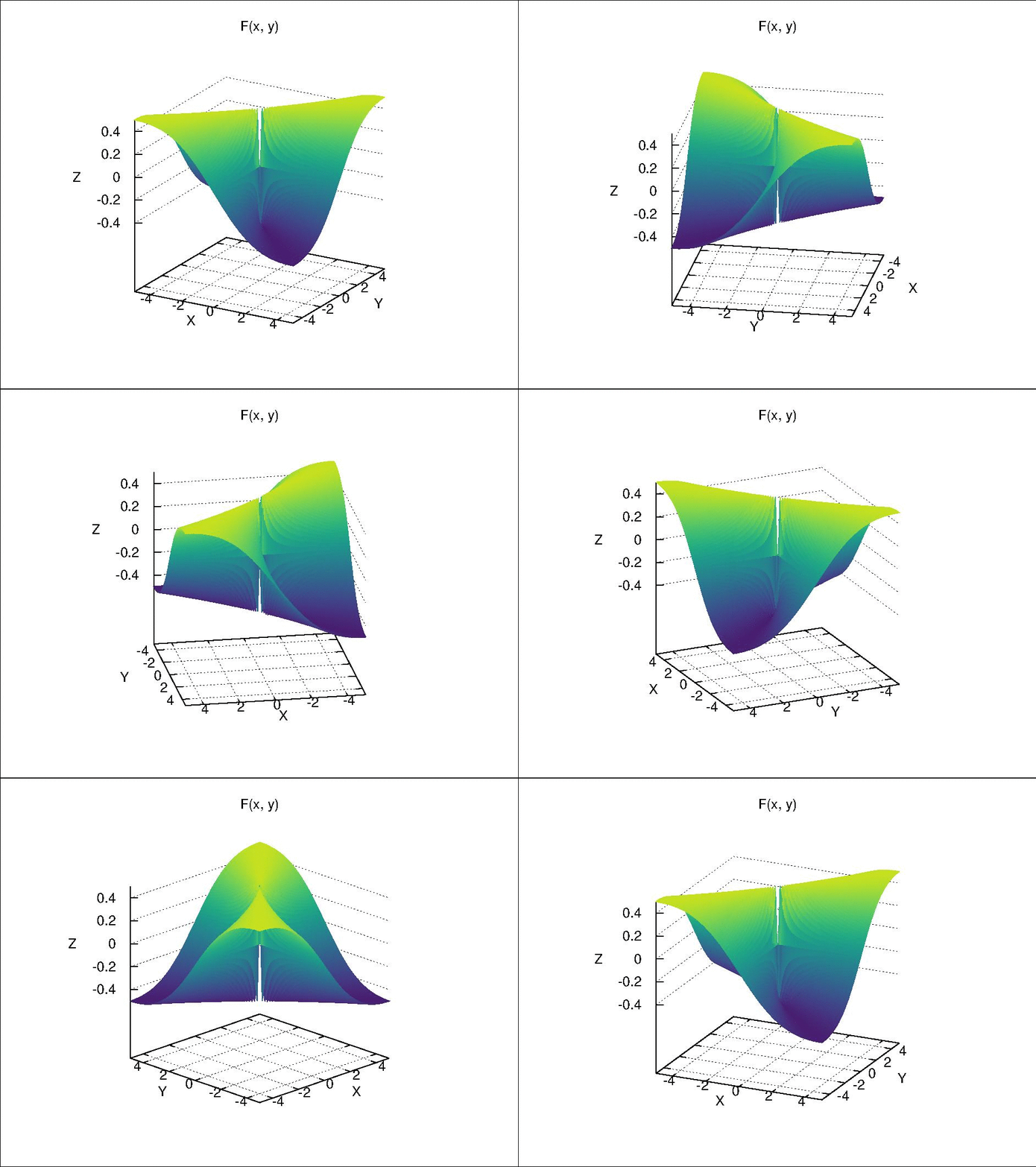
Fix \(y\) at \(y_0\), we have \(F_{y_0}(x) = F(x \times y_0)\). When \(y_0 \neq 0\), \(F_{y_0}(x)\) is continuous with respect to \(x\) because it is only a composition of continuous real valued functions via simple arithmetic. When \(y_0 = 0\), if \(x \neq 0\), \(F_0(x) = 0\); if \(x =0\), \(F_0(x)\) is also 0 due to the definition of \(F(x \times y)\). Therefore, \(F_0(x)\) is a constant function, which is continuous due to Theorem 18.2 (a). Similarly, \(F_{x_0}(y)\) is also continuous with respect to \(y\).
However, if we let \(x = y\) and approach \((x, y) = (x, x)\) to \((0, 0)\), it can be seen that \(F(x \times x)\) is not continuous, because
- when \(x \neq 0\), \(F(x \times x) = \frac{x^2}{x^2 + x^2} = \frac{1}{2}\);
- when \(x = 0\), \(F(x \times x) = 0\).
If we let \(x = -y\) and approach \((x ,y) = (x, -x)\) to \((0, 0)\), \(F = -\frac{1}{2}\) when \(x \neq 0\) and \(F = 0\) when \(x = 0\).
Then, if we select an open set such as \((-\frac{1}{4}, \frac{1}{4})\) around the function value \(0\) in \(\mathbb{R}\), its pre-image \(U\) in \(\mathbb{R} \times \mathbb{R}\) should include the point \((0, 0)\) and exclude the rays \((x, x)\) and \((x, -x)\) with \(x \in \mathbb{R}\) and \(x \neq 0\). Due to these excluded rays, there is no neighborhood of \((0, 0)\) in \(\mathbb{R} \times \mathbb{R}\) that is contained completely in \(U\). Therefore, \(U\) is not an open set and \(F(x \times y)\) is not continuous.
From the above analysis, some lessons can be learned.
- Pure analysis can be made and general conclusions can be obtained before entering into the real world with a solid example.
- A tangible counter example is a sound proof for negation of a proposition. Just one is enough!
James Munkres Topology: Sec 18 Exer 12的更多相关文章
- James Munkres Topology: Sec 22 Exer 3
Exercise 22.3 Let \(\pi_1: \mathbb{R} \times \mathbb{R} \rightarrow \mathbb{R}\) be projection on th ...
- James Munkres Topology: Sec 22 Exer 6
Exercise 22.6 Recall that \(\mathbb{R}_{K}\) denotes the real line in the \(K\)-topology. Let \(Y\) ...
- James Munkres Topology: Sec 37 Exer 1
Exercise 1. Let \(X\) be a space. Let \(\mathcal{D}\) be a collection of subsets of \(X\) that is ma ...
- James Munkres Topology: Sec 22 Example 1
Example 1 Let \(X\) be the subspace \([0,1]\cup[2,3]\) of \(\mathbb{R}\), and let \(Y\) be the subsp ...
- James Munkres Topology: Theorem 19.6
Theorem 19.6 Let \(f: A \rightarrow \prod_{\alpha \in J} X_{\alpha}\) be given by the equation \[ f( ...
- James Munkres Topology: Lemma 21.2 The sequence lemma
Lemma 21.2 (The sequence lemma) Let \(X\) be a topological space; let \(A \subset X\). If there is a ...
- James Munkres Topology: Theorem 20.3 and metric equivalence
Proof of Theorem 20.3 Theorem 20.3 The topologies on \(\mathbb{R}^n\) induced by the euclidean metri ...
- James Munkres Topology: Theorem 20.4
Theorem 20.4 The uniform topology on \(\mathbb{R}^J\) is finer than the product topology and coarser ...
- James Munkres Topology: Theorem 16.3
Theorem 16.3 If \(A\) is a subspace of \(X\) and \(B\) is a subspace of \(Y\), then the product topo ...
随机推荐
- docker_监控
目录 Docker 自带的监控子命令 sysdig Weave Scope cAdvisor Prometheus Prometheus 的架构 多维数据模型 Docker 自带的监控子命令 ps d ...
- Maven pom文件标签解析大全
<span style="padding:0px; margin:0px"><project xmlns="http://maven.apache.or ...
- Zookeeper与Curator二三事【坑爹】
起因:我的Dubbo服务起不来:我本地Zookeeper3.4.11,Curator4.1 Caused by: org.apache.zookeeper.KeeperException$Unimpl ...
- Eclipse 添加 Source 源代码、Javadoc 文档
源代码 Source 按住 Ctrl 键,鼠标放到对应的类.方法上,出现 Open Declaration,Open Implementation ,可查看对应的实现.声明源代码. 也可以在[Proj ...
- go interface接口
一:接口概要 接口是一种重要的类型,他是一组确定的方法集合. 一个接口变量可以存储任何实现了接口方法的具体值.一个重要的例子就是io.Reader和io.Writer type Reader inte ...
- 应用调试(五)侵入式SWI
目录 应用调试(五)侵入式SWI 场景应用 测试程序 修改APP的bin 修改SWI 获得当前进程的寄存器 测试运行 恢复代码 进程间内存拷贝 TODO 更多参考文献 title: 应用调试(五)侵入 ...
- 包管理工具之Pipenv
pipenv 都包含什么? pipenv 是 Pipfile 主要倡导者.requests 作者 Kenneth Reitz 写的一个命令行工具,主要包含了Pipfile.pip.click.requ ...
- ubuntu14.04 网络配置
流程分析: 在Ubuntu系统网络设备启动的流程中,会依赖/etc/network/interface的配置文件初始化网络接口,所以直接在/etc/network/interface之中配置好对应的d ...
- python之路(2)集合(set)和字符串格式化
目录 集合(set) 字符串的格式化(%和format) 集合(set) {‘a’,'b','c','d','e'} 定义:有不同元素组成的集合,集合的元素为不可变类型(数字,字符串,元组),集合是一 ...
- 点评cat系列-简介
面上有很多优秀的 OS 级监控系统 (比如 falcon), 这些监控系统主要聚焦在 CPU/IO/Mem/Disk 和应用端口, falcon 甚至可以监控到 JVM. 但对于应用系统内部的一些监控 ...