
python3 语法小结
(1) 关键字
# -*- coding: utf-8 -*-

#!/usr/bin/python3

"""

1、关键字(保留字)

['False', 'None', 'True', 'and', 'as', 'assert', 'async', 'await', 'break', 'class', 'continue', 'def', 'del', 'elif',

 'else', 'except', 'finally', 'for', 'from', 'global', 'if', 'import', 'in', 'is', 'lambda', 'nonlocal', 'not', 'or',

 'pass', 'raise', 'return', 'try', 'while', 'with', 'yield']

"""

import keyword

print(keyword.kwlist)

"""2、注释"""

#单行注释

""" 多行注释"""

'''多行注释'''
(2)数据类型,此处重点字符串常用方法
# -*- coding: utf-8 -*-

#!/usr/bin/python3

#1、数字类型

"""

数字有四种类型:整数、布尔型、浮点数和复数。

int (整数), 如 1, 只有一种整数类型 int,表示为长整型,没有 python2 中的 Long。

bool (布尔), 如 True。

float (浮点数), 如 1.23、3E-2

complex (复数), 如 1 + 2j、 1.1 + 2.2j

"""

#2、字符串  参考:https://www.cnblogs.com/fyknight/p/7895894.html

def strFuc():

    a = "hello"

    b = a *3

    print(a) #python2  print不要括号

    print(b)

    print(a,b)

    #不换行

    print(a,end=",")

    print(b,end=",")

    """

    hello

    hellohellohello

    hello hellohellohello

    hello,hellohellohello,

    """

    s = "hello stupid"

    #---------<常用方法>-----------

    #index 返回元素下标

    index = s.index("u")

    print(index)  #

    #find

    leftIndex = s.find("stu")

    print(leftIndex)  #

    #count 得到字符串元素的个数

    count = s.count("l")

    print(count)  #

    #strip 类似java trim(),移除左右两边空格

    print("   add  ".strip())

    #split 分隔符,返回列表

    s = "hello,stupid"

    lis = s.split(",")

    print(lis)

    print(isinstance(lis, list))  # 列表

    #replace 替换

    s = "hello,stupid"

    rep = s.replace("stupid", "笨蛋")

    print(rep)  # hello,笨蛋

    #join 序列中的元素以指定的字符拼接生成一个新的字符串,并返回这个字符串

    tup = ("Hello,my ", "beautiful", " girl")  #tup = ["Hello,my ","beautiful"," girl"]

    str = "".join(tup)

    print(str)  # Hello,my beautiful girl

    #format

    # 按默认顺序对字符串进行格式化

    s = "I am dark {},I'm {} years old!"

    s1 = s.format('knight', '')

    print(s1)  # I am dark knight,I'm 28 years old!

    #按位置对字符串进行格式化

    s = "I am dark {1},I'm {0} years old!"

    s1 = s.format('', 'knight')

    print(s1) #I am dark knight,I'm 28 years old!

    # endoce()和decode()

    # 以utf-8的方式进行编码并解码

    s = '暗黑骑士'

    s1 = s.encode('utf-8')

    print(s1)  # 得到以"utf-8"编码后的二进制数

    s2 = s1.decode('utf-8')

    print(s2)  # 用decode解码,以什么编码就要以什么解码,否则乱码

    """

    b'\xe6\x9a\x97\xe9\xbb\x91\xe9\xaa\x91\xe5\xa3\xab'

    暗黑骑士

    """

    # startswith(suffix,start,end)和endswith(suffix,start,end)

    s = 'dark knight'

    s1 = s.startswith('dark')

    print(s1)  # True

    # 判断字符串是否以指定字符串开头,并指定范围

    s = 'dark knight'

    s1 = s.startswith('k', 5)

    print(s1)  # True

    #upper() 和lower()

    # title()  将字符串中的所有单词的首字母替换成大写字母

    s = "i am hero"

    print(s.title())  # I Am Hero

    # swapcase() 将字符串的大小写字母进行转换,并返回转换后的字符串

    print(s.swapcase())  # I AM HERO

    #capitalize() 返回一个将字符串首字母大写、字符串中的其它字母变为小写的字符串

    s = 'dARk kNigHt'

    s1 = s.capitalize()

    print(s1) #Dark knight

    #center(len,sginl) 返回一个居中对齐的字符串,并使用指定长度的填充符号,不指定填充符号默认使用空格作为填充符号

    s = 'dark knight'

    s1 = s.center(30)

    print('开始->', s1, '<-结束')                #开始->          dark knight           <-结束

    print('开始->', s.center(30,"*"), '<-结束') #开始-> *********dark knight********** <-结束

    #zfill() 按指定长度在字符串的左侧填充"0"补齐,并返回这个补齐“0”后的字符串

    s = "hej"

    print(s.zfill(15)) #000000000000hej

    #isdigit() 判断字符串是否只由数字组成,并返回一个布尔值

    #isalpha() 判断字符串是否只由字母组成

    #isalnum() 判断字符串是否只由字母或数字组成

    #isupper() 判断字符串中所有的字母是否为大写。并返回一个布尔值

    #islower() 判断字符串中所有的字母是否为小写。并返回一个布尔值

    #isspace() 判断字符串是否只由空白字符组成,并返回一个布尔值
(3)python 导入:

commonModule.py
# -*- coding: utf-8 -*-

#!/usr/bin/python3

def isGreater(x,y):

    '''

    x是否大于

    :param x:

    :param y:

    :return:yTrue or False

    '''

    return x > y
moduleTest.py
# -*- coding: utf-8 -*-

#!/usr/bin/python3

import com.grammar.commonModule as commonModule

if __name__ == "__main__":

    a = commonModule.isGreater(3,2)

    print(a)
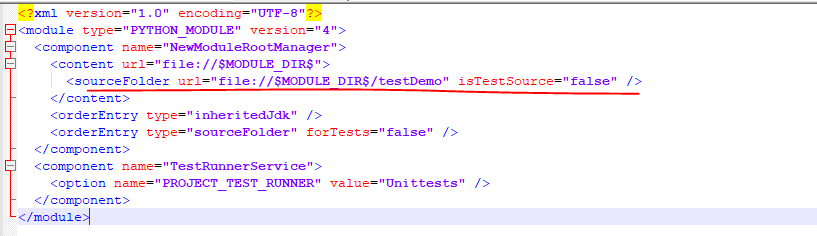
此处需要指定工程为sourceFolder。具体有下两种:
1、pycharm:file>setting>

2、找到工程python37.iml文件
(4)数据类型(列表、元组、字典、集合)
列表:
# -*- coding: utf-8 -*-

#!/usr/bin/python3

def listFuc():

    lis = [2,3,"hello"]  #列表的数据项不需要具有相同的类型

    print(lis)

    #len(list) 列表元素个数

    #max(list) 返回列表元素最大值  注意:元素相同类型,否则报错

    #min(list) 返回列表元素最小值

    #list(seq) 将元组转换为列表

    #----列表方法

    #list.append(obj)  在列表末尾添加新的对象

    #list.count(obj)  统计某个元素在列表中出现的次数

    #list.extend(seq) 在列表末尾一次性追加另一个序列中的多个值(用新列表扩展原来的列表

    #list.index(obj)  从列表中找出某个值第一个匹配项的索引位置

    #list.insert(index, obj) 将对象插入列表

    list1 = ['Google', 'Runoob', 'Taobao']

    list1.insert(1, 'Baidu')

    print('列表插入元素后为 : ', list1) #列表插入元素后为 :  ['Google', 'Baidu', 'Runoob', 'Taobao']

    #list.pop([index=-1])  移除列表中的一个元素(默认最后一个元素),并且返回该元素的值

    #list.remove(obj) 移除列表中某个值的第一个匹配项

    #list.reverse() 反向列表中元素

    #list.sort(key=None, reverse=False)  对原列表进行排序,其中key是按照某种规则排序

    vowels = ['e', 'a', 'u', 'o', 'i']

    vowels.sort(reverse=True)  ## 降序

    print('降序输出:', vowels)  # 降序输出: ['u', 'o', 'i', 'e', 'a']

    random = [(2, 2), (3, 4), (4, 1), (1, 3)]

    # 以元组第二元素有小到达排序

    random.sort(key=lambda x: x[1])  # [(4, 1), (2, 2), (1, 3), (3, 4)]

    print(random)

    #list.clear() 清空列表

    #list.copy()  复制列表

    #遍历列表(1)

    lis = [2,3,4,5,1,7]

    for i in lis:

        print(i,end=",")

    else:

        print("结束")

    #遍历列表(2)

    for i in range(len(lis)):

        print("序号:%s   值:%s"%(i,lis[i]))

        # 遍历列表(3)

    for i, val in enumerate(lis):

        print("序号:%s   值:%s" % (i, val))

    """

    序号:0   值:2

    序号:1   值:3

    序号:2   值:4

    序号:3   值:5

    序号:4   值:1

    序号:5   值:7

    """

    #添加元素

    list = [2, 3, 4, 5, 1, 7]

    # list[6] =8 #IndexError

    list.append(8)  # ok

    print(list)

    #删除数据

    delList = [2,3,4,5,1,7]

    #del delList[6] #IndexError  注意:不要超出范围

    del delList[5]

    print(delList)#[2, 3, 4, 5, 1]

    #序列

    seqList = [2,3,4,5,1,7]

    print(seqList[0:2]) #[2, 3]

    print(seqList[1:])  # [3, 4, 5, 1, 7]

    print(seqList[0:len(seqList)]) #[2, 3, 4, 5, 1, 7]
元组:
# -*- coding: utf-8 -*-

#!/usr/bin/python3

import collections

def tupleFuc():

    tup1 = (50)

    tup2 = (50,)

    print(type(tup1))  # <class 'int'>

    print(type(tup2))  # <class 'tuple'>

    # 访问元组

    tup1 = ('Google', 'Runoob', 1997, 2000)

    tup2 = (1, 2, 3, 4, 5, 6, 7)

    print("tup1[0]: ", tup1[0])  # tup1[0]:  Google

    print("tup2[1:5]: ", tup2[1:5])  # tup2[1:5]:  (2, 3, 4, 5)

    # 元组中的元素值是不允许直接修改的

    tup1 = (12, 34.56);

    tup2 = ('abc', 'xyz')

    # 以下修改元组元素操作是非法的。

    # tup1[0] = 100

    # 但可以对元组进行连接组合

    tup3 = tup1 + tup2;

    print(tup3)  # (12, 34.56, 'abc', 'xyz')

    #通过间接方法修改元组

    #方法1:

    tuple1 = (1, 2, 4, 5)

    tuple2 = tuple1[:2] + (3,) + tuple1[2:]

    print(tuple2) #(1, 2, 3, 4, 5)

    #方法2:

    t1=(1,2,3,4)

    list = list(t1)

    list[1] = 9

    t2= tuple(list)

    print(t2) #(1, 9, 3, 4)

    tup = ('Google', 'Runoob', 1997, 2000)

    print(tup)

    del tup;

    print("删除后的元组 tup : ")

    print(tup) #NameError: name 'tup' is not defined

    # ---元组运算符

    # len() 计算元素个数

    print(len((1, 2, 3)))  #

    # 元组连接

    a = (1, 2, 3) + (4, 5, 6, 7)

    print(a)  # (1, 2, 3, 4, 5, 6, 7)

    # 复制

    print(("Hi") * 3)  # HiHiHi  相当于字符串复制

    print(("Hi",) * 3)  # ('Hi', 'Hi', 'Hi')

    # 元素是否存在

    print(3 in (1, 4, 3))  # True

    #迭代

    for i in (1, 2, 3, 4): print(i)

    #内置函数

    #len(tuple)  计算元组元素个数

    #max(tuple) 返回元组中元素最大值  元素类型一致

    #min(tuple) 返回元组中元素最小值

    #tuple(list) 将列表转换为元组  与list(tuple) 相反

    list1 = ['Google', 'Taobao', 'Runoob', 'Baidu']

    l = tuple(list1)

    print(l)  ##('Google', 'Taobao', 'Runoob', 'Baidu')

    s = "Hello,%s,%s" % ("jack", "Tom")

    print(s) #Hello,jack,Tom

    #遍历  range(start,end,step)

    t1 = (1, 2, 3, 4)

    for i in range(0, 9, 2):

        print(i)

    """

    0

    2

    4

    6

    8

    """

def namedtupleFuc():

    #Python元组的升级版本 -- namedtuple(具名元组)

    # 两种方法来给 namedtuple 定义方法名

    # User = collections.namedtuple('User', ['name', 'age', 'id'])

    User = collections.namedtuple('User', 'name age id')

    user = User('tester', '', '')

    print(user) #User(name='tester', age='22', id='464643123')

    print(user.name,user.age,user.id) #tester 22 464643123
字典:
# -*- coding: utf-8 -*-

#!/usr/bin/python3

def dictFuc():

    dict = {'Alice': '', 'Beth': '', 'Cecil': ''}

    # 访问指定元素

    print(dict["Beth"])  #

    # print(dict.Beth) #AttributeError

    print(dict.get("Beth")) #

    # 修改字典

    dict["Alice"] = ""

    print(dict)  # {'Alice': '1234', 'Beth': '9102', 'Cecil': '3258'}

    #删除字典元素和字典

    delDict = {'Name': 'Runoob', 'Age': 7, 'Class': 'First'}

    del delDict['Name']  # 删除键 'Name'

    print(delDict)  # {'Age': 7, 'Class': 'First'}

    delDict.clear()  # 清空字典

    print(delDict)  # {}

    del delDict  # 删除字典

    print(delDict)  # NameError: name 'delDict' is not defined

    #注意:1、不允许同一个键出现两次。创建时如果同一个键被赋值两次,后一个值会被记住

    # 2、键必须不可变,所以可以用数字,字符串或元组充当,而用列表就不行

    #内置函数

    #len(dict)   计算字典元素个数,即键的总数

    #str(dict) 输出字典,以可打印的字符串表

    strDict = {'Name': 'Runoob', 'Age': 7, 'Class': 'First'}

    print(str(strDict))  # {'Name': 'Runoob', 'Age': 7, 'Class': 'First'}

    #内置方法

    #dict.clear() 删除字典内所有元素

    # dict.copy() 返回一个字典的浅复制

    # dict.fromkeys() 创建一个新字典,以序列seq中元素做字典的键,val为字典所有键对应的初始值

    attribute = ("name", "age", "gender")

    userDict = dict.fromkeys(attribute)

    print(userDict)  # {'name': None, 'age': None, 'gender': None}

    userDict = dict.fromkeys(attribute, 10)

    print(userDict)  # {'name': 10, 'age': 10, 'gender': 10}

    # dict.get(key, default=None)  返回指定键的值,如果值不在字典中返回default值

    # key in dict 如果键在字典dict里返回true,否则返回false

    # dict.items() 以列表返回可遍历的(键, 值) 元组数组

    itemDict = {'Name': 'Runoob', 'Age': 7}

    print(itemDict.items()) #Value : dict_items([('Name', 'Runoob'), ('Age', 7)])

    print(type(itemDict.items())) #<class 'dict_items'>

    print(list(itemDict.items()))  # [('Name', 'Runoob'), ('Age', 7)] 注意: 需要转换

    #print(itemDict.items()[0]) #TypeError: 'dict_items' object does not support indexing

    for k,v in itemDict.items():

        print(k,v)

    """

    Name Runoob

    Age 7

    """

    # dict.keys() 返回一个迭代器,可以使用 list() 来转换为列表

    # dict.setdefault(key, default=None) 和get()类似, 但如果键不存在于字典中,将会添加键并将值设为default

    # dict.update(dict2)

    updict = {'Name': 'Runoob', 'Age': 7}

    updict2 = {'Age': 'female'}

    updict.update(updict2)

    # 注意:如果键值有重复,则 dict2 的内容更新替换到 dict 中

    print("更新字典 dict : ", updict)  # 更新字典 dict :  {'Name': 'Runoob', 'Age': 'female'}

   #按照key给字典排序

    sdict = {200: 'a', 20: 'b', 610: 'c'}

    d1 = {}

    for k in sorted(sdict.keys()):

        d = {k: sdict[k]}

        d1.update(d)

    print(d1)  # {20: 'b', 200: 'a', 610: 'c'}

    # dict.values() 返回一个迭代器,可以使用 list() 来转换为列表

    # dict.    pop(key[,default]) 删除字典给定键 key 所对应的值,返回值为被删除的值。key值必须给出。 否则,返回default值。

    # dict.    popitem() 随机返回并删除字典中的一对键和值(一般删除末尾对)。
集合:
# -*- coding: utf-8 -*-

#!/usr/bin/python3

def setFuc():

    # 空集合

    s = set()  # { },因为 { } 是用来创建一个空字典

    #初始化

    basket = {'apple', 'orange', 'apple', 'pear', 'orange', 'banana'}

    s1 = set({'apple', 'orange', 'apple', 'pear', 'orange', 'banana'})

    # 一个无序的不重复元素序列

    print(s1) #{'banana', 'pear', 'orange', 'apple'}

    ar = set('abracadabra')  #不推荐

    print(ar) #{'c', 'r', 'a', 'b', 'd'}

    #集合间的运算

    a = set('abracadabra')

    b = set('alacazam')

    #集合a中包含而集合b中不包含的元素

    print(a-b) #{'d', 'b', 'r'}

    #集合a或b中包含的所有元素  =>并集

    print(a|b) #{'r', 'm', 'a', 'z', 'd', 'c', 'b', 'l'}

    # 集合a和b中都包含了的元素  =>交集

    print(a & b ) #{'a', 'c'}

    #不同时包含于a和b的元素  =>并集 - 交集

    print(a ^ b  ) #{'l', 'z', 'r', 'd', 'b', 'm'}

    c=(a|b)-(a & b)

    print(c) #{'d', 'z', 'r', 'm', 'l', 'b'}

    # 添加元素

    addS = set({'apple', 'orange', 'apple', 'pear', 'orange', 'banana'})

    addS.add('pix')

    print(addS)  # {'orange', 'banana', 'pear', 'apple', 'pix'}

    addS.add({1, 3})  #TypeError: unhashable type: 'set'  add() 不能是列表、元组或字典

    #update() 参数可以是列表,元组,字典等

    print(addS.update({1, 3}))  # {1, 'apple', 3, 'pear', 'orange', 'banana'}

    #移除元素

    remS = set({'apple', 'orange', 'apple', 'pear', 'orange', 'banana'})

    remS.remove('apple')

    print(remS)  # {'banana', 'orange', 'pear'}

    remS.remove('adg')

    print(remS)  # 元素不存在,KeyError: 'adg'

    #discard() 元素不存在,不会发生错误

    remS.discard('adg')

    print(remS)  # {'orange','banana', 'pear'}

    #pop()

    thisset = set(("Google", "Runoob", "Taobao", "Facebook"))

    x = thisset.pop()

    print(x)  # Runoob  每次结果不一样

    print(thisset)  # {'Facebook', 'Google', 'Taobao'}

    #注意:如果元素是列表或元组,从左删除

    listSet = set([3, 2, 1, 5, 4, 7, 8])

    print(listSet)  # {1, 2, 3, 4, 5, 7, 8}

    listSet.pop()

    print(listSet)  # {2, 3, 4, 5, 7, 8}

    tupleSet = set((3, 2, 1, 5, 4, 7, 8))

    print(tupleSet)  # {1, 2, 3, 4, 5, 7, 8}

    tupleSet.pop()

    print(tupleSet)  # {2, 3, 4, 5, 7, 8}

    #len(s) 集合元素个数

    lset = set(("Google", "Runoob", "Taobao"))

    print(len(lset))  #

    #clear()清空集合

    clrset = set(("Google", "Runoob", "Taobao"))

    clrset.clear()

    print(clrset)  # set()

    #判断元素是否在集合中存在  x in s

    inset = set(("Google", "Runoob", "Taobao"))

    print("Google" in inset)  # True

if __name__ == "__main__":

    listSet = set([3,2,1,5,4,7,8])

    print(listSet) #{1, 2, 3, 4, 5, 7, 8}

    listSet.pop()

    print(listSet)#{2, 3, 4, 5, 7, 8}
(5)条件、循环
条件
# -*- coding: utf-8 -*-

#!/usr/bin/python3

def conditionFuc1():

    var1 = 100

    if var1:  #True  或 非0数字 或非""字符串

        print("1 - if 表达式条件为 true")

        print(var1)

    else:

        print("...")

    var2 = 0

    if var2:

        print("2 - if 表达式条件为 true")

        print(var2)

    print("Good bye!")

    """

    1 - if 表达式条件为 true

    100

    Good bye!

    """

if __name__ == "__main__":

    var1 = 100

    if var1:

        print("1 - if 表达式条件为 true")

        print(var1)

    else:

        print("...")

    var2 = 0

    if var2:

        print("2 - if 表达式条件为 true")

        print(var2)

    print("Good bye!")

    """

    1 - if 表达式条件为 true

    100

    Good bye!

    """
循环
# -*- coding: utf-8 -*-

#!/usr/bin/python3

def whileFuc():

    n = 100

    sum = 0

    counter = 1

    while counter <= n:

        sum = sum + counter

        counter += 1

    else:

        print("counter > n,counter=%s"%counter) #最后一次打印:counter > n,counter=101

    print("1 到 %d 之和为: %d" % (n, sum)) ##1 到 100 之和为: 5050

def forFuc():

    sites = ["Baidu", "Google", "Runoob", "Taobao"]

    for site in sites:

        if site == "Runoob":

            print("Runoob!")

            break

        print("循环数据 " + site)

    else:

        print("没有循环数据!")

    print("完成循环!")

    """

    循环数据 Baidu

    循环数据 Google

    Runoob!

    完成循环!

    """

def rangeFuc():

    #range(start,end,step)

    for i in range(0, 10, 3):

        print(i)

    """

    0

    3

    6

    9

    """

#break和 continue 与java相同

#pass 表示空语句,什么都不做

if __name__ == "__main__":

    rangeFuc()
(6)迭代器与生成器
未完待续。。。
python3 语法小结的更多相关文章
- python2 与 python3 语法区别
python2 与 python3 语法区别 概述# 原稿地址:使用 2to3 将代码移植到 Python 3 几乎所有的Python 2程序都需要一些修改才能正常地运行在Python 3的环境下.为 ...
- python从入门到大神---3、浮光掠影python3语法
python从入门到大神---3.浮光掠影python3语法 一.总结 一句话总结: 语法不必一次记全部,效率太差,用哪部分内容,就把那部分内容全部记下来 1.python3中单引号和双引号的区别是什 ...
- python2.+进化至python3.+ 语法变动差异(不定期更新)
1.输出 python2.+ 输出: print "" python3.+ 输出: print ("") 2.打开文件 python2.+ 打开文件: file ...
- Python3语法详解
一.下载安装 1.1Python下载 Python官网:https://www.python.org/ 1.2Python安装 1.2.1 Linux 平台安装 以下为在Unix & Linu ...
- IT兄弟连 HTML5教程 HTML5的基本语法 小结及习题
小结 一个完整的HTML文件由标题.段落.列表.表格.文本,即嵌入的各种对象所组成,这些逻辑上统一的对象称为元素.HTML文档主体结构分为两部分,一部分是定义文档类型,另一部分则是定义文档主体的结构框 ...
- pyhton2 python3 语法区别
几乎所有的Python 2程序都需要一些修改才能正常地运行在Python 3的环境下.为了简化这个转换过程,Python 3自带了一个叫做2to3的实用脚本(Utility Script),这个脚本会 ...
- XML语法小结
语法结构主要要求: (1)有且仅有一个根元素. 根元素也称文档元素,整个 XML 文档的其他元素都包含在根元素中,并通过嵌套形成树 型结构.除了根元素外,其他元素都是子元素. (2)每个元素必须有开始 ...
- Markdown基础语法小结
一.前言 Markdown是一种可以使用普通文本编辑器编写的标记语言,通过简单的标记语法,它可以使普通文本内容具有一定的格式. --摘自百度百科 没想到一向不太靠谱的百度百科这次竟有了如此精辟的解释. ...
- python的语法小结
break 与continue的区别: 1.break是直接中断全部循环 2.continue则是在只不执行此次所循环的东西,其它循环依旧执行,比方说只是跳过第4次循环,第5次循环照常进行. \n 表 ...
随机推荐
- Oracle Redo log 状态及工作原理解析
Oracle重做日志(redo log)是用来记录操作条目,用于数据库数据恢复.为了提高效率,oracle通常建议设置三组redo log.本文将对重做日志组的状态以及多种状态之间切换做解析,力求掌握 ...
- tp5 中使用自定义扩展类和函数
如果是要引用其它控制器里定义的方法参考:https://www.cnblogs.com/efyefy/p/8796014.html 如果在extend定义的类和函数默认是在全局命名空间下的 new \ ...
- host文件的作用
什么是host文件 Hosts是一个没有扩展名的系统文件,其基本作用就是将一些常用的网址域名与其对应的IP地址建立一个关联“数据库”,当用户在浏览器中输入一个需要登录的网址时,系统会首先自动从Host ...
- 【python37--面向对象】
一. self是什么 绑定方法,self就是实例对象的唯一标志 >>> class Ball: def setName(self,name): self.name = name de ...
- 配置maven默认jdk版本
1.在setting.xml中配置.对所有通过该配置文件构建的maven项目有效. <profile> <id>jdk-1.8</id> <activatio ...
- topcoder srm list
300 305 310 315 320 325 330 335 340 350 360 370 380 390 400 410 415 420 425 430 435 440 445 450 455 ...
- Eclipse git commit错误;Committing changes has encountered a problem An Internal error occured
背景 在使用eclipse时,使用git commit 提交代码时,出项如下错误 解决方法 在工程目录下找到 .git 文件夹 ,找到里面的 index.lock 文件,然后删掉这个文件就可以了,如下 ...
- AndroidO Treble架构下Hal进程启动及HIDL服务注册过程【转】
本文转载自:https://blog.csdn.net/yangwen123/article/details/79854267 通过前面对Treble架构的介绍,我们知道,Android Framew ...
- FastQC结果详解
REF https://www.plob.org/article/5987.html 解压后,查看html格式的结果报告.结果分为如下几项: 结果分为绿色的"PASS",黄色的&q ...
- 第一章(欢迎进入node.js世界)
本章内容 1:Node.js是什么 2:服务器端javascript 3:node的异步和事件触发本质 4:node为谁而生 5:node程序示例 1.1 node.js他的首次亮相是在2009年,非 ...