
【转载】hyperNeat进化神经网络算法——HyperNEAT Explained——Advancing Neuroevolution
原文地址:
HyperNEAT Explained: Advancing Neuroevolution
Expanding NeuroEvolution
Last week, I wrote an article about NEAT (NeuroEvolution of Augmenting Topologies) and we discussed a lot of the cool things that surrounded the algorithm. We also briefly touched upon how this older algorithm might even impact how we approach network building today, alluding to the fact that neural networks need not be built entirely by hand.
Today, we are going to dive into a different approach to neuroevolution, an extension of NEAT called HyperNEAT. NEAT, as you might remember, had a direct encoding for its network structure. This was so that networks could be more intuitively evolved, node by node and connection by connection. HyperNEAT drops this idea because in order to evolve a network like the brain (with billions of neurons), one would need a much faster way of evolving that structure.
HyperNEAT is a much more conceptually complex algorithm (in my opinion, at least) and even I am working on understanding the nuts and bolts of how it all works. Today, we will take a look under the hood and explore some of the components of this algorithm so that we might better understand what makes it so powerful and reason about future extensions in this age of deep learning.
HyperNEAT
Motivation
Before diving into the paper and algorithm, I think it’s worth exploring a bit more the motivation behind HyperNEAT.
The full name of the paper is “A Hypercube-Based Indirect Encoding for Evolving Large-Scale Neural Networks”, which is quite the mouthful! But already, we can see two of the major points. It’s a hypercube-based indirect encoding. We’ll get into the hypercube part later, but already we know that it’s a move from direct encodings to indirect encodings (see my last blog on NEAT for a more detailed description of some differences between the two). Furthermore, we get the major reasoning behind it as well: For evolving big neural nets!
More than that, the creators of this algorithm highlight that if one were to look at the brain, they see a “network” with billions of nodes and trillions of connections. They see a network that uses repetition of structure, reusing a mapping of the same gene to generate the same physical structure multiple times. They also highlight that the human brain is constructed in a way to exploit physical properties of the world: symmetry (have mirrors of structures, two eyes for input for example) and locality (where nodes are in the structure influences their connections and functions).
Contrast this what we know about neural networks, either built through an evolution procedure or constructed by hand and trained. Do any of these properties hold? Sure, if we force the network to have symmetry and locality, maybe… However, even then, take a dense, feed-forward network where all nodes in one layer are connected to all nodes in the next! And when looking at the networks constructed by the vanilla NEAT algorithm? They tend to be disorganized, sporadic, and not exhibit any of these nice regularities.
Enter in HyperNEAT! Utilizing an indirect encoding through something called connective Compositional Pattern Producing Networks (CPPNs), HyperNEAT attempts to exploit geometric properties to produce very large neural networks with these nice features that we might like to see in our evolved networks.
What’s a Compositional Pattern Producing Network?
In the previous post, we discussed encodings, and today we’ll dive deeper into the indirect encoding used for HyperNEAT. Now, indirect encodings are a lot more common than you might think. In fact, you have one inside yourself!
DNA is an indirect encoding because the phenotypic results (what we actually see) are orders of magnitude larger than the genotypic content (the genes in the DNA). If you look at a human genome, we’ll say it has about 30,000 genes coding for approximately 3 billion amino acids. Well, the brain has 3 trillion connections. Obviously, there is something indirect going on here!
Something borrowed from the ideas of biology is an encoding scheme called developmental encoding. This is the idea that all genes should be able to be reused at any point in time during the developmental process and at any location within the individual. Compositional Pattern Producing Networks (CPPNs) are an abstraction of this concept that have been show to be able to create patterns for repeating structures in Cartesian space. See some structures that were produced with CPPNs here:
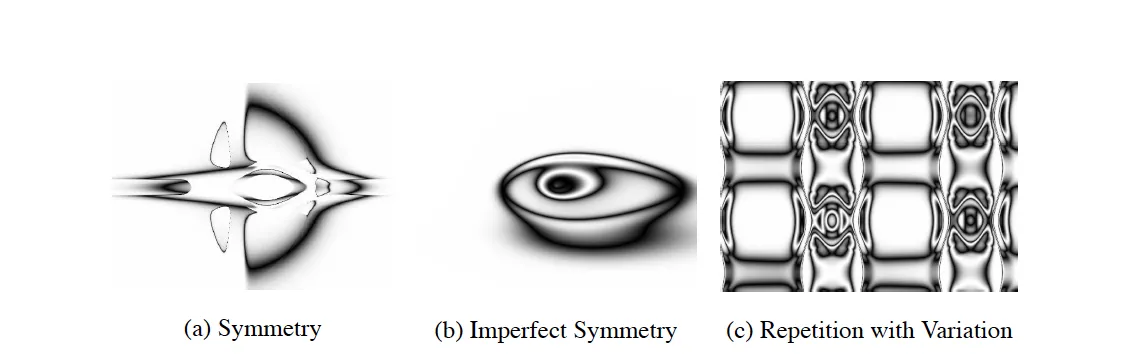
CPPN Images
Pure CPPNs
A phenotype can be described as a function of n dimensions, where n is the number of phenotypic traits. What we see is the result of some transformation from genetic encoding to the exhibited traits. By composing simple functions, complex patterns can actually be easily represented. Things like symmetry, repetition, asymmetry, and variation all easily fall out of an encoding structure like this depending on the types of networks that are produced.
We’ll go a bit deeper into the specifics of how CPPNs are specifically used in this context, but hopefully this gives you the general feel for why and how they are important in the context of indirect encodings.
Tie In to NEAT
In HyperNEAT, a bunch of familiar properties reappear for the original NEAT paper. Things like complexification over time are important (we’ll start with simple and evolve complexity if and when it’s needed). Historical markings will be used so that we can properly line up encodings for any sort of crossover. Uniform starting populations will also be used so that there’s no wildcard, incompatible networks from the start.
The major difference in how NEAT is used in this paper and the previous? Instead of using the NEAT algorithm to evolve neural networks directly, HyperNEAT uses NEAT to evolve CPPNs. This means that more “activation” functions are used for CPPNs since Gaussian distributions give rise to symmetry and trigonometric functions help with repetition of structure.
The Algorithm
So now that we’ve talked about what a CPPN is and that we use the NEAT algorithm to evolve and adjust them, it begs the question of how are these actually used in the overall HyperNEAT context?
First, we need to introduce the concept of a substrate. In the scope of HyperNEAT, a substrate is simply a geometric ordering of nodes. The simplest example could be a plane or a grid, where each discrete (x, y) point is a node. A connective CPPN will actually take two of these points and compute weight between these two nodes. We could think of that as the following equation:
CPPN(x1, y1, x2, y2) = w
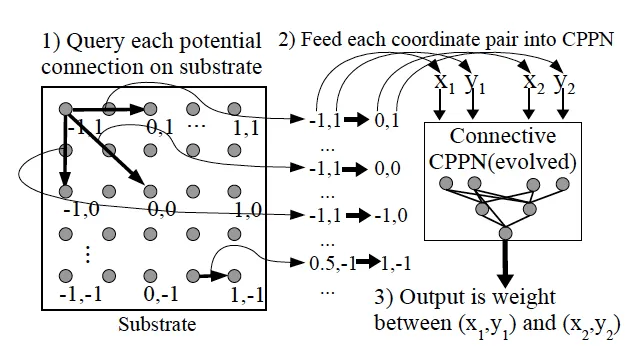
Basic CPPN layout
Where CPPN is an evolved CPPN, like that of what we’ve discussed in previous sections. We can see that in doing this, every single node will actually have some sort of weight connection between them (even allowing for recurrent connections). Connections can be positive or negative, and a minimum weight magnitude can also be defined so that any outputs below that threshold will result in no connection.
The geometric layout of nodes must be specified prior to the evolution of any CPPN. As a result, as the CPPN is evolved, the actually connection weights and network topology will result in a pattern that is geometric (all inputs are based on the positions of nodes).
In the case where the nodes are arranged on some sort of 2 dimensional plane or grid, the CPPN is a function of four dimensions, and thus we can say it is being evolved on a four dimensional hypercube. This is where we get the name of the paper!
Regularities in the Produced Patterns
All regularities that we’ve mentioned before can easily fall out of an encoding like this. Symmetry can occur by using symmetric functions over something like x1 and x2. This can be a function like a Gaussian function. Imperfect symmetry can occur when symmetry is used over things like both x and y, but only with respect to one axis.
Repetition also falls out, like we’ve mentioned before, with periodic functions such as sine, cosine, etc. And like with symmetry, variation against repetition can be introduced by inducing a periodic function over a non-repeating aspect of the substrate. Thus, all four major regularities that were aimed for are able to develop from this encoding.
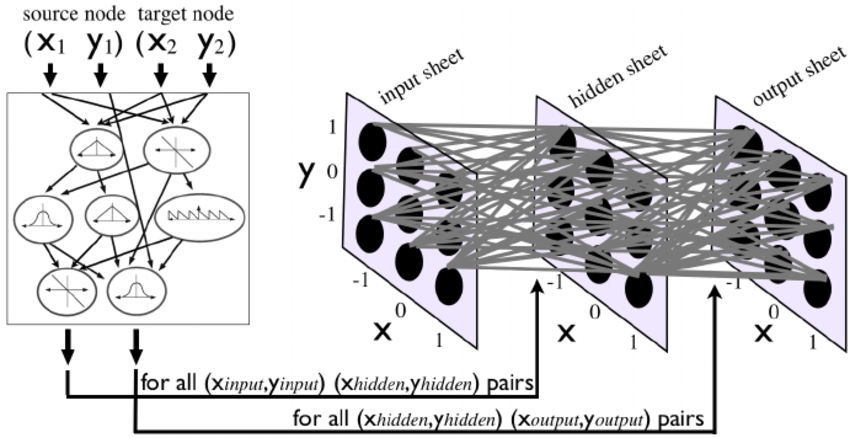
CPPN for Weights
Substrate Configuration
You may have guessed from the above that the configuration of the substrate is critical. And that makes a lot of sense. In biology, the structure of something is tied to its functionality. Therefore, in our own evolution schema, the structure of our nodes are tightly linked to the functionality and performance that may be seen on a particular task.
Here, we can see a couple of substrate configurations specifically outlined in the original paper:
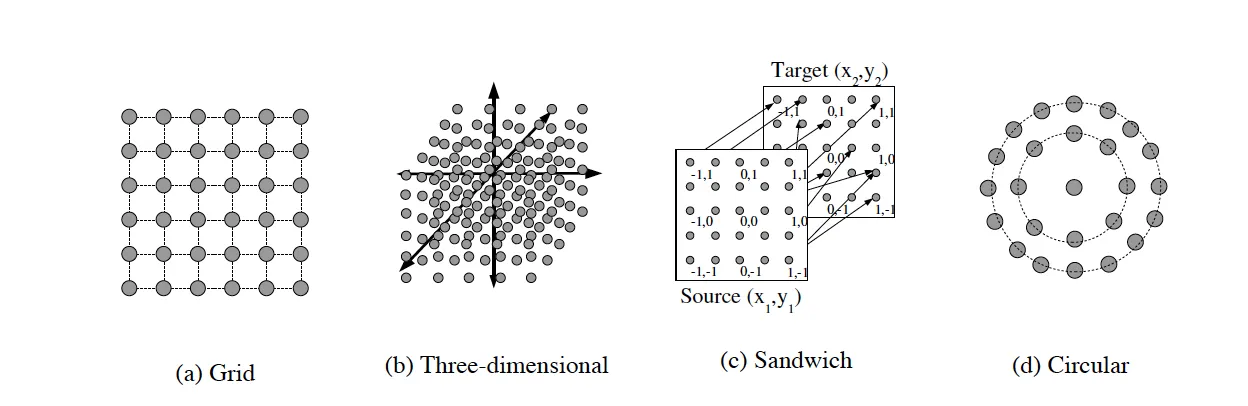
HyperNEAT Substrate Configurations
I think it’s very important to look at the configuration that is a three-dimensional cube and note how it simply adjusts our CPPN equation from four dimensional to six dimensional:
CPPN(x1, y1, z1, x2, y2, z2) = w
Also, the grid can be extended to the sandwich configuration by only allowing for nodes on one half to connect to the other half. This can be seen easily as an input/output configuration! The authors of the paper actually use this configuration to take in visual activation on the input half and use it to activate certain nodes on the output half.
The circular layout is also interesting, as geometry need not be a grid for a configuration. A radial geometry can be used instead, allowing for interesting behavioral properties to spawn out of the unique geometry that a circle can represent.
Input and Output Layout
Inputs and outputs are laid out prior to the evolution of CPPNs. However, unlike a traditional neural network, our HyperNEAT algorithm is made aware of the geometry of the inputs and outputs and can learn to exploit and embrace the regularities of it. Locality and repetition of inputs and outputs can be easily exploited through this extra information that HyperNEAT receives.
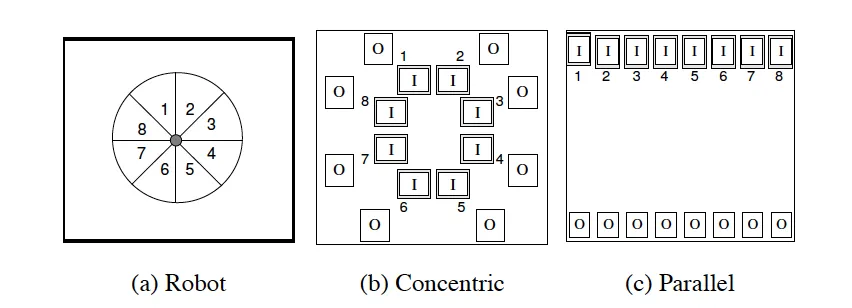
HyperNEAT Inputs and Outputs
Substrate Resolution
Another powerful and unique property of HyperNEAT is the ability to scale the resolution of a substrate up and down. What does that mean? Well, let’s say you evolve a HyperNEAT network based on images of a certain size. The underlying geometry that was exploited to perform well at that size results in the same pattern when scaled to a new size. Except, no extra training is needed. It simply scales to another size!
Summarization of the Algorithm
I think with all that information about how this algorithm works, it’s worth summarizing the steps of it.
- Chose a substrate configuration (the layout of nodes and where input/output is located)
- Create a uniform, minimal initial population of connective CPPNs
- Repeat until solution:
- For each CPPN
- Generate connections for the neural network using the CPPN
- Evaluate the performance of the neural network
- Reproduce CPPNs using NEAT algorithm
- For each CPPN
Conclusion
And there we have it! That’s the HyperNEAT algorithm. I encourage you to take a look at the paper if you wish to explore more of the details or wish to look at the performance on some experiments they did with the algorithm (I particularly enjoy their food gathering robot experiment).
What are the implications for the future? That’s something I’ve been thinking about recently as well. Is there a tie-in from HyperNEAT to training traditional deep networks today? Is this a better way to train deep networks? There’s another paper of Evolvable Substrate HyperNEAT where the actual substrates are evolved as well, a paper I wish to explore in the future! But is there something hidden in that paper that bridges the gap between HyperNEAT and deep neural networks? Only time will tell, and only we can answer that question!
Hopefully, this article was helpful! If I missed anything or if you have questions, let me know.
强化学习算法library库:(集成库)
https://github.com/Denys88/rl_games
https://github.com/Domattee/gymTouch
个人github博客地址:
https://devilmaycry812839668.github.io/
【转载】hyperNeat进化神经网络算法——HyperNEAT Explained——Advancing Neuroevolution的更多相关文章
- 如何用70行Java代码实现深度神经网络算法(转)
对于现在流行的深度学习,保持学习精神是必要的——程序员尤其是架构师永远都要对核心技术和关键算法保持关注和敏感,必要时要动手写一写掌握下来,先不用关心什么时候用到——用不用是政治问题,会不会写是技术问题 ...
- 目前所有的ANN神经网络算法大全
http://blog.sina.com.cn/s/blog_98238f850102w7ik.html 目前所有的ANN神经网络算法大全 (2016-01-20 10:34:17) 转载▼ 标签: ...
- 如何用70行Java代码实现深度神经网络算法
http://www.tuicool.com/articles/MfYjQfV 如何用70行Java代码实现深度神经网络算法 时间 2016-02-18 10:46:17 ITeye 原文 htt ...
- 利用神经网络算法的C#手写数字识别
欢迎大家前往云+社区,获取更多腾讯海量技术实践干货哦~ 下载Demo - 2.77 MB (原始地址):handwritten_character_recognition.zip 下载源码 - 70. ...
- "如何用70行Java代码实现深度神经网络算法" 的delphi版本
http://blog.csdn.net/hustjoyboy/article/details/50721535 "如何用70行Java代码实现深度神经网络算法" 的delphi ...
- 利用神经网络算法的C#手写数字识别(一)
利用神经网络算法的C#手写数字识别 转发来自云加社区,用于学习机器学习与神经网络 欢迎大家前往云+社区,获取更多腾讯海量技术实践干货哦~ 下载Demo - 2.77 MB (原始地址):handwri ...
- 《BI那点儿事》Microsoft 神经网络算法
Microsoft神经网络是迄今为止最强大.最复杂的算法.要想知道它有多复杂,请看SQL Server联机丛书对该算法的说明:“这个算法通过建立多层感知神经元网络,建立分类和回归挖掘模型.与Micro ...
- bp神经网络算法
对于BP神经网络算法,由于之前一直没有应用到项目中,今日偶然之时 进行了学习, 这个算法的基本思路是这样的:不断地迭代优化网络权值,使得输入与输出之间的映射关系与所期望的映射关系一致,利用梯度下降的方 ...
- NN:神经网络算法进阶优化法,进一步提高手写数字识别的准确率—Jason niu
上一篇文章,比较了三种算法实现对手写数字识别,其中,SVM和神经网络算法表现非常好准确率都在90%以上,本文章进一步探讨对神经网络算法优化,进一步提高准确率,通过测试发现,准确率提高了很多. 首先,改 ...
- 使用Python scikit-learn 库实现神经网络算法
1:神经网络算法简介 2:Backpropagation算法详细介绍 3:非线性转化方程举例 4:自己实现神经网络算法NeuralNetwork 5:基于NeuralNetwork的XOR实例 6:基 ...
随机推荐
- MFC实现屏幕截屏
屏幕截屏 void CMainFormDlg::GetScreenPic(Rect area, OUT Mat &img, float rate, bool gray) { CDC *pDC ...
- curl可以访问虚拟机资源,但是宿主机浏览器不能访问
如果想从宿主机访问到虚拟机内的php,需要关闭宿主机的代理,并且设置虚拟机内的防火墙不要屏蔽宿主机的ip. 设置虚拟机防火墙方法: 查找宿主机IP:win+r,输入ipconfig 打开虚拟机,输入s ...
- Ubuntu16.04使用命令行安装jdk1.8
在Ubuntu中安装jdk过于麻烦,有时设置不好可能就没有办法使用,卸载也难以卸载干净,所以这篇文章使用相对简单的命令行来安装jdk,只需简单的四个命令,省去许多麻烦,下面是方法. 进入Ubuntu打 ...
- portainer安装&升级
2024年4月15日 关于升级: 如果需要升级 Portainer,请按以下步骤操作: 使用以下命令列出所有镜像: docker ps -a 根据需要删除指定镜像: docker rm <镜像名 ...
- 【DVWA】搭建安全测试环境
一.搭建DVWA环境 用docker输入命令: docker run -d --name zc_dvwa -p 8081:80 vulnerables/web-dvwa 安装完成: 输入地址:http ...
- C++ lambda 引用捕获临时对象引发 core 的案例
今天复习前几年在项目过程中积累的各类技术案例,有一个小的 coredump 案例,当时小组里几位较资深的同事都没看出来,后面是我周末查了两三个小时解决掉的,今天再做一次系统的总结,给出一个复现的案例代 ...
- SoftCLT: 时间序列的软对比学习《Soft Contrastive Learning for Time Series》(时间序列、时序分类任务、软对比学习、实例上软赋值距离差异、数据空间非嵌入空间度量相似性)
2024年6月25日,10:11,好几天没看论文了,一直在摸鱼写代码(虽然也没学会多少),今天看一篇师兄推荐的. 论文:Soft Contrastive Learning for Time Serie ...
- manim边学边做--通用多边形
manim提供了通用多边形模块,可以绘制任意的多边形. 通用多边形模块有两种,Polygon和Polygram. Polygon是一个几何学术语,主要指的是由三条或三条以上的线段首尾顺次连接所组成的平 ...
- CSS – z-index
介绍 z-index 是用来设置 element 层次高低的 (当 element 重叠的时候) 参考: 4 reasons your z-index isn't working (and how t ...
- MyBatis——案例——查询-查询所有
查询-查询所有数据 1.创建相应Mapper接口文件 以及Mapper配置信息文件 修改配置文件中 namespace : 2.编写接 ...