
JDK源码学习笔记——LinkedHashMap
HashMap有一个问题,就是迭代HashMap的顺序并不是HashMap放置的顺序,也就是无序。
LinkedHashMap保证了元素迭代的顺序。该迭代顺序可以是插入顺序或者是访问顺序。通过维护一个双向链表实现。
需要在理解HashMap实现原理的基础上学习LinkedHashMap,JDK源码学习笔记——HashMap
一、数据结构
实际上就是在HashMap的基础上加了LinkedList

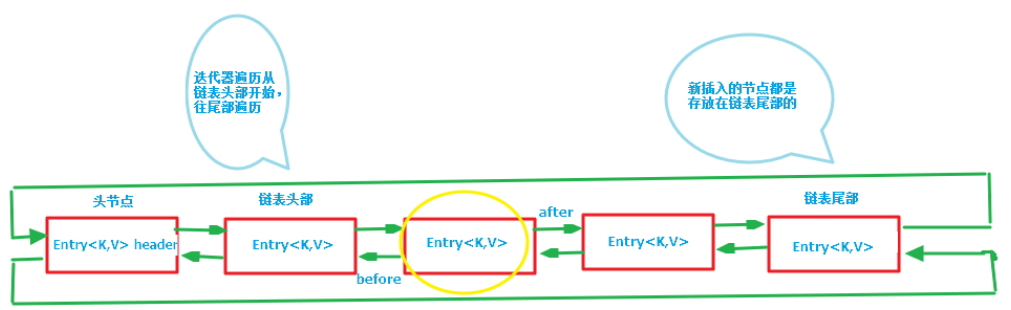
(图片来自Java集合之LinkedHashMap)
LinkedHashMap.Entry继承了HashMap.Node,并扩展了before ,after属性
    static class Entry<K,V> extends HashMap.Node<K,V> {

        Entry<K,V> before, after;

        Entry(int hash, K key, V value, Node<K,V> next) {

            super(hash, key, value, next);

        }

    }
二、类
继承了HashMap
public class LinkedHashMap<K,V> extends HashMap<K,V> implements Map<K,V>
三、属性
    transient LinkedHashMap.Entry<K,V> head;

    transient LinkedHashMap.Entry<K,V> tail;

    final boolean accessOrder;//true表示按照访问顺序迭代(最近访问在后),false时表示按照插入顺序(先插入在前,默认)
四、主要方法
put
    /**

     * 直接使用HashMap的put方法

     * 重写了newNode()方法:维护双向链表

     * 重写了afterNodeAccess(e)方法:如果按访问顺序排序,把node移动到双链表的尾端

     */

    Node<K,V> newNode(int hash, K key, V value, Node<K,V> e) {

        LinkedHashMap.Entry<K,V> p =

            new LinkedHashMap.Entry<K,V>(hash, key, value, e);

        linkNodeLast(p);

        return p;

    }

    private void linkNodeLast(LinkedHashMap.Entry<K,V> p) {

        LinkedHashMap.Entry<K,V> last = tail;

        tail = p;

        if (last == null)

            head = p;

        else {

            p.before = last;

            last.after = p;

        }

    }

    void afterNodeAccess(Node<K,V> e) { // move node to last

        LinkedHashMap.Entry<K,V> last;

        if (accessOrder && (last = tail) != e) {

            LinkedHashMap.Entry<K,V> p =

                (LinkedHashMap.Entry<K,V>)e, b = p.before, a = p.after;

            p.after = null;

            if (b == null)

                head = a;

            else

                b.after = a;

            if (a != null)

                a.before = b;

            else

                last = b;

            if (last == null)

                head = p;

            else {

                p.before = last;

                last.after = p;

            }

            tail = p;

            ++modCount;

        }

    }
get
    /**

     * 重写了get方法

     * 如果按访问顺序排序,把node移动到双链表的尾端

     */

    public V get(Object key) {

        Node<K,V> e;

        if ((e = getNode(hash(key), key)) == null)

            return null;

        if (accessOrder)

            afterNodeAccess(e);// 如果按访问顺序排序,把node移动到双链表的尾端

        return e.value;

    }
remove
    /**

     * 直接使用HashMap的remove方法

     * 重写了afterNodeRemoval()方法:维护双端链表

     */

    void afterNodeRemoval(Node<K,V> e) { // unlink

        LinkedHashMap.Entry<K,V> p =

            (LinkedHashMap.Entry<K,V>)e, b = p.before, a = p.after;

        p.before = p.after = null;

        if (b == null)

            head = a;

        else

            b.after = a;

        if (a == null)

            tail = b;

        else

            a.before = b;

    }
遍历
    /**

     * 主要看nextNode()方法

     * 直接遍历的双向链表

     */

    final class LinkedKeyIterator extends LinkedHashIterator implements Iterator<K> {

        public final K next() {

            return nextNode().getKey();

        }

    }

    final class LinkedValueIterator extends LinkedHashIterator implements Iterator<V> {

        public final V next() {

            return nextNode().value;

        }

    }

    final class LinkedEntryIterator extends LinkedHashIterator implements Iterator<Map.Entry<K, V>> {

        public final Map.Entry<K, V> next() {

            return nextNode();

        }

    }

    abstract class LinkedHashIterator {

        LinkedHashMap.Entry<K,V> next;

        LinkedHashMap.Entry<K,V> current;

        int expectedModCount;

        LinkedHashIterator() {

            next = head;

            expectedModCount = modCount;

            current = null;

        }

        public final boolean hasNext() {

            return next != null;

        }

        final LinkedHashMap.Entry<K,V> nextNode() {

            LinkedHashMap.Entry<K,V> e = next;

            if (modCount != expectedModCount)

                throw new ConcurrentModificationException();

            if (e == null)

                throw new NoSuchElementException();

            current = e;

            next = e.after;

            return e;

        }

        public final void remove() {

            Node<K,V> p = current;

            if (p == null)

                throw new IllegalStateException();

            if (modCount != expectedModCount)

                throw new ConcurrentModificationException();

            current = null;

            K key = p.key;

            removeNode(hash(key), key, null, false, false);

            expectedModCount = modCount;

        }

    }
JDK源码学习笔记——LinkedHashMap的更多相关文章
- jdk源码阅读笔记-LinkedHashMap
Map是Java collection framework 中重要的组成部分,特别是HashMap是在我们在日常的开发的过程中使用的最多的一个集合.但是遗憾的是,存放在HashMap中元素都是无序的, ...
- JDK源码学习笔记——String
1.学习jdk源码,从以下几个方面入手: 类定义(继承,实现接口等) 全局变量 方法 内部类 2.hashCode private int hash; public int hashCode() { ...
- JDK源码学习笔记——Integer
一.类定义 public final class Integer extends Number implements Comparable<Integer> 二.属性 private fi ...
- JDK源码学习笔记——Enum枚举使用及原理
一.为什么使用枚举 什么时候应该使用枚举呢?每当需要一组固定的常量的时候,如一周的天数.一年四季等.或者是在我们编译前就知道其包含的所有值的集合. 利用 public final static 完全可 ...
- JDK源码学习笔记——Object
一.源码解析 public class Object { /** * 一个本地方法,具体是用C(C++)在DLL中实现的,然后通过JNI调用 */ private static native void ...
- JDK源码学习笔记——HashMap
Java集合的学习先理清数据结构: 一.属性 //哈希桶,存放链表. 长度是2的N次方,或者初始化时为0. transient Node<K,V>[] table; //最大容量 2的30 ...
- JDK源码学习笔记——HashSet LinkedHashSet TreeSet
你一定听说过HashSet就是通过HashMap实现的 相信我,翻一翻HashSet的源码,秒懂!! 其实很多东西,只是没有静下心来看,只要去看,说不定一下子就明白了…… HashSet 两个属性: ...
- JDK源码学习笔记——TreeMap及红黑树
找了几个分析比较到位的,不再重复写了…… Java 集合系列12之 TreeMap详细介绍(源码解析)和使用示例 [Java集合源码剖析]TreeMap源码剖析 java源码分析之TreeMap基础篇 ...
- JDK源码学习笔记——LinkedList
一.类定义 public class LinkedList<E> extends AbstractSequentialList<E> implements List<E& ...
随机推荐
- hdu 2680 Choose the best route (dijkstra算法 最短路问题)
题目链接:http://acm.hdu.edu.cn/showproblem.php?pid=2680 Choose the best route Time Limit: 2000/1000 MS ( ...
- scikit-learn中的岭回归(Ridge Regression)与Lasso回归
一.岭回归模型 岭回归其实就是在普通最小二乘法回归(ordinary least squares regression)的基础上,加入了正则化参数λ. 二.如何调用 class sklearn.lin ...
- 安全测试===sqlmap(肆)转载
十八.杂项 1.使用简写 参数:-z 有些参数组合是被经常用到的,如“--batch --random-agent --ignore-proxy --technique=BEU”,这样写一大串很不好看 ...
- 64_k2
kf5-libkdepim-akonadi-17.04.1-1.fc26.x86_64.rpm 25-May-2017 12:22 177198 kf5-libkdepim-devel-17.04.1 ...
- python string 对齐文本的几个方法
用rjust().ljust()和center()方法对齐文本
- 微信小程序获取输入框(input)内容
微信小程序---获取输入框(input)内容 wxml <input placeholder="请输入手机号码" maxlength="11" type= ...
- centos 6 编译安装php-5.4/5.5(lamp模式)
在安装LAMP架构时,我们常用php-5.3的版本 现进行php-5.4/5.5的编译安装演示: [root@localhost ~]# cd /usr/local/src [root@localho ...
- 机器学习方法(四):决策树Decision Tree原理与实现技巧
欢迎转载,转载请注明:本文出自Bin的专栏blog.csdn.net/xbinworld. 技术交流QQ群:433250724,欢迎对算法.技术.应用感兴趣的同学加入. 前面三篇写了线性回归,lass ...
- ubuntu上安装mysql及导入导出
ubuntu上安装mysql: 1. sudo apt-get install mysql-server 2. apt-get isntall mysql-client3. sudo apt-get ...
- YII2源码阅读:autoload_real.php 22~23行
spl_autoload_register(array('ComposerAutoloaderInit32b8eb537f8e12e57c5e7bade69d01f0', 'loadClassLoad ...