
UofTCTF 2024 比赛记录
这次的题目挺有意思,难度适中,*开头的代表未做出,简单记录一下解题笔记。
Introduction
General Information
题目
The flag format for all challenges is UofTCTF{...}, case insensitive. If you are experiencing technical difficulties with challenges, support is on our Discord server: https://discord.gg/Un7avdkq7Z. The flag for this challenge is UofTCTF{600d_1uck}.
我的解答:
介绍题,没啥说的直接给了
UofTCTF{600d_1uck}
Cryptography
repeat
题目
I'm a known repeat offender when it comes to bad encryption habits. But the secrets module is secure, so you'll never be able to guess my key!
Author: SteakEnthusiast
gen.py
import os

import secrets

flag = "REDACATED"

xor_key = secrets.token_bytes(8)

def xor(message, key):

    return bytes([message[i] ^ key[i % len(key)] for i in range(len(message))])

encrypted_flag = xor(flag.encode(), xor_key).hex()

with open("flag.enc", "w") as f:

    f.write("Flag: "+encrypted_flag)
flag.enc
Flag: 982a9290d6d4bf88957586bbdcda8681de33c796c691bb9fde1a83d582c886988375838aead0e8c7dc2bc3d7cd97a4我的解答:
标准的XOR加密,从题目可知,密钥长度为8个字节,这个是非常重要的。因为我们知道flag的前8个字节“uoftctf”
因此,由于XOR是个可逆函数,我们可以很容易得到flag
exp:
from binascii import unhexlify

from Crypto.Util.strxor import strxor

ct = unhexlify("982a9290d6d4bf88957586bbdcda8681de33c796c691bb9fde1a83d582c886988375838aead0e8c7dc2bc3d7cd97a4")

key = strxor(ct[:8], b'uoftctf{')

def xor(message, key):

    return bytes([message[i] ^ key[i % len(key)] for i in range(len(message))])

flag = xor(ct, key)

print(flag)

#uoftctf{x0r_iz_r3v3rs1bl3_w17h_kn0wn_p141n73x7}
Pianoman
题目
Windy, a piano prodigy, believes that RSA encryption may not provide sufficient security to safeguard his invaluable piano mastery secrets. So, he uses his musical talents to add another layer of security to the RSA encryption scheme. Now, no one will be able to figure out his secrets!
Note: The flag is UofTCTF{plaintext}.
Author: XiaoXiangjiao
Windy是一位钢琴神童,他认为RSA加密可能无法提供足够的安全性来保护他宝贵的钢琴掌握秘密。因此,他利用自己的音乐天赋为 RSA 加密方案增加了另一层安全性。现在,没有人能够弄清楚他的秘密!
注意:标志是 UofTCTF{plaintext}。
music_cipher.py
# no secrets for you!

flag = ...

# Prime numbers

p = 151974537061323957822386073908385085419559026351164685426097479266890291010147521691623222013307654711435195917538910433499461592808140930995554881397135856676650008657702221890681556382541341154333619026995004346614954741516470916984007797447848200982844325683748644670322174197570545222141895743221967042369

q = 174984645401233071825665708002522121612485226530706132712010887487642973021704769474826989160974464933559818767568944237124745165979610355867977190192654030573049063822083356316183080709550520634370714336131664619311165756257899116089875225537979520325826655873483634761961805768588413832262117172840398661229

n = p * q

# a public exponent hidden away by Windy's musical talents

e = ...

# Converting the message to an integer

m = int.from_bytes(message.encode(), 'big')

# Encrypting the message: c = m^e mod n

inc_m = pow(message_int, e, n)

print(encrypted_message_int)
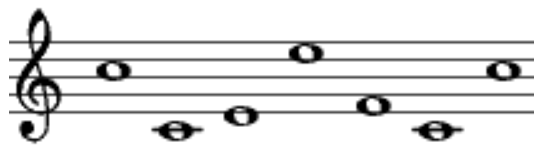
musical_e.png
output.txt
13798492512038760070176175279601263544116956273815547670915057561532348462120753731852024424193899030774938204962799194756105401464136384387458651343975594539877218889319074841918281784494580079814736461158750759327630935335333130007375268812456855987866715978531148043248418247223808114476698088473278808360178546541128684643502788861786419871174570376835894025839847919827231356213726961581598139013383568524808876923469958771740011288404737208217659897319372970291073214528581692244433371304465252501970552162445326313782129351056851978201181794212716520630569898498364053054452320641433167009005762663177324539460我的解答:
看了一下题目发现我们只要找到e,这道题就解决了
给了一个图片显然可以找到e,属于Music Sheet Cipher密码
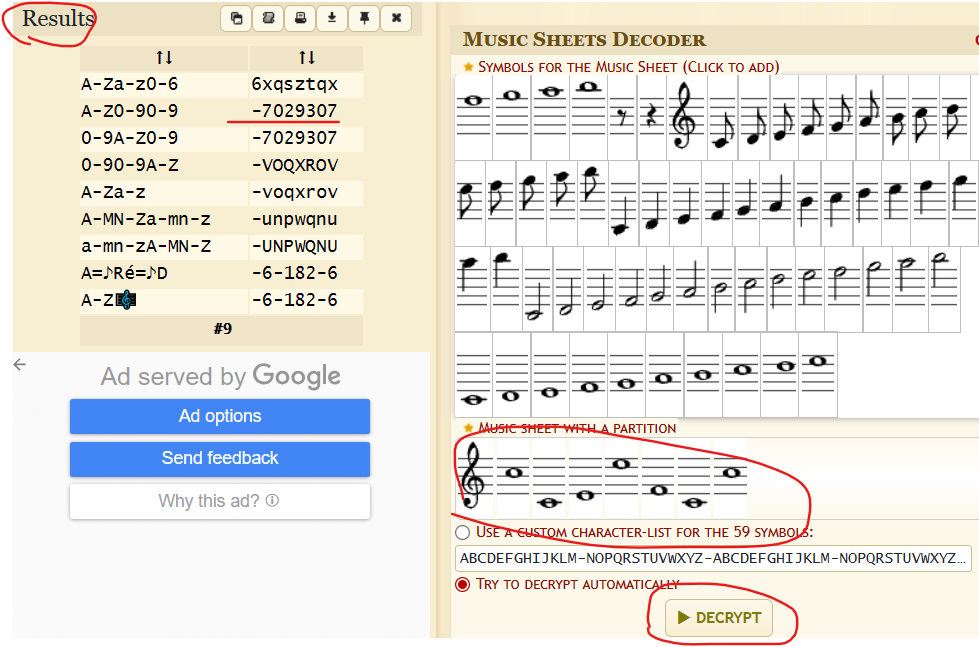
e = 7029307
exp:
import gmpy2

from Crypto.Util.number import *

p = 151974537061323957822386073908385085419559026351164685426097479266890291010147521691623222013307654711435195917538910433499461592808140930995554881397135856676650008657702221890681556382541341154333619026995004346614954741516470916984007797447848200982844325683748644670322174197570545222141895743221967042369

q = 174984645401233071825665708002522121612485226530706132712010887487642973021704769474826989160974464933559818767568944237124745165979610355867977190192654030573049063822083356316183080709550520634370714336131664619311165756257899116089875225537979520325826655873483634761961805768588413832262117172840398661229

c= 13798492512038760070176175279601263544116956273815547670915057561532348462120753731852024424193899030774938204962799194756105401464136384387458651343975594539877218889319074841918281784494580079814736461158750759327630935335333130007375268812456855987866715978531148043248418247223808114476698088473278808360178546541128684643502788861786419871174570376835894025839847919827231356213726961581598139013383568524808876923469958771740011288404737208217659897319372970291073214528581692244433371304465252501970552162445326313782129351056851978201181794212716520630569898498364053054452320641433167009005762663177324539460

e = 7029307

n = p*q

phi = (p-1) * (q-1)

d = gmpy2.invert(e, phi)

m = pow(c, d, n)

print(long_to_bytes(m))

#uoftctf{AT1d2jMCVs03xxalViU9zTyiiV1INNJY}
Clever Thinking
题目
I think that Diffie-Hellman is better with some curves, maybe elliptic ones. Let's share a secret!
Wrap the secret (which is a point) in
uoftctf{(x:y:z)}, where(x:y:z)are homogeneous coordinates.Author: Phoenix
我认为 Diffie-Hellman 更适合一些曲线,也许是椭圆形曲线。让我们分享一个秘密!
将密钥(即一个点)包装在 uoftctf{(x:y:z)} 中,其中 (x:y:z) 是齐次坐标。
chal.sage
m = 235322474717419

F = GF(m)

C = EllipticCurve(F, [0, 8856682])

public_base = (185328074730054:87402695517612:1)

Q1 = (184640716867876:45877854358580:1) # my public key

Q2 = (157967230203538:128158547239620:1) # your public key

secret = ...

my_private_key = ...

assert(my_private_key*public_base == Q1)

assert(my_private_key*Q2 == secret)
我的解答:
这是非常标准的椭圆加密。
基本上,我们的私钥乘以公钥的标量乘法将返回我们的公钥 Q1,而我们的私钥与其他人的公钥 Q2 的标量乘法将返回共享密钥。
我们可以用Smart攻击。本文对Smart的攻击进行了更深入的描述。然而,我们需要知道的是,当有限群的阶数等价于 p 时,它就会起作用,我们可以用 Sage 的 .order() 函数轻松检查。
解题脚本参考这个。剩下的就是用我们的参数替换参数,然后将其乘以 Q2 以获得共享密钥!
exp:
def SmartAttack(P,Q,p):

    E = P.curve()

    Eqp = EllipticCurve(Qp(p, 2), [ ZZ(t) + randint(0,p)*p for t in E.a_invariants() ])

    P_Qps = Eqp.lift_x(ZZ(P.xy()[0]), all=True)

    for P_Qp in P_Qps:

        if GF(p)(P_Qp.xy()[1]) == P.xy()[1]:

            break

    Q_Qps = Eqp.lift_x(ZZ(Q.xy()[0]), all=True)

    for Q_Qp in Q_Qps:

        if GF(p)(Q_Qp.xy()[1]) == Q.xy()[1]:

            break

    p_times_P = p*P_Qp

    p_times_Q = p*Q_Qp

    x_P,y_P = p_times_P.xy()

    x_Q,y_Q = p_times_Q.xy()

    phi_P = -(x_P/y_P)

    phi_Q = -(x_Q/y_Q)

    k = phi_Q/phi_P

    return ZZ(k)

# p = 235322474717419

# E = EllipticCurve(GF(p), [0, 8856682])

# P = E.point((185328074730054,87402695517612))

# Q = E.point((184640716867876,45877854358580))

# Curve parameters --> Replace the next three lines with given values

p = 235322474717419

a = 0

b = 8856682

# Define curve

E = EllipticCurve(GF(p), [a, b])

assert(E.order() == p)

# Replace the next two lines with given values

pub_base = E(185328074730054 , 87402695517612)

Q1 = E(184640716867876 , 45877854358580)

priv_key = SmartAttack(pub_base, Q1,p)

print(priv_key)

Q2 = E(157967230203538,128158547239620)

print(priv_key * Q2)

#uoftctf{(11278025017971:36226806176053:1)}
Wheel Barrow
题目
A wheelbarrow ran over the flag. Can you fix it?
Please wrap the flag in
uoftctf{}. Please keep the$in the flag when submitting.Author: notnotpuns
密文:hc0rhh3r3ylmsrwr___lsewt_03raf_rpetouin$_3tb0_t
我的解答:
根据题目名称查找相应密码发现 Burrows-Wheeler 变换
所有可能结果如下:

整合得到:burr0w_wh33ler_transform_is_pr3tty_c00l_eh$th3_
根据题目意思最终得到:
uoftctf{th3_burr0w_wh33ler_transform_is_pr3tty_c00l_eh$}
*Export Grade Cipher(不会!有时间再回顾吧!)
题目
This "state of the art" cipher can be exported to your enemies without restriction.
Author: nullptr
nc 0.cloud.chals.io 23753
chal.py
查看代码
 import ast

import threading

from exportcipher import *

try:

    from flag import FLAG

except:

    FLAG = "test{FLAG}"

MAX_COUNT = 100

TIMEOUT = 120 # seconds

def input_bytes(display_msg):

    m = input(display_msg)

    try:

        m = ast.literal_eval(m)

    except:

        # might not be valid str or bytes literal but could still be valid input, so just encode it

        pass

    if isinstance(m, str):

        m = m.encode()

    assert isinstance(m, bytes)

    return m

def timeout_handler():

    print("Time is up, you can throw out your work as the key changed.")

    exit()

if __name__ == "__main__":

    print("Initializing Export Grade Cipher...")

    key = int.from_bytes(os.urandom(5))

    cipher = ExportGradeCipher(key)

    print("You may choose up to {} plaintext messages to encrypt.".format(MAX_COUNT))

    print("Recover the 40-bit key to get the flag.")

    print("You have {} seconds.".format(TIMEOUT))

    # enough time to crack a 40 bit key with the compute resources of a government

    threading.Timer(TIMEOUT, timeout_handler).start()

    i = 0

    while i < MAX_COUNT:

        pt = input_bytes("[MSG {}] plaintext: ".format(i))

        if not pt:

            break

        if len(pt) > 512:

            # don't allow excessively long messages

            print("Message Too Long!")

            continue

        nonce = os.urandom(256)

        cipher.init_with_nonce(nonce)

        ct = cipher.encrypt(pt)

        print("[MSG {}] nonce: {}".format(i, nonce))

        print("[MSG {}] ciphertext: {}".format(i, ct))

        # sanity check decryption

        cipher.init_with_nonce(nonce)

        assert pt == cipher.decrypt(ct)

        i += 1

    recovered_key = ast.literal_eval(input("Recovered Key: "))

    assert isinstance(recovered_key, int)

    if recovered_key == key:

        print("That is the key! Here is the flag: {}".format(FLAG))

    else:

        print("Wrong!")
exportcipher.py
查看代码
 import os

class LFSR:

    def __init__(self, seed, taps, size):

        assert seed != 0

        assert (seed >> size) == 0

        assert len(taps) > 0 and (size - 1) in taps

        self.state = seed

        self.taps = taps

        self.mask = (1 << size) - 1

    def _shift(self):

        feedback = 0

        for tap in self.taps:

            feedback ^= (self.state >> tap) & 1

        self.state = ((self.state << 1) | feedback) & self.mask

    def next_byte(self):

        val = self.state & 0xFF

        for _ in range(8):

            self._shift()

        return val

class ExportGradeCipher:

    def __init__(self, key):

        # 40 bit key

        assert (key >> 40) == 0

        self.key = key

        self.initialized = False

    def init_with_nonce(self, nonce):

        # 256 byte nonce, nonce size isnt export controlled so hopefully this will compensate for the short key size

        assert len(nonce) == 256

        self.lfsr17 = LFSR((self.key & 0xFFFF) | (1 << 16), [2, 9, 10, 11, 14, 16], 17)

        self.lfsr32 = LFSR(((self.key >> 16) | 0xAB << 24) & 0xFFFFFFFF, [1, 6, 16, 21, 23, 24, 25, 26, 30, 31], 32)

        self.S = [i for i in range(256)]

        # Fisher-Yates shuffle S-table

        for i in range(255, 0, -1):

            # generate j s.t. 0 <= j <= i, has modulo bias but good luck exploiting that

            j = (self.lfsr17.next_byte() ^ self.lfsr32.next_byte()) % (i + 1)

            self.S[i], self.S[j] = self.S[j], self.S[i]

        j = 0

        # use nonce to scramble S-table some more

        for i in range(256):

            j = (j + self.lfsr17.next_byte() ^ self.lfsr32.next_byte() + self.S[i] + nonce[i]) % 256

            self.S[i], self.S[j] = self.S[j], self.S[i]

        self.S_inv = [0 for _ in range(256)]

        for i in range(256):

            self.S_inv[self.S[i]] = i

        self.initialized = True

    def _update(self, v):

        i = self.lfsr17.next_byte() ^ self.lfsr32.next_byte()

        self.S[v], self.S[i] = self.S[i], self.S[v]

        self.S_inv[self.S[v]] = v

        self.S_inv[self.S[i]] = i

    def encrypt(self, msg):

        assert self.initialized

        ct = bytes()

        for v in msg:

            ct += self.S[v].to_bytes()

            self._update(v)

        return ct

    def decrypt(self, ct):

        assert self.initialized

        msg = bytes()

        for v in ct:

            vo = self.S_inv[v]

            msg += vo.to_bytes()

            self._update(vo)

        return msg

if __name__ == "__main__":

    cipher = ExportGradeCipher(int.from_bytes(os.urandom(5)))

    nonce = os.urandom(256)

    print("="*50)

    print("Cipher Key: {}".format(cipher.key))

    print("Nonce: {}".format(nonce))

    msg = "ChatGPT: The Kerckhoffs' Principle, formulated by Auguste Kerckhoffs in the 19th century, is a fundamental concept in cryptography that states that the security of a cryptographic system should not rely on the secrecy of the algorithm, but rather on the secrecy of the key. In other words, a cryptosystem should remain secure even if all the details of the encryption algorithm, except for the key, are publicly known. This principle emphasizes the importance of key management in ensuring the confidentiality and integrity of encrypted data and promotes the development of encryption algorithms that can be openly analyzed and tested by the cryptographic community, making them more robust and trustworthy."

    print("="*50)

    print("Plaintext: {}".format(msg))

    cipher.init_with_nonce(nonce)

    ct = cipher.encrypt(msg.encode())

    print("="*50)

    print("Ciphertext: {}".format(ct))

    cipher.init_with_nonce(nonce)

    dec = cipher.decrypt(ct)

    print("="*50)

    try:

        print("Decrypted: {}".format(dec))

        assert msg.encode() == dec

    except:

        print("Decryption failed")
Miscellaneous(只会一个)
Out of the Bucket
题目
Check out my flag website!
Author: windex
我的解答:
题目给出了一个网站,访问会发现两张图,lsb隐写?也不是。其他方式也试了不行。。。。
修改下url试试,最终在
https://storage.googleapis.com/out-of-the-bucket
里发现啦一些东西。以 XML 格式列出该站点的文档树如下:
This XML file does not appear to have any style information associated with it. The document tree is shown below.

<ListBucketResult>

<Name>out-of-the-bucket</Name>

<Prefix/>

<Marker/>

<IsTruncated>false</IsTruncated>

<Contents>

<Key>secret/</Key>

<Generation>1703868492595821</Generation>

<MetaGeneration>1</MetaGeneration>

<LastModified>2023-12-29T16:48:12.634Z</LastModified>

<ETag>"d41d8cd98f00b204e9800998ecf8427e"</ETag>

<Size>0</Size>

</Contents>

<Contents>

<Key>secret/dont_show</Key>

<Generation>1703868647771911</Generation>

<MetaGeneration>1</MetaGeneration>

<LastModified>2023-12-29T16:50:47.809Z</LastModified>

<ETag>"737eb19c7265186a2fab89b5c9757049"</ETag>

<Size>29</Size>

</Contents>

<Contents>

<Key>secret/funny.json</Key>

<Generation>1705174300570372</Generation>

<MetaGeneration>1</MetaGeneration>

<LastModified>2024-01-13T19:31:40.607Z</LastModified>

<ETag>"d1987ade72e435073728c0b6947a7aee"</ETag>

<Size>2369</Size>

</Contents>

<Contents>

<Key>src/</Key>

<Generation>1703867253127898</Generation>

<MetaGeneration>1</MetaGeneration>

<LastModified>2023-12-29T16:27:33.166Z</LastModified>

<ETag>"d41d8cd98f00b204e9800998ecf8427e"</ETag>

<Size>0</Size>

</Contents>

<Contents>

<Key>src/index.html</Key>

<Generation>1703867956175503</Generation>

<MetaGeneration>1</MetaGeneration>

<LastModified>2023-12-29T16:39:16.214Z</LastModified>

<ETag>"dc63d7225477ead6f340f3057263643f"</ETag>

<Size>1134</Size>

</Contents>

<Contents>

<Key>src/static/antwerp.jpg</Key>

<Generation>1703867372975107</Generation>

<MetaGeneration>1</MetaGeneration>

<LastModified>2023-12-29T16:29:33.022Z</LastModified>

<ETag>"cef4e40eacdf7616f046cc44cc55affc"</ETag>

<Size>45443</Size>

</Contents>

<Contents>

<Key>src/static/guam.jpg</Key>

<Generation>1703867372954729</Generation>

<MetaGeneration>1</MetaGeneration>

<LastModified>2023-12-29T16:29:32.993Z</LastModified>

<ETag>"f6350c93168c2955ceee030ca01b8edd"</ETag>

<Size>48805</Size>

</Contents>

<Contents>

<Key>src/static/style.css</Key>

<Generation>1703867372917610</Generation>

<MetaGeneration>1</MetaGeneration>

<LastModified>2023-12-29T16:29:32.972Z</LastModified>

<ETag>"0c12d00cc93c2b64eb4cccb3d36df8fd"</ETag>

<Size>76559</Size>

</Contents>

</ListBucketResult>
显然有一些可疑的URL,尝试访问发现 secret/dont_show 里面有flag
uoftctf{allUsers_is_not_safe}
UofTCTF 2024 比赛记录的更多相关文章
- 【arc101】比赛记录
这场还好切出了D,rt应该能涨,然而这场的题有点毒瘤,700分的D没多少人切,更别说EF了.(暴打出题人)既然这样,干脆就水一篇博客,做个简单的比赛记录. C - Candles 这题是一道一眼题,花 ...
- 【cf比赛记录】Codeforces Round #606 (Div. 2, based on Technocup 2020 Elimination Round 4)
比赛传送门 只能说当晚状态不佳吧,有点头疼感冒的症状.也跟脑子没转过来有关系,A题最后一步爆搜没能立即想出来,B题搜索没有用好STL,C题也因为前面两题弄崩了心态,最后,果然掉分了. A:简单数学 B ...
- 【cf比赛记录】Codeforces Round #605 (Div. 3)
比赛传送门 Div3真的是暴力杯,比div2还暴力吧(这不是明摆的嘛),所以对我这种一根筋的挺麻烦的,比如A题就自己没转过头来浪费了很久,后来才醒悟过来了.然后这次竟然还上分了...... A题:爆搜 ...
- 【cf比赛记录】Educational Codeforces Round 78 (Rated for Div. 2)
比赛传送门 A. Shuffle Hashing 题意:加密字符串.可以把字符串的字母打乱后再从前面以及后面接上字符串.问加密后的字符串是否符合加密规则. 题解:字符串的长度很短,直接暴力搜索所有情况 ...
- 【cf比赛记录】Codeforces Round #601 (Div. 2)
Codeforces Round #601 (Div. 2) ---- 比赛传送门 周二晚因为身体不适鸽了,补题补题 A // http://codeforces.com/contest/1255/p ...
- 【cf比赛记录】Codeforces Round #600 (Div. 2)
Codeforces Round #600 (Div. 2) ---- 比赛传送门 昨晚成绩还好,AC A,B题,还能上分(到底有多菜) 补了C.D题,因为昨晚对C.D题已经有想法了,所以补起题来也快 ...
- BestCoder Round #92 比赛记录
上午考完试后看到了晚上的BestCoder比赛,全机房都来参加 感觉压力好大啊QAQ,要被虐了. 7:00 比赛开始了,迅速点进了T1 大呼这好水啊!告诉了同桌怎么看中文题面 然后就开始码码码,4分1 ...
- [Codeforces 872]比赛记录
强行打了$cf$上的第一场比赛,现在感觉自己的$rating$会炸飞= = A 这是练习输入输出吗QAQ,竟然$WA$了两遍QAQ,我$WA$的一声就哭了出来啊QAQ B 好像很水的乱扫就好了,m ...
- 【cf比赛记录】Codeforces Round #604 (Div. 2)
比赛传送门 感觉这场是最近以来做过的最顺手的一场,持续上分,开心w A了 前三题,然后第四题其实还有半个多小时,但怕身体撑不住,就先退了,其实第四题也很简单 自己认为的算法标签: A.暴力模拟.字 ...
- 【cf比赛记录】Educational Codeforces Round 77 (Rated for Div. 2)
比赛传送门 这场题目前三题看得挺舒服的,没有臃肿的题目,对于我这种英语渣渣就非常友好,但因为太急了,wa了两发A后才意识到用模拟(可以删了,博主真的是个菜鸟),结果导致心态大崩 ---- 而且也跟最近 ...
随机推荐
- JDK1.8下载 用阿里云盘
JDK1.8下载 用阿里云盘 jdk-8u202-windows-x64.exe https://www.aliyundrive.com/s/jJhWUk17jMt 点击链接保存,或者复制本段内容,打 ...
- 部署堡垒机4——CentOS7 编译安装 Python 3.8.12
1.去python3的官方网站下载源代码 https://www.python.org/downloads/ 下载安装Python 3.8.12到/opt/python3 cd /opt wget h ...
- Shell的概念、shebang、bash的概念
什么是shell shell的作用是 解释执行用户输入的命令或程序等 用户输入一条命令,shell就解释一条 键盘输入命令,Linux给与响应的方式,称之为交互式 linux的计算机是如何跟用户进行交 ...
- 10.elasticsearch集群red恢复损坏的索引
背景 客户磁盘损坏,修复磁盘后,重启机器,发现elasticsearch启动成功,ES状态正常green,但是历史数据都没有加载进,查看ES存储数据目录,发现数据还在. 解决方案 首先,需要确认ind ...
- IPv6实现内网穿透,极低成本保姆级教程
摘要 一直想实现内网穿透从而达到随时随地可以连接到自己电脑的目的.尝试过使用一些付费的现成方案,但是价格偏高,而流量少得可怜,只能开放几个固定端口. 实现内网穿透的最大难点就在于拥有一个公网IP,但是 ...
- Linux 逻辑卷管理
如果用标准分区在硬盘上创建了文件系统,为已有的文件系统添加额外的空间是一件十分痛苦的事情.只能在已有的硬盘上的可用空间范围内调整分区大小,如果硬盘空间不够的话,就只能换一个大容量的硬盘,然后手动将已有 ...
- 微短剧市场暴涨267.65%,用微短剧场景AUI Kit精巧入局
微短剧,不仅上头,更要上心. 微短剧,深度"拿捏"了这个碎片化时代,也是刚过去的2023年绕不开的热词. 与传统影视剧制作精益求精.耗时长相反,门槛与耗时"双低" ...
- 一图看懂CodeArts Deploy 5大特性,带你玩转部署服务
摘要:华为云自动化部署服务,助力企业安全.高效生产! 华为云持续部署服务CodeArts Deploy,通过模块化自由编排部署流程,实现软件的自动化部署,基于其易入门.功能全.集成度高.自动化.可靠的 ...
- 从原理到实践,手把手带你轻松get数仓双集群容灾
摘要:本文通过介绍双集群的架构.log结构.分析步骤来介绍双集群容灾的问题分析方法. 本文分享自华为云社区<从原理到实践,手把手带你轻松get数仓双集群容灾>,原文作者:Puyol . 双 ...
- 多语言ASR?没有什么听不懂,15种语言我全都要
摘要:在这篇博文中,我们介绍来自Google的一篇论文<Scaling End-to-End Models for Large-Scale Multilingual ASR>,来看看如何构 ...