
Vulkan Tutorial 27 combined image sampler
操作系统:Windows8.1
显卡:Nivida GTX965M
开发工具:Visual Studio 2017
Introduction
我们在教程的 uniform buffer 章节中首次了解了描述符。在本章节我们会看到一种新的描述符类型:combined image sampler 组合图像取样器。该描述符使着色器通过类似上一章创建的采样器对象那样,来访问图像资源。
我们将首先修改描述符布局,描述符对象池和描述符集合,以包括这样一个组合的图像采样器描述符。完成之后,我们会添加纹理贴图坐标到Vertex数据中,并修改片段着色器从纹理中读取颜色,而不是内插顶点颜色。
Updating the descriptors
浏览到createDesriptorSetLayout函数,并为组合图像采样器描述符添加一个VkDescriptorSetLayoutBinding。我们将简单的在uniform buffer之后进行绑定操作。
VkDescriptorSetLayoutBinding samplerLayoutBinding = {};

samplerLayoutBinding.binding = ;

samplerLayoutBinding.descriptorCount = ;

samplerLayoutBinding.descriptorType = VK_DESCRIPTOR_TYPE_COMBINED_IMAGE_SAMPLER;

samplerLayoutBinding.pImmutableSamplers = nullptr;

samplerLayoutBinding.stageFlags = VK_SHADER_STAGE_FRAGMENT_BIT;

std::array<VkDescriptorSetLayoutBinding, > bindings = {uboLayoutBinding, samplerLayoutBinding};

VkDescriptorSetLayoutCreateInfo layoutInfo = {};

layoutInfo.sType = VK_STRUCTURE_TYPE_DESCRIPTOR_SET_LAYOUT_CREATE_INFO;

layoutInfo.bindingCount = static_cast<uint32_t>(bindings.size());

layoutInfo.pBindings = bindings.data();
确保stageFlags正确设置,指定我们打算在片段着色器中使用组合图像采样器描述符。这就是片段颜色最终被确定的地方。可以在顶点着色器中使用纹理采样,比如,通过高度图 heightmap 动态的变形顶点的网格。
如果你开启validation layers运行程序,你将会看到它引起了描述符对象池不能使用这个布局分配描述符集合,因为它没有任何组合图像采样器描述符。来到createDescriptorPool函数,以包含此描述符的VkDescriptorPoolSize:
std::array<VkDescriptorPoolSize, > poolSizes = {};

poolSizes[].type = VK_DESCRIPTOR_TYPE_UNIFORM_BUFFER;

poolSizes[].descriptorCount = ;

poolSizes[].type = VK_DESCRIPTOR_TYPE_COMBINED_IMAGE_SAMPLER;

poolSizes[].descriptorCount = ;

VkDescriptorPoolCreateInfo poolInfo = {};

poolInfo.sType = VK_STRUCTURE_TYPE_DESCRIPTOR_POOL_CREATE_INFO;

poolInfo.poolSizeCount = static_cast<uint32_t>(poolSizes.size());

poolInfo.pPoolSizes = poolSizes.data();

poolInfo.maxSets = ;
最后一步是将实际的图像和采样器资源绑定到描述符集合中的具体描述符。来到createDescriptorSet函数。
VkDescriptorImageInfo imageInfo = {};

imageInfo.imageLayout = VK_IMAGE_LAYOUT_SHADER_READ_ONLY_OPTIMAL;

imageInfo.imageView = textureImageView;

imageInfo.sampler = textureSampler;
组合图像采样器结构体的资源必须在VkDescriptorImageInfo结构进行指定。就像在VkDescriptorBufferInfo结构体中指定一个 uniform buffer descriptor 缓冲区资源一样。这是上一章节中的对象汇集的代码段。
std::array<VkWriteDescriptorSet, > descriptorWrites = {};

descriptorWrites[].sType = VK_STRUCTURE_TYPE_WRITE_DESCRIPTOR_SET;

descriptorWrites[].dstSet = descriptorSet;

descriptorWrites[].dstBinding = ;

descriptorWrites[].dstArrayElement = ;

descriptorWrites[].descriptorType = VK_DESCRIPTOR_TYPE_UNIFORM_BUFFER;

descriptorWrites[].descriptorCount = ;

descriptorWrites[].pBufferInfo = &bufferInfo;

descriptorWrites[].sType = VK_STRUCTURE_TYPE_WRITE_DESCRIPTOR_SET;

descriptorWrites[].dstSet = descriptorSet;

descriptorWrites[].dstBinding = ;

descriptorWrites[].dstArrayElement = ;

descriptorWrites[].descriptorType = VK_DESCRIPTOR_TYPE_COMBINED_IMAGE_SAMPLER;

descriptorWrites[].descriptorCount = ;

descriptorWrites[].pImageInfo = &imageInfo;

vkUpdateDescriptorSets(device, static_cast<uint32_t>(descriptorWrites.size()), descriptorWrites.data(), , nullptr);
描述符必须与此图像信息一起更新,就像缓冲区一样。这次我们使用pImageInfo数组代替pBufferInfo。描述符现在可以被着色器使用!
Texture coordinates
纹理映射的一个重要组成部分仍然缺少,这是每个顶点的实际坐标。坐标决定如何实际的映射到几何图形上。
struct Vertex {

    glm::vec2 pos;

    glm::vec3 color;

    glm::vec2 texCoord;

    static VkVertexInputBindingDescription getBindingDescription() {

        VkVertexInputBindingDescription bindingDescription = {};

        bindingDescription.binding = ;

        bindingDescription.stride = sizeof(Vertex);

        bindingDescription.inputRate = VK_VERTEX_INPUT_RATE_VERTEX;

        return bindingDescription;

    }

    static std::array<VkVertexInputAttributeDescription, > getAttributeDescriptions() {

        std::array<VkVertexInputAttributeDescription, > attributeDescriptions = {};

        attributeDescriptions[].binding = ;

        attributeDescriptions[].location = ;

        attributeDescriptions[].format = VK_FORMAT_R32G32_SFLOAT;

        attributeDescriptions[].offset = offsetof(Vertex, pos);

        attributeDescriptions[].binding = ;

        attributeDescriptions[].location = ;

        attributeDescriptions[].format = VK_FORMAT_R32G32B32_SFLOAT;

        attributeDescriptions[].offset = offsetof(Vertex, color);

        attributeDescriptions[].binding = ;

        attributeDescriptions[].location = ;

        attributeDescriptions[].format = VK_FORMAT_R32G32_SFLOAT;

        attributeDescriptions[].offset = offsetof(Vertex, texCoord);

        return attributeDescriptions;

    }

};
修改Vertex结构体包含vec2结构用于纹理坐标。确保加入VkVertexInputAttributeDescription结构体,如此我们就可以在顶点着色器中访问纹理UV坐标数据。这是必要的,以便能够将它们传递到片段着色器,以便在正方形的表面进行插值处理。
const std::vector<Vertex> vertices = {

    {{-0.5f, -0.5f}, {1.0f, 0.0f, 0.0f}, {1.0f, 0.0f}},

    {{0.5f, -0.5f}, {0.0f, 1.0f, 0.0f}, {0.0f, 0.0f}},

    {{0.5f, 0.5f}, {0.0f, 0.0f, 1.0f}, {0.0f, 1.0f}},

    {{-0.5f, 0.5f}, {1.0f, 1.0f, 1.0f}, {1.0f, 1.0f}}

};
在本教程中,使用坐标从左上角 0,0 到右下角的 1,1 来映射纹理,从而简单的填充矩形。在这里可以尝试各种坐标。尝试使用低于 0 或者 1 以上的坐标来查看寻址模式的不同表现。
Shaders
最后一步是修改着色器从纹理中采样颜色。我们首先需要修改顶点着色器,传递纹理坐标到片段着色器。
layout(location = ) in vec2 inPosition;

layout(location = ) in vec3 inColor;

layout(location = ) in vec2 inTexCoord;

layout(location = ) out vec3 fragColor;

layout(location = ) out vec2 fragTexCoord;

void main() {

    gl_Position = ubo.proj * ubo.view * ubo.model * vec4(inPosition, 0.0, 1.0);

    fragColor = inColor;

    fragTexCoord = inTexCoord;

}
就像每个顶点的颜色,fragTexCoord值通过光栅化平滑的插值到矩形区域内。我们可以通过使片段着色器输出的纹理坐标为颜色来可视化看到这些:
#version

#extension GL_ARB_separate_shader_objects : enable

layout(location = ) in vec3 fragColor;

layout(location = ) in vec2 fragTexCoord;

layout(location = ) out vec4 outColor;

void main() {

    outColor = vec4(fragTexCoord, 0.0, 1.0);

}
现在应该可以看到如下图所示的效果。不要忘记重新编译着色器!
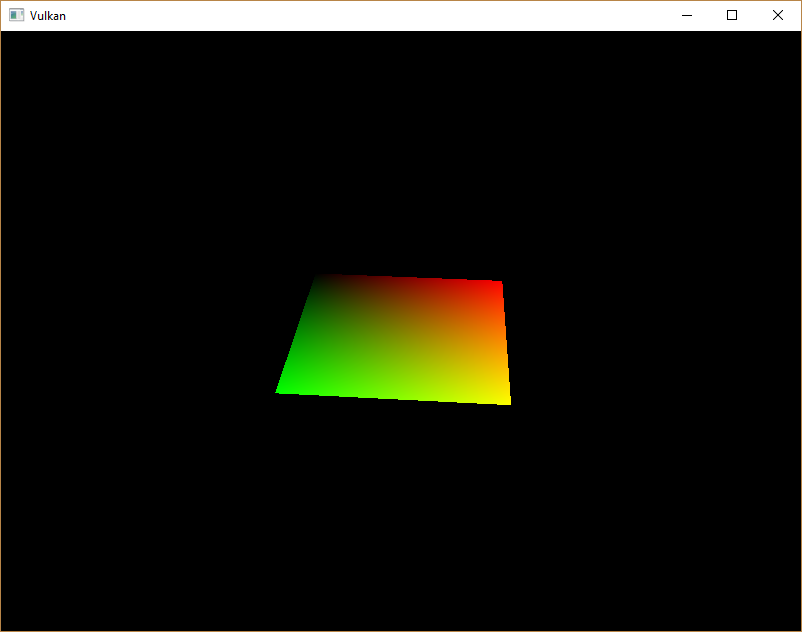
绿色通道代表水平坐标,红色通道代表垂直坐标。黑色和黄色角确认了纹理坐标正确的从 0,0 到 1,1 进行插值填充到方形中。使用颜色可视化在着色器中编程等价于 printf 调试,除此之外没有更好的方法!
组合图像采样器描述符在GLSL中通过采样器 uniform代替。在片段着色器中引用它:
layout(binding = ) uniform sampler2D texSampler;
对于其他图像有等价的 sampler1D 和 sampler3D 类型。确保正确的绑定操作。
void main() {

    outColor = texture(texSampler, fragTexCoord);

}
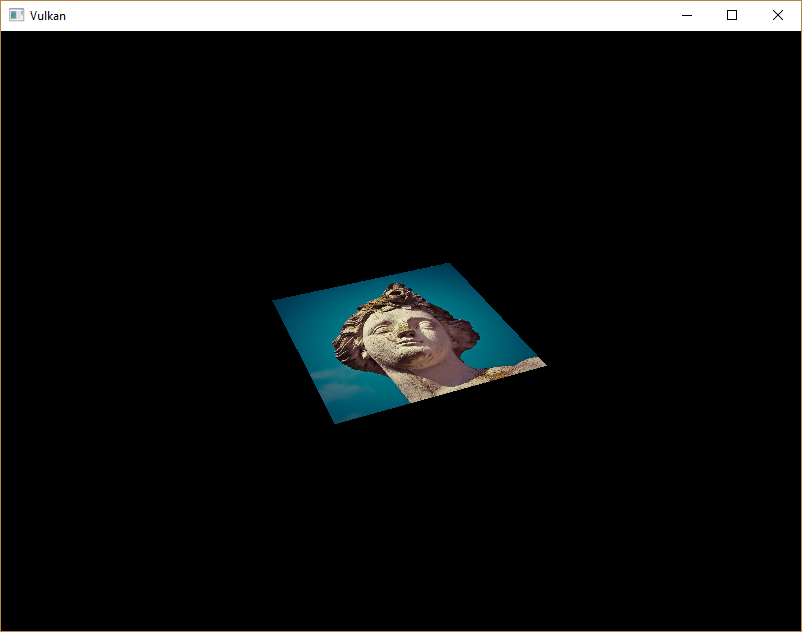
纹理采用内置的 texture 函数进行采样。它需要使用 sampler 和 坐标作为参数。采样器在后台自动处理过滤和变化功能。你应该可以看到纹理贴图在方形上:
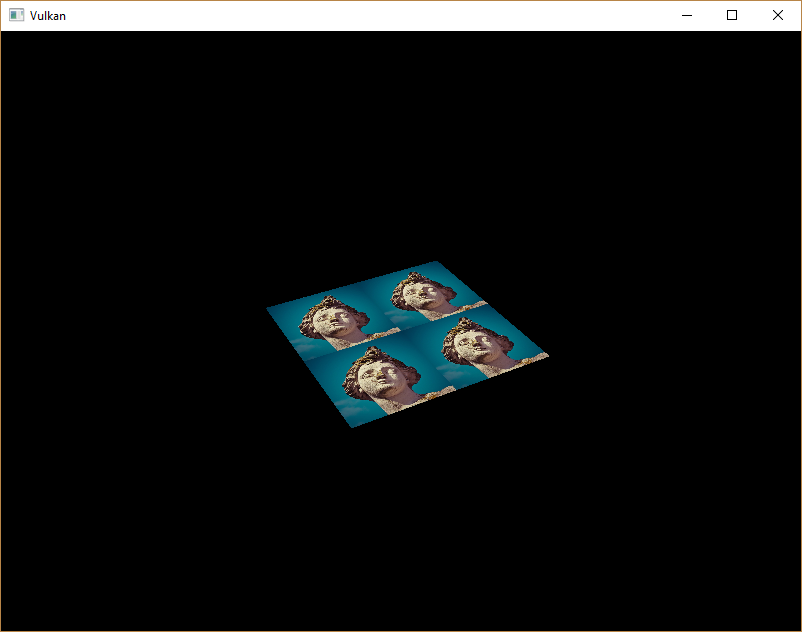
尝试修改寻址模式放大大于 1 来观测效果。比如,下面的片段着色器输出的结果使用VK_SAMPLER_ADDRESS_MODE_REPEAT:
void main() {

    outColor = texture(texSampler, fragTexCoord * 2.0);

}
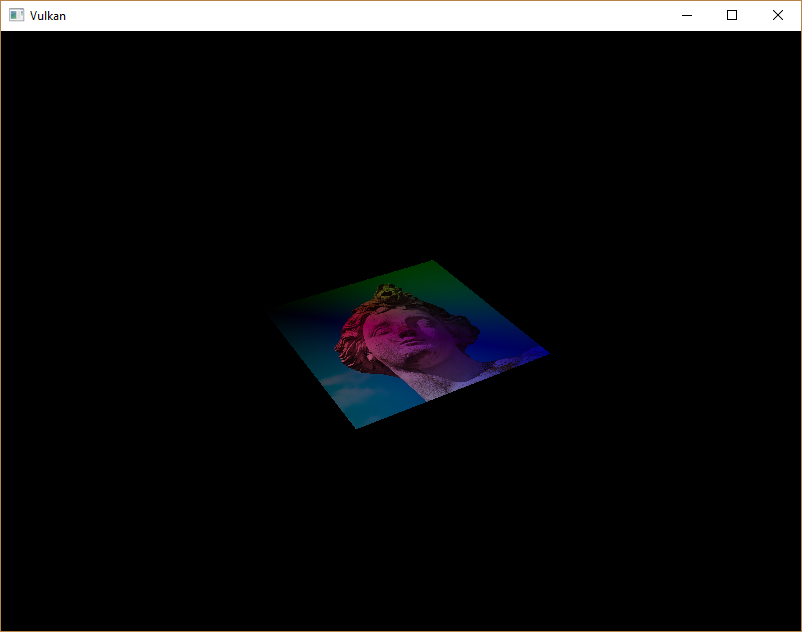
还可以使用顶点颜色来处理纹理颜色:
void main() {

    outColor = vec4(fragColor * texture(texSampler, fragTexCoord).rgb, 1.0);

}
将RGB和alha通道分离开,以便不缩放alpha通道。
现在已经知道如何在着色器中访问图像!当与帧缓冲区中的图像进行结合时,这是一个非常有效的技术。你可以看到这些图像作为输入实现很酷的效果,比如 post-processing和3D世界摄像机显示。
项目代码 GitHub地址。
Vulkan Tutorial 27 combined image sampler的更多相关文章
- Vulkan Tutorial 26 view and sampler
操作系统:Windows8.1 显卡:Nivida GTX965M 开发工具:Visual Studio 2017 在本章节我们将为图形管线创建另外两个资源来对图像进行采样.第一个资源我们之前已经接触 ...
- [译]Vulkan教程(27)Image
[译]Vulkan教程(27)Image Images Introduction 入门 The geometry has been colored using per-vertex colors so ...
- Vulkan Tutorial 26 Image view and sampler
操作系统:Windows8.1 显卡:Nivida GTX965M 开发工具:Visual Studio 2017 在本章节我们将为图形管线创建另外两个资源来对图像进行采样.第一个资源我们之前已经接触 ...
- Vulkan Tutorial 29 Loading models
操作系统:Windows8.1 显卡:Nivida GTX965M 开发工具:Visual Studio 2017 Introduction 应用程序现在已经可以渲染纹理3D模型,但是 vertice ...
- Vulkan Tutorial 开发环境搭建之Windows
操作系统:Windows8.1 显卡:Nivida GTX965M 开发工具:Visual Studio 2017 相信很多人在开始学习Vulkan开发的起始阶段都会在开发环境的配置上下一些功夫,那么 ...
- Vulkan Tutorial 02 编写Vulkan应用程序框架原型
操作系统:Windows8.1 显卡:Nivida GTX965M 开发工具:Visual Studio 2017 General structure 在上一节中,我们创建了一个正确配置.可运行的的V ...
- Vulkan Tutorial 05 物理设备与队列簇
操作系统:Windows8.1 显卡:Nivida GTX965M 开发工具:Visual Studio 2017 Selecting a physical device 通过VkInstance初始 ...
- Vulkan Tutorial 05 逻辑设备与队列
操作系统:Windows8.1 显卡:Nivida GTX965M 开发工具:Visual Studio 2017 Introduction 在选择要使用的物理设备之后,我们需要设置一个逻辑设备用于交 ...
- Vulkan Tutorial 07 Window surface
操作系统:Windows8.1 显卡:Nivida GTX965M 开发工具:Visual Studio 2017 到目前为止,我们了解到Vulkan是一个与平台特性无关联的API集合.它不能直接与窗 ...
随机推荐
- 第6章 影响 MySQL Server 性能的相关因素
前言: 大部分人都一致认为一个数据库应用系统(这里的数据库应用系统概指所有使用数据库的系统)的性能瓶颈最容易出现在数据的操作方面,而数据库应用系统的大部分数据操作都是通过数据库管理软件所提供的相关接口 ...
- SparkMLlib学习之线性回归
SparkMLlib学习之线性回归 (一)回归的概念 1,回归与分类的区别 分类模型处理表示类别的离散变量,而回归模型则处理可以取任意实数的目标变量.但是二者基本的原则类似,都是通过确定一个模型,将输 ...
- 项目中的报错信息,maven报错等的总结
Maven是一个自动化的构建和管理工具.在项目开发中,如果遇到了错误(红叉),一般有如下的解决方法: 1.java.lang.UnsatisfiedLinkError: E:\apache-tomca ...
- nodejs服务实现反向代理,解决本地开发接口请求跨域问题
前后端分离项目需要解决第一个问题就是,前端本地开发时如何解决通过ajax请求产生的跨域的问题.一般的做法是通过本地配置nginx反向代理进行处理的,除此之外,还可以通过nodejs来进行代理接口.当然 ...
- css中那些容易被我们程序猿所忽略的选择器
css中那些容易被我们程序猿所忽略的选择器 作为一个程序猿,我们可能会遇到这样的问题,假如:有5个li,要求给第三个li设置背景颜色怎么办?有人会说,用JS啊,循环遍历出第三个不就行了.但是,用JS解 ...
- 利用React/anu编写一个弹出层
本文将一步步介绍如何使用React或anu创建 一个弹出层. React时代,代码都是要经过编译的,我们很多时间都耗在babel与webpack上.因此本文也介绍如何玩webpack与babel. 我 ...
- oracle中的function的简单语法定义
1. create or replace 函数名 (参数名 in 类型) return 返回值类型 as 定义变量 begin 函数体 end;
- 安装python2.7
系统的yum程序使用的是python2.6,不能够卸载系统所带的python环境.python2.7的安装命令如下 tar vjxf Python-2.7.1.tar.bz2 cd Python-2. ...
- ASP.NET MVC + ECharts图表案例
废话不多说直接讲讲今天要做的事. 利用微软爸爸的MVC框架结合百度的良心产品ECharts图表进行动态图表的生成,本文以柱状图为例. ECharts下载以及相关文档:http://echarts.ba ...
- STM32CubeMX GPIO的使用
一.GPIO口配置1.GPIO的主要配置有输入和输出① 作为普通GPIO输入:根据需要配置该引脚为浮空输入.带弱上拉输入或带弱下拉输入,同时不要使能该引脚对应的所有复用功能模块.② 作为普通GPIO输 ...