
poj3009 Curling 2.0 (DFS按直线算步骤)
| Time Limit: 1000MS | Memory Limit: 65536K | |
| Total Submissions: 14563 | Accepted: 6080 |
Description
On Planet MM-21, after their Olympic games this year, curling is getting popular. But the rules are somewhat different from ours. The game is played on an ice game board on which a square mesh is marked. They use only a single stone. The purpose of the game is to lead the stone from the start to the goal with the minimum number of moves.
Fig. 1 shows an example of a game board. Some squares may be occupied with blocks. There are two special squares namely the start and the goal, which are not occupied with blocks. (These two squares are distinct.) Once the stone begins to move, it will proceed until it hits a block. In order to bring the stone to the goal, you may have to stop the stone by hitting it against a block, and throw again.

Fig. 1: Example of board (S: start, G: goal)
The movement of the stone obeys the following rules:
- At the beginning, the stone stands still at the start square.
- The movements of the stone are restricted to x and y directions. Diagonal moves are prohibited.
- When
the stone stands still, you can make it moving by throwing it. You may
throw it to any direction unless it is blocked immediately(Fig. 2(a)). - Once thrown, the stone keeps moving to the same direction until one of the following occurs:
- The stone hits a block (Fig. 2(b), (c)).
- The stone stops at the square next to the block it hit.
- The block disappears.
- The stone gets out of the board.
- The game ends in failure.
- The stone reaches the goal square.
- The stone stops there and the game ends in success.
- The stone hits a block (Fig. 2(b), (c)).
- You
cannot throw the stone more than 10 times in a game. If the stone does
not reach the goal in 10 moves, the game ends in failure.
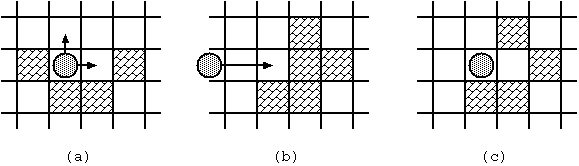
Fig. 2: Stone movements
Under
the rules, we would like to know whether the stone at the start can
reach the goal and, if yes, the minimum number of moves required.
With
the initial configuration shown in Fig. 1, 4 moves are required to
bring the stone from the start to the goal. The route is shown in Fig.
3(a). Notice when the stone reaches the goal, the board configuration
has changed as in Fig. 3(b).
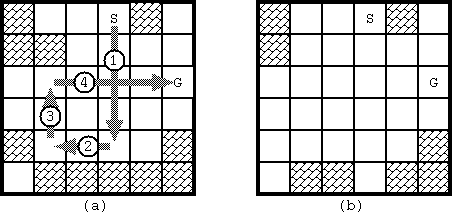
Fig. 3: The solution for Fig. D-1 and the final board configuration
Input
The
input is a sequence of datasets. The end of the input is indicated by a
line containing two zeros separated by a space. The number of datasets
never exceeds 100.
Each dataset is formatted as follows.
the width(=w) and the height(=h) of the board
First row of the board
...
h-th row of the board
The width and the height of the board satisfy: 2 <= w <= 20, 1 <= h <= 20.
Each line consists of w decimal numbers delimited by a space. The number describes the status of the corresponding square.
0 vacant square 1 block 2 start position 3 goal position
The dataset for Fig. D-1 is as follows:
6 6
1 0 0 2 1 0
1 1 0 0 0 0
0 0 0 0 0 3
0 0 0 0 0 0
1 0 0 0 0 1
0 1 1 1 1 1
Output
For
each dataset, print a line having a decimal integer indicating the
minimum number of moves along a route from the start to the goal. If
there are no such routes, print -1 instead. Each line should not have
any character other than this number.
Sample Input
2 1

3 2

6 6

1 0 0 2 1 0

1 1 0 0 0 0

0 0 0 0 0 3

0 0 0 0 0 0

1 0 0 0 0 1

0 1 1 1 1 1

6 1

1 1 2 1 1 3

6 1

1 0 2 1 1 3

12 1

2 0 1 1 1 1 1 1 1 1 1 3

13 1

2 0 1 1 1 1 1 1 1 1 1 1 3

0 0
Sample Output
1

4

-1

4

10

-1
Source
#include<stdio.h>

#include<string.h>

#include<iostream>

#include<algorithm>

using namespace std;

int map[][];

int n,m;

int sx,sy,ex,ey;

int nex[][]={,,,,,-,-,};

int ans,step;

bool judge(int x,int y){

    if(x>=&&x<n&&y>=&&y<m&&map[x][y]!=)

    return true;

    return false;

}

void dfs(int x,int y){

    if(step>)

    return;

    for(int i=;i<;i++){

        int tx=x+nex[i][];

        int ty=y+nex[i][];

        bool flag=false;

        while(judge(tx,ty)){

            flag=true;

            if(tx==ex&&ty==ey&&step<ans)

            ans=step;

            tx+=nex[i][];

            ty+=nex[i][];

        }

        if(map[tx][ty]==&&flag){

           step++;

           map[tx][ty]=;

           dfs(tx-nex[i][],ty-nex[i][]);

           step--;

           map[tx][ty]=;

        }

    }

}

int main(){

   while(scanf("%d%d",&m,&n)!=EOF){

        memset(map,,sizeof(map));

        if(n==&&m==)

        break;

        for(int i=;i<n;i++){

           for(int j=;j<m;j++){

              scanf("%d",&map[i][j]);

              if(map[i][j]==)

              sx=i,sy=j;

              if(map[i][j]==)

              ex=i,ey=j;

           }

        }

        ans=;

        step=;

        dfs(sx,sy);

        if(ans>)

          printf("-1\n");

        else

          printf("%d\n",ans);

   }

   return ;

}
poj3009 Curling 2.0 (DFS按直线算步骤)的更多相关文章
- POJ3009——Curling 2.0(DFS)
Curling 2.0 DescriptionOn Planet MM-21, after their Olympic games this year, curling is getting popu ...
- POJ3009 Curling 2.0(DFS)
迷宫问题求最短路. 略有不同的是假设不碰到石头的话会沿着一个方向一直前进,出界就算输了.碰到石头,前方石头会消失,冰壶停在原地. 把这个当作状态的转移. DFS能够求出其最小操作数. #include ...
- POJ-3009 Curling 2.0 (DFS)
Description On Planet MM-21, after their Olympic games this year, curling is getting popular. But th ...
- 【POJ】3009 Curling 2.0 ——DFS
Curling 2.0 Time Limit: 1000MS Memory Limit: 65536K Total Submissions: 11432 Accepted: 4831 Desc ...
- Curling 2.0(dfs回溯)
Curling 2.0 Time Limit: 1000MS Memory Limit: 65536K Total Submissions: 15567 Accepted: 6434 Desc ...
- poj3009 Curling 2.0(很好的题 DFS)
https://vjudge.net/problem/POJ-3009 做完这道题,感觉自己对dfs的理解应该又深刻了. 1.一般来说最小步数都用bfs求,但是这题因为状态记录很麻烦,所以可以用dfs ...
- POJ3009 Curling 2.0(DFS)
题目链接. 分析: 本题BFS A不了. 00100 00001 01020 00000 00010 00010 00010 00010 00030 对于这样的数据,本来应当是 5 步,但bfs却 4 ...
- Curling 2.0(dfs)
Time Limit: 1000MS Memory Limit: 65536K Total Submissions: 8795 Accepted: 3692 Description On Pl ...
- POJ3009 Curling 2.0
正式做POJ的第一题,做出来后又看了别人的代码,就又完善了一下,也通过了.参考 http://blog.sina.com.cn/s/blog_4abcd9bc0100phzb.html 改了之后觉得写 ...
随机推荐
- java Vamei快速教程02 方法和数据成员
作者:Vamei 出处:http://www.cnblogs.com/vamei 欢迎转载,也请保留这段声明.谢谢! 在Java基础01 从HelloWorld到面向对象,我们初步了解了对象(obje ...
- selenium显示等待解决浏览器未加载完成查找控件的问题
问题描述:wap版支付成功后,跳转到支付成功页,查找的元素已出现,如图的:元素1,元素2,但是提示查找的元素超时,失败,并且每到这个页面都会报页面超时,不能查找到页面元素 原始代码: try{ op. ...
- hdu-1317 XYZZY---Floyd判连通+bellman最短路
题目链接: http://acm.hdu.edu.cn/showproblem.php?pid=1317 题目大意: 题意:有n个房间(n<=100),每个房间有一个点权(第1号房间和第n号房间 ...
- vuejs数据和事件
<body> <div id='root'>{{number}}</div> <script> new Vue({ el:'#root', data:{ ...
- IPC Gateway 设计
1. IPC Gateway对外提供的功能: IPC的register/request/reply/notification服务. 2. IPC Gatew的实现原理: 各个具体的服务注册自己的回调函 ...
- MySQL优化器功能开关optimizer_switch
MySQL 8.0新增特性 use_invisible_indexes:是否使用不可见索引,MySQL 8.0新增可以创建invisible索引,这一开关控制优化器是否使用invisible索引,on ...
- react与微信小程序
由组员完成 原文链接 都说react和微信小程序很像,但是像在什么部分呢,待我稍作对比. 生命周期 1.React React的生命周期在16版本以前与之后发生了重大变化,原因在于引入的React F ...
- relu函数为分段线性函数,为什么会增加非线性元素
relu函数为分段线性函数,为什么会增加非线性元素 我们知道激活函数的作用就是为了为神经网络增加非线性因素,使其可以拟合任意的函数.那么relu在大于的时候就是线性函数,如果我们的输出值一直是在大于0 ...
- 什么是redis缓存穿透, 缓存雪崩, 缓存击穿
什么是redis? redis是一个非关系型数据库,相对于其他数据库而言,它的查询速度极快,且能承受的瞬时并发量非常的高.所以常常被用来存放网站的缓存,以减少主要数据库(如mysql)的服务器压力. ...
- IIC如何释放数据总线? 为什么=1就是释放?
最近看IIC原理,释放一词经常用遇到,在nxp的标准中也有看到,有点疑惑,因此百度,在百度知道中,有大佬的解释,可以看看何为“释放”,结合数字电子技术,应该可以理解了. 下面总结了一下三个解释何为“释 ...