
(PatchGANs)Pecomputed Real-time Texture Synthesis With Markovian Generative Adversarial Networks
Introduction:
Deconvolution; Computational costs; Strided convolutional nets; Markov patches;
1. Q: The task of texture synthesis have considerable computational costs becuase of a numerical deconvolution in previous work.
2. A: the author propose to procompute a feed-forwaed, strided convolutional network :
This framework can -
1. capture statistics of Markov patches.
2. directly generate output of arbitrary dimensions.
3. this method have considerable advantage in the fact of time-computation.
4. traditional complexity constraints(复杂性约束) using Markov random field that characterizes(表征) images by statistics of local patches of pixels(局部像素快的统计信息).
5. Deep architectures capture appearance variations in object classes beyond the abilities of pixel-level ap-
proaches.(深层架构能够捕获外表形状的变化的能力超过了基于像素水平的方法)
6.two main class of deep generative models:
1. full images models, often including specially trained 'auto-encoder', which limited fidelity(精确度) in details.
2. deep Markov models, capture the statistics of local patches, and assemble them to high-resolution.
Advantage:Markov model have good fidelity of details.
Disadvantage:
如果不重要的的全局结构要被产生, 则需要额外的辅助指导;
high time computation
这自然地提供了the blending of patches,并允许重用复杂的、紧急的多层特征表示的 大 型、有区别地训练的神经网络,如VGG网络[30],重新利用它们进行图像合成wih deconvolution framwork.
Objective: to improve the effciency of deep Markovian texture synthesis.
The key idea:
To precompute the inversion of strided the network by fitting a convolutional network [31,29] to the inversion process, which operates purely in a feed-forward fashion.(关键思想是通过将跨步卷积网络拟合到反演过程来预先计算网络的反演,该反演过程纯粹以前馈方式运行)
尽管在固定大小的patch上进行训练,得到的网络可以生成任意尺寸的连续图像,而不需要任何额外的优化或混合,从而产生一个具有特殊风格和高性能的高质量纹理合成器.
The model:
the framework of DCGANs is applied, nonetheless(然而).相同(be equivalent to )
Related work
1.Xie et al. [34] have proved that a generative random field model can be derived from used discriminative networks, and show applications to unguided texture synthesis.(Xie等人的[34]已经证明了从所使用的判别网络中可以导出一个生成的随机场模型,并展示了它在非制导纹理合成中的应用。)
2.full image method with auto-encoders as generative nets.
DCGANs stabilzed the performance of GANs and shows the generator have vector arithmeric properties(向量运算性质).生成器具备了“向量运算”的神奇性质,类似于word embedding可以操纵向量,并且能够按照“语义”生成新内容。
Adversarial nets offer perceptual metrics(感知指标) that allow AEs to be trianing effciency.
3. this PatchGANs is the use of feature-patch statistics rather than learn Gaussian distributions of individual feature vectors.(本文的主要概念差异是使用了Li等人的[21]特征-patch统计量,而不是学习单个特征向量的高斯分布,这在更忠实地再现纹理方面提供了一些好处。)
Model

Motivation:
1.As figure shown,real data does not always comly with(遵守) a Gaussian distribution(a), but a complex nonlinear monifold(复杂的非线性流体)(b), We adversarially learn a mapping to project contextually related patches to that manifold.
2. Statistics based mehods match the disribution of input and target with a Gaussian model.
3. Adversarial training (GANs) can recognize such manifold with its discriminative network. and strengthen its generative power with a projection on the manifold.
4. to improve adversarial training with contextually corresponding Markovian patches(上下文对应的马尔可夫patches),to focus on depictions(描述) of same context.
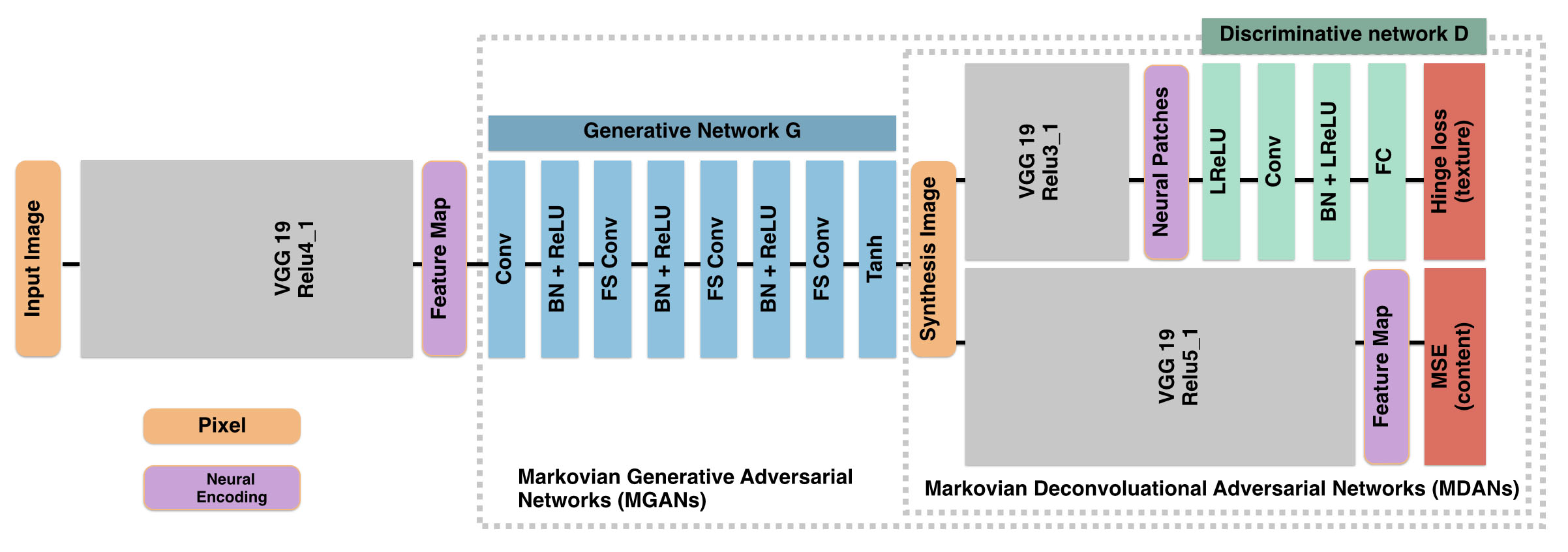
Model Depictions:
for D:
D (green blocks) that learns to distinguish actual feature patches (on VGG 19 layer Relu3 1, purple block) from inappropriately synthesized ones(不当的合成的patches).
第二次比较(管道下面的D)与VGG 19编码相同的图像在较高的,更抽象的层Relu5 1可以选择用于指导the distinguish of content.
for G:
encoding with VGG19_Relu4_1 and decodes it to pixels of the synthesis image
for MDANs: with a deconvolutional process is driven by adversarial traning
1. D (green blocks) is trained to distinguish between "neural patches" sampled from the synthesis image and sampled from the example image.
2. the score (1-s) is its texture loss.
with loss function:

$E_{t}$ denotes the loss between example texture image and synthsized image.
We initialize $x$ with random noise for un-guided synthesis, or an content image $x_{c}$ for guided synthesis.
with Hinge loss :
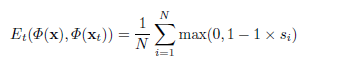
Here $s_{i}$ denotes the classication score of i-th neural patch, and $N$ is the total
number of sampled patches.
for MGANs
1. G decodes a picture through a ordinary convolution followed by a cascade(级联) of fractional-strided convolutions(分数阶跃卷积) (FS Conv).
Although being trained with fixed size input, the generator naturally extends to arbitrary size images.
2. 欧式距离的损失函数会使 产生(yield)的图像过于平滑(over-smooth)
3.compared with GANs, PatchGans do not operate on full images, but neural patches. in order to make learning easier with contextual correspondence between the patches
4. replace sigmoid by hinge loss.
Experiment detail
1. augment dataset with rotations and scales
2. samle subwindow of 128-by-128, where neural patches are sampled from its relu3_1 encoding as the input of D.
for Training
The training process has three main steps:
- Use MDAN to generate training images (MDAN_wrapper.lua).
- Data Augmentation (AG_wrapper.lua).
- Train MGAN (MDAN_wrapper.lua).
(PatchGANs)Pecomputed Real-time Texture Synthesis With Markovian Generative Adversarial Networks的更多相关文章
- StackGAN: Text to Photo-realistic Image Synthesis with Stacked Generative Adversarial Networks 论文笔记
StackGAN: Text to Photo-realistic Image Synthesis with Stacked Generative Adversarial Networks 本文将利 ...
- 语音合成论文翻译:2019_MelGAN: Generative Adversarial Networks for Conditional Waveform Synthesis
论文地址:MelGAN:条件波形合成的生成对抗网络 代码地址:https://github.com/descriptinc/melgan-neurips 音频实例:https://melgan-neu ...
- 【Paper Reading】Improved Textured Networks: Maximizing quality and diversity in Feed-Forward Stylization and Texture Synthesis
Improved Textured Networks: Maximizing quality and diversity in Feed-Forward Stylization and Texture ...
- 卷积神经网络图像纹理合成 Texture Synthesis Using Convolutional Neural Networks
代码实现 概述 这是关于Texture Synthesis Using Convolutional Neural Networks论文的tensorflow2.0代码实现,使用keras预训练的VGG ...
- 论文笔记之:Generative Adversarial Text to Image Synthesis
Generative Adversarial Text to Image Synthesis ICML 2016 摘要:本文将文本和图像练习起来,根据文本生成图像,结合 CNN 和 GAN 来有效的 ...
- 《Unpaired Image-to-Image Translation using Cycle-Consistent Adversarial Networks》论文笔记
Code Address:https://github.com/junyanz/CycleGAN. Abstract 引出Image Translating的概念(greyscale to color ...
- Generative Adversarial Nets[CycleGAN]
本文来自<Unpaired Image-to-Image Translation using Cycle-Consistent Adversarial Networks>,时间线为2017 ...
- Generative Adversarial Nets[pix2pix]
本文来自<Image-to-Image Translation with Conditional Adversarial Networks>,是Phillip Isola与朱俊彦等人的作品 ...
- Awesome Torch
Awesome Torch This blog from: A curated list of awesome Torch tutorials, projects and communities. T ...
随机推荐
- selenium初探
先看看官方给的小demo from selenium import webdriver from selenium.webdriver.common.keys import Keys driver = ...
- 我把公司 10 年老系统改造 Maven,真香!!
公司有几个老古董项目,应该是 10 年前开发的了,有一个是 JSP + Servlet,有一个还用的 SSH 框架,打包用的 Ant,是有多老啊,我想在座的各位很多都没听过吧. 为了持续集成.持续部署 ...
- 原子类的 ABA 问题
原子引用 public class AtomicReferenceDemo { public static void main(String[] args) { User cuzz = new Use ...
- Spring学习(七)bean装配详解之 【通过注解装配 Bean】【自动装配的歧义解决】
自动装配 1.歧义性 我们知道用@Autowired可以对bean进行注入(按照type注入),但如果有两个相同类型的bean在IOC容器中注册了,要怎么去区分对哪一个Bean进行注入呢? 如下情况, ...
- Oracle学习(二)SQL高级--表数据相关
SQL高级语句 top / limit / rownum / percent (前XXX条数据) --top(SQL Server / MS Access) select top 条数 from 表; ...
- spring:Beanfactory和ApplicationContext、BeanFactory 和 FactoryBean
1.Beanfactory和ApplicationContext有什么区别 ApplicationContext (1)在配置文件加载后创建bean 利用debug方式,在Student类的无参构造方 ...
- 对之前IoT项目的完善
博文有点长,因为是两个大项目(四个小项目)放一起了,不过都很适合新手小白(有源程序的情况),也可以再接 OLED 屏,就是前几篇博客的操作 一.esp8266 读取 DHT11 数据并通过微信小程序发 ...
- 初学源码之——银行案例手写IOC和AOP
手写实现lOC和AOP 上一部分我们理解了loC和AOP思想,我们先不考虑Spring是如何实现这两个思想的,此处准备了一个『银行转账」的案例,请分析该案例在代码层次有什么问题?分析之后使用我们已有知 ...
- NodeJS二进制合并
Node.js 批量文件合并code cnblogs @ Orcim 本 文主要介绍使用 Node 进行 ACB 序列文件(Atom CueSheet Binary,编译 AtomCueSheet ...
- 065 01 Android 零基础入门 01 Java基础语法 08 Java方法 02 带参无返回值方法
065 01 Android 零基础入门 01 Java基础语法 08 Java方法 03 带参无返回值方法 本文知识点:带参无返回值方法 说明:因为时间紧张,本人写博客过程中只是对知识点的关键步骤进 ...