
获取指定订阅下所有Azure ARM虚拟机配置(CPU核数,内存大小,磁盘信息)的使用情况
脚本内容:
<#

.SYNOPSIS

    This script grab all ARM VM VHD file in the subscription and caculate VHD size.

.DESCRIPTION

    This script grab all ARM VM VHD file in the subscription and caculate VHD size.

.Example

    .\Get-ArmVMDiskSize.ps1 -subscriptionid xxxxxxx-xxxx-xxxx-xxxxxxx

    Then input the username and password of Azure China.

.Disclaimer

    This sample code is provided for the purpose of illustration only and is not intended to be used in a production environment.

    THIS SAMPLE CODE AND ANY RELATED INFORMATION ARE PROVIDED "AS IS" WITHOUT WARRANTY OF ANY KIND, EITHER EXPRESSED OR IMPLIED, INCLUDING BUT NOT LIMITED TO THE IMPLIED WARRANTIES OF MERCHANTABILITY AND/OR FITNESS FOR A PARTICULAR PURPOSE.

    We grant You a nonexclusive, royalty-free right to use and modify the Sample Code and to reproduce and distribute the object code form of the Sample Code, provided that You agree:

    (i)     to not use Our name, logo, or trademarks to market Your software product in which the Sample Code is embedded;

    (ii)    to include a valid copyright notice on Your software product in which the Sample Code is embedded;

    (iii)    to indemnify, hold harmless, and defend Us and Our suppliers from and against any claims or lawsuits, including attorneys’ fees, that arise or result from the use or distribution of the Sample Code.

#>

param(

    [Parameter(Mandatory = $true)]

    [String]$SubscriptionID

)

function Get-BlobBytes

{

    param (

        [Parameter(Mandatory=$true)]

        [Microsoft.WindowsAzure.Commands.Common.Storage.ResourceModel.AzureStorageBlob]$Blob)

    # Base + blob name

    $blobSizeInBytes = 124 + $Blob.Name.Length * 2

    # Get size of metadata

    $metadataEnumerator = $Blob.ICloudBlob.Metadata.GetEnumerator()

    while ($metadataEnumerator.MoveNext())

    {

        $blobSizeInBytes += 3 + $metadataEnumerator.Current.Key.Length + $metadataEnumerator.Current.Value.Length

    }

    if ($Blob.BlobType -eq [Microsoft.WindowsAzure.Storage.Blob.BlobType]::BlockBlob)

    {

        $blobSizeInBytes += 8

        $Blob.ICloudBlob.DownloadBlockList() |

            ForEach-Object { $blobSizeInBytes += $_.Length + $_.Name.Length }

    }

    else

    {

        [int64]$rangeSize = 1GB

        [int64]$start = 0; $pages = "Start";

        While ($pages)

        {

            try

            {

                $pages = $Blob.ICloudBlob.GetPageRanges($start, $rangeSize)

            }

            catch

            {

                if ($_ -like "*the range specified is invalid*")

                {

                    $pages = $null

                    break

                }

                else

                {

                    write-error $_

                }

            }

            $pages | ForEach-Object { $blobSizeInBytes += 12 + $_.EndOffset - $_.StartOffset }

            $start += $rangeSize

        }

    }

    return @{"vhdlength" = "{0:F2}" -f ($blob.Length / 1GB) -replace ","; "usedsize" = "{0:F2}" -f ($blobSizeInBytes / 1GB) -replace ","}

}

function Get-VMCoresandMemory

{

    param (

        [Parameter(Mandatory=$true)]

        [String]$VMSize)

    $csvfile = $env:USERPROFILE+"\Downloads\VMsizes.csv"

    $VMSizeList = Import-Csv $csvfile

    $VMcoresmem = $VMSizeList | where {$_.Size -eq $VMSize}

    return @{"Cores" = $VMcoresmem.Cores; "Memory" = $vmcoresmem.Memory}

}

<#

Import-Module AzureRM.Compute

$PSversion = (Get-Module -Name AzureRM.Compute).Version

If($PSversion -lt [System.Version]"2.6.0")

{

    Write-Host "PowerShell Version too low. Visit https://docs.microsoft.com/en-us/powershell/azure/overview to install the newest AzureRM module.";

    Exit

}

#>

Login-AzureRmAccount -EnvironmentName AzureChinaCloud  | Out-Null

Get-AzureRmSubscription -SubscriptionId $SubscriptionID  | Out-Null

Select-AzureRmSubscription -SubscriptionId $SubscriptionID  | Out-Null

$armfile = $env:USERPROFILE+"\Downloads\armvms-"+$subscriptionID+".csv"

Set-Content $armfile -Value "ResourceGroup,VMName,VMSize,Cores,Memory(GB),DiskName,OSorData,VHDUri,StorageAccount,VHDLength,VHDUsedSize"

Write-Verbose "ARM part starts!"

$armvms = Get-AzureRmVM

foreach($armvm in $armvms)

{

    $vmresourcegroup = $armvm.ResourceGroupName

    $vmname = $armvm.Name

    $vmsize = $armvm.HardwareProfile.VmSize

    $vmcores = (Get-VMCoresandMemory -VMSize $vmsize).Cores

    $vmmemory = (Get-VMCoresandMemory -VMSize $vmsize).Memory

    $vmosdiskname = $armvm.StorageProfile.OsDisk.Name

    If ($armvm.StorageProfile.OsDisk.vhd -eq $null)

    {

        Write-Host ("The VM "+$vmname+" is using Managed Disks.")

        $vmosdisksize = (Get-AzureRmDisk -ResourceGroupName $vmresourcegroup -DiskName $vmosdiskname).DiskSizeGB

        Add-Content $armfile -Value ($vmresourcegroup+","+$vmname+","+$vmsize+“,”+$vmcores+","+$vmmemory+","+$vmosdiskname+",OSDisk,No visible VHD files for Managed Disk VM,No visible storage account for Managed Disk VM,"+$vmosdisksize+",Managed Disks don't support GetBlobSize method")

        $datadisks = $armvm.StorageProfile.DataDisks

        If ($datadisks.Count -eq 0)

        {

            Write-Host ("The VM "+$vmname+" contains no data disk.")

        }

        else

        {

            Write-Host ("The VM "+$vmname+" contains "+$datadisks.Count+" data disk(s).")

            foreach ($datadisk in $datadisks)

            {

                $vmdatadiskname = $datadisk.Name

                $vmdatadisksize = (Get-AzureRmDisk -ResourceGroupName $vmresourcegroup -DiskName $vmdatadiskname).DiskSizeGB

                Add-Content $armfile -Value (",,,,,"+$vmdatadiskname+",DataDisk,No visible VHD files for Managed Disk VM,No visible storage account for Managed Disk VM,"+$vmdatadisksize+",Managed Disks don't support GetBlobSize method")

            }

        }

    }

    else

    {

        $vmosdiskuri = $armvm.StorageProfile.OsDisk.Vhd.Uri

        $vmosdiskstorageaccountname = ($armvm.StorageProfile.OsDisk.Vhd.Uri.Split("{/,.}"))[2]

        $vmosdiskstorageaccountkey = (Get-AzureRmStorageAccount | ? {$_.StorageAccountName -eq $vmosdiskstorageaccountname} | Get-AzureRmStorageAccountKey)[0].Value

        $vmosdiskstorageaccountcontext = New-AzureStorageContext -StorageAccountName $vmosdiskstorageaccountname -StorageAccountKey $vmosdiskstorageaccountkey

        $vmosdiskcontainername = ($armvm.StorageProfile.OsDisk.Vhd.Uri.Split("/")[3])

        $vmosdiskblobname = ($armvm.StorageProfile.OsDisk.Vhd.Uri.Split("/")[(($armvm.StorageProfile.OsDisk.Vhd.Uri.Split("/")).count) - 1])

        $vmosdiskblob = Get-AzureStorageBlob -Context $vmosdiskstorageaccountcontext -blob $vmosdiskblobname -Container $vmosdiskcontainername

        $osvhdsize = Get-BlobBytes $vmosdiskblob

        If ($vmsize -like "*DS*")

        {

            Add-Content $armfile -Value ($vmresourcegroup+","+$vmname+","+$vmsize+","+$vmcores+","+$vmmemory+","+$vmosdiskname+",OSDisk,"+$vmosdiskuri+","+$vmosdiskstorageaccountname+","+$osvhdsize+",Premium Disks don't support GetBlobSize method")

        }

        else

        {

            Add-Content $armfile -Value ($vmresourcegroup+","+$vmname+","+$vmsize+","+$vmcores+","+$vmmemory+","+$vmosdiskname+",OSDisk,"+$vmosdiskuri+","+$vmosdiskstorageaccountname+","+$osvhdsize.vhdlength+","+$osvhdsize.usedsize)

        }

        $datadisks = $armvm.StorageProfile.DataDisks

        If ($datadisks.count -eq 0)

        {

            Write-Host ("The VM "+$vmname+" contains no data disk.")

        }

        else

        {

            Write-Host ("The VM "+$vmname+" contains "+$datadisks.Count+" data disk(s).")

            foreach ($datadisk in $datadisks)

            {

                $vmdatadiskname = $datadisk.Name

                $vmdatadiskuri = $datadisk.Vhd.Uri

                $vmdatadiskstorageaccountname = ($vmdatadiskuri.Split("{/,.}"))[2]

                $vmdatadiskstorageaccountkey = (Get-AzureRmStorageAccount | ? {$_.StorageAccountName -eq $vmdatadiskstorageaccountname} | Get-AzureRmStorageAccountKey)[0].Value

                $vmdatadiskstorageaccountcontext = New-AzureStorageContext -StorageAccountName $vmdatadiskstorageaccountname -StorageAccountKey $vmdatadiskstorageaccountkey

                $vmdatadiskcontainername = ($datadisk.Vhd.Uri.Split("/")[3])

                $vmdatadiskblobname = ($datadisk.Vhd.Uri.Split("/")[(($datadisk.Vhd.Uri.Split("/")).count) - 1])

                $vmdatadiskblob = Get-AzureStorageBlob -Context $vmdatadiskstorageaccountcontext -blob $vmdatadiskblobname -Container $vmdatadiskcontainername

                $datavhdsize = Get-BlobBytes $vmdatadiskblob

                If ($vmsize -like "*DS*")

                {

                    Add-Content $armfile -Value (",,,,,"+$vmdatadiskname+",DataDisk,"+$vmdatadiskuri+","+$vmdatadiskstorageaccountname+","+$datavhdsize.vhdlength+",Premium Disks don't support GetBlobSize method")

                }

                else

                {

                    Add-Content $armfile -Value (",,,,,"+$vmdatadiskname+",DataDisk,"+$vmdatadiskuri+","+$vmdatadiskstorageaccountname+","+$datavhdsize.vhdlength+","+$datavhdsize.usedsize)

                }

            }

        }

    }

}

Write-Verbose "ARM part finished!"
脚本运行步骤:
1.安装较新的Azure Powershell模块,https://docs.azure.cn/zh-cn/powershell-install-configure
2.将附件压缩包下的.csv文件拷贝至机器%UserProfile%\Downloads 文件夹下
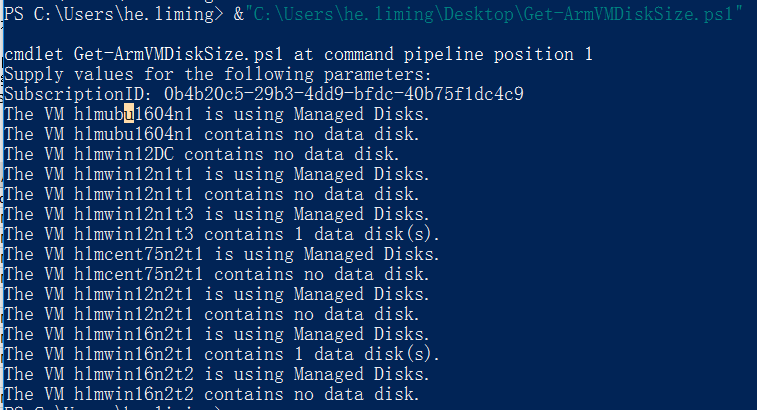
3.在PowerShell中运行脚本,提供订阅号并登陆账号,即可成功抓取虚拟机的CPU核数、内存大小及磁盘信息
执行脚本及输出示例:

获取指定订阅下所有Azure ARM虚拟机配置(CPU核数,内存大小,磁盘信息)的使用情况的更多相关文章
- Java获取Linux和Window系统CPU、内存和磁盘总使用率的情况
这是一个工具类,获取的内容: CPU使用率:得到的是当前CPU的使用情况,这是算出的是两次500毫秒时间差的CPU使用率 内存使用率:[1 - 剩余的物理内存/(总的物理内存+虚拟内存) ] * 1 ...
- Azure Powershell获取指定订阅下的虚拟机信息(ARM)
为方便Azure用户导出已创建虚拟机的相关信息,特编写如下脚本: 详情脚本: # 登陆Azure Account Add-AzureRmAccount -EnvironmentName AzureCh ...
- Azure Powershell获取指定订阅下的虚拟机信息(ASM)
为方便Azure用户导出已创建虚拟机的相关信息,特编写如下脚本: 详情脚本: # 登陆Azure Account Add-AzureAccount -Environment AzureChinaClo ...
- linux下查看CPU、内存、磁盘信息
1.查看CPU信息# 总核数 = 物理CPU个数 X 每颗物理CPU的核数 # 总逻辑CPU数 = 物理CPU个数 X 每颗物理CPU的核数 X 超线程数 # 查看物理CPU个数cat /proc/c ...
- 【转】Linux下查看CPU、内存、磁盘信息
1.查看CPU信息# 总核数 = 物理CPU个数 X 每颗物理CPU的核数 # 总逻辑CPU数 = 物理CPU个数 X 每颗物理CPU的核数 X 超线程数 # 查看物理CPU个数cat /proc/c ...
- Azure ARM虚拟机部署反恶意软件-安全扩展
Azure虚拟机,默认情况下没有安装杀毒软件.如果您有此需求可以通过Azure 扩展进行安装,有关Azure反恶意软件的官方说明请参考:https://docs.azure.cn/zh-cn/secu ...
- 一个获取指定目录下一定格式的文件名称和文件修改时间并保存为文件的python脚本
摘自:http://blog.csdn.net/forandever/article/details/5711319 一个获取指定目录下一定格式的文件名称和文件修改时间并保存为文件的python脚本 ...
- PHP 获取指定目录下所有文件(包含子目录)
PHP 获取指定目录下所有文件(包含子目录) //glob — 寻找与模式匹配的文件路径 $filter_dir = array('CVS', 'templates_c', 'log', 'img', ...
- TDirectory.GetFileSystemEntries获取指定目录下的目录和文件
使用函数: System.IOUtils.TDirectory.GetFileSystemEntries 所有重载: class function GetFileSystemEntries(const ...
随机推荐
- ArcEngine调用GP里的Merge工具传参问题
Merge工具inputs参数形式与Python中不同: string startLayerPath= cpj.TempWs.PathName + @"\" + datasetNa ...
- Unity5.x Reflection Probe反射探针
http://blog.csdn.net/yupu56/article/details/53487216
- rabbitmq的延迟消息队列实现
第一部分:延迟消息的实现原理和知识点 使用RabbitMQ来实现延迟任务必须先了解RabbitMQ的两个概念:消息的TTL和死信Exchange,通过这两者的组合来实现上述需求. 消息的TTL(Tim ...
- Linux select/poll和epoll实现机制对比
关于这个话题,网上已经介绍的比较多,这里只是以流程图形式做一个简单明了的对比,方便区分. 一.select/poll实现机制 特点: 1.select/poll每次都需要重复传递全部的监听fd进来,涉 ...
- Java 设计模式系列(四)生成器模式
Java 设计模式系列(四)生成器模式 生成器模式也称之为建造者模式.将一个复杂对象的构建与它的表示分离,使得同样的构建过程可以创建不同的表示.demo 1. 生成器模式原理 1.1 生成器模式结构 ...
- Spring boot——logback.xml 配置详解(二)
阅读目录 1 根节点包含的属性 2 根节点的子节点 文章转载自:http://aub.iteye.com/blog/1101260,在此对作者的辛苦表示感谢! 回到顶部 1 根节点<config ...
- View Pi's Status on WebBrowser
1. install php and cgi support sudo apt-get install php5-common sudo apt-get install php5-cgi sudo a ...
- Cockroachdb 四、用户管理及授权
四 用户管理及授权 用户管理 简介# Create a user:cockroach user set <username> <flags> # List all users: ...
- Maven Compilation error [package org.testng.annotations does not exist]
背景 在执行mvn test的时候,提示package org.testng.annotations does not exist 解决办法 Open pom.xml file. Go to &quo ...
- 手动编译安装lamp之php
转自马哥教育讲课文档 三.编译安装php-5.4.8 1.解决依赖关系: 请配置好yum源(可以是本地系统光盘)后执行如下命令: # yum -y groupinstall "X Softw ...