
python爬取b站排行榜
爬取b站排行榜并存到mysql中
目的
b站是我平时看得最多的一个网站,最近接到了一个爬虫的课设。首先要选择一个网站,并对其进行爬取,最后将该网站的数据存储并使其可视化。
网站的结构
目标网站:bilibili排行榜
网页的层次
- 首先要确定要提取的信息,也就是标题、播放量、作者up主、评分、播放量和评论量

- 在网页源代码中找到要找的信息
每个网页中大概有多条这样的rank-item项目,要提取的信息就包含其中
<li class="rank-item">

     <div class="num">3</div>

         <div class="content">

           <div class="img">

           <a href="//bangumi.bilibili.com/anime/28016" target="_blank">

                   <div class="lazy-img cover"><img alt="女高中生的虚度日常" src=""></div>

           </a>

           <!---->

     </div>

       <div class="info">

           <a href="//bangumi.bilibili.com/anime/28016" target="_blank"class="title">

           女高中生的虚度日常

           </a>

       <div class="bangumi-info">全12话</div>

       <div class="detail">

       <span class="data-box">

           <i class="b-icon play"></i>

           3491.1万

       </span>

       <span class="data-box">

           <i class="b-icon view"></i>

           74.3万

       </span>

       <span class="data-box">

           <i class="fav">

           </i>

           176.4万

       </span></div>

       <div class="pts">

             <div>2218000</div>综合得分

       </div>

   </div>

   </div>

</li>
1.名称在title类的a标签下
2.播放量、评论数、和up主在data-box类的span标签下
3.综合评分在pts类的div标签下
对应解析其的代码
def getPage(url):#爬取单个页面,核心代码

    spider=Spider(url)

    spider.setSoup()

    itemList=spider.findTagByAttrs('li','rank-item')

    pageContentList=[]

    for item in itemList:

        pageContentItem=[]

        for title in item.find_all('a','title'):

            pageContentItem.append(title.string)

            # print(title.string)

        for playnum in item.find_all('span','data-box'):

            pattern=r">([^<]+)<"

            n=re.findall(pattern,playnum.__str__())[0]

            pageContentItem.append(n)

            # print(n)

        # print(item.find_all('div','pts')[0].div.string)

        pageContentItem.append(item.find_all('div','pts')[0].div.string)

        pageContentList.append(pageContentItem)

    return pageContentList
网站的层次
通过观察连接参数的变化
https://www.bilibili.com/ranking/all/0/0/3
以这个链接为例,通过实验,该网页链接的参数代表各种意义,ranking代表排行,all代表是否是全站还是原创,第一个参数0代表,各个分区,第二个参数0代表了全部投稿还是近期投稿,第三个参数3代表了是三日内投递的,根据实验规律,得到了生成连接的代码,但是只有全站榜和原创榜支持这个规律,其他的暂时没爬
def getURLFormBilibili():# 获取各种各样排行的榜单的信息

    date={

        1:'日排行',

        3:'三日排行',

        7:'周排行',

        30:'月排行'

    }

    areatype={

        0:'全站',

        1:'动画',

        168:'国漫相关',

        3:'音乐',

        129:'舞蹈',

        4:'游戏',

        36:'科技',

        188:'数码',

        160:'生活',

        119:'鬼畜',

        155:'时尚',

        5:'娱乐',

        181:'影视'

    }

    ranktype={

       'all':'全站',

       'origin':'原创'

    }

    submit={

        '0':'全部投稿',

        '1':'近期投稿'

    }

    urlDict={}#存放相应url的字典

    for ranktypeItem in ranktype.keys():

        for areatypeItem in areatype.keys():

            for submitItem in submit.keys():

                for dateTypeItem in date.keys():

                    title=ranktype[ranktypeItem]+'_'+areatype[areatypeItem]+'_'+submit[submitItem]+'_'+date[dateTypeItem]

                    destinaTionUrl='https://www.bilibili.com/ranking/{}/{}/{}/{}'.format(ranktypeItem,areatypeItem,submitItem,dateTypeItem)

                    urlDict[title]=destinaTionUrl

    return urlDict
保存到mysql数据库
这里使用了pymysql这个库,安装使用pip就好了,就不再赘述,为了方便我把它写成了一个类
class MysqlConnect:#数据库的连接类

    def __init__(self):

        pass

    def getConnect(self):

        db=coon = pymysql.connect(

            host = 'localhost',user = 'root',passwd = '你的密码',

            port = 3306,db = 'bilibilirank',charset = 'utf8'

             #port必须写int类型

             #charset必须写utf8,不能写utf-8

        )

        return db

    def insertInfo(self,sql):

        db=self.getConnect()

        cursor=db.cursor()

        try:

            cursor.execute(sql)

            db.commit()

            print("sucessed...")

        except:

            print("failed...")

            db.rollback()

    def queryOutCome(self,sql):

         # 获取数据库连接

        db = self.getConnect()

        # 使用cursor() 方法创建一个游标对象 cursor

        cursor = db.cursor()

        try:

            # 执行sql语句

            cursor.execute(sql)

            result = cursor.fetchone()

        except: #方法二:采用traceback模块查看异常

            #输出异常信息

            traceback.print_exc()

            # 如果发生异常,则回滚

            db.rollback()

        finally:

            # 最终关闭数据库连接

            db.close()

        return result

    def getCreateTableSql(self,tableName):#获取创建表的sql语句

        sql='''

        create table `{}` (

            id int(11) auto_increment primary key,

            title char(100) NOT NULL UNIQUE,

            playnum char(100) NOT NULL,

            commentnum char(100) NOT NULL,

            author char(100) NOT NULL,

            score char(100) NOT NULL

        )ENGINE=innodb DEFAULT CHARSET=utf8;

        '''.format(tableName)

        return sql

    def getInsertToTableSql(self,tableName,title,playnum,commentnum,author,score):

        sql='''

        insert into `{}` values(null,'{}','{}','{}','{}','{}');

        '''.format(tableName,title,playnum,commentnum,author,score)

        return sql

    def createTable(self,tableName,sql):

        db=self.getConnect()

        cursor=db.cursor()

        cursor.execute("drop table if exists %s" %(tableName))

        cursor.execute(sql)

        db.close()
爬取数据
按照页面逐个爬取保存到数据库
if __name__ == "__main__":

    #开始爬取数据

    urlDict=getURLFormBilibili()#获取对应的URL信息

    mysqlconnect=MysqlConnect()#用于连接数据库

    for urlName in urlDict:

        print("正在处理"+urlName+"页面...")

        url=urlDict[urlName]

        tableName=urlName

        createsql=mysqlconnect.getCreateTableSql(tableName)

        mysqlconnect.createTable(tableName,createsql)

        pageList=getPage(url)

        for contentItem in pageList:

            insertsql=mysqlconnect.getInsertToTableSql(tableName,contentItem[0],contentItem[1],contentItem[2],contentItem[3],contentItem[4])

            print(insertsql)

            mysqlconnect.insertInfo(insertsql)
结果

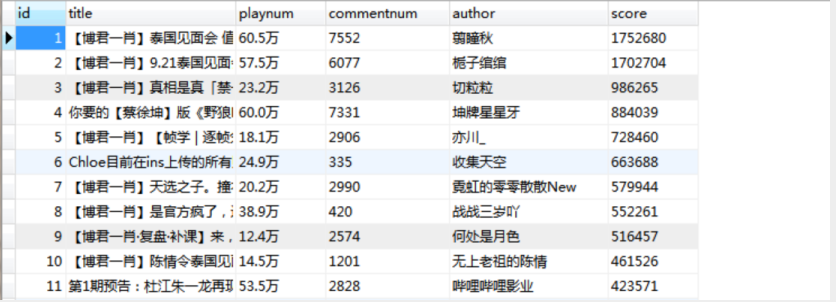
源代码
import requests

import re

from bs4 import BeautifulSoup

import pymysql

import traceback

class Spider:#常用的爬取方法的简单封装

    def __init__(self,url):

        self.url=url

    def getHTML(self):#获取html的对应代码

        headers={'User-Agent':'Mozilla/5.0 (Windows NT 10.0; WOW64) AppleWebKit/537.36 (KHTML, like Gecko) Chrome/55.0.2883.103 Safari/537.36'}

        try:

            response=requests.get(url=self.url,headers=headers,timeout=20)

            response.raise_for_status()

            response.encoding=response.apparent_encoding

            return response.text

        except:

            return "网页访问失败"

    def setSoup(self):#获取soup对象

        html=self.getHTML()

        self.soup=BeautifulSoup(html,'html.parser')

    def findTag(self,tagName):#按照标签名查找标签

        return self.soup.find_all(tagName)

    def findTagByAttrs(self,tagName,attrs):

        return self.soup.find_all(tagName,attrs)

    def getBeautifyHTML(self):

        return self.soup.prettify()

def getPage(url):#爬取单个页面,核心代码

    spider=Spider(url)

    spider.setSoup()

    itemList=spider.findTagByAttrs('li','rank-item')

    pageContentList=[]

    for item in itemList:

        pageContentItem=[]

        for title in item.find_all('a','title'):

            pageContentItem.append(title.string)

            # print(title.string)

        for playnum in item.find_all('span','data-box'):

            pattern=r">([^<]+)<"

            n=re.findall(pattern,playnum.__str__())[0]

            pageContentItem.append(n)

            # print(n)

        # print(item.find_all('div','pts')[0].div.string)

        pageContentItem.append(item.find_all('div','pts')[0].div.string)

        pageContentList.append(pageContentItem)

    return pageContentList

def getURLFormBilibili():# 获取各种各样排行的榜单的信息

    date={

        1:'日排行',

        3:'三日排行',

        7:'周排行',

        30:'月排行'

    }

    areatype={

        0:'全站',

        1:'动画',

        168:'国漫相关',

        3:'音乐',

        129:'舞蹈',

        4:'游戏',

        36:'科技',

        188:'数码',

        160:'生活',

        119:'鬼畜',

        155:'时尚',

        5:'娱乐',

        181:'影视'

    }

    ranktype={

       'all':'全站',

       'origin':'原创'

    }

    submit={

        '0':'全部投稿',

        '1':'近期投稿'

    }

    urlDict={}#存放相应url的字典

    for ranktypeItem in ranktype.keys():

        for areatypeItem in areatype.keys():

            for submitItem in submit.keys():

                for dateTypeItem in date.keys():

                    title=ranktype[ranktypeItem]+'_'+areatype[areatypeItem]+'_'+submit[submitItem]+'_'+date[dateTypeItem]

                    destinaTionUrl='https://www.bilibili.com/ranking/{}/{}/{}/{}'.format(ranktypeItem,areatypeItem,submitItem,dateTypeItem)

                    urlDict[title]=destinaTionUrl

    return urlDict

class MysqlConnect:#数据库的连接类

    def __init__(self):

        pass

    def getConnect(self):

        db=coon = pymysql.connect(

            host = 'localhost',user = 'root',passwd = '你的密码',

            port = 3306,db = 'bilibilirank',charset = 'utf8'

             #port必须写int类型

             #charset必须写utf8,不能写utf-8

        )

        return db

    def insertInfo(self,sql):

        db=self.getConnect()

        cursor=db.cursor()

        try:

            cursor.execute(sql)

            db.commit()

            print("sucessed...")

        except:

            print("failed...")

            db.rollback()

    def queryOutCome(self,sql):

         # 获取数据库连接

        db = self.getConnect()

        # 使用cursor() 方法创建一个游标对象 cursor

        cursor = db.cursor()

        try:

            # 执行sql语句

            cursor.execute(sql)

            result = cursor.fetchone()

        except: #方法二:采用traceback模块查看异常

            #输出异常信息

            traceback.print_exc()

            # 如果发生异常,则回滚

            db.rollback()

        finally:

            # 最终关闭数据库连接

            db.close()

        return result

    def getCreateTableSql(self,tableName):#获取创建表的sql语句

        sql='''

        create table `{}` (

            id int(11) auto_increment primary key,

            title char(100) NOT NULL UNIQUE,

            playnum char(100) NOT NULL,

            commentnum char(100) NOT NULL,

            author char(100) NOT NULL,

            score char(100) NOT NULL

        )ENGINE=innodb DEFAULT CHARSET=utf8;

        '''.format(tableName)

        return sql

    def getInsertToTableSql(self,tableName,title,playnum,commentnum,author,score):

        sql='''

        insert into `{}` values(null,'{}','{}','{}','{}','{}');

        '''.format(tableName,title,playnum,commentnum,author,score)

        return sql

    def createTable(self,tableName,sql):

        db=self.getConnect()

        cursor=db.cursor()

        cursor.execute("drop table if exists %s" %(tableName))

        cursor.execute(sql)

        db.close()

if __name__ == "__main__":

    #开始爬取数据

    urlDict=getURLFormBilibili()#获取对应的URL信息

    mysqlconnect=MysqlConnect()#用于连接数据库

    for urlName in urlDict:

        print("正在处理"+urlName+"页面...")

        url=urlDict[urlName]

        tableName=urlName

        createsql=mysqlconnect.getCreateTableSql(tableName)

        mysqlconnect.createTable(tableName,createsql)

        pageList=getPage(url)

        for contentItem in pageList:

            insertsql=mysqlconnect.getInsertToTableSql(tableName,contentItem[0],contentItem[1],contentItem[2],contentItem[3],contentItem[4])

            print(insertsql)

            mysqlconnect.insertInfo(insertsql)
python爬取b站排行榜的更多相关文章
- python爬取b站排行榜视频信息
和上一篇相比,差别不是很大 import xlrd#读取excel import xlwt#写入excel import requests import linecache import wordcl ...
- 萌新学习Python爬取B站弹幕+R语言分词demo说明
代码地址如下:http://www.demodashi.com/demo/11578.html 一.写在前面 之前在简书首页看到了Python爬虫的介绍,于是就想着爬取B站弹幕并绘制词云,因此有了这样 ...
- 用Python爬取B站、腾讯视频、爱奇艺和芒果TV视频弹幕!
众所周知,弹幕,即在网络上观看视频时弹出的评论性字幕.不知道大家看视频的时候会不会点开弹幕,于我而言,弹幕是视频内容的良好补充,是一个组织良好的评论序列.通过分析弹幕,我们可以快速洞察广大观众对于视频 ...
- python爬取某站新闻,并分析最近新闻关键词
在爬取某站时并做简单分析时,遇到如下问题和大家分享,避免犯错: 一丶网站的path为 /info/1013/13930.htm ,其中13930为不同新闻的 ID 值,但是这个数虽然为升序,但是没有任 ...
- 用python爬取B站在线用户人数
最近在自学Python爬虫,所以想练一下手,用python来爬取B站在线人数,应该可以拿来小小分析一下 设计思路 首先查看网页源代码,找到相应的html,然后利用各种工具(BeautifulSoup或 ...
- Python爬取B站视频信息
该文内容已失效,现已实现scrapy+scrapy-splash来爬取该网站视频及用户信息,由于B站的反爬封IP,以及网上的免费代理IP绝大部分失效,无法实现一个可靠的IP代理池,免费代理网站又是各种 ...
- Python爬取b站任意up主所有视频弹幕
爬取b站弹幕并不困难.要得到up主所有视频弹幕,我们首先进入up主视频页面,即https://space.bilibili.com/id号/video这个页面.按F12打开开发者菜单,刷新一下,在ne ...
- Python爬取B站耗子尾汁、不讲武德出处的视频弹幕
本文的文字及图片来源于网络,仅供学习.交流使用,不具有任何商业用途,如有问题请及时联系我们以作处理. 前言 耗子喂汁是什么意思什么梗呢?可能很多人不知道,这个梗是出自马保国,经常上网的人可能听说过这个 ...
- 使用python爬取P站图片
刚开学时有一段时间周末没事,于是经常在P站的特辑里收图,但是P站加载图片的速度比较感人,觉得自己身为计算机专业,怎么可以做一张张图慢慢下这么low的事,而且这样效率的确也太低了,于是就想写个程序来帮我 ...
随机推荐
- shell练习--PAT题目1004: 成绩排名 !(失败案例,shell运行超时)
读入 n(>)名学生的姓名.学号.成绩,分别输出成绩最高和成绩最低学生的姓名和学号. 输入格式: 每个测试输入包含 1 个测试用例,格式为 第 1 行:正整数 n 第 2 行:第 1 个学生的姓 ...
- 两句话掌握 Python 最难知识点——元类
千万不要被所谓“元类是99%的python程序员不会用到的特性”这类的说辞吓住.因为每个中国人,都是天生的元类使用者 学懂元类,你只需要知道两句话: 道生一,一生二,二生三,三生万物 我是谁?我从哪来 ...
- ArrayList,Vector ,LinkedList的存储性能和特性
ArrayList,Vector,LinkedList : 两者都采用数组元素方式存储数据,此数组元素数大于实际存储的数据(以便于增加和插入元素),允许直接按照序号索引元素,但是插入元素涉及数组元素移 ...
- Mysql中 BLOB字段转String的方法
转:https://www.cnblogs.com/renjie0520/p/5242350.html 1.通过sql直接转换 select CONVERT (*** USING utf8) AS u ...
- Java 简单工厂
在面向对象编程中, 最通常的方法是一个new操作符产生一个对象实例,new操作符就是用来构造对象实例的.但是在一些情况下, new操作符直接生成对象会带来一些问题.举例来说, 许多类型对象的创造需要一 ...
- Oracle开发:normal ,sysdba,sysoper区别
Oracle将用户分成两类:[system]和[sys] [system]用户只能用normal身份登陆em.(可以看成公司的普通成员) [sys]用户具有“SYSDBA”(可以看成公司的CEO)或者 ...
- instanceOf与isInstance()方法之间的区别
instanceof运算符 只被用于对象引用变量,检查左边的被测试对象 是不是 右边类或接口的 实例化.如果被测对象是null值,则测试结果总是false.Class类的isInstance(Obje ...
- Mysql 数据库锁表的原因和解决方法
摘自: https://www.csdn.net/gather_2f/MtTaIgxsMTM5NC1ibG9n.html 锁表的原因:当多个连接(数据库连接)同时对一个表的数据进行更新操作,那么速度将 ...
- legend3---阿里云如何多个域名指向同一个网站
legend3---阿里云如何多个域名指向同一个网站 一.总结 一句话总结: 先寻求资料及文档,没有找到的话自己摸索一下就好 结论:多个域名都需要备案 二.阿里云如何多个域名指向同一个网站 当前情况 ...
- 数据结构和算法(Java版)快速学习(线性表)
线性表的基本特征: 第一个数据元素没有前驱元素: 最后一个数据元素没有后继元素: 其余每个数据元素只有一个前驱元素和一个后继元素. 线性表按物理存储结构的不同可分为顺序表(顺序存储)和链表(链式存储) ...