
Design Pattern ->Bridge
Layering & Contract Philosophy With additional indirection.
 class CWindowImp

 {

     public: virtual void DrawLine(){};

         public: virtual void DrawText(){};

 }

 class CWindow

 {

       public: virtual void DrawLine(){};

                  virtual void DrawText(){};

       protect: WindowImp* GetWindowImp()

       {

             return WindowSystemFactory::Instance()->MakeWindwImp();

        } ;

        private: WindowImp *pWindowImp;

 }

 class CXPWindow: public CWindow

 {

          public: void DrawLine()

          {

                GetWindowImp()->DrawLine();

          }

 }

 class CMacWindow: public CWindow

 {

           public: void DrawLine()

          {

              do_something_special; GetWindowImp()->DrawLine();

           }

 class CXPWindowImp: public CWindowImp

 class CMacWindowImp: public CWindowImp
Applicability
Use the Bridge pattern when
- you want to avoid a permanent binding between an abstraction and its implementation. This might be the case, for example, when the implementation must be selected or switched at run-time.
- Layering or interface-Based/Oriented programming. Separate the layer.
- Both the abstractions and their implementations should be extensible by subclassing. In this case, the Bridge pattern lets you combine the different abstractions and implementations and extend them independently.
- Changes in the implementation of an abstraction should have no impact/effect/influence on clients; that is, their code should not have to be recompiled.
- (C++) you want to hide the implementation of an abstraction completely from clients. In C++ the representation of a class is visible in the class interface.
- You have a proliferation of classes as shown earlier in the first Motivation diagram. Such a class hierarchy indicates the need for splitting an object into two parts. Rumbaugh uses the term "nested generalizations" [RBP+91] to refer to such class hierarchies.
- You want to share an implementation among multiple objects (perhaps using reference counting), and this fact should be hidden from the client. A simple example is Coplien's String class [Cop92], in which multiple objects can share the same string representation (StringRep).
Participants
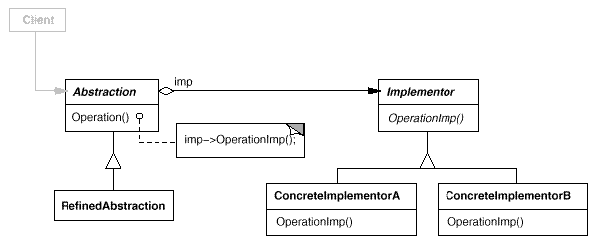
- Abstraction (Window)Defines the abstraction's interface.Maintains a reference to an object of type Implementor.
- RefinedAbstraction (IconWindow)Extends the interface defined by Abstraction.
- Implementor (WindowImp) Defines the interface for implementation classes. This interface doesn't have to correspond exactly to Abstraction's interface; in fact the two interfaces can be quite different. Typically the Implementor interface provides only primitive operations, and Abstraction defines higher-level operations based on these primitives.
- ConcreteImplementor (XWindowImp, PMWindowImp)Implements the Implementor interface and defines its concrete implementation.
Collaborations
- Abstraction forwards client requests to its Implementor object.
Consequences
The Bridge pattern has the following consequences:
- Decoupling interface and implementation. An implementation is not bound permanently to an interface. The implementation of an abstraction can be configured at run-time. It's even possible for an object to change its implementation at run-time. Decoupling Abstraction and Implementor also eliminates compile-time dependencies on the implementation. Changing an implementation class doesn't require recompiling the Abstraction class and its clients. This property is essential when you must ensure binary compatibility between different versions of a class library. Furthermore, this decoupling encourages layering that can lead to a better-structured system. The high-level part of a system only has to know about Abstraction and Implementor.
- Improved extensibility. You can extend the Abstraction and Implementor hierarchies independently.
- Hiding implementation details from clients. You can shield clients from implementation details, like the sharing of implementor objects and the accompanying reference count mechanism (if any).
Design Pattern ->Bridge的更多相关文章
- Design Pattern Bridge 桥设计模式
桥设计模式事实上就是一个简单的has a relationship.就是一个类拥有还有一个类,并使用还有一个类实现须要的功能. 比方遥控器和电视之间能够使用桥设计模式达到能够使用同一个遥控器控制多台电 ...
- 说说设计模式~大话目录(Design Pattern)
回到占占推荐博客索引 设计模式(Design pattern)与其它知识不同,它没有华丽的外表,没有吸引人的工具去实现,它是一种心法,一种内功,如果你希望在软件开发领域有一种新的突破,一个质的飞越,那 ...
- 设计模式(Design Pattern)系列之.NET专题
最近,不是特别忙,重新翻了下设计模式,特地在此记录一下.会不定期更新本系列专题文章. 设计模式(Design pattern)是一套被反复使用.多数人知晓的.经过分类编目的.代码设计经验的总结. 使用 ...
- [转]Design Pattern Interview Questions - Part 4
Bridge Pattern, Composite Pattern, Decorator Pattern, Facade Pattern, COR Pattern, Proxy Pattern, te ...
- [转]Design Pattern Interview Questions - Part 1
Factory, Abstract factory, prototype pattern (B) What are design patterns? (A) Can you explain facto ...
- C++ Design Pattern: What is a Design Pattern?
Q: What is a Design Pattern? A: Design Patterns represent solutions to problems what arise when deve ...
- Design Pattern in Simple Examples
Instead of defining what is design pattern lets define what we mean by design and what we mean by pa ...
- java设计模式大全 Design pattern samples in Java(最经典最全的资料)
java设计模式大全 Design pattern samples in Java(最经典最全的资料) 2015年06月19日 13:10:58 阅读数:11100 Design pattern sa ...
- [转]Design Pattern Interview Questions - Part 2
Interpeter , Iterator , Mediator , Memento and Observer design patterns. (I) what is Interpreter pat ...
随机推荐
- 暴力【bzoj2208】: [Jsoi2010]连通数
2208: [Jsoi2010]连通数 暴力过的. 没脸说... 正解好像是缩点+递推. 应该也不难写. code: #include <iostream> #include <cs ...
- 【NOIP 2015】斗地主
题目描述 牛牛最近迷上了一种叫斗地主的扑克游戏.斗地主是一种使用黑桃.红心.梅花.方片的 A 到 K 加上大小王的共 54 张牌来进行的扑克牌游戏.在斗地主中,牌的大小关 系根据牌的数码表示如下: 3 ...
- Cocoapds pod install时报错 :The sandbox is not sync with the Podfile.lock
解决方法简单:仅供其他小伙伴参考 删除项目工程本地文件夹中的xxx.workspace和Podfile.lock文件,然后重新pod install即可
- C#学习之按钮点击事件
描述:asp.net中服务器控件Button的点击事件OnClientClick和OnClick的区别? 解答:http://www.cnblogs.com/ypfnet/archive/2012/1 ...
- P4159 [SCOI2009]迷路
传送门 先考虑只有 01 边权的情况 显然可以DP+矩阵加速 但是现在边权不止 1 然鹅最大也只有 9 所以从这里入手,把点拆成 9 个,然后点之间的边权也就可以变成 1 了 同样的转移和矩阵加速 注 ...
- linux虚拟机管理
1.虚拟机管理命令virsh-manager ##开启虚拟机管理器 virsh list ##显示正在运行的虚拟机virsh list --all ##查看所 ...
- vue入门----------scss的配置使用
1.安装相应的依赖 cnpm install sass-loader --save-dev cnpm install node-sass --save-dev 2.在build文件下的webpack. ...
- canvas基础入门(一)canvas的width、height于css样式中的宽高区别
canvas的width.height于css样式中的宽高对画布的内容显示是有所区别的 1.在canvas标签下调用他的width和height,而且是没有单位的宽高,这种指定canvas大小的方法也 ...
- c++ 封装线程库 3
1. 继承与重写run方法 我们封装了Thread类,并设置成员函数run()为纯虚函数,因此我们使用类继承,并重写run方法: class IncCount : public Thread//增加计 ...
- html-3
<hr> 下划线实体:想在页面显示被浏览器解析的内容为表格添加标题<caption>跟tr同级,只在<table>下 <link> 为页面加小图标 在& ...