
JAVA8学习——深入浅出函数式接口FunctionInterface(学习过程)
函数式接口
函数式接口详解:FunctionInterface接口
话不多说,先打开源码,查阅一番。寻得FunctionInterface接口
package java.util.function;

import java.util.Objects;

/**

 * Represents a function that accepts one argument and produces a result.

 *

 * <p>This is a <a href="package-summary.html">functional interface</a>

 * whose functional method is {@link #apply(Object)}.

 *

 * @param <T> the type of the input to the function

 * @param <R> the type of the result of the function

 *

 * @since 1.8

 */

@FunctionalInterface

public interface Function<T, R> {

    /**

     * Applies this function to the given argument.

     *

     * @param t the function argument

     * @return the function result

     */

    R apply(T t);

    /**

     * Returns a composed function that first applies the {@code before}

     * function to its input, and then applies this function to the result.

     * If evaluation of either function throws an exception, it is relayed to

     * the caller of the composed function.

     *

     * @param <V> the type of input to the {@code before} function, and to the

     *           composed function

     * @param before the function to apply before this function is applied

     * @return a composed function that first applies the {@code before}

     * function and then applies this function

     * @throws NullPointerException if before is null

     *

     * @see #andThen(Function)

     */

    default <V> Function<V, R> compose(Function<? super V, ? extends T> before) {

        Objects.requireNonNull(before);

        return (V v) -> apply(before.apply(v));

    }

    /**

     * Returns a composed function that first applies this function to

     * its input, and then applies the {@code after} function to the result.

     * If evaluation of either function throws an exception, it is relayed to

     * the caller of the composed function.

     *

     * @param <V> the type of output of the {@code after} function, and of the

     *           composed function

     * @param after the function to apply after this function is applied

     * @return a composed function that first applies this function and then

     * applies the {@code after} function

     * @throws NullPointerException if after is null

     *

     * @see #compose(Function)

     */

    default <V> Function<T, V> andThen(Function<? super R, ? extends V> after) {

        Objects.requireNonNull(after);

        return (T t) -> after.apply(apply(t));

    }

    /**

     * Returns a function that always returns its input argument.

     *

     * @param <T> the type of the input and output objects to the function

     * @return a function that always returns its input argument

     */

    static <T> Function<T, T> identity() {

        return t -> t;

    }

}
函数式接口代码测试:FunctionTest
public class FunctionTest {

    public static void main(String[] args) {

        FunctionTest test = new FunctionTest();

        // 传递行为,而不是传递值

        System.out.println(test.comput(1, value -> 2 * value));

        System.out.println(test.comput(2, value -> 5 + value));

        System.out.println(test.comput(3,Integer::intValue));

        System.out.println(test.convert(4,value -> value + "helloworld"));

    }

    public int comput(int a, Function<Integer, Integer> function) {

        //apply ,传递的是行为

        int result = function.apply(a);

        return result;

    }

    public String convert(int a, Function<Integer, String> function) {

        return function.apply(a);

    }

    //    对于之前只传递值的写法,几种行为就要定义几种写法。 现在可以使用上面的方式去 传递行为

    public int method1(int a) {

        return a + 1;

    }

    public int method2(int a) {

        return a * 5;

    }

    public int method3(int a) {

        return a * a;

    }

}
高阶函数:如果一个函数接收一个函数作为参数,或者返回一个函数作为返回值,那么该函数就叫做高阶函数。函数式编程语言js等语言里面都支持大量的高阶函数,JAVA从1.8开始也开始支持高阶函数。
FunctionInterface接口中提供的方法详解
- apply
- compose (function组合)
- andThen
- identity
代码测试上述方法
package java.util.function;

import java.util.Objects;

/**

 * Represents a function that accepts one argument and produces a result.

 *

 * <p>This is a <a href="package-summary.html">functional interface</a>

 * whose functional method is {@link #apply(Object)}.

 *

 * @param <T> the type of the input to the function

 * @param <R> the type of the result of the function

 *

 * @since 1.8

 */

@FunctionalInterface

public interface Function<T, R> {

    /**

     * Applies this function to the given argument.

     *

     * @param t the function argument

     * @return the function result

     */

    R apply(T t);

    /**

     * Returns a composed function that first applies the {@code before}

     * function to its input, and then applies this function to the result.

     * If evaluation of either function throws an exception, it is relayed to

     * the caller of the composed function.

     *

     * @param <V> the type of input to the {@code before} function, and to the

     *           composed function

     * @param before the function to apply before this function is applied

     * @return a composed function that first applies the {@code before}

     * function and then applies this function

     * @throws NullPointerException if before is null

     * 先应用beforefunction,再应用实例的function

     实际上:将两个function组合在一起了。先执行before方法,然后将处理的结果传递给当前对象的apply方法。实现了两个function的串联。既然实现了两个function的串联,就能实现多个函数的串联。

     * @see #andThen(Function)

     */

    default <V> Function<V, R> compose(Function<? super V, ? extends T> before) {

        Objects.requireNonNull(before);

        return (V v) -> apply(before.apply(v));

    }

    /**

     * Returns a composed function that first applies this function to

     * its input, and then applies the {@code after} function to the result.

     * If evaluation of either function throws an exception, it is relayed to

     * the caller of the composed function.

     *

     * @param <V> the type of output of the {@code after} function, and of the

     *           composed function

     * @param after the function to apply after this function is applied

     * @return a composed function that first applies this function and then

     * applies the {@code after} function

     * @throws NullPointerException if after is null

     和before函数相反,先应用this function,然后再使用after方法。 实现两个方法的串联。

     * @see #compose(Function)

     */

    default <V> Function<T, V> andThen(Function<? super R, ? extends V> after) {

        Objects.requireNonNull(after);

        return (T t) -> after.apply(apply(t));

    }

    /**

     * Returns a function that always returns its input argument.

     *

     * @param <T> the type of the input and output objects to the function

     * @return a function that always returns its input argument

     */

    static <T> Function<T, T> identity() {

        return t -> t;

    }

}
- compose:
先应用beforefunction,再应用实例的function
实际上:将两个function组合在一起了。先执行before方法,然后将处理的结果传递给当前对象的apply方法。实现了两个function的串联。既然实现了两个function的串联,就能实现多个函数的串联。 - andThen:
和before函数相反,先应用this function,然后再使用after方法。 实现两个方法的串联。 - identity:
传入什么,返回什么。
这些方法都是很有价值的。
/**

 *  compose , andThen 方法的使用

 */

public class FunctionTest2 {

    public static void main(String[] args) {

        FunctionTest2 test2 = new FunctionTest2();

        int compute = test2.compute(2, v -> v * 3, v -> v * v);//12

        int compute2 = test2.compute2(2, v -> v * 3, v -> v * v);//36

        System.out.println(compute);

        System.out.println(compute2);

    }

    public int compute(int a, Function<Integer, Integer> function1, Function<Integer, Integer> function2) {

        return function1.compose(function2).apply(a);

    }

    public int compute2(int a, Function<Integer, Integer> function1, Function<Integer, Integer> function2) {

        return function1.andThen(function2).apply(a);

    }

}
BiFunction类详解
package java.util.function;

import java.util.Objects;

/**

 * Represents a function that accepts two arguments and produces a result.

 * This is the two-arity specialization of {@link Function}.

 *

 * <p>This is a <a href="package-summary.html">functional interface</a>

 * whose functional method is {@link #apply(Object, Object)}.

 *

 * @param <T> the type of the first argument to the function

 * @param <U> the type of the second argument to the function

 * @param <R> the type of the result of the function

 *

 * @see Function

 * @since 1.8

 */

@FunctionalInterface

public interface BiFunction<T, U, R> {

    /**

     * Applies this function to the given arguments.

     *

     * @param t the first function argument

     * @param u the second function argument

     * @return the function result

     */

    R apply(T t, U u);

    /**

     * Returns a composed function that first applies this function to

     * its input, and then applies the {@code after} function to the result.

     * If evaluation of either function throws an exception, it is relayed to

     * the caller of the composed function.

     *

     * @param <V> the type of output of the {@code after} function, and of the

     *           composed function

     * @param after the function to apply after this function is applied

     * @return a composed function that first applies this function and then

     * applies the {@code after} function

     * @throws NullPointerException if after is null

     */

    default <V> BiFunction<T, U, V> andThen(Function<? super R, ? extends V> after) {

        Objects.requireNonNull(after);

        return (T t, U u) -> after.apply(apply(t, u));

    }

}
BiFunction类,双向接口类,提供了两个输入参数,一个输出参数
    //BiFunction类的使用。 有两个输入参数

    public int compute3(int a, int b, BiFunction<Integer, Integer, Integer> biFunction) {

        return biFunction.apply(a, b);

    }

    public int compute4(int a, int b, BiFunction<Integer, Integer, Integer> biFunction,Function<Integer,Integer> function) {

        return biFunction.andThen(function).apply(a,b);

    }

    //使用BiFunction来完成

    System.out.println(test2.compute3(1,2,(value1,value2)-> value1 + value2));

    System.out.println(test2.compute3(1,2,(value1,value2)-> value1 - value2));

    System.out.println(test2.compute3(1, 2, (value1, value2) -> value1 * value2));

    System.out.println(test2.compute3(1, 2, (value1, value2) -> value1 / value2));

    //使用BiFunction中的andThen.

    System.out.println(test2.compute4(2,3,(value1,value2)->value1+value2,value->value*value));
为什么BiFunction类中没有Compose方法呢?
倒推一下:因为如果有Compose方法,会先执行参数的Function。无论参数是Function还是BiFunction,返回值也都是一个值,然后就没办法再去执行BiFuntion.
使用lambda表达式解决简单的开发问题:
定义一个简单的Person类,然后使用lambda表达式解决一些问题

public class Person {

    private String username;

    private int age;

}
package com.dawa.jdk8;

import java.util.Arrays;

import java.util.List;

import java.util.function.BiFunction;

import java.util.stream.Collectors;

public class PersonTest {

    public static void main(String[] args) {

        Person person1 = new Person("zhangsan", 20);

        Person person2 = new Person("lisi", 30);

        Person person3 = new Person("wangwu", 40);

        List<Person> list = Arrays.asList(person1,person2,person3);

        PersonTest test = new PersonTest();

        //测试第一个方法。

        List<Person> list1 = test.getPersonByUsername("zhangsan", list);

        list1.forEach(person -> System.out.println(person.getUsername()));

        //测试第二种方法

        List<Person> personByAge = test.getPersonByAge(20, list);

        personByAge.forEach(person -> System.out.println(person.getAge()));

        //测试第三方法

        List<Person> peopleList = test.getPersonByArg(20, list,

                (age, personList) -> personList.stream().filter(p

                erson -> person.getAge() > age).collect(Collectors.toList()));

        peopleList.forEach(person -> System.out.println(person.getUsername()));

    }

    //使用lambda表达式定义一个 处理的方法

    //filter 方法,参数是一个Predicate 谓语

    //stream 提供了一个将流转换成集合的方法 collect(Collectors.toList())

    public List<Person> getPersonByUsername(String username, List<Person> personList) {

        return personList.stream().

        filter(person ->

        person.getUsername().equals("zhangsan")).collect(Collectors.toList());

    }

    //第二种方式,先直接使用lambda表达式将BiFunction定义好,然后直接将方法的两个参数传入到BiFunction.

    public List<Person> getPersonByAge(int age, List<Person> personList) {

        BiFunction<Integer, List<Person>, List<Person>> biFunction = (ageArg, Persons) -> {

          return   Persons.stream().filter(person -> person.getAge() > ageArg).collect(Collectors.toList());

        };

        return biFunction.apply(age,personList);

    }

    //第三种方式,动作也让他自己传递。 函数式接口的好处。

    public List<Person> getPersonByArg(int age, List<Person> personList, BiFunction<Integer, List<Person>, List<Person>> biFunction) {

        return biFunction.apply(age, personList);

    }

}
真谛:函数式接口,传递的是行为,而不是数据。
Predicate 类详解(谓词)
package java.util.function;

import java.util.Objects;

/**

 * Represents a predicate (boolean-valued function) of one argument.

 *

 * <p>This is a <a href="package-summary.html">functional interface</a>

 * whose functional method is {@link #test(Object)}.

 *

 * @param <T> the type of the input to the predicate

 *

 * @since 1.8

 */

@FunctionalInterface

public interface Predicate<T> {

    /**

     * Evaluates this predicate on the given argument.

     *

     * @param t the input argument

     * @return {@code true} if the input argument matches the predicate,

     * otherwise {@code false}

     */

    boolean test(T t);

    /**

     * Returns a composed predicate that represents a short-circuiting logical

     * AND of this predicate and another.  When evaluating the composed

     * predicate, if this predicate is {@code false}, then the {@code other}

     * predicate is not evaluated.

     *

     * <p>Any exceptions thrown during evaluation of either predicate are relayed

     * to the caller; if evaluation of this predicate throws an exception, the

     * {@code other} predicate will not be evaluated.

     *

     * @param other a predicate that will be logically-ANDed with this

     *              predicate

     * @return a composed predicate that represents the short-circuiting logical

     * AND of this predicate and the {@code other} predicate

     * @throws NullPointerException if other is null

     */

    default Predicate<T> and(Predicate<? super T> other) {

        Objects.requireNonNull(other);

        return (t) -> test(t) && other.test(t);

    }

    /**

     * Returns a predicate that represents the logical negation of this

     * predicate.

     *

     * @return a predicate that represents the logical negation of this

     * predicate

     */

    default Predicate<T> negate() {

        return (t) -> !test(t);

    }

    /**

     * Returns a composed predicate that represents a short-circuiting logical

     * OR of this predicate and another.  When evaluating the composed

     * predicate, if this predicate is {@code true}, then the {@code other}

     * predicate is not evaluated.

     *

     * <p>Any exceptions thrown during evaluation of either predicate are relayed

     * to the caller; if evaluation of this predicate throws an exception, the

     * {@code other} predicate will not be evaluated.

     *

     * @param other a predicate that will be logically-ORed with this

     *              predicate

     * @return a composed predicate that represents the short-circuiting logical

     * OR of this predicate and the {@code other} predicate

     * @throws NullPointerException if other is null

     */

    default Predicate<T> or(Predicate<? super T> other) {

        Objects.requireNonNull(other);

        return (t) -> test(t) || other.test(t);

    }

    /**

     * Returns a predicate that tests if two arguments are equal according

     * to {@link Objects#equals(Object, Object)}.

     *

     * @param <T> the type of arguments to the predicate

     * @param targetRef the object reference with which to compare for equality,

     *               which may be {@code null}

     * @return a predicate that tests if two arguments are equal according

     * to {@link Objects#equals(Object, Object)}

     */

    static <T> Predicate<T> isEqual(Object targetRef) {

        return (null == targetRef)

                ? Objects::isNull

                : object -> targetRef.equals(object);

    }

}
默认调用:boolean test(T t)给定一个输入参数,判断是否满足条件。满足则返回true,不满足返回false。
测试案例:
package com.dawa.jdk8;

import java.util.function.Predicate;

public class PreDicateTest {

    public static void main(String[] args) {

        Predicate<String> predicate = p -> p.length() > 5;

        System.out.println(predicate.test("hello"));

    }

}
这个接口会在流stream里面得到大量的运用。上述案例在 stream的 filter()方法参数中使用。
到现在为止,Function包下的接口已经基础了两个了。
可是只是讲了几个特别重要的接口,其他的接口是没时间一个一个讲的。
这个时候我去看了一下源码,发现JAVA8底层源码,大量的使用函数接口来进行实现。
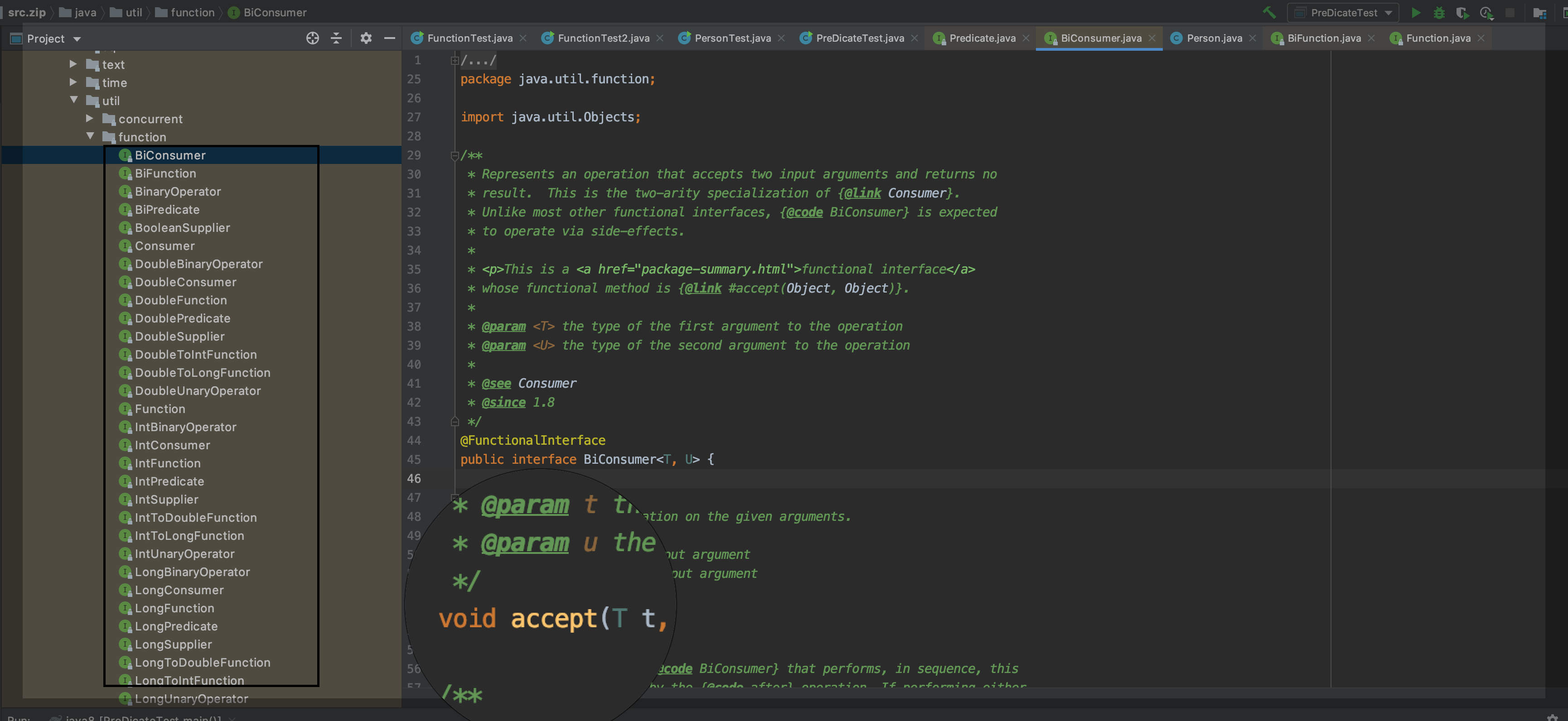
道阻且长。~ 加油。
2019年12月29日22:18:25。明天就要上班了,今晚早点休息。
JAVA8学习——深入浅出函数式接口FunctionInterface(学习过程)的更多相关文章
- JAVA8学习——深入浅出Lambda表达式(学习过程)
JAVA8学习--深入浅出Lambda表达式(学习过程) lambda表达式: 我们为什么要用lambda表达式 在JAVA中,我们无法将函数作为参数传递给一个方法,也无法声明返回一个函数的方法. 在 ...
- Java8 学习笔记--函数式接口
通过之前的函数式接口与lambda表达式的关系那篇文章,大家应该对函数式接口有了一定的了解了,在Java中它是lambda表达式的基础,没有函数式接口就没有办法使用lambda表达式. 函数式接口如此 ...
- Java8 学习笔记--函数式接口与lambda表达式的关系
在java中,lambda表达式与函数式接口是不可分割的,都是结合起来使用的. 对于函数式接口,我们可以理解为只有一个抽象方法的接口,除此之外它和别的接口相比并没有什么特殊的地方.为了确保函数式接口的 ...
- java8新特性学习:函数式接口
本文概要 什么是函数式接口? 如何定义函数式接口? 常用的函数式接口 函数式接口语法注意事项 总结 1. 什么是函数式接口? 函数式接口其实本质上还是一个接口,但是它是一种特殊的接口:SAM类型的接口 ...
- java基础---->java8中的函数式接口
这里面简单的讲一下java8中的函数式接口,Function.Consumer.Predicate和Supplier. 函数式接口例子 一.Function:接受参数,有返回参数 package co ...
- Java8 新特性 函数式接口
什么是函数式接口 函数式接口是Java8引用的一个新特性,是一种特殊的接口:SAM类型的接口(Single Abstract Method).但是它还是一个接口,只是有些特殊罢了. 函数式接口的 ...
- Java8 新特性----函数式接口,以及和Lambda表达式的关系
这里来讲解一下Java8 新特性中的函数式接口, 以及和Lambda 表达式的关系.看到过很多不少介绍Java8特性的文章,都会介绍到函数式接口和lambda表达式,但是都是分别介绍,没有将两者的关系 ...
- JAVA8学习——深入Comparator&Collector(学习过程)
深入Comparator&Collector 从源码深入Comparator Comparator从Java1.2就出来了,但是在1.8的时候,又添加了大量的默认方法. compare() e ...
- java8中使用函数式接口
使用函数式接口 Predicate @FunctionalInterface interface Predicate<T>{ boolean test(T t); } public sta ...
随机推荐
- LeetCode91 Decode Ways
题目: A message containing letters from A-Z is being encoded to numbers using the following mapping: ' ...
- Python中的TCP三次握手和四次挥手过程
tcp三次握手和四次挥手 首先先介绍什么是传输层: 1.三次握手 1) 三次握手的详述 首先Client(客户)端发送连接请求报文,Server(服务器)段接受连接后回复ACK报文,并为这次连接分配资 ...
- hdu 3652 【数位dp】
hdu 3652 题意:求1到n中包含'13'('13'不一定连续)且能被13整除的数的个数. 这是我第一道比较了能看懂的数位dp.定义状态dp[pos][res][sta]表示处理到第pos位,模的 ...
- Gym - 101480D_Digit Division
题意:输入n,m,将n分段,每一段都可以被m整除,有多少种方法. 题解:找到n最多可以分成多少段,1段1中分法,2段2中分法,3段4种分法--计算可知若有x段则2^x-1种分法. 注意:如果n无法被m ...
- oracle 用TRUNCATE替代DELETE
当删除表中的记录时,在通常情况下, 回滚段(rollback segments ) 用来存放可以被恢复的信息. 如果你没有COMMIT事务, ORACLE会将数据恢复到删除之前的状态(准确地说是恢复到 ...
- Angular项目目录结构
前言:不支持MakeDown的博客园调格式的话,真的写到快o(╥﹏╥)o了,所以老夫还是转战到CSDN吧,这边就不更新啦啦啦~ CSDN地址:https://blog.csdn.net/Night20 ...
- oracle用WHERE替代ORDER BY
ORDER BY 子句只在两种严格的条件下使用索引. ORDER BY中所有的列必须包含在相同的索引中并保持在索引中的排列顺序. ORDER BY中所有的列必须定义为非空. WHERE子句使用的索引和 ...
- Oracle - @和@@、&与&& 的区别
2018-01-15 15:36:17 袭冷 阅读数 4783更多 分类专栏: DB 版权声明:本文为博主原创文章,遵循CC 4.0 BY-SA版权协议,转载请附上原文出处链接和本声明. 本文链接 ...
- python中break和continue的区别
python中break和continue的区别 break和continue 1.break 意思为结束循环 例: i = 0 while i<10: i+=1 if ...
- supersockets命令过滤器
关键字: 命令过滤器, 命令, 过滤器, OnCommandExecuting, OnCommandExecuted SuperSocket 中的命令过滤器看起来有些像 ASP.NET MVC 中的 ...