
分析AppClassLoader,ExtClassLoader 和URLClassLoader 的关系
测试代码:
 class Hello

 {

   public String str = "Hello World";

   public void fun()

   {

     System.out.println(str);

 7   }

 }

 public class Test{

   public static void main(String[] args)

   {

     Hello hello = new Hello();

     hello.fun();

     System.out.println("----------------------");

     //Hello类的类加载器

     ClassLoader classLoaderOfHello = Hello.class.getClassLoader();

     System.out.println("Hello is Loaded by : "+classLoaderOfHello);

24     System.out.println("----------------------");

     //Hello类的类加载器的Class对象

     Class AppClazz = classLoaderOfHello.getClass();

     //分析Hello类的类加载器的Class对象的类继承关系

     while(AppClazz != null)

31     {

     System.out.println(AppClazz);

34     AppClazz = AppClazz.getSuperclass();

35     }

     System.out.println("----------------------");

     //取得扩展器加载器的类对象Class

     Class ExtClazz = classLoaderOfHello.getParent().getClass();

     while(ExtClazz != null)

     {

     System.out.println(ExtClazz);

     ExtClazz = ExtClazz.getSuperclass();

     }

   }

 }
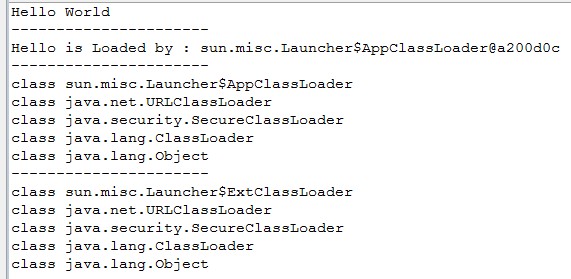
结论:
1. 用户自定义的类是由 应用(系统)类加载器AppClassLoader加载
2. 在”父亲委托机制”中,扩展类加载器ExtClassLoader是AppClassLoader的父亲,并不是继承关系,而是ExtClassLoader加载了AppClassLoader
3. AppClassLoader 和 ExtClassLoader 都扩展于 URLClassLoader加载器.
4. 也同时说明AppClassLoader而非继承ExtClassLoader.
继承关系:
java.lang.Object
--- java.lang.ClassLoader
--- java.security.SecureClassLoader
--- java.net.URLClassLoader
--- sun.misc.Launcher$ExtClassLoader
java.lang.Object
--- java.lang.ClassLoader
--- java.security.SecureClassLoader
--- java.net.URLClassLoader
--- sun.misc.Launcher$AppClassLoader
其实很简单嘛,直接看AppClassLoader的源代码就可以了嘛,哈哈,终于找到了好东东,上
JDK7: http://download.java.net/openjdk/jdk7/
JDK6: http://download.java.net/openjdk/jdk6/
下载其源代码就可以了
现在直接来看其源代码:
/**
* The class loader used for loading from java.class.path.
* runs in a restricted security context.
*/
static class AppClassLoader extends URLClassLoader {
static {
ClassLoader.registerAsParallelCapable();
}
public static ClassLoader getAppClassLoader(final ClassLoader extcl)
throws IOException
{
final String s = System.getProperty("java.class.path");
final File[] path = (s == null) ? new File[0] : getClassPath(s);
return AccessController.doPrivileged(
new PrivilegedAction<AppClassLoader>() {
public AppClassLoader run() {
URL[] urls =
(s == null) ? new URL[0] : pathToURLs(path);
return new AppClassLoader(urls, extcl);
}
});
}
/*
* Creates a new AppClassLoader
*/
AppClassLoader(URL[] urls, ClassLoader parent) {
super(urls, parent, factory);
}
/**
* Override loadClass so we can checkPackageAccess.
*/
public Class loadClass(String name, boolean resolve)
throws ClassNotFoundException
{
int i = name.lastIndexOf('.');
if (i != -1) {
SecurityManager sm = System.getSecurityManager();
if (sm != null) {
sm.checkPackageAccess(name.substring(0, i));
}
}
return (super.loadClass(name, resolve));
}
/**
* allow any classes loaded from classpath to exit the VM.
*/
protected PermissionCollection getPermissions(CodeSource codesource)
{
PermissionCollection perms = super.getPermissions(codesource);
perms.add(new RuntimePermission("exitVM"));
return perms;
}
/**
* This class loader supports dynamic additions to the class path
* at runtime.
*
* @see java.lang.instrument.Instrumentation#appendToSystemClassPathSearch
*/
private void appendToClassPathForInstrumentation(String path) {
assert(Thread.holdsLock(this));
// addURL is a no-op if path already contains the URL
super.addURL( getFileURL(new File(path)) );
}
/**
* create a context that can read any directories (recursively)
* mentioned in the class path. In the case of a jar, it has to
* be the directory containing the jar, not just the jar, as jar
* files might refer to other jar files.
*/
private static AccessControlContext getContext(File[] cp)
throws java.net.MalformedURLException
{
PathPermissions perms =
new PathPermissions(cp);
ProtectionDomain domain =
new ProtectionDomain(new CodeSource(perms.getCodeBase(),
(java.security.cert.Certificate[]) null),
perms);
AccessControlContext acc =
new AccessControlContext(new ProtectionDomain[] { domain });
return acc;
}
}
哈,看了AppClassLoader的源代码后,大家明白了吧,AppClassLoader 继承了URLClassLoader,而且构造函数是直接调用URLClassLoader的构造
函数,loadClass(String name, boolean resolve)方法只是简单做了包的安全检查,然后就调用ClassLoader的 loadClass(String name, boolean resolve)方法了,其它的话,也是差不多..所以其功能和URLClassLoader差不多...
在ExtClassLoader也差不多,大家看看源代码就明了的:
/*
* Creates a new ExtClassLoader for the specified directories.
*/
public ExtClassLoader(File[] dirs) throws IOException {
super(getExtURLs(dirs), null, factory);
}
private static File[] getExtDirs() {
String s = System.getProperty("java.ext.dirs");
File[] dirs;
if (s != null) {
StringTokenizer st =
new StringTokenizer(s, File.pathSeparator);
int count = st.countTokens();
dirs = new File[count];
for (int i = 0; i < count; i++) {
dirs[i] = new File(st.nextToken());
}
} else {
dirs = new File[0];
}
return dirs;
}
private static URL[] getExtURLs(File[] dirs) throws IOException {
Vector<URL> urls = new Vector<URL>();
for (int i = 0; i < dirs.length; i++) {
String[] files = dirs[i].list();
if (files != null) {
for (int j = 0; j < files.length; j++) {
if (!files[j].equals("meta-index")) {
File f = new File(dirs[i], files[j]);
urls.add(getFileURL(f));
}
}
}
}
URL[] ua = new URL[urls.size()];
urls.copyInto(ua);
return ua;
}
/*
* Searches the installed extension directories for the specified
* library name. For each extension directory, we first look for
* the native library in the subdirectory whose name is the value
* of the system property <code>os.arch</code>. Failing that, we
* look in the extension directory itself.
*/
public String findLibrary(String name) {
name = System.mapLibraryName(name);
URL[] urls = super.getURLs();
File prevDir = null;
for (int i = 0; i < urls.length; i++) {
// Get the ext directory from the URL
File dir = new File(urls[i].getPath()).getParentFile();
if (dir != null && !dir.equals(prevDir)) {
// Look in architecture-specific subdirectory first
// Read from the saved system properties to avoid deadlock
String arch = VM.getSavedProperty("os.arch");
if (arch != null) {
File file = new File(new File(dir, arch), name);
if (file.exists()) {
return file.getAbsolutePath();
}
}
// Then check the extension directory
File file = new File(dir, name);
if (file.exists()) {
return file.getAbsolutePath();
}
}
prevDir = dir;
}
return null;
}
private static AccessControlContext getContext(File[] dirs)
throws IOException
{
PathPermissions perms =
new PathPermissions(dirs);
ProtectionDomain domain = new ProtectionDomain(
new CodeSource(perms.getCodeBase(),
(java.security.cert.Certificate[]) null),
perms);
AccessControlContext acc =
new AccessControlContext(new ProtectionDomain[] { domain });
return acc;
}
}
---------------------
作者:irelandken
来源:CSDN
原文:https://blog.csdn.net/irelandken/article/details/7046689
版权声明:本文为博主原创文章,转载请附上博文链接!
分析AppClassLoader,ExtClassLoader 和URLClassLoader 的关系的更多相关文章
- 源码分析:动态分析 Linux 内核函数调用关系
源码分析:动态分析 Linux 内核函数调用关系 时间 2015-04-22 23:56:07 泰晓科技 原文 http://www.tinylab.org/source-code-analysi ...
- <十>面向对象分析之UML核心元素之关系
关系 --->在UML中关系是非常重要的语义,它抽象出对象之间的联系,让对象构成特定的结构. 一,关联关系(association)
- 数据挖掘(data mining),机器学习(machine learning),和人工智能(AI)的区别是什么? 数据科学(data science)和商业分析(business analytics)之间有什么关系?
本来我以为不需要解释这个问题的,到底数据挖掘(data mining),机器学习(machine learning),和人工智能(AI)有什么区别,但是前几天因为有个学弟问我,我想了想发现我竟然也回答 ...
- 使用UML工具分析类图与类的关系-bouml(java和C++)
在分析类之间的关系时可以借助工具来实现. bouml是一个UML分析工具,最新的版本是收费的,但是之前的版本是免费的. 这里使用的是4.23版. Bouml安装: 安装软件就按照流程走就行了.但是第一 ...
- 通过分析iframe和无阻塞脚本关系能让我们更懂iframe
在我上篇文章里,我提到一种使用iframe完成无阻塞脚本加载的方式,因为我对iframe的偏见很大,所以上篇文章里我没有展开讨论这个问题. 文章发表后有位网友问了我这样一个问题,下面是他问题的原文,如 ...
- spring源码分析系列2:Bean与BeanDefinition关系
接口表示一种能力,实现了一个接口,即拥有一种能力. BeanDefinition与Bean的关系, 就好比类与对象的关系. 类在spring的数据结构就是BeanDefinition.根据BeanDe ...
- MyBatis源码分析(1)——整体依赖关系图
后续补充更新
- 源码分析:静态分析 C 程序函数调用关系图
http://www.tinylab.org/callgraph-draw-the-calltree-of-c-functions/
- 0032 Java学习笔记-类加载机制-初步
JVM虚拟机 Java虚拟机有自己完善的硬件架构(处理器.堆栈.寄存器等)和指令系统 Java虚拟机是一种能运行Java bytecode的虚拟机 JVM并非专属于Java语言,只要生成的编译文件能匹 ...
随机推荐
- 论文阅读笔记(二)【IJCAI2016】:Video-Based Person Re-Identification by Simultaneously Learning Intra-Video and Inter-Video Distance Metrics
摘要 (1)方法: 面对不同行人视频之间和同一个行人视频内部的变化,提出视频间和视频内距离同时学习方法(SI2DL). (2)模型: 视频内(intra-vedio)距离矩阵:使得同一个视频更紧凑: ...
- [转]触发fullgc的条件
良好的状态是:minor gc比较多 full gc 比较少 因为fullgc时间比较慢,而且会占用CPU的时间片. 不好的状态是:minor gc比较少 full gc 比较多 这样程序就一直卡在f ...
- [转]JVM内存区域划分Eden Space、Survivor Space、Tenured Gen,Perm Gen解释
jvm区域总体分两类,heap区和非heap区.heap区又分:Eden Space(伊甸园).Survivor Space(幸存者区).Tenured Gen(老年代-养老区). 非heap区又分: ...
- C++ stringstream用法(转)
一直觉得C++ iostream的cout输出比起printf差了太多,今天查c++字符串拼接的时候偶然看到原来还有stringstream这个类,还是挺好用的,该类位于<sstream> ...
- 【Linux】iptables相关实践,原理及参数解释
1.禁止指定IP地址的主机进行连接 iptables -I INPUT -s .***.***. -j DROP 2.解除禁止指定IP地址的主机进行连接 iptables -D INPUT -s .* ...
- Java自学-Lambda 概念
Java Lambda 表达式概念 假设一个情景: 找出满足条件的Hero 从使用普通方法,匿名类,以及Lambda这几种方式,逐渐的引入Lambda的概念 步骤 1 : 普通方法 使用一个普通方法, ...
- 基于Python的face_recognition库实现人脸识别
一.face_recognition库简介 face_recognition是Python的一个开源人脸识别库,支持Python 3.3+和Python 2.7.引用官网介绍: Recognize a ...
- SIFT解析(一)高斯模糊
"模糊"的算法有很多种,其中有一种叫做"高斯模糊"(Gaussian Blur).它将正态分布(又名"高斯分布")用于图像处理. 所谓&qu ...
- Centsos7 aria2
wget -N --no-check-certificate https://raw.githubusercontent.com/ToyoDAdoubi/doubi/master/aria2.sh & ...
- 删除空目录命令 - rmdir
(1) 命令名称:rmdir (2) 英文原意:remove empty directories (3) 命令所在路径:/bin/rmdir (4) 执行权限:所有用户 (5) 功能描述:删除空目录( ...