
[Tensorflow] Object Detection API - prepare your training data
From: TensorFlow Object Detection API
This chapter help you to train your own model to identify objects required.
1. Data
1.1 Get your own data
- 标准的范例,从ImageNet上获取数据集
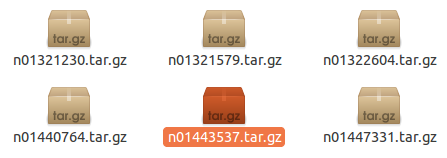
Get your own data from ImageNet
Download tiny-imagenet-200.zip, which is smaller than original monster. (150G)
- 图片格式转化
We need .png but not .jpg here, so
cd ./images
ls -1 *.jpg | xargs -n 1 bash -c 'convert "$0" "${0%.jpg}.png"'
1.2 Create your Annotation.
- 获取标记记录
Sol 01:
# 找数据集上现成的对应的标记框记录
Find its xml version from: http://image-net.org/download-bboxes

Sol 02:
# 自己写标记记录
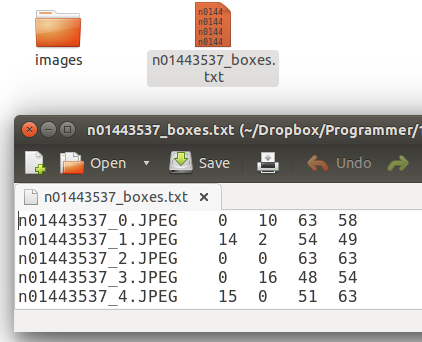
Write script to create your xml for Annotation from *_box.txt. This is not a complex structure as following.
<annotation>

    <folder>n02119789</folder>

    <filename>n02119789_122</filename>

    <source>

        <database>ImageNet database</database>

    </source>

    <size>

        <width>200</width>

        <height>191</height>

        <depth>3</depth>

    </size>

    <segmented>0</segmented>

    <object>

        <name>n02119789</name>

        <pose>Unspecified</pose>

        <truncated>0</truncated>

        <difficult>0</difficult>

        <bndbox>

            <xmin>17</xmin>

            <ymin>16</ymin>

            <xmax>181</xmax>

            <ymax>181</ymax>

        </bndbox>

    </object>

</annotation>
Sol 03:
# 通过工具辅助生成标记框记录
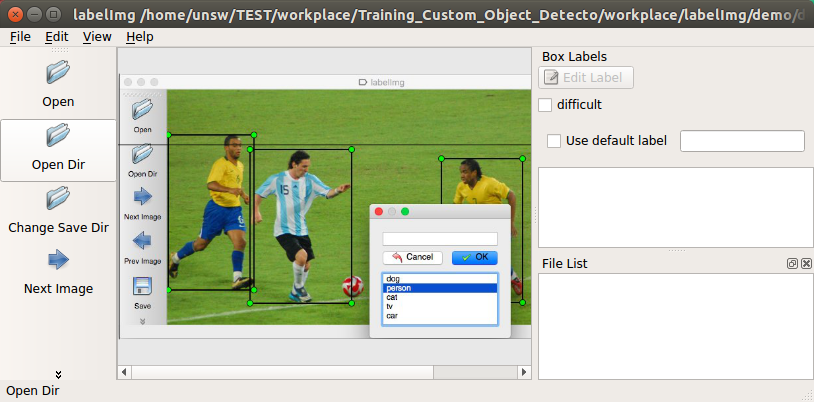
Label them manually. This is a crazy way to create your train data (100-500 images) if you have enough time.
sudo apt-get install pyqt5-dev-tools

sudo pip3 install lxml
git clone https://github.com/tzutalin/labelImg

unsw@unsw-UX303UB$ make qt5py3

unsw@unsw-UX303UB$ python3 labelImg.py
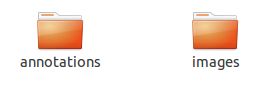
- 完整的数据集
Finally, this is what we need.
- .csv 格式的数据集
Similarly, we need .csv but not .xml here, so
Download: https://raw.githubusercontent.com/datitran/raccoon_dataset/master/xml_to_csv.py
import os

import glob

import pandas as pd

import xml.etree.ElementTree as ET

def xml_to_csv(path):

    xml_list = []

    for xml_file in glob.glob(path + '/*.xml'):

        tree = ET.parse(xml_file)

        root = tree.getroot()

        for member in root.findall('object'):

            value = (root.find('filename').text,

                     int(root.find('size')[0].text),

                     int(root.find('size')[1].text),

                     member[0].text,

                     int(member[4][0].text),

                     int(member[4][1].text),

                     int(member[4][2].text),

                     int(member[4][3].text)

                     )

            xml_list.append(value)

    column_name = ['filename', 'width', 'height', 'class', 'xmin', 'ymin', 'xmax', 'ymax']

    xml_df = pd.DataFrame(xml_list, columns=column_name)

    return xml_df

def main():

    image_path = os.path.join(os.getcwd(), 'annotations')

    xml_df = xml_to_csv(image_path)

    xml_df.to_csv('raccoon_labels.csv', index=None)

    print('Successfully converted xml to csv.')

main()
xml_to_csv.py
unsw@unsw-UX303UB$ python xml_to_csv.py
Successfully converted xml to csv.

unsw@unsw-UX303UB$ ls

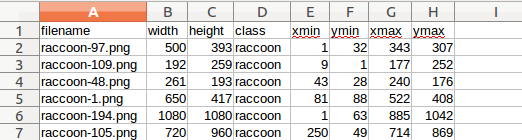
annotations  images  Others  raccoon_labels.csv  xml_to_csv.py
This is final bounding box info.
2. Cascade Classifier Training
一、相关方案
Ref: https://docs.opencv.org/2.4/doc/user_guide/ug_traincascade.html
- 接口
THE OPENCV TUTORIAL FOR TRAINING CASCADE CLASSIFIERS is a pretty good place to start. It explains the 2 binary utilities used in the process (opencv_createsamples and opencv_traincascade),
and all of their command line arguments and options, but it doesn’t really give an example of a flow to follow, nor does it explain all the possible uses for the opencv_createsamplesutility.
- 方案一
On the other hand, NAOTOSHI SEO’S TUTORIAL is actually quite thorough and explains the 4 different uses for the opencv_createsamples utility.
THORSTEN BALL WROTE A TUTORIAL using Naotoshi Seo’s scripts to train a classifier to detect bananas, but it requires running some perl scripts and compiling some C++… too much work…
- 方案二
Jeff also has some NICE NOTES about how he prepared his data, and a SCRIPT for automatically iterating over a couple of options for the 2 utilities.
The way we did it was inspired by all of these tutorials, with some minor modifications and optimizations.
二、Process
- 是什么
Ref: https://processing.org/download/
一种语言,处理图像,提供了更为亲和的方式。
/* implement */
[Tensorflow] Object Detection API - prepare your training data的更多相关文章
- [Tensorflow] Object Detection API - build your training environment
一.前期准备 Prepare protoc Download Protocol Buffers Create folder: protoc and unzip it. unsw@unsw-UX303U ...
- Tensorflow object detection API 搭建属于自己的物体识别模型
一.下载Tensorflow object detection API工程源码 网址:https://github.com/tensorflow/models,可通过Git下载,打开Git Bash, ...
- [Tensorflow] Object Detection API - predict through your exclusive model
开始预测 一.训练结果 From: Testing Custom Object Detector - TensorFlow Object Detection API Tutorial p.6 训练结果 ...
- TensorFlow object detection API应用
前一篇讲述了TensorFlow object detection API的安装与配置,现在我们尝试用这个API搭建自己的目标检测模型. 一.准备数据集 本篇旨在人脸识别,在百度图片上下载了120张张 ...
- 使用TensorFlow Object Detection API+Google ML Engine训练自己的手掌识别器
上次使用Google ML Engine跑了一下TensorFlow Object Detection API中的Quick Start(http://www.cnblogs.com/take-fet ...
- 基于TensorFlow Object Detection API进行迁移学习训练自己的人脸检测模型(二)
前言 已完成数据预处理工作,具体参照: 基于TensorFlow Object Detection API进行迁移学习训练自己的人脸检测模型(一) 设置配置文件 新建目录face_faster_rcn ...
- Install Tensorflow object detection API in Anaconda (Windows)
This blog is to explain how to install Tensorflow object detection API in Anaconda in Windows 10 as ...
- TensorFlow object detection API
cloud执行:https://github.com/tensorflow/models/blob/master/research/object_detection/g3doc/running_pet ...
- Tensorflow object detection API 搭建物体识别模型(四)
四.模型测试 1)下载文件 在已经阅读并且实践过前3篇文章的情况下,读者会有一些文件夹.因为每个读者的实际操作不同,则文件夹中的内容不同.为了保持本篇文章的独立性,制作了可以独立运行的文件夹目标检测. ...
随机推荐
- startup.bat闪退问题
startup.bat闪退问题 我自己遇到的 1.例如: 手动点击startup.bat 后 ,一闪而过 2例如:在cmd下 进到tomcat的bin目录 运行 startup.bat 解决问题,第一 ...
- sitemap xml文件生成
sitemap xml生成方法 <?php /** * SitemapService.php. * * 生成sitemap */ class Sitemap { public $newLine ...
- DNS解析全过程分析
DNS解析过程 1.检查浏览器缓存中是否缓存过该域名对应的IP地址 用户通过浏览器浏览过某网站之后,浏览器就会自动缓存该网站域名对应的IP地址, 当用户再次访问的时候,浏览器就会从缓存中查找该域名对应 ...
- ESAPI学习笔记
ESAPI是owasp提供的一套API级别的web应用解决方案,本人通过对ESAPI和其提供的demo源码学习发现,关键的不是对其所提供的API的使用,而是其web应用安全防御体系的构建的思 ...
- 这可能是最好的RxJava 2.x 入门教程(一)
这可能是最好的 RxJava 2.x 入门教程系列专栏 文章链接: 这可能是最好的 RxJava 2.x 入门教程(完结版)[重磅推出] 这可能是最好的RxJava 2.x 入门教程(一) 这可能是最 ...
- 【ZH奶酪】如何用textgenrnn处理中文
如何用textgenrnn处理中文 1. 什么是textgenrnn? textgenrnn是建立在Keras和TensorFlow之上的,可用于生成字级别和词级别文本.网络体系结构使用注意力加权来加 ...
- centos7安装配置mysql5.6
1. 下载mysql的repo源 $ wget http://repo.mysql.com/mysql-community-release-el7-5.noarch.rpm 2. 安装mysql-co ...
- CentOS6.9下安装python notebook
操作系统:CentOS6.9_x64 python版本 : python2.7.13 添加低权限新用户: useradd mike su mike 使用virtualenv安装python2.7环境 ...
- TF_Server gRPC failed, call return code:8:Received message larger than max (45129801 vs. 4194304)
tensorflow_serving 遇到错误:gRPC failed, call return code:8:Received message larger than max (45129801 v ...
- arcgis server瓦片行列号计算
2013-08-01 arcgis server切图时会设置一个原点坐标,如果是经纬度坐标一般默认(x0,y0)=(-400,400)作为切图的起始点,即从这开始算行列号.假设切图的地图某点坐标为x, ...