
poj 3087 Shuffle'm Up (模拟过程)
Description
A common pastime for poker players at a poker table is to shuffle stacks of chips. Shuffling chips is performed by starting with two stacks of poker chips, S1 and S2, each stack containing C chips. Each stack may contain chips of several different colors.
The actual shuffle operation is performed by interleaving a chip from S1 with a chip from S2 as shown below for C = 5:
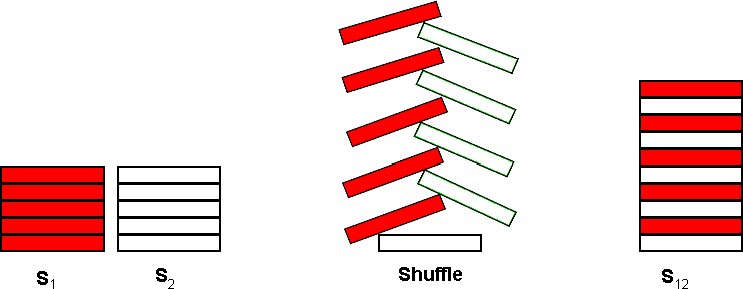
The single resultant stack, S12, contains 2 * C chips. The bottommost chip of S12 is the bottommost chip from S2. On top of that chip, is the bottommost chip from S1. The interleaving process continues taking the 2nd chip from the bottom of S2 and placing that on S12, followed by the 2nd chip from the bottom of S1 and so on until the topmost chip from S1 is placed on top of S12.
After the shuffle operation, S12 is split into 2 new stacks by taking the bottommost C chips from S12 to form a new S1 and the topmost C chips from S12 to form a new S2. The shuffle operation may then be repeated to form a new S12.
For this problem, you will write a program to determine if a particular resultant stack S12 can be formed by shuffling two stacks some number of times.
Input
The first line of input contains a single integer N, (1 ≤ N ≤ 1000) which is the number of datasets that follow.
Each dataset consists of four lines of input. The first line of a dataset specifies an integer C, (1 ≤ C ≤ 100) which is the number of chips in each initial stack (S1 and S2). The second line of each dataset specifies the colors of each of the C chips in stack S1, starting with the bottommost chip. The third line of each dataset specifies the colors of each of the C chips in stack S2 starting with the bottommost chip. Colors are expressed as a single uppercase letter (A through H). There are no blanks or separators between the chip colors. The fourth line of each dataset contains 2 * C uppercase letters (A through H), representing the colors of the desired result of the shuffling of S1 and S2 zero or more times. The bottommost chip’s color is specified first.
Output
Output for each dataset consists of a single line that displays the dataset number (1 though N), a space, and an integer value which is the minimum number of shuffle operations required to get the desired resultant stack. If the desired result can not be reached using the input for the dataset, display the value negative 1 (−1) for the number of shuffle operations.
Sample Input
2

4

AHAH

HAHA

HHAAAAHH

3

CDE

CDE

EEDDCC
Sample Output
1 2

2 -1
大致题意:输入一个N,表示有N组数据,每组数据有四行,第一行是一个整数C,表示 每堆牌的数量,接下来是三行字符序列,第一行是S1堆,第二行是S2堆,第三行S12是预想的排序序列,求需要几步才能到达预想序列。
已知两堆牌s1和s2的初始状态, 其牌数均为c,按给定规则能将他们相互交叉组合成一堆牌s12,再将s12的最底下的c块牌归为s1,最顶的c块牌归为s2,依此循环下去。现在输入s1和s2的初始状态 以及 预想的最终状态s12.问s1 s2经过多少次洗牌之后,最终能达到状态s12,若永远不可能相同,则输出"-1"。
思路就是过程模拟,感觉最机智的就是用map<string,bool>vis,来标记字符序列了。
 #include <iostream>

 #include <cstring>

 #include <map>

 using namespace std;

 const int maxn=;

 char s1[maxn],s2[maxn];

 char s12[maxn<<]; //预想的牌的状态

 int main()

 {

     int n,c,cnt=;

     cin>>n;

     while(n--)

     {

         cin>>c;

         cin>>s1>>s2>>s12;

         int step=;

         map<string,bool>vis;

         vis[s12]=true;

         while()

         {

             char temp[maxn<<];

             int k=;

             for(int i=;i<c;i++)  //把s1和s2按照错乱顺序放到临时变量中

             {

                 temp[k++]=s2[i];

                 temp[k++]=s1[i];

             }

             temp[k++]='\0';

             step++;

             if(strcmp(temp,s12)==)  //如果和预设匹配,就输出步数

             {

                 cout<<++cnt<<' '<<step<<endl;

                 break;

             }

             else if(vis[temp]&&strcmp(temp,s12)!=) //如果成环了,表示无法匹配了,输出-1

             {

                 cout<<++cnt<<' '<<-<<endl;

                 break;

             }

             vis[temp]=true; //标记这个序列出现过

             strncpy(s1,temp,c);    //把temp数组的钱c个字符放进s1

             strncpy(s2,temp+c,c);  //把temp数组下面c个字符放进s2

             s1[c]=s2[c]='\0';

            // cout<<"--"<<s1<<"--"<<s2<<endl;

         }

     }

     return ;

 }
poj 3087 Shuffle'm Up (模拟过程)的更多相关文章
- POJ 3087 Shuffle'm Up (模拟+map)
题目链接:http://poj.org/problem?id=3087 题目大意:已知两堆牌s1和s2的初始状态, 其牌数均为c,按给定规则能将他们相互交叉组合成一堆牌s12,再将s12的最底下的c块 ...
- POJ 3087 Shuffle'm Up 模拟,看着不像搜索啊
题意:给定s1,s1两副扑克,顺序从下到上.依次将s2,s1的扑克一张一张混合.例如s1,ABC; s2,DEF. 则第一次混合后为DAEBFC. 然后令前半段为s1, 后半段为s2. 如果可以变换成 ...
- POJ.3087 Shuffle'm Up (模拟)
POJ.3087 Shuffle'm Up (模拟) 题意分析 给定两个长度为len的字符串s1和s2, 接着给出一个长度为len*2的字符串s12. 将字符串s1和s2通过一定的变换变成s12,找到 ...
- POJ 3087 Shuffle'm Up(洗牌)
POJ 3087 Shuffle'm Up(洗牌) Time Limit: 1000MS Memory Limit: 65536K Description - 题目描述 A common pas ...
- DFS POJ 3087 Shuffle'm Up
题目传送门 /* 题意:两块扑克牌按照顺序叠起来后,把下半部分给第一块,上半部给第二块,一直持续下去,直到叠成指定的样子 DFS:直接模拟搜索,用map记录该字符串是否被搜过.读懂题目是关键. */ ...
- POJ 3087 Shuffle'm Up
Shuffle'm Up Time Limit:1000MS Memory Limit:65536KB 64bit IO Format:%I64d & %I64u Submit ...
- poj 3087 Shuffle'm Up ( map 模拟 )
题目:http://poj.org/problem?id=3087 题意:已知两堆牌s1和s2的初始状态, 其牌数均为c,按给定规则能将他们相互交叉组合成一堆牌s12,再将s12的最底下的c块牌归为s ...
- POJ 3087 Shuffle'm Up(模拟)
Shuffle'm Up Time Limit: 1000MS Memory Limit: 65536K Total Submissions: 7404 Accepted: 3421 Desc ...
- POJ 3087 Shuffle'm Up【模拟/map/string】
Shuffle'm Up Time Limit: 1000MS Memory Limit: 65536K Total Submissions: 14471 Accepted: 6633 Descrip ...
随机推荐
- WordPress版微信小程序开发系列(一):WordPress REST API
自动我发布开源程序WordPress版微信小程序以来,很多WordPress站长在搭建微信小程序的过程中会碰到各种问题来咨询我,有些问题其实很简单,只要仔细看看我写的文章,就可以自己解决.不过这些文章 ...
- centos7将可执行程序做成服务
1.systemctl 用法:systemctl [OPT] COMMAND [NAME]…启动服务:systemctl start NAME.service停止服务:systemctl stop N ...
- wampserver_x86_3.0.6 允许外网访问配置教程
1.打开wamp目录下的apache配置文件中的httpd.conf 用可以看行数的编辑器打开 大概244行: 改为 <Directory /> AllowOverride none Re ...
- Python 快速排序 算法
基本的快排算法,二分法 #!/usr/bin/env python # encoding: utf-8 l1=[1,4,2,6,3] def path_sort(l,start_index,end_i ...
- CentOS 7 实现ssh无密码登录
cd ~ 进入根目录. (使用ls -a或者 ls -la 能够看到当前文件夹下的所有文件包含隐藏文件夹等) 我们首先使用ls -la 发现并没有.ssh的文件夹存在. 在终端输入 ssh lo ...
- getColor问题
getResource.getColor(R.color.color_name) 过时了,可以使用新加入的方法 ContextCompat.getColor(context, R.color.colo ...
- oracle instantclient + plsql 远程连接数据库
PLSQL Developer连接数据库: 1.不连接数据库登陆PLSQL Developer(登陆界面按“取消”即可).在Tools->Perferences->Connection ...
- javascript:控制台详解
javascript工具——浏览器控制台详解 大神这篇博客是写在2011年,主要介绍 “Firefox” 浏览器插件 “Firebug” 的操作,如今主流浏览器对控制台都已经提供了很好的支持.我自己 ...
- txt,csv,json互相转化
也没啥,记下来怕忘了.说明都在代码里面: 麻蛋,这个着色好难看 import csv import json #从txt变为csv student_txt=[]; with open("st ...
- Java中锁的实现与内存语义
目录 1. 概述 2. 锁的内存语义 3. 锁内存语义的实现 4. 总结 1. 概述 锁在实际使用时只是明白锁限制了并发访问, 但是锁是如何实现并发访问的, 同学们可能不太清楚, 下面这篇文章就来揭开 ...