
Pattern: API Gateway / Backend for Front-End
http://microservices.io/patterns/apigateway.html
Pattern: API Gateway / Backend for Front-End
Context
Let’s imagine you are building an online store that uses the Microservice architecture pattern and that you are implementing the product details page. You need to develop multiple versions of the product details user interface:
- HTML5/JavaScript-based UI for desktop and mobile browsers - HTML is generated by a server-side web application
- Native Android and iPhone clients - these clients interact with the server via REST APIs
In addition, the online store must expose product details via a REST API for use by 3rd party applications.
A product details UI can display a lot of information about a product. For example, the Amazon.com details page for POJOs in Action displays:
- Basic information about the book such as title, author, price, etc.
- Your purchase history for the book
- Availability
- Buying options
- Other items that are frequently bought with this book
- Other items bought by customers who bought this book
- Customer reviews
- Sellers ranking
- …
Since the online store uses the Microservice architecture pattern the product details data is spread over multiple services. For example,
- Product Info Service - basic information about the product such as title, author
- Pricing Service - product price
- Order service - purchase history for product
- Inventory service - product availability
- Review service - customer reviews …
Consequently, the code that displays the product details needs to fetch information from all of these services.
Problem
How do the clients of a Microservices-based application access the individual services?
Forces
The granularity of APIs provided by microservices is often different than what a client needs. Microservices typically provide fine-grained APIs, which means that clients need to interact with multiple services. For example, as described above, a client needing the details for a product needs to fetch data from numerous services.
Different clients need different data. For example, the desktop browser version of a product details page desktop is typically more elaborate then the mobile version.
Network performance is different for different types of clients. For example, a mobile network is typically much slower and has much higher latency than a non-mobile network. And, of course, any WAN is much slower than a LAN. This means that a native mobile client uses a network that has very difference performance characteristics than a LAN used by a server-side web application. The server-side web application can make multiple requests to backend services without impacting the user experience where as a mobile client can only make a few.
The number of service instances and their locations (host+port) changes dynamically
Partitioning into services can change over time and should be hidden from clients
Services might use a diverse set of protocols, some of which might not be web friendly
Solution
Implement an API gateway that is the single entry point for all clients. The API gateway handles requests in one of two ways. Some requests are simply proxied/routed to the appropriate service. It handles other requests by fanning out to multiple services.
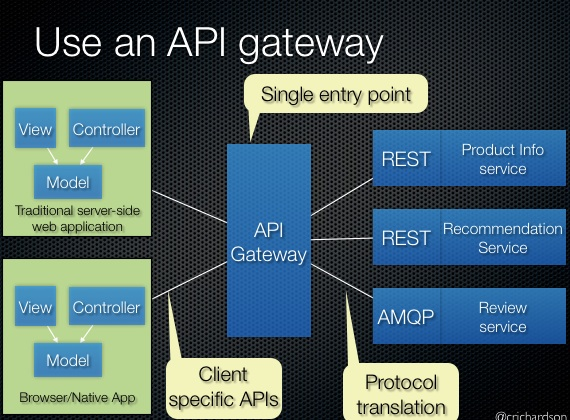
Rather than provide a one-size-fits-all style API, the API gateway can expose a different API for each client. For example, the Netflix API gateway runs client-specific adapter code that provides each client with an API that’s best suited to its requirements.
The API gateway might also implement security, e.g. verify that the client is authorized to perform the request
Variation: Backend for front-end
A variation of this pattern is the Backend for Front-End pattern. It defines a separate API gateway for each kind of client.

In this example, there are three kinds of clients: web application, mobile application, and external 3rd party application. There are three different API gateways. Each one is provides an API for its client.
Examples
- Netflix API gateway
- A simple Java/Spring API gateway from the Money Transfer example application.
Resulting context
Using an API gateway has the following benefits:
- Insulates the clients from how the application is partitioned into microservices
- Insulates the clients from the problem of determining the locations of service instances
- Provides the optimal API for each client
- Reduces the number of requests/roundtrips. For example, the API gateway enables clients to retrieve data from multiple services with a single round-trip. Fewer requests also means less overhead and improves the user experience. An API gateway is essential for mobile applications.
- Simplifies the client by moving logic for calling multiple services from the client to API gateway
- Translates from a “standard” public web-friendly API protocol to whatever protocols are used internally
减少请求量
为每个客户端提供最优api
对不同数据源的数据获取可以通过统一的api协议
The API gateway pattern has some drawbacks:
- Increased complexity - the API gateway is yet another moving part that must be developed, deployed and managed
- Increased response time due to the additional network hop through the API gateway - however, for most applications the cost of an extra roundtrip is insignificant.
Issues:
- How implement the API gateway? An event-driven/reactive approach is best if it must scale to scale to handle high loads. On the JVM, NIO-based libraries such as Netty, Spring Reactor, etc. make sense. NodeJS is another option.
Related patterns
- The Microservice architecture pattern creates the need for this pattern.
- The API gateway must use either the Client-side Discovery pattern or Server-side Discovery pattern to route requests to available service instances.
- The API Gateway may authenticate the user and pass an Access Token containing information about the user to the services
- An API Gateway will use a Circuit Breaker to invoke services
- An API gateway often implements the API Composition pattern
Known uses
Example application
See the API Gateway that part of my Microservices pattern’s example application. It’s implemented using Spring Cloud Gateway.
Pattern: API Gateway / Backend for Front-End的更多相关文章
- 【设计模式 7】从公司的目前框架和API Gateway,谈谈对外观模式的理解
我,第一次用到外观模式,应该是3年多以前.那时候是做一个收费系统,在当时的U层和B层之间,加了一层Facade.当时,在一些复杂的业务逻辑处理时,感受到了加入外观层的好处,但对于一些简单的(我指的是, ...
- Using Amazon API Gateway with microservices deployed on Amazon ECS
One convenient way to run microservices is to deploy them as Docker containers. Docker containers ar ...
- Why Do Microservices Need an API Gateway?
Why Do Microservices Need an API Gateway? - DZone Integration https://dzone.com/articles/why-do-micr ...
- Using HAProxy as an API Gateway, Part 3 [Health Checks]
转自:https://www.haproxy.com/blog/using-haproxy-as-an-api-gateway-part-3-health-checks/ Achieving high ...
- Using HAProxy as an API Gateway, Part 2 [Authentication]
转自:https://www.haproxy.com/blog/using-haproxy-as-an-api-gateway-part-2-authentication/ HAProxy is a ...
- 聊聊 API Gateway 和 Netflix Zuul
最近参与了公司 API Gateway 的搭建工作,技术选型是 Netflix Zuul,主要聊一聊其中的一些心得和体会. 本文主要是介绍使用 Zuul 且在不强制使用其他 Neflix OSS 组件 ...
- API Gateway : Kong
what problems 多个服务要写自己的log,auth,对于比较耗时的,有时还要高流量限制. solution intro 单点部署的情况: why not just haproxy log ...
- Building Microservices: Using an API Gateway
What are microservices? http://microservices.io/ What are microservices? Microservices - also known ...
- Using HAProxy as an API Gateway, Part 1 [Introduction]
转自:https://www.haproxy.com/blog/using-haproxy-as-an-api-gateway-part-1/ An API gateway handles load ...
随机推荐
- MySQL 待解决死锁
官方文档:https://dev.mysql.com/doc/refman/5.6/en/innodb-locks-set.html 线上出现一个死锁现象,信息显示的是两条对同一个表的不同记录的upd ...
- WebLoad XML-parser methods
WebLOAD provides an embedded, third-party XML parser object to improve the multi-platform support fo ...
- 洛谷 [P1290] 欧几里得的游戏
SG函数的应用 看到这题就想到了SG函数 那么可以考虑最终情况:一个数是x,另一个是0,那么先手必败(因为上一个人已经得到0了,其实游戏已经结束了) 剩下的情况:一个数n, 一个数m,假设n>m ...
- 对象数据源objectdatasource的使用,类的编写实现查询增删改的方法
原文发布时间为:2008-08-01 -- 来源于本人的百度文章 [由搬家工具导入] using System;using System.Data;using System.Configuration ...
- 了解Chrome扩展程序开发--摘抄
了解Chrome扩展程序开发 2018-01-11 边城到此莫若 鸡蛋君说前端 首先,我尝试来用简单几句话描述一下Chrome扩展程序: Chrome扩展主要用于对浏览器功能的增强,它强调与浏览器相结 ...
- 转 DOS 8.3 文件名命名规则
http://www.360doc.com/content/10/0813/14/73007_45757514.shtml DOS 8.3 文件名命名规则 经常看到命令行或者其它软件在显示目录的时候出 ...
- C++ 中new
operator new在C++中的各种写法 (2011-09-21 14:59:33) 标签: 杂谈 乍一看,在C++中动态分配内存很简单:new是分配,delete是释放,就这么简单.然而,这 ...
- ngxtop
http://www.cnblogs.com/felixzh/p/8709201.html
- android Containers控件
1.RadioGroup 一组单选框容器 2.ListView 3.GridView 4.ExpandableListView 可折叠列表 5.ScrollView 上下滚动条 6.Horizonta ...
- Codeforces 667C Reberland Linguistics【DFS】
一道卡题意的题. 题目链接: http://codeforces.com/problemset/problem/667/C 题意: 一个串可以看成一个长度大于4的根,加上其后面的若干个相邻(in a ...