
Spark Shuffle(二)Executor、Driver之间Shuffle结果消息传递、追踪(转载)
1. 前言
2. StatusUpdate消息
  override def statusUpdate(taskId: Long, state: TaskState, data: ByteBuffer) {

    val msg = StatusUpdate(executorId, taskId, state, data)

    driver match {

      case Some(driverRef) => driverRef.send(msg)

      case None => logWarning(s"Drop $msg because has not yet connected to driver")

    }

  }
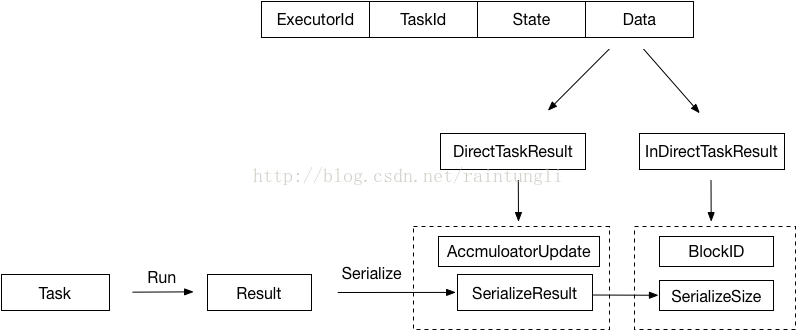
- ExecutorId: Executor自己的ID
- TaskId: task分配的ID
- State: Task的运行状态
LAUNCHING, RUNNING, FINISHED, FAILED, KILLED, LOST
- Data: 保存序列化的Result
2.1 Executor端发送
- 最大的返回结果大小,如果超过设定的最大返回结果时,返回的结果内容会被丢弃,只是返回序列化的InDirectTaskResult,里面包含着BlockID和序列化后的结果大小
spark.driver.maxResultSize
- 最大的直接返回结果大小:如果返回的结果大于最大的直接返回结果大小,小于最大的返回结果大小,采用了保存的折中的策略,将序列化DirectTaskResult保存到BlockManager中,关于BlockManager可以参考前面写的BlockManager系列,返回InDirectTaskResult,里面包含着BlockID和序列化的结果大小
spark.task.maxDirectResultSize
- 直接返回:如果返回的结果小于等于最大的直接返回结果大小,将直接将序列化的DirectTaskResult返回给Driver端
val serializedResult: ByteBuffer = {

          if (maxResultSize >  && resultSize > maxResultSize) {

            logWarning(s"Finished $taskName (TID $taskId). Result is larger than maxResultSize " +

              s"(${Utils.bytesToString(resultSize)} > ${Utils.bytesToString(maxResultSize)}), " +

              s"dropping it.")

            ser.serialize(new IndirectTaskResult[Any](TaskResultBlockId(taskId), resultSize))

          } else if (resultSize > maxDirectResultSize) {

            val blockId = TaskResultBlockId(taskId)

            env.blockManager.putBytes(

              blockId,

              new ChunkedByteBuffer(serializedDirectResult.duplicate()),

              StorageLevel.MEMORY_AND_DISK_SER)

            logInfo(

              s"Finished $taskName (TID $taskId). $resultSize bytes result sent via BlockManager)")

            ser.serialize(new IndirectTaskResult[Any](blockId, resultSize))

          } else {

            logInfo(s"Finished $taskName (TID $taskId). $resultSize bytes result sent to driver")

            serializedDirectResult

          }

        }
2.2 Driver端接收
Driver端处理StatusUpdate的消息的代码如下:
case StatusUpdate(executorId, taskId, state, data) =>

        scheduler.statusUpdate(taskId, state, data.value)

        if (TaskState.isFinished(state)) {

          executorDataMap.get(executorId) match {

            case Some(executorInfo) =>

              executorInfo.freeCores += scheduler.CPUS_PER_TASK

              makeOffers(executorId)

            case None =>

              // Ignoring the update since we don't know about the executor.

              logWarning(s"Ignored task status update ($taskId state $state) " +

                s"from unknown executor with ID $executorId")

          }

        }
scheduler实例是TaskSchedulerImpl.scala
if (TaskState.isFinished(state)) {

              cleanupTaskState(tid)

              taskSet.removeRunningTask(tid)

              if (state == TaskState.FINISHED) {

                taskResultGetter.enqueueSuccessfulTask(taskSet, tid, serializedData)

              } else if (Set(TaskState.FAILED, TaskState.KILLED, TaskState.LOST).contains(state)) {

                taskResultGetter.enqueueFailedTask(taskSet, tid, state, serializedData)

              }

            }
statusUpdate函数调用了enqueueSuccessfulTask方法
def enqueueSuccessfulTask(

      taskSetManager: TaskSetManager,

      tid: Long,

      serializedData: ByteBuffer): Unit = {

    getTaskResultExecutor.execute(new Runnable {

      override def run(): Unit = Utils.logUncaughtExceptions {

        try {

          val (result, size) = serializer.get().deserialize[TaskResult[_]](serializedData) match {

            case directResult: DirectTaskResult[_] =>

              if (!taskSetManager.canFetchMoreResults(serializedData.limit())) {

                return

              }

              // deserialize "value" without holding any lock so that it won't block other threads.

              // We should call it here, so that when it's called again in

              // "TaskSetManager.handleSuccessfulTask", it does not need to deserialize the value.

              directResult.value(taskResultSerializer.get())

              (directResult, serializedData.limit())

            case IndirectTaskResult(blockId, size) =>

              if (!taskSetManager.canFetchMoreResults(size)) {

                // dropped by executor if size is larger than maxResultSize

                sparkEnv.blockManager.master.removeBlock(blockId)

                return

              }

              logDebug("Fetching indirect task result for TID %s".format(tid))

              scheduler.handleTaskGettingResult(taskSetManager, tid)

              val serializedTaskResult = sparkEnv.blockManager.getRemoteBytes(blockId)

              if (!serializedTaskResult.isDefined) {

                /* We won't be able to get the task result if the machine that ran the task failed

                 * between when the task ended and when we tried to fetch the result, or if the

                 * block manager had to flush the result. */

                scheduler.handleFailedTask(

                  taskSetManager, tid, TaskState.FINISHED, TaskResultLost)

                return

              }

              val deserializedResult = serializer.get().deserialize[DirectTaskResult[_]](

                serializedTaskResult.get.toByteBuffer)

              // force deserialization of referenced value

              deserializedResult.value(taskResultSerializer.get())

              sparkEnv.blockManager.master.removeBlock(blockId)

              (deserializedResult, size)

          }

          // Set the task result size in the accumulator updates received from the executors.

          // We need to do this here on the driver because if we did this on the executors then

          // we would have to serialize the result again after updating the size.

          result.accumUpdates = result.accumUpdates.map { a =>

            if (a.name == Some(InternalAccumulator.RESULT_SIZE)) {

              val acc = a.asInstanceOf[LongAccumulator]

              assert(acc.sum == 0L, "task result size should not have been set on the executors")

              acc.setValue(size.toLong)

              acc

            } else {

              a

            }

          }

          scheduler.handleSuccessfulTask(taskSetManager, tid, result)

        } catch {

          case cnf: ClassNotFoundException =>

            val loader = Thread.currentThread.getContextClassLoader

            taskSetManager.abort("ClassNotFound with classloader: " + loader)

          // Matching NonFatal so we don't catch the ControlThrowable from the "return" above.

          case NonFatal(ex) =>

            logError("Exception while getting task result", ex)

            taskSetManager.abort("Exception while getting task result: %s".format(ex))

        }

      }

    })

  }
2.2.1 DirectTaskResult处理过程
- 直接反序列化成DirectTaskResult,反序列化后进行了整体返回内容的大小的判断,在前面的2.1中介绍参数:spark.driver.maxResultSize,这个参数是Driver端的参数控制的,在Spark中会启动多个Task,参数的控制是一个整体的控制所有的Tasks的返回结果的数量大小,当然单个task使用该筏值的控制也是没有问题,因为只要有一个任务返回的结果超过maxResultSize,整体返回的数据也会超过maxResultSize。
- 对DirectTaskResult里的result进行了反序列化。
2.2.2 InDirectTaskResult处理过程
- 通过size判断大小是否超过spark.driver.maxResultSize筏值控制
- 通过BlockManager来获取BlockID的内容反序列化成DirectTaskResult
- 对DirectTaskResult里的result进行了反序列化
最后调用handleSuccessfulTask方法
sched.dagScheduler.taskEnded(tasks(index), Success, result.value(), result.accumUpdates, info)
回到了Dag的调度,向eventProcessLoop的队列里提交了CompletionEvent的事件
def taskEnded(

      task: Task[_],

      reason: TaskEndReason,

      result: Any,

      accumUpdates: Seq[AccumulatorV2[_, _]],

      taskInfo: TaskInfo): Unit = {

    eventProcessLoop.post(

      CompletionEvent(task, reason, result, accumUpdates, taskInfo))

  }
2.3 MapOutputTracker
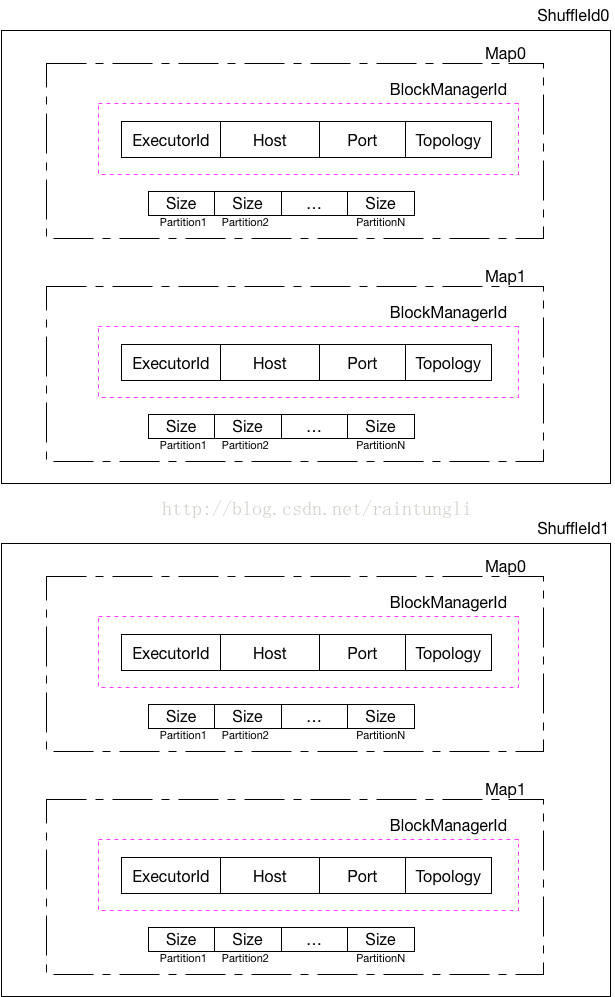
2.3.1 RegisterMapOutput
  def compressSize(size: Long): Byte = {

    if (size == ) {

    } else if (size <= 1L) {

    } else {

      math.min(, math.ceil(math.log(size) / math.log(LOG_BASE)).toInt).toByte

    }

  }
private[scheduler] def handleTaskCompletion(event: CompletionEvent) {

............

case smt: ShuffleMapTask =>

            val shuffleStage = stage.asInstanceOf[ShuffleMapStage]

            updateAccumulators(event)

            val status = event.result.asInstanceOf[MapStatus]

            val execId = status.location.executorId

            logDebug("ShuffleMapTask finished on " + execId)

            if (failedEpoch.contains(execId) && smt.epoch <= failedEpoch(execId)) {

              logInfo(s"Ignoring possibly bogus $smt completion from executor $execId")

            } else {

              shuffleStage.addOutputLoc(smt.partitionId, status)

            }

            if (runningStages.contains(shuffleStage) && shuffleStage.pendingPartitions.isEmpty) {

              markStageAsFinished(shuffleStage)

              logInfo("looking for newly runnable stages")

              logInfo("running: " + runningStages)

              logInfo("waiting: " + waitingStages)

              logInfo("failed: " + failedStages)

              // We supply true to increment the epoch number here in case this is a

              // recomputation of the map outputs. In that case, some nodes may have cached

              // locations with holes (from when we detected the error) and will need the

              // epoch incremented to refetch them.

              // TODO: Only increment the epoch number if this is not the first time

              //       we registered these map outputs.

              mapOutputTracker.registerMapOutputs(

                shuffleStage.shuffleDep.shuffleId,

                shuffleStage.outputLocInMapOutputTrackerFormat(),

                changeEpoch = true)

              clearCacheLocs()

              if (!shuffleStage.isAvailable) {

                // Some tasks had failed; let's resubmit this shuffleStage

                // TODO: Lower-level scheduler should also deal with this

                logInfo("Resubmitting " + shuffleStage + " (" + shuffleStage.name +

                  ") because some of its tasks had failed: " +

                  shuffleStage.findMissingPartitions().mkString(", "))

                submitStage(shuffleStage)

              } else {

                // Mark any map-stage jobs waiting on this stage as finished

                if (shuffleStage.mapStageJobs.nonEmpty) {

                  val stats = mapOutputTracker.getStatistics(shuffleStage.shuffleDep)

                  for (job <- shuffleStage.mapStageJobs) {

                    markMapStageJobAsFinished(job, stats)

                  }

                }

                submitWaitingChildStages(shuffleStage)

              }

            }
当处理shuffleMapTask的结果的时候,mapOutputTracker.registerMapOutputs进行了MapOutputs的注册
  protected val mapStatuses = new ConcurrentHashMap[Int, Array[MapStatus]]().asScala

def registerMapOutputs(shuffleId: Int, statuses: Array[MapStatus], changeEpoch: Boolean = false) {

    mapStatuses.put(shuffleId, statuses.clone())

    if (changeEpoch) {

      incrementEpoch()

    }

  }
2.3.2 获取MapStatus
val blockFetcherItr = new ShuffleBlockFetcherIterator(

      context,

      blockManager.shuffleClient,

      blockManager,

      mapOutputTracker.getMapSizesByExecutorId(handle.shuffleId, startPartition, endPartition),

      // Note: we use getSizeAsMb when no suffix is provided for backwards compatibility

      SparkEnv.get.conf.getSizeAsMb("spark.reducer.maxSizeInFlight", "48m") *  * ,

      SparkEnv.get.conf.getInt("spark.reducer.maxReqsInFlight", Int.MaxValue))
通过getMapSizesByExecutorId获取ShuffledId所对应的MapStatus
def getMapSizesByExecutorId(shuffleId: Int, startPartition: Int, endPartition: Int)

      : Seq[(BlockManagerId, Seq[(BlockId, Long)])] = {

    logDebug(s"Fetching outputs for shuffle $shuffleId, partitions $startPartition-$endPartition")

    val statuses = getStatuses(shuffleId)

    // Synchronize on the returned array because, on the driver, it gets mutated in place

    statuses.synchronized {

      return MapOutputTracker.convertMapStatuses(shuffleId, startPartition, endPartition, statuses)

    }

  }
在getStatuses方法中
 private def getStatuses(shuffleId: Int): Array[MapStatus] = {

    val statuses = mapStatuses.get(shuffleId).orNull

    if (statuses == null) {

      logInfo("Don't have map outputs for shuffle " + shuffleId + ", fetching them")

      val startTime = System.currentTimeMillis

      var fetchedStatuses: Array[MapStatus] = null

      fetching.synchronized {

        // Someone else is fetching it; wait for them to be done

        while (fetching.contains(shuffleId)) {

          try {

            fetching.wait()

          } catch {

            case e: InterruptedException =>

          }

        }

        // Either while we waited the fetch happened successfully, or

        // someone fetched it in between the get and the fetching.synchronized.

        fetchedStatuses = mapStatuses.get(shuffleId).orNull

        if (fetchedStatuses == null) {

          // We have to do the fetch, get others to wait for us.

          fetching += shuffleId

        }

      }

      if (fetchedStatuses == null) {

        // We won the race to fetch the statuses; do so

        logInfo("Doing the fetch; tracker endpoint = " + trackerEndpoint)

        // This try-finally prevents hangs due to timeouts:

        try {

          val fetchedBytes = askTracker[Array[Byte]](GetMapOutputStatuses(shuffleId))

          fetchedStatuses = MapOutputTracker.deserializeMapStatuses(fetchedBytes)

          logInfo("Got the output locations")

          mapStatuses.put(shuffleId, fetchedStatuses)

        } finally {

          fetching.synchronized {

            fetching -= shuffleId

            fetching.notifyAll()

          }

        }

      }

      logDebug(s"Fetching map output statuses for shuffle $shuffleId took " +

        s"${System.currentTimeMillis - startTime} ms")

      if (fetchedStatuses != null) {

        return fetchedStatuses

      } else {

        logError("Missing all output locations for shuffle " + shuffleId)

        throw new MetadataFetchFailedException(

          shuffleId, -, "Missing all output locations for shuffle " + shuffleId)

      }

    } else {

      return statuses

    }

  }
- 封装了一层缓存mapStatus,对同一个Executor来说,里面的线程都是运行同一个Driver的提交的任务,对相同的shuffeID,MapStatus是一样的
- 对同一个Executor、ShuffeID来说,通过Driver获取信息只需要一次,Driver里保存的Shuffle的结果是单点的,对同一个Executor来说获取同一个ShuffleID只需要请求一次,在Traker里面保存了一个队列fetching,里面保存的ShuffeID代表的是有线程正在从Driver端获取ShuffleID的MapStatus,如果发现有值,当前线程会等待,直到其他的线程获取ShuffleID状态并保存到缓存结束,当前线程直接从缓存中获取当前状态
- Executor 向Driver发送GetMapOutputStatuses(shuffleId)消息
- Driver收到GetMapOutputStatuses消息后保存到消息队列mapOutputRequests,Map-Output-Dispatcher-x多线程处理消息队列,返回序列化的MapStatus
- Executor反序列化成MapStatus
2.2.3 以BlockManagerId为key的Shuffle的序列
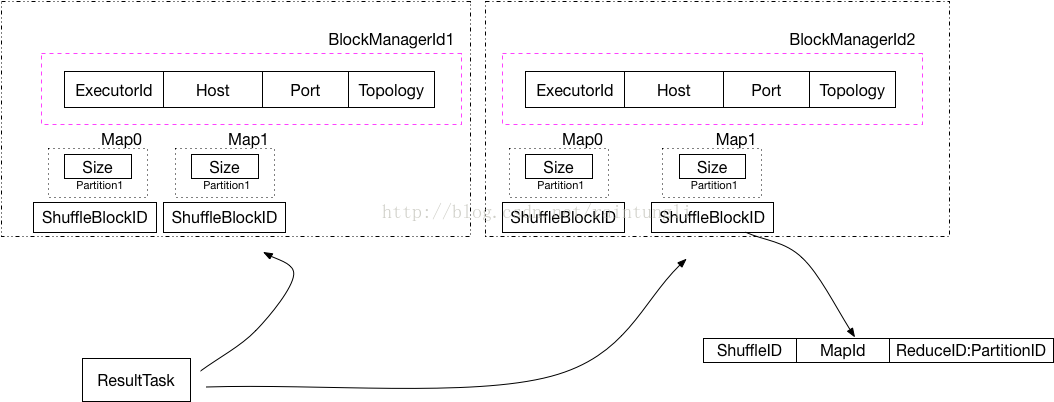
private def convertMapStatuses(

      shuffleId: Int,

      startPartition: Int,

      endPartition: Int,

      statuses: Array[MapStatus]): Seq[(BlockManagerId, Seq[(BlockId, Long)])] = {

    assert (statuses != null)

    val splitsByAddress = new HashMap[BlockManagerId, ArrayBuffer[(BlockId, Long)]]

    for ((status, mapId) <- statuses.zipWithIndex) {

      if (status == null) {

        val errorMessage = s"Missing an output location for shuffle $shuffleId"

        logError(errorMessage)

        throw new MetadataFetchFailedException(shuffleId, startPartition, errorMessage)

      } else {

        for (part <- startPartition until endPartition) {

          splitsByAddress.getOrElseUpdate(status.location, ArrayBuffer()) +=

            ((ShuffleBlockId(shuffleId, mapId, part), status.getSizeForBlock(part)))

        }

      }

    }

    splitsByAddress.toSeq

  }
Spark Shuffle(二)Executor、Driver之间Shuffle结果消息传递、追踪(转载)的更多相关文章
- [Spark性能调优] 第三章 : Spark 2.1.0 中 Sort-Based Shuffle 产生的内幕
本課主題 Sorted-Based Shuffle 的诞生和介绍 Shuffle 中六大令人费解的问题 Sorted-Based Shuffle 的排序和源码鉴赏 Shuffle 在运行时的内存管理 ...
- Spark Executor Driver资源调度小结【转】
一.引子 在Worker Actor中,每次LaunchExecutor会创建一个CoarseGrainedExecutorBackend进程,Executor和CoarseGrainedExecut ...
- Spark Executor Driver资源调度汇总
一.简介 于Worker Actor于,每次LaunchExecutor这将创建一个CoarseGrainedExecutorBackend流程.Executor和CoarseGrainedExecu ...
- 大数据:Spark Core(二)Driver上的Task的生成、分配、调度
1. 什么是Task? 在前面的章节里描写叙述过几个角色,Driver(Client),Master,Worker(Executor),Driver会提交Application到Master进行Wor ...
- Spark Core(二)Driver上的Task的生成、分配、调度(转载)
1. 什么是Task? 在前面的章节里描述过几个角色,Driver(Client),Master,Worker(Executor),Driver会提交Application到Master进行Worke ...
- Spark源码分析之Sort-Based Shuffle读写流程
一 .概述 我们知道Spark Shuffle机制总共有三种: 1.未优化的Hash Shuffle:每一个ShuffleMapTask都会为每一个ReducerTask创建一个单独的文件,总的文件数 ...
- Spark 调优之ShuffleManager、Shuffle
Shuffle 概述 影响Spark性能的大BOSS就是shuffle,因为该环节包含了大量的磁盘IO.序列化.网络数据传输等操作. 因此,如果要让作业的性能更上一层楼,就有必要对 shuffle 过 ...
- 大话Spark(4)-一文理解MapReduce Shuffle和Spark Shuffle
Shuffle本意是 混洗, 洗牌的意思, 在MapReduce过程中需要各节点上同一类数据汇集到某一节点进行计算,把这些分布在不同节点的数据按照一定的规则聚集到一起的过程成为Shuffle. 在Ha ...
- Spark Tungsten揭秘 Day2 Tungsten-sort Based Shuffle
Spark Tungsten揭秘 Day2 Tungsten-sort Based Shuffle 今天在对钨丝计划思考的基础上,讲解下基于Tungsten的shuffle. 首先解释下概念,Tung ...
随机推荐
- 你与论文达人只差一个MathType的距离
在理工类的论文文档中总是少不了数学公式的出现,各种符号夹杂在期间导致论文在编写时总是会出现各种各样的问题.但是这些问题在论文达人们手中全都不是事儿!分分钟搞定你数学公式上出现的问题!论文达人们是怎么搞 ...
- Java集合----概述、Collection接口、Iterator接口
Java 集合概述 Java 集合就像一种容器,可以把多个对象的引用放入容器中. Java 集合类可以用于存储数量不等的多个对象,还可用于保存具有映射关系的关联数组 Java 集合可分为 Set.Li ...
- VMware 12安装虚拟机Mac OS X 10.10(VMware12安装/共享文件夹)
推荐电脑配置 1:Inter I5及以上 (A卡请自行百度大神解决方案) 必须开启CPU虚拟化:开机进入BIOS--->Intel Virtualization Technology---> ...
- swift - 之TabBarController的用法
TabBarController的使用,下面记录两种写法,代码如下: TabBarItem系统自带图标样式(System)介绍: Custom:自定义方式,配合Selected Image来自定义图标 ...
- 微信jssdk批量添加卡券接口(踩坑经验)
1)首先是官方接口文档: 1.批量添加卡券接口:https://mp.weixin.qq.com/wiki?action=doc&id=mp1421141115&t=0.0861973 ...
- [笔试题]黑板上写下50个数字,选两个黑板上数字a和b,在黑板写|b-a|,剩下的数字?
在黑板上写下50个数字:1至50.在接下来的49轮操作中,每次做如下操作:选取两个黑板上的数字a和b,擦去,在黑板上写|b-a|.请问最后一次动作之后剩下的数字可能是什么?为什么?(不用写代码,不写原 ...
- <转>KMP算法详解
看了好久的KMP算法,都一直没有看明白,直到看到了这篇博客http://www.tuicool.com/articles/e2Qbyyf让我瞬间顿悟. 如果你看不懂 KMP 算法,那就看一看这篇文章 ...
- python epoll实现异步socket
一.同步和异步: 在程序执行中,同步运行意味着等待调用的函数.线程.子进程等的返回结果后继续处理:异步指不等待当下的返回结果,直接运行主进程下面的程序,等到有返回结果时,通知主进程处理.有点高效. 二 ...
- 高中生的IT之路-1.2离开校园
记得那是07年夏季的一天,高考成绩出来之后,班主任老师通知大家回学校报考志愿. 那天我刚到学校会议室,我还没来得及和同学见面就被班主任喊过去了,把志愿表递给我了我,我当时连仔细看那张志愿表都没看,随手 ...
- Unity3D笔记五 快捷键
一.近距离查看游戏对象 在Hierarchy视图中选择游戏对象,然后在Scene视图中按快捷键“F”来近距离查看该游戏对象. 二.游戏对象不在主摄像头中? Hierarchy中双击选择需要显示的游戏对 ...