
JavaPersistenceWithHibernate第二版笔记-第四章-Mapping persistent classes-002identity详解
一、简介
1.You now have three methods for distinguishing references:
Objects are identical if they occupy the same memory location in the JVM . This can be checked with the a == b operator. This concept is known as object identity.
Objects are equal if they have the same state, as defined by the a.equals(Object b) method. Classes that don’t explicitly override this method inherit the implementation defined by java.lang.Object , which compares object identity with == . This concept is known as object equality.
Objects stored in a relational database are identical if they share the same table and primary key value. This concept, mapped into the Java space, is known as database identity.
2.To become the primary key, a candidate key must satisfy the following requirements:
The value of any candidate key column is never null. You can’t identify something with data that is unknown, and there are no nulls in the relational model.Some SQL products allow defining (composite) primary keys with nullable columns, so you must be careful.
The value of the candidate key column(s) is a unique value for any row.
The value of the candidate key column(s) never changes; it’s immutable.
3.JPA标准支持的生id成策略
Usually you want the system to generate a primary key value when you save an entity instance, so you write the @GeneratedValue annotation next to @Id . JPA standardizes several value-generation strategies with the javax.persistence.GenerationType enum, which you select with @GeneratedValue(strategy = ...) :
GenerationType.AUTO —Hibernate picks an appropriate strategy, asking the SQL dialect of your configured database what is best. This is equivalent to @GeneratedValue() without any settings.
GenerationType.SEQUENCE —Hibernate expects (and creates, if you use the tools) a sequence named HIBERNATE_SEQUENCE in your database. The sequence will be called separately before every INSERT , producing sequential numeric values.
GenerationType.IDENTITY —Hibernate expects (and creates in table DDL ) a special auto-incremented primary key column that automatically generates a numeric value on INSERT , in the database.
GenerationType.TABLE —Hibernate will use an extra table in your database schema that holds the next numeric primary key value, one row for each entity class. This table will be read and updated accordingly, before INSERT s. The default table name is HIBERNATE_SEQUENCES with columns SEQUENCE_NAME and SEQUENCE_NEXT_HI_VALUE . (The internal implementation uses a more complex but efficient hi/lo generation algorithm; more on this later.)
4.用生成器生成id
JPA has two built-in annotations you can use to configure named generators: @javax .persistence.SequenceGenerator and @javax.persistence.TableGenerator .但Hibernate的更灵活,可以把生成器定义在与domainpackage-info.java文件中,且支持所有Hibernate提供的功能,可以自定义sequence表名,初始化值等。you can use the Hibernate annotation in a package-info.java file, typically in the same package as your domain model classes.Hibernate支持的生成器如下:
(1)native —Automatically selects other strategies, such as sequence or identity ,depending on the configured SQL dialect.
(2)sequence —Uses a native database sequence named HIBERNATE_SEQUENCE .( org.hibernate.id.SequenceGenerator .)
(3)sequence-identity —Generates key values by calling a database sequence on insertion: for example, insert into ITEM(ID) values (HIBERNATE_SEQUENCE.nextval) .(org.hibernate.id.SequenceIdentityGenerator)
(4)enhanced-sequence —Uses a native database sequence when supported; otherwise falls back to an extra database table with a single column and row, emulating a sequence. Defaults to name HIBERNATE_SEQUENCE
,most likely your best option of the built-in strategies.( org.hibernate.id.enhanced.SequenceStyleGenerator )
(5)seqhilo —Uses a native database sequence named HIBERNATE_SEQUENCE , optimizing calls before INSERT by combining hi/lo values.(org.hibernate.id.SequenceHiLoGenerator)
(6)hilo —Uses an extra table named HIBERNATE_UNIQUE_KEY with the same algorithm as the seqhilo strategy.( org.hibernate.id.TableHiLoGenerator)
(7)enhanced-table —Uses an extra table named HIBERNATE_SEQUENCES , with one row by default representing the sequence, storing the next value.( org.hibernate.id.enhanced.TableGenerator )
(8)identity —Supports IDENTITY and auto-increment columns in DB2 , MySQL,MS SQL Server, and Sybase.
(9)increment —At Hibernate startup, reads the maximum (numeric) primary key column value of each entity’s table and increments the value by one each time a new row is inserted.
(10)select —Hibernate won’t generate a key value or include the primary key column in an INSERT statement. Hibernate expects the DBMS to assign a (default in schema or by trigger) value to the column on insertion. Hibernate then retrieves the primary key column with a SELECT query after insertion.
(11)uuid2 —Produces a unique 128-bit UUID in the application layer. Useful when you need globally unique identifiers across databases( org.hibernate.id.UUIDGenerator)
(12)guid —Uses a globally unique identifier produced by the database, with an SQL function available on Oracle, Ingres, MS SQL Server, and MySQL. Hibernate calls the database function before an INSERT .( org.hibernate.id.IdentityGenerator)
总结:最好用pre-insert generation strategies,最好用enhanced-sequence
二、代码
1.结构
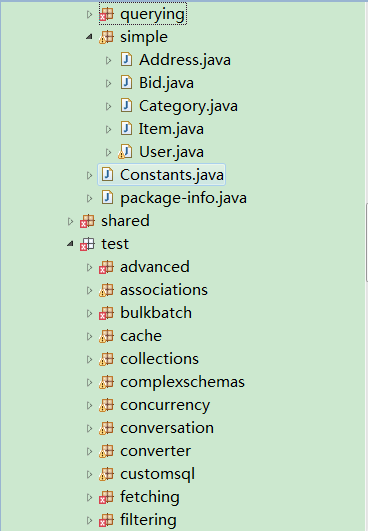
2.实体类
(1)
 package org.jpwh.model.simple;

 import javax.persistence.Entity;

 import javax.persistence.FetchType;

 import javax.persistence.GeneratedValue;

 import javax.persistence.Id;

 import javax.persistence.ManyToOne;

 import javax.persistence.Transient;

 import javax.persistence.Version;

 import javax.validation.constraints.Future;

 import javax.validation.constraints.NotNull;

 import javax.validation.constraints.Size;

 import java.math.BigDecimal;

 import java.util.Date;

 import java.util.HashSet;

 import java.util.Set;

 @Entity

 public class Item {

     @Id

     @GeneratedValue(generator = "ID_GENERATOR")

     protected Long id;

     public Long getId() { // Optional but useful

         return id;

     }

     @Version

     protected long version;

     @NotNull

     @Size(

         min = 2,

         max = 255,

         message = "Name is required, maximum 255 characters."

     )

     protected String name;

     @Future

     protected Date auctionEnd;

     public String getName() {

         return name;

     }

     public void setName(String name) {

         this.name = name;

     }

     public Date getAuctionEnd() {

         return auctionEnd;

     }

     public void setAuctionEnd(Date auctionEnd) {

         this.auctionEnd = auctionEnd;

     }

     protected BigDecimal buyNowPrice;

     public BigDecimal getBuyNowPrice() {

         return buyNowPrice;

     }

     public void setBuyNowPrice(BigDecimal buyNowPrice) {

         this.buyNowPrice = buyNowPrice;

     }

     @Transient

     protected Set<Bid> bids = new HashSet<Bid>();

     public Set<Bid> getBids() {

         return bids;

     }

     public void setBids(Set<Bid> bids) {

         this.bids = bids;

     }

     @ManyToOne(fetch = FetchType.LAZY)

     protected Category category;

     public Category getCategory() {

         return category;

     }

     public void setCategory(Category category) {

         this.category = category;

     }

     public void addBid(Bid bid) {

         // Be defensive

         if (bid == null)

             throw new NullPointerException("Can't add null Bid");

         if (bid.getItem() != null)

             throw new IllegalStateException("Bid is already assigned to an Item");

         getBids().add(bid);

         bid.setItem(this);

     }

     public Bid placeBid(Bid currentHighestBid, BigDecimal bidAmount) {

         if (currentHighestBid == null ||

                 bidAmount.compareTo(currentHighestBid.getAmount()) > 0) {

             return new Bid(bidAmount, this);

         }

         return null;

     }

 }
3.辅助类
(1)
 package org.jpwh.model;

 public interface Constants {

     // These are not used in the simple.Item class and in the model/package-info.java,

     // as this would only confuse new users even more. So don't forget to rename them

     // there if you rename them here.

     public static final String ID_GENERATOR = "ID_GENERATOR";

     public static final String ID_GENERATOR_POOLED = "ID_GENERATOR_POOLED";

 }
(2)package-info.java
 @org.hibernate.annotations.GenericGenerator(

   name = "ID_GENERATOR",

   strategy = "enhanced-sequence",

   parameters = {

      @org.hibernate.annotations.Parameter(

         name = "sequence_name",

         value = "JPWH_SEQUENCE"

      ),

      @org.hibernate.annotations.Parameter(

         name = "initial_value",

         value = "1000"

      )

 })

 package org.jpwh.model;
JavaPersistenceWithHibernate第二版笔记-第四章-Mapping persistent classes-002identity详解的更多相关文章
- JavaPersistenceWithHibernate第二版笔记-第四章-Mapping persistent classes-003映射实体时的可选操作(<delimited-identifiers/>、PhysicalNamingStrategy、PhysicalNamingStrategyStandardImpl、、、)
一.自定义映射的表名 1. @Entity @Table(name = "USERS") public class User implements Serializable { / ...
- JavaPersistenceWithHibernate第二版笔记-第四章-Mapping persistent classes-001区分entities and value types
一.介绍 1.这种引用方式不对,但删除时不能级联 要这种引用方式 2.The Bid class could be a problem. In object-oriented modeling, th ...
- JavaPersistenceWithHibernate第二版笔记-第五章-Mapping value types-001Mapping basic properties(@Basic、@Access、access="noop"、@Formula、@ColumnTransformer、@Generated、 @ColumnDefaul、@Temporal、@Enumerated)
一.简介 在JPA中,默认所有属性都会persist,属性要属于以下3种情况,Hibernate在启动时会报错 1.java基本类型或包装类 2.有注解 @Embedded 3.有实现java.io. ...
- JavaPersistenceWithHibernate第二版笔记-第六章-Mapping inheritance-006Mixing inheritance strategies(@SecondaryTable、@PrimaryKeyJoinColumn、<join fetch="select">)
一.结构 For example, you can map a class hierarchy to a single table, but, for a particular subclass, s ...
- JavaPersistenceWithHibernate第二版笔记-第六章-Mapping inheritance-003Table per concrete class with unions(@Inheritance(strategy = InheritanceType.TABLE_PER_CLASS)、<union-subclass>)
一.代码 1. package org.jpwh.model.inheritance.tableperclass; import org.jpwh.model.Constants; import ja ...
- JavaPersistenceWithHibernate第二版笔记-第六章-Mapping inheritance-002Table per concrete class with implicit polymorphism(@MappedSuperclass、@AttributeOverride)
一.结构 二.代码 1. package org.jpwh.model.inheritance.mappedsuperclass; import javax.persistence.MappedSup ...
- JavaPersistenceWithHibernate第二版笔记-第五章-Mapping value types-007UserTypes的用法(@org.hibernate.annotations.Type、@org.hibernate.annotations.TypeDefs、CompositeUserType、DynamicParameterizedType、、、)
一.结构 二.Hibernate支持的UserTypes接口 UserType —You can transform values by interacting with the plain JD ...
- JavaPersistenceWithHibernate第二版笔记-第五章-Mapping value types-006类型转换器( @Converter(autoApply = true) 、type="converter:qualified.ConverterName" )
一.结构 二.代码 1. package org.jpwh.model.advanced; import java.io.Serializable; import java.math.BigDecim ...
- JavaPersistenceWithHibernate第二版笔记-第五章-Mapping value types-005控制类型映射(Nationalized、@LOB、@org.hibernate.annotations.Type)
一.简介 1. 2. 3. 4. to override this default mapping. The JPA specification has a convenient shortcut a ...
随机推荐
- Struts1+JQuery的例子
Struts1+JQuery的例子 2014年2月10日 11:25 Struts1+JQuery+JSON/XML的例子 1.Struts+JQuery+XML struts-config.xml如 ...
- P1230: [Usaco2008 Nov]lites 开关灯
嗯嗯,这是一道线段树的题,询问区间内亮着的灯的个数,我们可以把区间修改的线段树改一下,原本的求和改成若有奇数次更改则取反(总长度-亮着的灯个数),而判断是否奇数次只要数组加一个delta的值,upda ...
- python关于字符串的操作
#-*- coding:utf-8 -*-#Author:gxli#字符串的操作name=' zhangsan,lisi,wangwu '#分割操作name=name.split(',')print( ...
- STL之multiset
参见http://www.cplusplus.com/reference/set/multiset/ template < class T, ...
- Nginx问题总汇
http://blog.csdn.net/llnara/article/details/8691049 关键字: open var run nginx pid failed 产生原因:添加模块,重编译 ...
- 【Python】vim7.4 配置python2.6支持Gundo
问题描述: vim7.4 配置python2.6支持Gundo 参考资料: (1) http://sjl.bitbucket.org/gundo.vim/ ...
- poj 1273 Drainage Ditches 最大流入门题
题目链接:http://poj.org/problem?id=1273 Every time it rains on Farmer John's fields, a pond forms over B ...
- 【POJ】【1637】Sightseeing tour
网络流/最大流 愚人节快乐XD 这题是给一个混合图(既有有向边又有无向边),让你判断是否有欧拉回路…… 我们知道如果一个[连通]图中每个节点都满足[入度=出度]那么就一定有欧拉回路…… 那么每条边都可 ...
- Linq to Xml示例
Xml文件: <?xml version="1.0"?> <Software xmlns:xsi="http://www.w3.org/2001/XML ...
- 四大机器学习降维算法:PCA、LDA、LLE、Laplacian Eigenmaps
四大机器学习降维算法:PCA.LDA.LLE.Laplacian Eigenmaps 机器学习领域中所谓的降维就是指采用某种映射方法,将原高维空间中的数据点映射到低维度的空间中.降维的本质是学习一个映 ...