
JavaPersistenceWithHibernate第二版笔记-第五章-Mapping value types-007UserTypes的用法(@org.hibernate.annotations.Type、@org.hibernate.annotations.TypeDefs、CompositeUserType、DynamicParameterizedType、、、)
一、结构
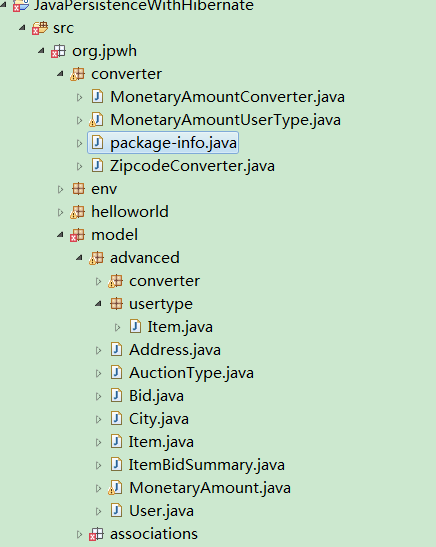
二、Hibernate支持的UserTypes接口
UserType —You can transform values by interacting with the plain JDBC PreparedStatement (when storing data) and ResultSet (when loading data).By implementing this interface, you can also control how Hibernate caches and
dirty-checks values. The adapter for MonetaryAmount has to implement this interface.
CompositeUserType —This extends UserType , providing Hibernate with more details about your adapted class. You can tell Hibernate that the MonetaryAmount component has two properties: amount and currency . You can then reference these properties in queries with dot notation: for example, select avg(i.buyNowPrice.amount) from Item i .
ParameterizedUserType —This provides settings to your adapter in mappings.You have to implement this interface for the MonetaryAmount conversion,because in some mappings you want to convert the amount to US dollars and in
other mappings to Euros. You only have to write a single adapter and can customize its behavior when mapping a property.
DynamicParameterizedType —This more powerful settings API gives you access to dynamic information in the adapter, such as the mapped column and table names. You might as well use this instead of ParameterizedUserType ; there is no additional cost or complexity.
EnhancedUserType —This is an optional interface for adapters of identifier properties and discriminators. Unlike JPA converters, a UserType in Hibernate can be an adapter for any kind of entity property. Because MonetaryAmount won’t be the type of an identifier property or discriminator, you won’t need it.
UserVersionType —This is an optional interface for adapters of version properties.
UserCollectionType —This rarely needed interface is used to implement custom collections. You have to implement it to persist a non- JDK collection and preserve additional semantics.
三、代码
1.
 package org.jpwh.converter;

 import org.hibernate.engine.spi.SessionImplementor;

 import org.hibernate.type.StandardBasicTypes;

 import org.hibernate.type.Type;

 import org.hibernate.usertype.CompositeUserType;

 import org.hibernate.usertype.DynamicParameterizedType;

 import org.jpwh.model.advanced.MonetaryAmount;

 import java.io.Serializable;

 import java.lang.annotation.Annotation;

 import java.math.BigDecimal;

 import java.sql.PreparedStatement;

 import java.sql.ResultSet;

 import java.sql.SQLException;

 import java.util.Currency;

 import java.util.Properties;

 public class MonetaryAmountUserType

     implements CompositeUserType, DynamicParameterizedType {

     protected Currency convertTo;

     public void setParameterValues(Properties parameters) {

         /**

          * You can access some dynamic parameters here, such as the

          * name of the mapped columns, the mapped (entity) table, or even the

          * annotations on the field/getter of the mapped property. We won't need

          * them in this example though.

          */

         ParameterType parameterType =

             (ParameterType) parameters.get(PARAMETER_TYPE);

         String[] columns = parameterType.getColumns();

         String table = parameterType.getTable();

         Annotation[] annotations = parameterType.getAnnotationsMethod();

         /**

          * We only use the <code>convertTo</code> parameter to

          * determine the target currency when saving a value into the database.

          * If the parameter hasn't been set, we default to US Dollar.

          */

         String convertToParameter = parameters.getProperty("convertTo");

         this.convertTo = Currency.getInstance(

             convertToParameter != null ? convertToParameter : "USD"

         );

     }

     /**

      * The method <code>returnedClass</code> adapts the given class, in this case

      * <code>MonetaryAmount</code>.

      */

     public Class returnedClass() {

         return MonetaryAmount.class;

     }

     /**

      * Hibernate can enable some optimizations if it knows

      * that <code>MonetaryAmount</code> is immutable.

      */

     public boolean isMutable() {

         return false;

     }

     /**

      * If Hibernate has to make a copy of the value, it will call

      * this method. For simple immutable classes like <code>MonetaryAmount</code>,

      * you can return the given instance.

      */

     public Object deepCopy(Object value) {

         return value;

     }

     /**

      * Hibernate calls <code>disassemble</code> when it stores a value in the global shared second-level

      * cache. You need to return a <code>Serializable</code> representation. For <code>MonetaryAmount</code>,

      * a <code>String</code> representation is an easy solution. Or, because <code>MonetaryAmount</code> is actually

      * <code>Serializable</code>, you could return it directly.

      */

     public Serializable disassemble(Object value,

                                     SessionImplementor session) {

         return value.toString();

     }

     /**

      * Hibernate calls this method when it reads the serialized

      * representation from the global shared second-level cache. We create a

      * <code>MonetaryAmount</code> instance from the <code>String</code>

      * representation. Or, if have stored a serialized <code>MonetaryAmount</code>,

      * you could return it directly.

      */

     public Object assemble(Serializable cached,

                            SessionImplementor session, Object owner) {

         return MonetaryAmount.fromString((String) cached);

     }

     /**

      * Called during <code>EntityManager#merge()</code> operations, you

      * need to return a copy of the <code>original</code>. Or, if your value type is

      * immutable, like <code>MonetaryAmount</code>, you can simply return the original.

      */

     public Object replace(Object original, Object target,

                           SessionImplementor session, Object owner) {

         return original;

     }

     /**

      * Hibernate will use value equality to determine whether the value

      * was changed, and the database needs to be updated. We rely on the equality

      * routine we have already written on the <code>MonetaryAmount</code> class.

      */

     public boolean equals(Object x, Object y) {

         return x == y || !(x == null || y == null) && x.equals(y);

     }

     public int hashCode(Object x) {

         return x.hashCode();

     }

     /**

      * Called to read the <code>ResultSet</code>, when a

      * <code>MonetaryAmount</code> value has to be retrieved from the database.

      * We take the <code>amount</code> and <code>currency</code> values as given

      * in the query result, and create a new instance of <code>MonetaryAmount</code>.

      */

     public Object nullSafeGet(ResultSet resultSet,

                               String[] names,

                               SessionImplementor session,

                               Object owner) throws SQLException {

         BigDecimal amount = resultSet.getBigDecimal(names[0]);

         if (resultSet.wasNull())

             return null;

         Currency currency =

             Currency.getInstance(resultSet.getString(names[1]));

         return new MonetaryAmount(amount, currency);

     }

     /**

      * Called when a <code>MonetaryAmount</code> value has

      * to be stored in the database. We convert the value to the target currency,

      * then set the <code>amount</code> and <code>currency</code> on the

      * provided <code>PreparedStatement</code>. (Unless the <code>MonetaryAmount</code>

      * was <code>null</code>, in that case, we call <code>setNull()</code> to

      * prepare the statement.)

      */

     public void nullSafeSet(PreparedStatement statement,

                             Object value,

                             int index,

                             SessionImplementor session) throws SQLException {

         if (value == null) {

             statement.setNull(

                 index,

                 StandardBasicTypes.BIG_DECIMAL.sqlType());

             statement.setNull(

                 index + 1,

                 StandardBasicTypes.CURRENCY.sqlType());

         } else {

             MonetaryAmount amount = (MonetaryAmount) value;

             // When saving, convert to target currency

             MonetaryAmount dbAmount = convert(amount, convertTo);

             statement.setBigDecimal(index, dbAmount.getValue());

             statement.setString(index + 1, convertTo.getCurrencyCode());

         }

     }

     /**

      * Here you can implement whatever currency conversion routine

      * you need. For the sake of the example, we simply double the value so we

      * can easily test if conversion was successful. You'll have to replace this

      * code with a real currency converter in a real application. It's not a

      * method of the Hibernate <code>UserType</code> API.

      */

     protected MonetaryAmount convert(MonetaryAmount amount,

                                      Currency toCurrency) {

         return new MonetaryAmount(

             amount.getValue().multiply(new BigDecimal(2)),

             toCurrency

         );

     }

     public String[] getPropertyNames() {

         return new String[]{"value", "currency"};

     }

     public Type[] getPropertyTypes() {

         return new Type[]{

             StandardBasicTypes.BIG_DECIMAL,

             StandardBasicTypes.CURRENCY

         };

     }

     public Object getPropertyValue(Object component,

                                    int property) {

         MonetaryAmount monetaryAmount = (MonetaryAmount) component;

         if (property == 0)

             return monetaryAmount.getValue();

         else

             return monetaryAmount.getCurrency();

     }

     public void setPropertyValue(Object component,

                                  int property,

                                  Object value) {

         throw new UnsupportedOperationException(

             "MonetaryAmount is immutable"

         );

     }

     // ...

 }
2.
 @org.hibernate.annotations.TypeDefs({

     @org.hibernate.annotations.TypeDef(

         name = "monetary_amount_usd",

         typeClass = MonetaryAmountUserType.class,

         parameters = {@Parameter(name = "convertTo", value = "USD")}

     ),

     @org.hibernate.annotations.TypeDef(

         name = "monetary_amount_eur",

         typeClass = MonetaryAmountUserType.class,

         parameters = {@Parameter(name = "convertTo", value = "EUR")}

     )

 })

 package org.jpwh.converter;

 import org.hibernate.annotations.Parameter;
3.
 package org.jpwh.model.advanced.usertype;

 import org.jpwh.model.advanced.MonetaryAmount;

 import javax.persistence.Column;

 import javax.persistence.Entity;

 import javax.persistence.GeneratedValue;

 import javax.persistence.Id;

 import javax.validation.constraints.NotNull;

 @Entity

 public class Item {

     @Id

     @GeneratedValue(generator = "ID_GENERATOR")

     protected Long id;

     @NotNull

     protected String name;

     @NotNull

     @org.hibernate.annotations.Type(

         type = "monetary_amount_usd"

     )

     @org.hibernate.annotations.Columns(columns = {

         @Column(name = "BUYNOWPRICE_AMOUNT"),

         @Column(name = "BUYNOWPRICE_CURRENCY", length = 3)

     })

     protected MonetaryAmount buyNowPrice;

     @NotNull

     @org.hibernate.annotations.Type(

         type = "monetary_amount_eur"

     )

     @org.hibernate.annotations.Columns(columns = {

         @Column(name = "INITIALPRICE_AMOUNT"),

         @Column(name = "INITIALPRICE_CURRENCY", length = 3)

     })

     protected MonetaryAmount initialPrice;

     public Long getId() {

         return id;

     }

     public String getName() {

         return name;

     }

     public void setName(String name) {

         this.name = name;

     }

     public MonetaryAmount getBuyNowPrice() {

         return buyNowPrice;

     }

     public void setBuyNowPrice(MonetaryAmount buyNowPrice) {

         this.buyNowPrice = buyNowPrice;

     }

     public MonetaryAmount getInitialPrice() {

         return initialPrice;

     }

     public void setInitialPrice(MonetaryAmount initialPrice) {

         this.initialPrice = initialPrice;

     }

     // ...

 }
4.
 package org.jpwh.model.advanced;

 import java.io.Serializable;

 import java.math.BigDecimal;

 import java.util.Currency;

 /*

    This value-typed class should be <code>java.io.Serializable</code>: When Hibernate stores entity

    instance data in the shared second-level cache (see <a href="#Caching"/>), it <em>disassembles</em>

    the entity's state. If an entity has a <code>MonetaryAmount</code> property, the serialized

    representation of the property value will be stored in the second-level cache region. When entity

    data is retrieved from the cache region, the property value will be deserialized and reassembled.

  */

 public class MonetaryAmount implements Serializable {

     /*

  The class does not need a special constructor, you can make it immutable, even with

         <code>final</code> fields, as your code will be the only place an instance is created.

      */

     protected final BigDecimal value;

     protected final Currency currency;

     public MonetaryAmount(BigDecimal value, Currency currency) {

         this.value = value;

         this.currency = currency;

     }

     public BigDecimal getValue() {

         return value;

     }

     public Currency getCurrency() {

         return currency;

     }

     /*

  You should implement the <code>equals()</code> and <code>hashCode()</code>

         methods, and compare monetary amounts "by value".

      */

     public boolean equals(Object o) {

         if (this == o) return true;

         if (!(o instanceof MonetaryAmount)) return false;

         final MonetaryAmount monetaryAmount = (MonetaryAmount) o;

         if (!value.equals(monetaryAmount.value)) return false;

         if (!currency.equals(monetaryAmount.currency)) return false;

         return true;

     }

     public int hashCode() {

         int result;

         result = value.hashCode();

         result = 29 * result + currency.hashCode();

         return result;

     }

     /*

  You will need a <code>String</code> representation of a monetary

         amount. Implement the <code>toString()</code> method and a static method to

         create an instance from a <code>String</code>.

      */

     public String toString() {

         return getValue() + " " + getCurrency();

     }

     public static MonetaryAmount fromString(String s) {

         String[] split = s.split(" ");

         return new MonetaryAmount(

             new BigDecimal(split[0]),

             Currency.getInstance(split[1])

         );

     }

 }
5.
JavaPersistenceWithHibernate第二版笔记-第五章-Mapping value types-007UserTypes的用法(@org.hibernate.annotations.Type、@org.hibernate.annotations.TypeDefs、CompositeUserType、DynamicParameterizedType、、、)的更多相关文章
- JavaPersistenceWithHibernate第二版笔记-第五章-Mapping value types-006类型转换器( @Converter(autoApply = true) 、type="converter:qualified.ConverterName" )
一.结构 二.代码 1. package org.jpwh.model.advanced; import java.io.Serializable; import java.math.BigDecim ...
- JavaPersistenceWithHibernate第二版笔记-第五章-Mapping value types-001Mapping basic properties(@Basic、@Access、access="noop"、@Formula、@ColumnTransformer、@Generated、 @ColumnDefaul、@Temporal、@Enumerated)
一.简介 在JPA中,默认所有属性都会persist,属性要属于以下3种情况,Hibernate在启动时会报错 1.java基本类型或包装类 2.有注解 @Embedded 3.有实现java.io. ...
- JavaPersistenceWithHibernate第二版笔记-第五章-Mapping value types-005控制类型映射(Nationalized、@LOB、@org.hibernate.annotations.Type)
一.简介 1. 2. 3. 4. to override this default mapping. The JPA specification has a convenient shortcut a ...
- JavaPersistenceWithHibernate第二版笔记-第五章-Mapping value types-004嵌套组件的注解AttributeOverrides
一.数据库 二.代码 1. package org.jpwh.model.advanced; import javax.persistence.AttributeOverride; import ja ...
- JavaPersistenceWithHibernate第二版笔记-第五章-Mapping value types-003使用@AttributeOverrides
Each @AttributeOverride for a component property is “complete”: any JPA or Hibernate annotation on t ...
- JavaPersistenceWithHibernate第二版笔记-第五章-Mapping value types-002使用@Embeddable
一.数据库 二.代码 1. package org.jpwh.model.simple; import javax.persistence.Column; import javax.persisten ...
- JavaPersistenceWithHibernate第二版笔记-第四章-Mapping persistent classes-003映射实体时的可选操作(<delimited-identifiers/>、PhysicalNamingStrategy、PhysicalNamingStrategyStandardImpl、、、)
一.自定义映射的表名 1. @Entity @Table(name = "USERS") public class User implements Serializable { / ...
- JavaPersistenceWithHibernate第二版笔记-第六章-Mapping inheritance-002Table per concrete class with implicit polymorphism(@MappedSuperclass、@AttributeOverride)
一.结构 二.代码 1. package org.jpwh.model.inheritance.mappedsuperclass; import javax.persistence.MappedSup ...
- JavaPersistenceWithHibernate第二版笔记-第六章-Mapping inheritance-003Table per concrete class with unions(@Inheritance(strategy = InheritanceType.TABLE_PER_CLASS)、<union-subclass>)
一.代码 1. package org.jpwh.model.inheritance.tableperclass; import org.jpwh.model.Constants; import ja ...
随机推荐
- QT 的信号与槽
转载: QT 的信号与槽机制介绍 QT 是一个跨平台的 C++ GUI 应用构架,它提供了丰富的窗口部件集,具有面向对象.易于扩展.真正的组件编程等特点,更为引人注目的是目前 Linux 上最为流行的 ...
- activemq整合spring
- Android -- 获取摄像头帧数据解码
由于Android下摄像头预览数据只能 ImageFormat.NV21 格式的,所以解码时要经过一翻周折. Camera mCamera = Camera.open(); Camera.Param ...
- Careercup - Microsoft面试题 - 5680049562845184
2014-05-10 06:51 题目链接 原题: "How would you find the number of gas stations in the United States?& ...
- Tomcat配置HTTPS方式生成安全证书
在Tomcat 6中配置SSL双向认证是相当容易的,本文将介绍如何使用JDK的keytool来为Tomcat配置双向SSL认证.并实现批量生成证书 系统需求:JDK 5.0Tomcat 6.0.16启 ...
- 【Merge Sorted Array】cpp
题目: Given two sorted integer arrays nums1 and nums2, merge nums2 into nums1 as one sorted array. Not ...
- 1566: [NOI2009]管道取珠 - BZOJ
Description Input第一行包含两个整数n, m,分别表示上下两个管道中球的数目. 第二行为一个AB字符串,长度为n,表示上管道中从左到右球的类型.其中A表示浅色球,B表示深色球. 第三行 ...
- hibernate---ID生成策略
5.1.4.1. Generator 可选的<generator>子元素是一个Java类的名字, 用来为该持久化类的实例生成唯一的标识.如果这个生成器实例需要某些配置值或者初始化参数, 用 ...
- 开发EXTMVC框架前需要了解的基础知识整理
1.组件选择器 目的:了解如何选择Extjs中的组件,就跟学习jquery时一定会先要学习:$()选择器一样. 常用场景: 1.在controller中的control事件中用到 ...
- VIM 技巧 (一)全文统一添加
大家应该有遇到过给整篇内容增加同样的东西的经历.例如给每行结尾增加分号.冒号等内容. 今天和大家分享下 关于此场景如何快速.高效的实现. 例如 Line one Line two Line three ...