
Poj 最短路和次短路的个数 Dij+优化?。
Description
Tour operator Your Personal Holiday organises guided bus trips across the Benelux. Every day the bus moves from one city S to another city F. On this way, the tourists in the bus can see the sights alongside the route travelled. Moreover, the bus makes a number of stops (zero or more) at some beautiful cities, where the tourists get out to see the local sights.
Different groups of tourists may have different preferences for the sights they want to see, and thus for the route to be taken from S to F. Therefore, Your Personal Holiday wants to offer its clients a choice from many different routes. As hotels have been booked in advance, the starting city S and the final city F, though, are fixed. Two routes from S to F are considered different if there is at least one road from a city A to a city B which is part of one route, but not of the other route.
There is a restriction on the routes that the tourists may choose from. To leave enough time for the sightseeing at the stops (and to avoid using too much fuel), the bus has to take a short route from S to F. It has to be either a route with minimal distance, or a route which is one distance unit longer than the minimal distance. Indeed, by allowing routes that are one distance unit longer, the tourists may have more choice than by restricting them to exactly the minimal routes. This enhances the impression of a personal holiday.
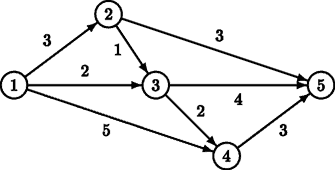
For example, for the above road map, there are two minimal routes from S = 1 to F = 5: 1 → 2 → 5 and 1 → 3 → 5, both of length 6. There is one route that is one distance unit longer: 1 → 3 → 4 → 5, of length 7.
Now, given a (partial) road map of the Benelux and two cities S and F, tour operator Your Personal Holiday likes to know how many different routes it can offer to its clients, under the above restriction on the route length.
Input
The first line of the input file contains a single number: the number of test cases to follow. Each test case has the following format:
One line with two integers N and M, separated by a single space, with 2 ≤ N ≤ 1,000 and 1 ≤ M ≤ 10, 000: the number of cities and the number of roads in the road map.
M lines, each with three integers A, B and L, separated by single spaces, with 1 ≤ A, B ≤ N, A ≠ B and 1 ≤ L ≤ 1,000, describing a road from city A to city B with length L.
The roads are unidirectional. Hence, if there is a road from A to B, then there is not necessarily also a road from B to A. There may be different roads from a city A to a city B.
One line with two integers S and F, separated by a single space, with 1 ≤ S, F ≤ N and S ≠ F: the starting city and the final city of the route.
There will be at least one route from S to F.
Output
For every test case in the input file, the output should contain a single number, on a single line: the number of routes of minimal length or one distance unit longer. Test cases are such, that this number is at most 109 = 1,000,000,000.
Sample Input
2

5 8

1 2 3

1 3 2

1 4 5

2 3 1

2 5 3

3 4 2

3 5 4

4 5 3

1 5

5 6

2 3 1

3 2 1

3 1 10

4 5 2

5 2 7

5 2 7

4 1
Sample Output
3

2

http://www.cnblogs.com/candy99/p/5873047.html   //参考代码

注意仔细体会vis数组,必不可少的,不仅仅是优化时间
#include<cstdio>

#include<cstring>

#include<algorithm>

#include<queue>

using namespace std;

const int N=;

const int M=;

const int INF=0x3f3f3f3f;

int n,m;

struct edge{

   int to,w,next;

}e[M];

int head[N],tot=;

void add(int u,int v,int w){

    e[tot].to=v;

    e[tot].w=w;

    e[tot].next=head[u];

    head[u]=tot++;

}

int d[N][],vis[N][],cnt[N][];

struct hn{

     int u,d,p;

     hn(int a=,int b=,int c=):u(a),d(b),p(c){}

     bool operator < (const hn &rhs)const{

      return d>rhs.d;

     }

};

void Dij(int s){

   priority_queue<hn>Q;

   memset(vis,,sizeof(vis));

   memset(cnt,,sizeof(cnt));

   for(int i=;i<=n;++i) d[i][]=d[i][]=INF;

   Q.push(hn(s,,));

   d[s][]=,cnt[s][]=;

   while(!Q.empty()){

    hn now=Q.top();Q.pop();

    int u=now.u,p=now.p;

    if(vis[u][p]) continue;

    vis[u][p]=;

    for(int i=head[u];i+;i=e[i].next){

        int v=e[i].to,w=e[i].w;

        if(d[v][]>d[u][p]+w) {

            d[v][]=d[v][],cnt[v][]=cnt[v][];

            d[v][]=d[u][p]+w,cnt[v][]=cnt[u][p];

            Q.push(hn(v,d[v][],));

            Q.push(hn(v,d[v][],));

        }

        else if(d[v][]==d[u][p]+w) cnt[v][]+=cnt[u][p];

        else if(d[v][]>d[u][p]+w) {

            d[v][]=d[u][p]+w;

            cnt[v][]=cnt[u][p];

            Q.push(hn(v,d[v][],));

        }

        else if(d[v][]==d[u][p]+w) cnt[v][]+=cnt[u][p];

    }

   }

}

int main(){

     int T,u,v,w;

     for(scanf("%d",&T);T--;){

        memset(head,-,sizeof(head));

        tot=;

        scanf("%d%d",&n,&m);

        for(int i=;i<=m;++i) { scanf("%d%d%d",&u,&v,&w);add(u,v,w);}

        int s,f;

        scanf("%d%d",&s,&f);

        Dij(s);

        if(d[f][]==d[f][]+) cnt[f][]+=cnt[f][];

        printf("%d\n",cnt[f][]);

     }

}
Poj 最短路和次短路的个数 Dij+优化?。的更多相关文章
- poj 3463 Sightseeing( 最短路与次短路)
http://poj.org/problem?id=3463 Sightseeing Time Limit: 2000MS Memory Limit: 65536K Total Submissio ...
- POJ 3635 - Full Tank? - [最短路变形][手写二叉堆优化Dijkstra][配对堆优化Dijkstra]
题目链接:http://poj.org/problem?id=3635 题意题解等均参考:POJ 3635 - Full Tank? - [最短路变形][优先队列优化Dijkstra]. 一些口胡: ...
- POJ - 3463 Sightseeing 最短路计数+次短路计数
F - Sightseeing 传送门: POJ - 3463 分析 一句话题意:给你一个有向图,可能有重边,让你求从s到t最短路的条数,如果次短路的长度比最短路的长度多1,那么在加上次短路的条数. ...
- POJ 3463 有向图求次短路的长度及其方法数
题目大意: 希望求出走出最短路的方法总数,如果次短路只比最短路小1,那也是可取的 输出总的方法数 这里n个点,每个点有最短和次短两种长度 这里采取的是dijkstra的思想,相当于我们可以不断找到更新 ...
- POJ 3463 Sightseeing 【最短路与次短路】
题目 Tour operator Your Personal Holiday organises guided bus trips across the Benelux. Every day the ...
- dijkstra(最短路)和Prim(最小生成树)下的堆优化
dijkstra(最短路)和Prim(最小生成树)下的堆优化 最小堆: down(i)[向下调整]:从第k层的点i开始向下操作,第k层的点与第k+1层的点(如果有)进行值大小的判断,如果父节点的值大于 ...
- POJ---3463 Sightseeing 记录最短路和次短路的条数
Sightseeing Time Limit: 2000MS Memory Limit: 65536K Total Submissions: 9247 Accepted: 3242 Descr ...
- 最短路和次短路问题,dijkstra算法
/* *题目大意: *在一个有向图中,求从s到t两个点之间的最短路和比最短路长1的次短路的条数之和; * *算法思想: *用A*求第K短路,目测会超时,直接在dijkstra算法上求次短路; ...
- UESTC30-最短路-Floyd最短路、spfa+链式前向星建图
最短路 Time Limit: 3000/1000MS (Java/Others) Memory Limit: 65535/65535KB (Java/Others) 在每年的校赛里,所有进入决赛的同 ...
随机推荐
- jdbc批量插入数据
//插入很多书(批量插入用法) public void insertBooks(List<Book> book) { final List<Book> tempBook=b ...
- 浅析 JS 中的作用域链
作用域链的形成 在 JS 中每个函数都有自己的执行环境,而每个执行环境都有一个与之对应的变量对象.例如: var a = 2 function fn () { var a = 1 console.lo ...
- bibernate中inverse和cascade用法
一口一口吃掉Hibernate(八)--Hibernate中inverse的用法 [转自 http://blog.csdn.net/xiaoxian8023 ] 一.Inverse是hibernate ...
- 【10月新版】Aspose.Pdf 10月新版V17.10发布 | 附下载
2019独角兽企业重金招聘Python工程师标准>>> Aspose.Pdf for .NET 17.10 更新 功能和改进 核心 概述 类别 PDFNET-38067 支持DICO ...
- 机器学习之分类回归树(python实现CART)
之前有文章介绍过决策树(ID3).简单回顾一下:ID3每次选取最佳特征来分割数据,这个最佳特征的判断原则是通过信息增益来实现的.按照某种特征切分数据后,该特征在以后切分数据集时就不再使用,因此存在切分 ...
- 用Swoole4 打造高并发的PHP协程Mysql连接池
码云代码仓库:https://gitee.com/tanjiajun/MysqlPool 代码仓库:https://github.com/asbectJ/swoole4.git 前言 在写这篇文章之前 ...
- 图论——Tarjan 初步 DFS序+时间戳+欧拉序
一.什么是DFS序: DFS序是按照先序遍历,先遍历根节点然后依次遍历左子树,右子树的过程,每次遇到新的节点就把新访问节点加到序列中,代码如下: int DFSrk[100000]; int cnt= ...
- postman(全局变量设置)
全局变量 全局变量作用于整个postman工具及所有环境 1.点击小齿轮进入到变量添加页面,点击Globals添加全局变量 2.输入变量名称和变量值 3.接口中设置变量 4.调用 Globals 变量 ...
- linux下编译boost的多线程程序
linux下面用boost库进行多线程编程,一开始总是编译不成功,花了好多的时间. 下面是一段小示例代码: //start from the very beginning,and to create ...
- Linux之进程管理工具supervisor
环境:CentOS 7官方文档:http://supervisord.org/ 安装 # yum install -y epel-release # yum install -y supervisor ...