
Python函数式编程之map/filter/reduce/sorted
Python函数式编程之map/filter/reduce/sorted
关于函数式编程
- 函数式编程Functional Programming,其思想更接近数学计算
- 函数式编程就是一种抽象程度很高的编程范式,纯粹的函数式编程语言编写的函数没有变量,因此,任意一个函数,只要输入是确定的,输出就是确定的。
- Python对函数式编程提供部分支持
- 由于Python允许使用变量,因此,Python不是纯函数式编程语言
- 函数式编程的一个特点就是,允许把函数本身作为参数传入另一个函数,还允许返回一个函数(你会想到,闭包?装饰器?)
map 映射
定义
- 关键是声明和注释,内置方法你可以先忽略
- map(func, *iterables) --> map object # 第一个参数是个函数名,第二个参数是个可迭代的对象
- map的作用是将func作用到迭代器中的每个元素上
class map(object)

 |  map(func, *iterables) --> map object

 |

 |  Make an iterator that computes the function using arguments from

 |  each of the iterables.  Stops when the shortest iterable is exhausted.

 |

 |  Methods defined here:

 |

 |  __getattribute__(self, name, /)

 |      Return getattr(self, name).

 |

 |  __iter__(self, /)

 |      Implement iter(self).

 |

 |  __next__(self, /)

 |      Implement next(self).

 |

 |  __reduce__(...)

 |      Return state information for pickling.

 |

 |  ----------------------------------------------------------------------

 |  Static methods defined here:

 |

 |  __new__(*args, **kwargs) from builtins.type

 |      Create and return a new object.  See help(type) for accurate signature.
实例
从简->难
1. 将列表中每个整数变为平方
list1 = [1,2,3] # --> [1,4,9]

# 循环

list2 = []

for _ in list1:

    list2.append(_**2)

# 列表推导式

[i**2 for i in list1]

# map

list(map(lambda x:x**2,list1))

# 等价于

def f(x):

    return x * x

list(map(f,list1))
- 从上面你可以看出来,map可以跟列表推导式一定程度上等价,当然也是可以用for来完成的。
- map很多的时候跟lambda结合使用。
- 效果见下图,map映射,有一一对应之意,将这个func(函数)作用到迭代器的每个元素上。
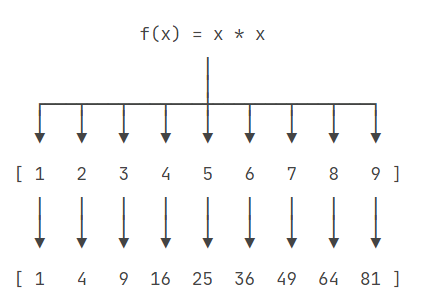
下面都是一些简单的例子而已
2. 将列表中每个整数变为字符串
list1 = [1,2,3]

list(map(str,list1))
- 注意map返回的是map object
3. 得到学生姓名的列表
students = [

            {"name": "John Doe",

             "father name": "Robert Doe",

             "Address": "123 Hall street"

             },

            {

              "name": "Rahul Garg",

              "father name": "Kamal Garg",

              "Address": "3-Upper-Street corner"

            },

            {

              "name": "Angela Steven",

             "father name": "Jabob steven",

             "Address": "Unknown"

            }

]
像例子1-2是烂大街的map举例的,像3这种就不太明显了,但却非常适合用map
list(map(lambda stu:stu['name'],students))
当然还有一个问题是这样的lambda你是否能想到?(虽然比较简单)
4. 将2个列表中对应的数据相乘
list1 = [1,2,3]

list2 = [4,5,6] # -> [4,10,18]  1*4  2*5 3*6
这个用列表推导式可以吗?反正我不太会做
[i*j for i in list1 for j in list2] # [4, 5, 6, 8, 10, 12, 12, 15, 18] # 可以看到是一个双重for循环用map实现
list(map(lambda x,y:x*y,list1,list2)) # 你可以看到x来自list1,y来自list2
- 是的,map后面第一个参数是函数名,第二个参数是可迭代对象,但可以是多个。
5. 映射多个函数的一个示例
# ×2

def double(x):

    return x + x

# 平方

def square(x):

    return x * x

# 数据

list1 = [1, 2, 3 ]

# 处理

for i in list1:

    temp = tuple(map(lambda x: x(i), (double, square)))

    print(temp)

###

# (2, 1)

# (4, 4)

# (6, 9)
6. 其他实例
把用户输入的不规范的英文名字,变为首字母大写,其他小写的规范名字
list1 = ['adam', 'LISA', 'barT']

list(map(lambda x:x.capitalize(),list1))
将一个数字字符串转换为整数的list
list(map(int,'1234'))
提取字典中的key
list(map(int,{1:2,2:3,3:4}))
快速生成26个英文字符
"".join(map(chr, range(ord('a'), ord('z') + 1)))
统计指定字符串每个字符出现的次数,从高到底排列
from collections import Counter

string =  "AAABBCCAC"

print("".join(map(lambda x: x[0] + str(x[1]), Counter(string).most_common())))  #A4C3B2
在pandas中大量存在map等应用
filter 过滤
- 筛选满足条件的元素时非常有用
定义
class filter(object)

 |  filter(function or None, iterable) --> filter object

 |

 |  Return an iterator yielding those items of iterable for which function(item)

 |  is true. If function is None, return the items that are true.

 |

 |  Methods defined here:

 |

 |  __getattribute__(self, name, /)

 |      Return getattr(self, name).

 |

 |  __iter__(self, /)

 |      Implement iter(self).

 |

 |  __next__(self, /)

 |      Implement next(self).

 |

 |  __reduce__(...)

 |      Return state information for pickling.

 |

 |  ----------------------------------------------------------------------

 |  Static methods defined here:

 |

 |  __new__(*args, **kwargs) from builtins.type

 |      Create and return a new object.  See help(type) for accurate signature
实例
1. 找出整数列表中的奇数
nums = [1,2,3,4,5]

list(filter(lambda x:x%2==1,nums))
2. 找出姓名长度不超过5个字符的人员信息
names = ['alice','jordan','richardson','mike','hudson']

list(filter(lambda x:len(x)<=5,names))
3. 求所有的水仙花数
list(filter(lambda num:int(str(num)[0])**3+int(str(num)[1])**3+int(str(num)[2])**3 == num,range(100,1000)))
4. 剔除所有空字符串
def not_empty(s):

    return s and s.strip()

list(filter(not_empty, ['A', '', 'B', None, 'C', '  ']))
reduce 递推
reduce是相对来说比较难的一个函数,一方面是不常用,但在某些应用场景中用它就非常巧妙,另外一方面这个递推的过程你得理解。
定义
reduce(...)

    reduce(function, sequence[, initial]) -> value

    Apply a function of two arguments cumulatively to the items of a sequence,

    from left to right, so as to reduce the sequence to a single value.

    For example, reduce(lambda x, y: x+y, [1, 2, 3, 4, 5]) calculates

    ((((1+2)+3)+4)+5).  If initial is present, it is placed before the items

    of the sequence in the calculation, and serves as a default when the

    sequence is empty.
此处的example对理解reduce非常重要
reduce(lambda x, y: x+y, [1, 2, 3, 4, 5])

--->

((((1+2)+3)+4)+5)
有个递归的意思在里面from functools import reduce
实例
1. 把[1,3,5,7,9]变成13579
from functools import reduce

reduce(lambda x,y:10*x+y, [1, 3, 5, 7, 9])
- 注意reduce在functools下面,需要导入
2. 对整数列表中的奇数元素进行求平方
items = [12, 5, 7, 10, 8, 19]

list(map(lambda x: x ** 2, filter(lambda x: x % 2, items)))

# 其实用 列表推导式反而简单了

items = [12, 5, 7, 10, 8, 19]

[x ** 2 for x in items if x % 2]
3. 实现str->int的转换
from functools import reduce

DIGITS = {'0': 0, '1': 1, '2': 2, '3': 3, '4': 4, '5': 5, '6': 6, '7': 7, '8': 8, '9': 9}

def char2num(s):

    return DIGITS[s]

def str2int(s):

    return reduce(lambda x, y: x * 10 + y, map(char2num, s))

string = '135'

print(str2int(string))
4. 对列表中所有数字相乘
from functools import reduce

def prod(L):

    return reduce(lambda x,y:x*y,L)

print('3 * 5 * 7 * 9 =', prod([3, 5, 7, 9]))

if prod([3, 5, 7, 9]) == 945:

    print('测试成功!')

else:

    print('测试失败!')
sorted 排序
sorted是python的内置函数,可以排序容器,并且自己定义排序的策略
定义
sorted(iterable, /, *, key=None, reverse=False)

    Return a new list containing all items from the iterable in ascending order.

    A custom key function can be supplied to customize the sort order, and the

    reverse flag can be set to request the result in descending order.
- reverse可以用来改变正序->倒序
- key可以用来自定义排序规则
实例
1. 常规正序倒序
list1 = [1,3,5,2,4,6]

sorted(list1)  # [1, 2, 3, 4, 5, 6]

sorted(list1,reverse=True)  # [6, 5, 4, 3, 2, 1]
2. 字典的key排序
dict1 = {"zhangsan":18,"lisi":20,"wangwu":23,"hanmeimei":22}

sorted(dict1)  # ['hanmeimei', 'lisi', 'wangwu', 'zhangsan']
- dict的sorted得到的结果就是按key来排序
3. 多维数据的排序
list1 = [('A',3,200),('C',1,100),('B',2,300)]

sorted(list1,key=lambda x:x[1])

# [('C', 1, 100), ('B', 2, 300), ('A', 3, 200)]

sorted(list1,key=lambda x:x[0],reverse=False)

# [('A', 3, 200), ('B', 2, 300), ('C', 1, 100)]

sorted(list1,key=lambda x:x[2])

# [('C', 1, 100), ('A', 3, 200), ('B', 2, 300)]
4. 根据字符串的长度排序
urls=['http://c.biancheng.net',

 'http://c.biancheng.net/python/',

 'http://c.biancheng.net/shell/',

 'http://c.biancheng.net/java/',

 'http://c.biancheng.net/golang/']

sorted(urls,key=lambda x:len(x))
5. 根据切割后的字典序(忽略大小写)
sorted("This is a test string from Andrew".split(), key=str.lower)

# ['a', 'Andrew', 'from', 'is', 'string', 'test', 'This']
6. 自定义类的排序
class Person:

    def __init__(self,name,age):

        self.name = name

        self.age = age

    def __repr__(self):

        return self.name

infos = [Person("wuxianfeng",18),Person("zhangsan",23),Person("lisi",21)]

sorted(infos,key=lambda per:per.age)  # [wuxianfeng, lisi, zhangsan]
Python函数式编程之map/filter/reduce/sorted的更多相关文章
- Python函数式编程之map()
Python函数式编程之map() Python中map().filter().reduce()这三个都是应用于序列的内置函数. 格式: map(func, seq1[, seq2,…]) 第一个参数 ...
- python 内置函数 map filter reduce lambda
map(函数名,可遍历迭代的对象) # 列组元素全加 10 # map(需要做什么的函数,遍历迭代对象)函数 map()遍历序列得到一个列表,列表的序号和个数和原来一样 l = [2,3,4,5,6, ...
- Python函数式编程中map()、reduce()和filter()函数的用法
Python中map().reduce()和filter()三个函数均是应用于序列的内置函数,分别对序列进行遍历.递归计算以及过滤操作.这三个内置函数在实际使用过程中常常和“行内函数”lambda函数 ...
- python 函数式编程之lambda( ), map( ), reduce( ), filter( )
lambda( ), map( ), reduce( ), filter( ) 1. lambda( )主要用于“行内函数”: f = lambda x : x + 2 #定义函数f(x)=x+2 g ...
- Python函数式编程之lambda表达式
一:匿名函数的定义 lambda parameter_list: expression 二:三元表达式 条件为真时返回的结果 if 条件判断 else 条件为假的时候返回的结果 三:map map(f ...
- Python面试题之Python中的lambda map filter reduce zip
当年龟叔想把上面列出来的这些都干掉.在 “All Things Pythonic: The fate of reduce() in Python 3000”这篇文章中,他给出了自己要移除lambda. ...
- python之内置函数:map ,filter ,reduce总结
map函数: #处理序列中的每个元素,得到的结果是一个'列表',该列表元素个数及位置与原来一样 filter函数: #遍历序列中的每个元素,判断每个元素得到一个布尔值,如果是true,则留下来 peo ...
- python函数式编程之yield表达式形式
先来看一个例子 def foo(): print("starting...") while True: res = yield print("res:",res ...
- Swift函数编程之Map、Filter、Reduce
在Swift语言中使用Map.Filter.Reduce对Array.Dictionary等集合类型(collection type)进行操作可能对一部分人来说还不是那么的习惯.对于没有接触过函数式编 ...
- python常用函数进阶(2)之map,filter,reduce,zip
Basic Python : Map, Filter, Reduce, Zip 1-Map() 1.1 Syntax # fun : a function applying to the iterab ...
随机推荐
- vulnhub靶场之DOUBLETROUBLE: 1
准备: 攻击机:虚拟机kali.本机win10. 靶机:DOUBLETROUBLE: 1,网段地址我这里设置的桥接,所以与本机电脑在同一网段,下载地址:https://download.vulnhub ...
- 如何快捷地修改虚拟机镜像——libguestfs-tools工具集介绍
前言 在使用云服务器产品时,由于问题修复.功能添加.软件更新等原因,往往需要对已有系统镜像进行二次修改. 这种情况下,最为简单的做法是:使用原镜像创建实例,在实例中进行修改,修改完毕后再转镜像.这种做 ...
- Optional对象
Optional对象 Optional 类是一个可以为null的容器对象,用于简化Java中对空值的判断处理,以防止出现各种空指针异常. 静态方法-of 必须确定对象不为null 在使用of封装成op ...
- Inventor 2021保姆级安装教程
Inventor 2021 WIN10 64位安装步骤: 1.先使用"百度网盘客户端"下载INT21_CN_x64安装包到电脑磁盘里,并鼠标右击进行解压缩,安装前先断网,然后找到I ...
- pyinstaller打包TVM/RPC相关脚本及DSO文件
0. 创建anaconda env numpy中MKL/BLAS库占用很大空间.使用如下命令创建新环境,并替换numpy. conda create -n extranumpy python=3.8. ...
- RNN的PyTorch实现
官方实现 PyTorch已经实现了一个RNN类,就在torch.nn工具包中,通过torch.nn.RNN调用. 使用步骤: 实例化类: 将输入层向量和隐藏层向量初始状态值传给实例化后的对象,获得RN ...
- 重学c#系列——linq(1) [二十七]
前言 简单介绍一下linq,linq很多人其实用的很熟练了,但是有些人不知道自己用的是linq. 正文 在介绍linq 之前,先介绍一下集合. public interface ICollection ...
- 主题 1 The Shell
主题 1 The Shell 课程概览与 shell · the missing semester of your cs education (missing-semester-cn.github.i ...
- VMware Workstation Pro 16安装CentOS7超详细图文步骤
安装的需要 VMware官方网站安装VMware Workstation Pro 16: https://download3.vmware.com/software/wkst/file/VMware- ...
- 使用 Link Cut Tree 维护最小生成树
简介 本文将简单介绍如何使用 Link Cut Tree 维护动态图最小生成树. 思路 最小生成树的性质:一个基环树的最小生成树,为将环上边权最大的边删除后所组成的树. Proof:如果删除环上的其他 ...