
CPU信息查看的工具
CPU信息查看的工具
背景
信创国产化如火如荼.

CPU的型号其实越来越多

lscpu出来的结果其实太抽象, 对CPU的缓存架构显示不充分

今天在看大佬的文章是看到了一个工具:

hwloc

感觉非常优秀.

想学习一下

https://plantegg.github.io/2023/12/23/几款不同的CPU一些数据--备查5/
第一步安装
yum install hwloc* -y

注意于原文不太一样, 显示图片需要安装gui组件.

另外这个软件包 base 包里面就有 安装还是比较简单的.
简单使用
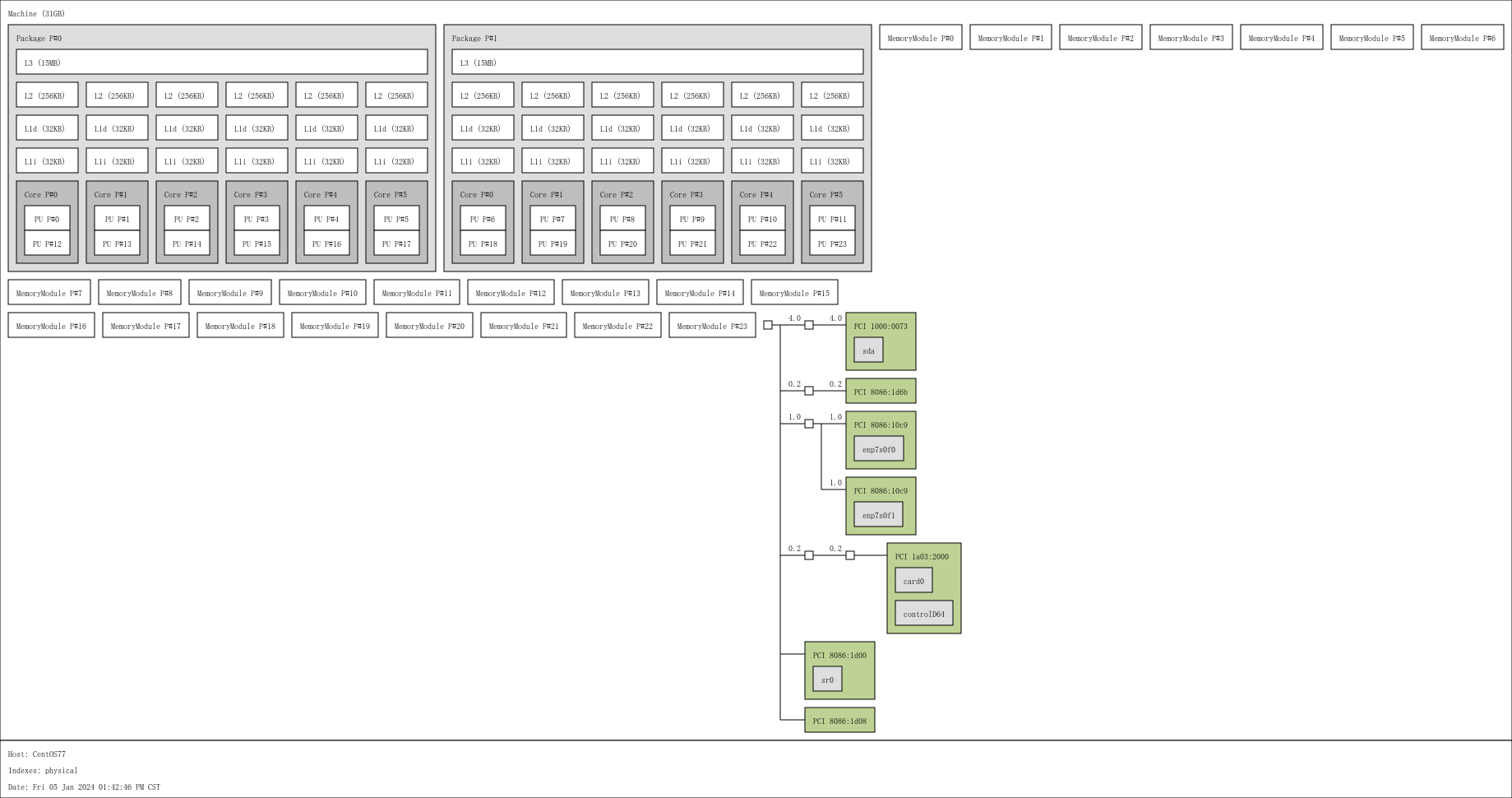
lstopo

部分参数介绍

*PU P#*是处理单元处理器# - 这些是CPU核心内的处理元素,从图片中我们可以看到4个核心,每个核心有2个处理元素(超线程),总共有8个,但实际是4个。

L#i代表指令高速缓存。

L#d代表数据高速缓存。

L1代表1级缓存。

L2代表第2级高速缓存。

L3代表三级缓存。

链接:https://juejin.cn/post/7117544110856077343

可以使用 lstopo zhaobsh.png 直接转储成图片.
查看内存信息
dmidecode -t memory

其实可以如下处理:

dmidecode -t

dmidecode: option requires an argument -- 't'

Type number or keyword expected

Valid type keywords are:

  bios

  system

  baseboard

  chassis

  processor

  memory

  cache

  connector

  slot

其实可以根据类型进行查看

比如dmidecode -t cache

查看缓存等信息
查看帮助
lstopo --help

Usage: lstopo [ options ] ... [ filename.format ]

See lstopo(1) for more details.

Default output is graphical (X11) if DISPLAY is set, console otherwise.

Supported output file formats: console, ascii, fig, pdf, ps, png, svg, xml, synthetic

Formatting options:

  -l --logical          Display hwloc logical object indexes

                        (default for console output)

  -p --physical         Display physical object indexes

                        (default for graphical output)

Output options:

  --output-format <format>

  --of <format>         Force the output to use the given format

  -f --force            Overwrite the output file if it exists

Textual output options:

  --only <type>         Only show objects of the given type in the textual output

  -v --verbose          Include additional details

  -s --silent           Reduce the amount of details to show

  -c --cpuset           Show the cpuset of each object

  -C --cpuset-only      Only show the cpuset of each object

  --taskset             Show taskset-specific cpuset strings

Object filtering options:

  --ignore <type>       Ignore objects of the given type

  --no-caches           Do not show caches

  --no-useless-caches   Do not show caches which do not have a hierarchical

                        impact

  --no-icaches          Do not show instruction caches

  --merge               Do not show levels that do not have a hierarchical

                        impact

  --no-collapse         Do not collapse identical PCI devices

  --restrict <cpuset>   Restrict the topology to processors listed in <cpuset>

  --restrict binding    Restrict the topology to the current process binding

  --restrict-flags <n>  Set the flags to be used during restrict

  --no-io               Do not show any I/O device or bridge

  --no-bridges          Do not any I/O bridge except hostbridges

  --whole-io            Show all I/O devices and bridges

Input options:

  --input <XML file>

  -i <XML file>         Read topology from XML file <path>

  --input <directory>

  -i <directory>        Read topology from chroot containing the /proc and /sys

                        of another system

  --input "node:2 2"

  -i "node:2 2"         Simulate a fake hierarchy, here with 2 NUMA nodes of 2

                        processors

  --input-format <format>

  --if <format>         Enforce input format among xml, fsroot, synthetic

  --thissystem          Assume that the input topology provides the topology

                        for the system on which we are running

  --pid <pid>           Detect topology as seen by process <pid>

  --whole-system        Do not consider administration limitations

Graphical output options:

  --fontsize 10         Set size of text font

  --gridsize 10         Set size of margin between elements

  --horiz[=<type,...>]  Horizontal graphical layout instead of nearly 4/3 ratio

  --vert[=<type,...>]   Vertical graphical layout instead of nearly 4/3 ratio

  --rect[=<type,...>]   Rectangular graphical layout with nearly 4/3 ratio

  --index=[<type,...>]  Display indexes for the given object types

  --no-index=[<type,.>] Do not display indexes for the given object types

  --attrs=[<type,...>]  Display attributes for the given object types

  --no-attrs=[<type,.>] Do not display attributes for the given object types

  --no-legend           Remove the text legend at the bottom

  --append-legend <s>   Append a new line of text at the bottom of the legend

Miscellaneous options:

  --export-synthetic-flags <n>

                        Set flags during the synthetic topology export

  --ps --top            Display processes within the hierarchy

  --version             Report version and exit
简单效果为:
CPU信息查看的工具的更多相关文章
- cpu信息查看
# 总核数 = 物理CPU个数 X 每颗物理CPU的核数 # 总逻辑CPU数 = 物理CPU个数 X 每颗物理CPU的核数 X 超线程数 # 查看物理CPU个数 cat /proc/cpuinfo| ...
- linux服务器cpu信息查看详解
在linux系统中,提供了/proc目录下文件,显示系统的软硬件信息.如果想了解系统中CPU的提供商和相关配置信息,则可以查/proc/cpuinfo.但是此文件输出项较多,不易理解.例如我们想获取, ...
- linux cpu信息查看
转自:https://www.cnblogs.com/emanlee/p/3587571.html # 总核数 = 物理CPU个数 X 每颗物理CPU的核数 # 总逻辑CPU数 = 物理CPU个数 X ...
- Linux CPU信息和使用情况查看(CentOS)
一.CPU信息查看 cat /proc/cpuinfo| grep "physical id"| sort -u | wc -l #查看是物理CPU个数,-u和uniq都是去重作用 ...
- Linux系统CPU核数等信息查看
版权声明:本文为原创文章,允许转载,转载时请务必以超链接形式标明文章 原始出处 .作者信息和本声明. https://blog.csdn.net/fgf00/article/details/52584 ...
- Linux下查看CPU信息[/proc/cpuinfo]
最近在研究linux系统负载的时候,接触到一些关于CPU信息查看的知识,和大家分享一下.通过对/proc/cpuinfo文件中的参数的分析,也学到了不少东西. 在linux操作系统中,CPU的信息在启 ...
- linux服务器硬件信息查看
1.linux 查看服务器序列号(S/N) [root@oss20hb106 ~]# dmidecode -t 1 # dmidecode 2.11 # SMBIOS entry point at 0 ...
- ubuntu下查看cpu信息
查看CPU信息cat /proc/cpuinfo 几个cpu more /proc/cpuinfo |grep "physical id"|uniq|wc -l 每个cpu是几核( ...
- Linux 查看CPU信息、机器型号等硬件信息
测试机器的硬件信息: 查看CPU信息(型号) # cat /proc/cpuinfo | grep name | cut -f2 -d: | uniq -c 8 Intel(R) Xeo ...
- Linux查看CPU信息
1. 查看物理CPU的个数 #cat /proc/cpuinfo |grep "physical id"|sort |uniq|wc –l 2. 查看逻辑CPU的个数 #ca ...
随机推荐
- 文心一言 VS 讯飞星火 VS chatgpt (49)-- 算法导论6.2 1题
一.参照图6-2的方法,说明 MAX-HEAPIFY(A,3)在数组 A=(27,17,3,16,13,10,1,5,7,12,4,8,9,0)上的操作过程. 文心一言: 下面是 MAX-HEAPIF ...
- 车机必备软件-小白点EasyTouch(类似苹果的悬浮球,返回,清理垃圾,杀进程)
简介 有些小伙伴升级车机后,由于部分软件打开后处于全屏状态无法返回,这里我教大家如何解决.解决办法就是:在车机上安装这款小白点软件,这款软件体积小巧,不占内存,操作也十分方便,它能帮助你快速回到主屏幕 ...
- Nginx unexpected end of file 配置证书遇到问题,如何解决?
原文链接 https://bysocket.com/nginx-unexpected-end-of-file-expecting-in-key-file/ 一.Nginx unexpected end ...
- Markdown 编辑器及语法使用入门指南
一.如何打开预览? 打开在线编辑器 - 点击如图所示 - 写作预览按钮即可: 如图所示,编写下面 Markdown 语法,进行对应语法的编写,愉快的写作了! 左侧 Markdown 语法 右侧实时显示 ...
- centos8 测地卸载php5.6 与卸载php7
centos8 yum php 默认安装 php7.1.2 我想卸载php7 ,安装php5.6 yum remove php 无法彻底卸载干净.必须强制删除,使用下面命令查看全部php软件包 rpm ...
- Solon Web 开发,十、签权
Solon Web 开发 一.开始 二.开发知识准备 三.打包与运行 四.请求上下文 五.数据访问.事务与缓存应用 六.过滤器.处理.拦截器 七.视图模板与Mvc注解 八.校验.及定制与扩展 九.跨域 ...
- Neo4j Neo.TransientError.General.MemoryPoolOutOfMemoryError
The allocation of an extra 4.0 MiB would use more than the limit 2.0 GiB. Currently using 2.0 GiB. d ...
- Axure 快速回到原点
如果点了[快速回到原点]不生效,可能是因为输入法导致.
- ThreadLocal 本地线程变量详解
概述 ThreadLocal 意为本地线程变量,即该变量只属于当前线程,对其他线程隔离 我们知道,一个普通变量如果被多线程访问会存在存在线程安全问题,这时我们可以使用 Synchronize 来保证该 ...
- 流媒体传输协议之 RTMP
作者:逸殊 审核:泰一 简介 RTMP 在可靠流式传输(TCP)的基础上提供了双向的消息多路复用服务,在通讯双方之间传输与时间相关的并行流数据,如音频,视频和数据消息.协议实现方通常为不同的消息类型指 ...