
TF_Variable Sharing
Reference: http://jermmy.xyz/2017/08/25/2017-8-25-learn-tensorflow-shared-variables/
Tensorflow doesn't know what nodes should be grouped together, unless you tell it to.
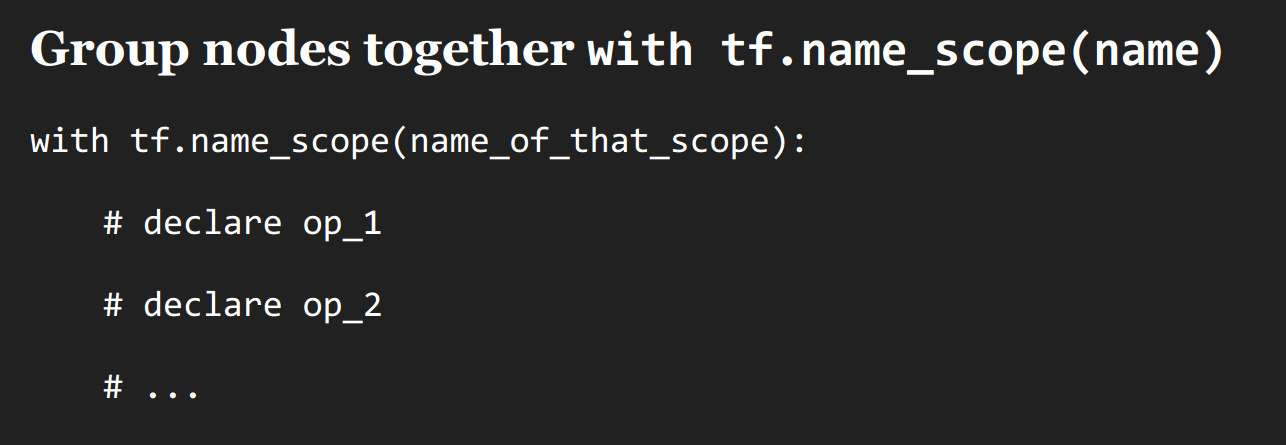
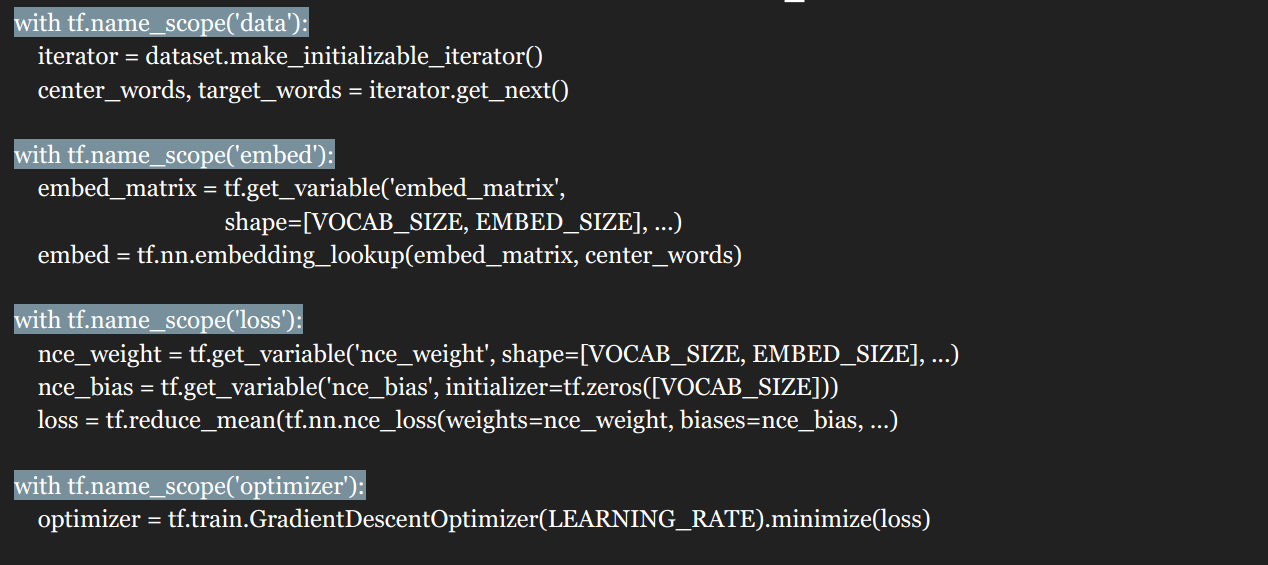

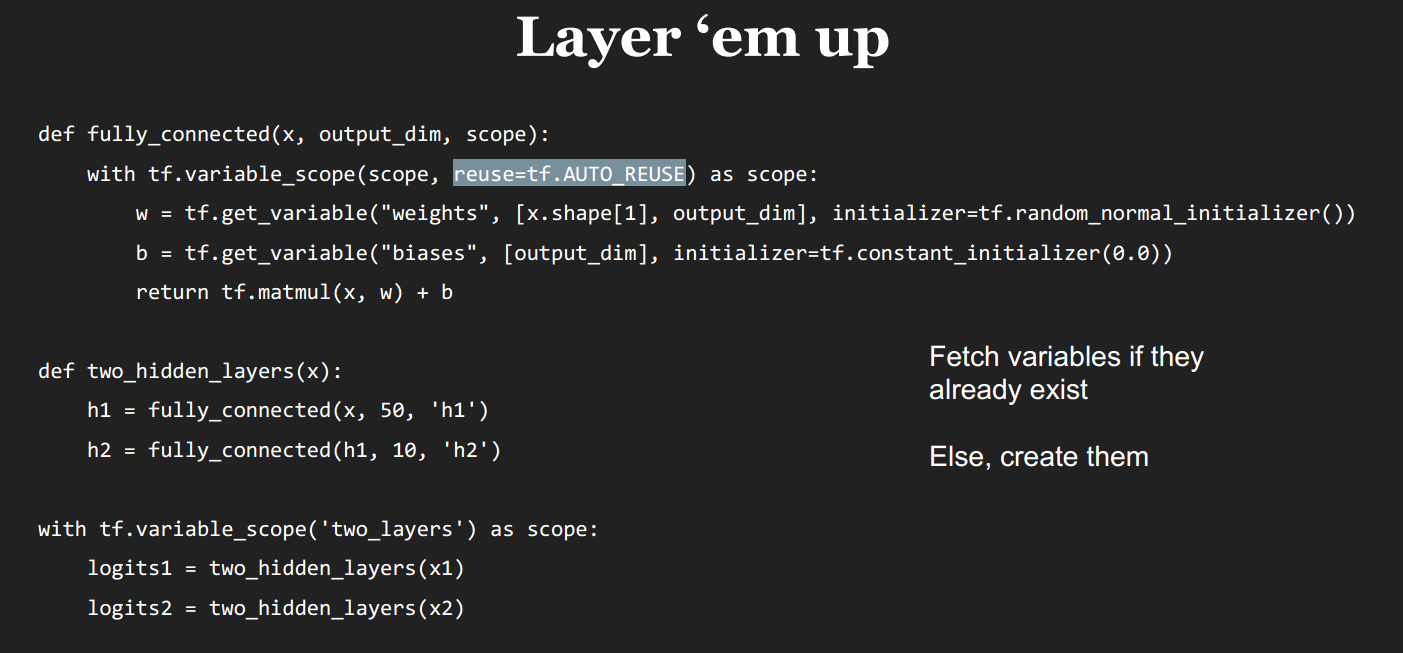
name scope VS variable scope tf.name_scope() VS tf.variable_scope() variable scope facilitates variable sharing
tf.variable_scope() implicitly creates a name scope.
 """ Examples to demonstrate variable sharing

 CS 20: 'TensorFlow for Deep Learning Research'

 cs20.stanford.edu

 Chip Huyen (chiphuyen@cs.stanford.edu)

 Lecture 05

 """

 import os

 os.environ['TF_CPP_MIN_LOG_LEVEL']=''

 import tensorflow as tf

 x1 = tf.truncated_normal([200, 100], name='x1')

 x2 = tf.truncated_normal([200, 100], name='x2')

 def two_hidden_layers(x):

     assert x.shape.as_list() == [200, 100]

     w1 = tf.Variable(tf.random_normal([100, 50]), name='h1_weights')

     b1 = tf.Variable(tf.zeros([50]), name='h1_biases')

     h1 = tf.matmul(x, w1) + b1

     assert h1.shape.as_list() == [200, 50]

     w2 = tf.Variable(tf.random_normal([50, 10]), name='h2_weights')

     b2 = tf.Variable(tf.zeros([10]), name='2_biases')

     logits = tf.matmul(h1, w2) + b2

     return logits

 def two_hidden_layers_2(x):

     assert x.shape.as_list() == [200, 100]

     w1 = tf.get_variable('h1_weights', [100, 50], initializer=tf.random_normal_initializer())

     b1 = tf.get_variable('h1_biases', [50], initializer=tf.constant_initializer(0.0))

     h1 = tf.matmul(x, w1) + b1

     assert h1.shape.as_list() == [200, 50]

     w2 = tf.get_variable('h2_weights', [50, 10], initializer=tf.random_normal_initializer())

     b2 = tf.get_variable('h2_biases', [10], initializer=tf.constant_initializer(0.0))

     logits = tf.matmul(h1, w2) + b2

     return logits

 # logits1 = two_hidden_layers(x1)

 # logits2 = two_hidden_layers(x2)


#### Two sets of variables are created. You want all your inputs to use the same weights and biases!

 # logits1 = two_hidden_layers_2(x1)

 # logits2 = two_hidden_layers_2(x2)

####ValueError: Variable h1_weights already exists,disallowed.Did you mean to set reuse=True in VarScope?

 # with tf.variable_scope('two_layers') as scope:

 #     logits1 = two_hidden_layers_2(x1)

 #     scope.reuse_variables()

 #     logits2 = two_hidden_layers_2(x2)

 # with tf.variable_scope('two_layers') as scope:

 #     logits1 = two_hidden_layers_2(x1)

 #     scope.reuse_variables()

 #     logits2 = two_hidden_layers_2(x2)

 def fully_connected(x, output_dim, scope):

     with tf.variable_scope(scope, reuse=tf.AUTO_REUSE) as scope:

         w = tf.get_variable('weights', [x.shape[1], output_dim], initializer=tf.random_normal_initializer())

         b = tf.get_variable('biases', [output_dim], initializer=tf.constant_initializer(0.0))

         return tf.matmul(x, w) + b

 def two_hidden_layers(x):

     h1 = fully_connected(x, 50, 'h1')

     h2 = fully_connected(h1, 10, 'h2')

 with tf.variable_scope('two_layers') as scope:

     logits1 = two_hidden_layers(x1)

     # scope.reuse_variables()

     logits2 = two_hidden_layers(x2)

 writer = tf.summary.FileWriter('./graphs/cool_variables', tf.get_default_graph())

 writer.close()
TF_Variable Sharing的更多相关文章
- 伪共享(false sharing),并发编程无声的性能杀手
在并发编程过程中,我们大部分的焦点都放在如何控制共享变量的访问控制上(代码层面),但是很少人会关注系统硬件及 JVM 底层相关的影响因素.前段时间学习了一个牛X的高性能异步处理框架 Disruptor ...
- Salesforce的sharing Rule 不支持Lookup型字段解决方案
Salesforce 中 sharing rule 并不支持Look up 字段 和 formula 字段.但在实际项目中,有时会需要在sharing rule中直接取Look up型字段的值,解决方 ...
- [Erlang 0127] Term sharing in Erlang/OTP 上篇
之前,在 [Erlang 0126] 我们读过的Erlang论文 提到过下面这篇论文: On Preserving Term Sharing in the Erlang Virtual Machine ...
- 跨域的另一种解决方案——CORS(Cross-Origin Resource Sharing)跨域资源共享
在我们日常的项目开发时使用AJAX,传统的Ajax请求只能获取在同一个域名下面的资源,但是HTML5打破了这个限制,允许Ajax发起跨域的请求.浏览器是可以发起跨域请求的,比如你可以外链一个外域的图片 ...
- 006_Salesforce Sharing 使用说明
Salesforce Sharing 使用说明 背景说明:Salesforce共享实施记录和其它数据时,需要员工之间共享或多个用户在一个组织间的共享.然而,共享这些数据是有风险的,尤其是当它涉及到敏感 ...
- salesforce 零基础开发入门学习(十二)with sharing 、without sharing 、无声明区别
在salesforce中,声明类大概可以分成三类:分别是可以声明为with sharing,without sharing,以及两者均不声明. public with sharing class A ...
- Cross-Origin Resource Sharing协议介绍
传统的Ajax请求只能获取在同一个域名下面的资源,但是HTML5打破了这个限制,允许Ajax发起跨域的请求.浏览器是可以发起跨域请求的,比如你可以外链一个外域的图片或者脚本.但是Javascript脚 ...
- [转]Stop Sharing Session State between Multiple Tabs of Browser
本文转自:http://jinaldesai.net/stop-sharing-session-state-between-multiple-tabs-of-browser/ Scenario: By ...
- POJ - 1666 Candy Sharing Game
这道题只要英语单词都认得,阅读没有问题,就做得出来. POJ - 1666 Candy Sharing Game Time Limit: 1000MS Memory Limit: 10000KB 64 ...
随机推荐
- ubuntu16.04 下通过rc.d(rc.local)实现开机启动(未登录)anydesk
先编辑anydesk-X.X.X/init/anydesk文件,将"DAEMON=//usr/bin$NAME"改成"DAEMON=/XXX/anydesk-5.1.1/ ...
- [Tensorflow] 使用 tf.keras.utils.get_file() 下载 MS-COCO 2014 数据集
import argparse import tensorflow as tf tf.enable_eager_execution() def main(args): ""&quo ...
- C#开发者必须知道的13件事情
1.开发流程 程序的Bug与瑕疵往往出现于开发流程当中.只要对工具善加利用,就有助于在你发布程序之前便将问题发现,或避开这些问题. 标准化代码书写 标准化代码书写可以使代码更加易于维护,尤其是在代码由 ...
- P5441 【XR-2】伤痕
Luogu5441 有 \(n\) 个点 ( \(n\) 为奇数 , \(n \le 99\) ) 的完全图 , 其中可以有最多 \(n\) 条无向边 , 其他都是有向边 . 如果对于某四个点不经过这 ...
- 使用kubeadm进行单master(single master)和高可用(HA)kubernetes集群部署
kubeadm部署k8s 使用kubeadm进行k8s的部署主要分为以下几个步骤: 环境预装: 主要安装docker.kubeadm等相关工具. 集群部署: 集群部署分为single master(单 ...
- java知识随笔整理-标量函数和表值函数
以sql server为例: 1.表值函数 用户定义表值函数返回 table 数据类型,表是单个 SELECT 语句的结果集. 示例代码CREATE FUNCTION Test_GetEmployee ...
- 小菜鸟之oracle
oracle 存储过程 函数 创建 删除 参数 传递 函数 查看 包 系统包 分类: Oracle 2011-10-27 17:31 264人阅读 评论(0) 收藏 举报 认识存储过程和函数 存储 ...
- C库函数:scanf、fscanf、printf、fprintf、sprintf、 snprintf
1. scanf 函数原型 int scanf(const char *format, ...); 功能:从标准输入 stdin 读取格式化输入. 2.fscanf 函数原型 int fscanf( ...
- MySQL 聚合函数(三)MySQL对GROUP BY的处理
原文来自MySQL 5.7 官方手册:12.20.3 MySQL Handling of GROUP BY SQL-92和更早版本不允许SELECT列表,HAVING条件或ORDER BY列表引用未在 ...
- OkHttp3 + retrofit2 封装
0.下载文件 1.gradle 添加 compile 'com.squareup.retrofit2:retrofit:2.1.0'compile 'com.squareup.retrofit2:co ...