
Acquire and Release Fences
转载自: http://preshing.com/20130922/acquire-and-release-fences/
Acquire and release fences, in my opinion, are rather misunderstood on the web right now. That’s too bad, because the C++11 Standards Committee did a great job specifying the meaning of these memory fences. They enable robust algorithms which scale well across multiple cores, and map nicely onto today’s most common CPU architectures.
First things first: Acquire and release fences are considered low-level lock-free operations. If you stick with higher-level, sequentially consistent atomic types, such as volatile variables in Java 5+, or default atomics in C++11, you don’t need acquire and release fences. The tradeoff is that sequentially consistent types are slightly less scalable or performant for some algorithms.
On the other hand, if you’ve developed for multicore devices in the days before C++11, you might feel an affinity for acquire and release fences. Perhaps, like me, you remember struggling with the placement of some lwsync intrinsics while synchronizing threads on Xbox 360. What’s cool is that once you understand acquire and release fences, you actually see what we were trying to accomplish using those platform-specific fences all along.
Acquire and release fences, as you might imagine, are standalone memory fences, which means that they aren’t coupled with any particular memory operation. So, how do they work?
An acquire fence prevents the memory reordering of any read which precedes it in program order with any read or write which follows it in program order.
A release fence prevents the memory reordering of any read or write which precedes it in program order with any write which follows it in program order.
In other words, in terms of the barrier types explained here, an acquire fence serves as both a #LoadLoad + #LoadStore barrier, while a release fence functions as both a #LoadStore + #StoreStore barrier. That’s all they purport to do.
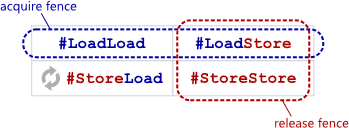
When programming in C++11, you can invoke them using the following functions:
#include <atomic>

std::atomic_thread_fence(std::memory_order_acquire);

std::atomic_thread_fence(std::memory_order_release);
In C11, they take this form:
#include <stdatomic.h>

atomic_thread_fence(memory_order_acquire);

atomic_thread_fence(memory_order_release);
And using Mintomic, a small, portable lock-free API:
#include <mintomic/mintomic.h>

mint_thread_fence_acquire();

mint_thread_fence_release();
On the SPARC-V9 architecture, an acquire fence can be implemented using the membar #LoadLoad | #LoadStore instruction, and an a release fence can be implemented as membar #LoadStore | #StoreStore. On other CPU architectures, the people who implement the above libaries must translate these operations into the next best thing – some CPU instruction which provides at least the required barrier types, and possibly more. On PowerPC, the next best thing is lwsync. On ARMv7, the next best thing is dmb. On Itanium, the next best thing is mf. And on x86/64, no CPU instruction is needed at all. As you might expect, acquire and release fences restrict reordering of neighboring operations at compile time as well.
They Can Establish Synchronizes-With Relationships
The most important thing to know about acquire and release fences is that they can establish a synchronizes-with relationship, which means that they prohibit memory reordering in a way that allows you to pass information reliably between threads. Keep in mind that, as the following chart illustrates, acquire and release fences are just one of many constructs which can establish a synchronizes-withrelationship.
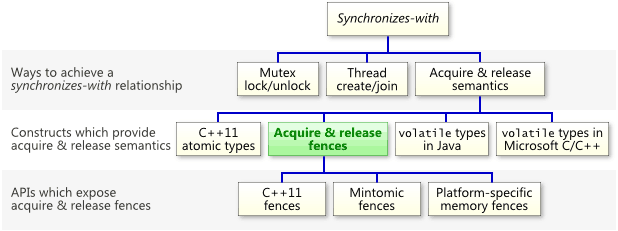
As I’ve shown before, a relaxed atomic load immediately followed by an acquire fence will convert that load into a read-acquire. Similarly, a relaxed atomic store immediately preceded by a release fence will convert that store into a write-release. For example, if g_guard has type std::atomic<int>, then this line
g_guard.store(1, std::memory_order_release);
can be safely replaced with the following.
std::atomic_thread_fence(std::memory_order_release);

g_guard.store(1, std::memory_order_relaxed);
One precision: In the latter form, it is no longer the store which synchronizes-with anything. It is the fence itself. To see what I mean, let’s walk through a detailed example.
A Walkthrough Using Acquire and Release Fences
We’ll take the example from my previous post and modify it to use C++11’s standalone acquire and release fences. Here’s the SendTestMessage function. The atomic write is now relaxed, and a release fence has been placed immediately before it.
void SendTestMessage(void* param)

{

    // Copy to shared memory using non-atomic stores.

    g_payload.tick  = clock();

    g_payload.str   = "TestMessage";

    g_payload.param = param;

    // Release fence.

    std::atomic_thread_fence(std::memory_order_release);

    // Perform an atomic write to indicate that the message is ready.

    g_guard.store(1, std::memory_order_relaxed);

}
Here’s the TryReceiveMessage function. The atomic read has been relaxed, and an acquire fence has been placed slightly after it. In this case, the fence does not occur immediately after the read; we first check whether ready != 0, since that’s the only case where the fence is really needed.
bool TryReceiveMessage(Message& result)

{

    // Perform an atomic read to check whether the message is ready.

    int ready = g_guard.load(std::memory_order_relaxed);

    if (ready != 0)

    {

        // Acquire fence.

        std::atomic_thread_fence(std::memory_order_acquire);

        // Yes. Copy from shared memory using non-atomic loads.

        result.tick  = g_payload.tick;

        result.str   = g_msg_str;

        result.param = g_payload.param;

        return true;

    }

    // No.

    return false;

}
Now, if TryReceiveMessage happens to see the write which SendTestMessage performed on g_guard, then it will issue the acquire fence, and the synchronizes-with relationship is complete. Again, strictly speaking, it’s the fences which synchronize-with each other.
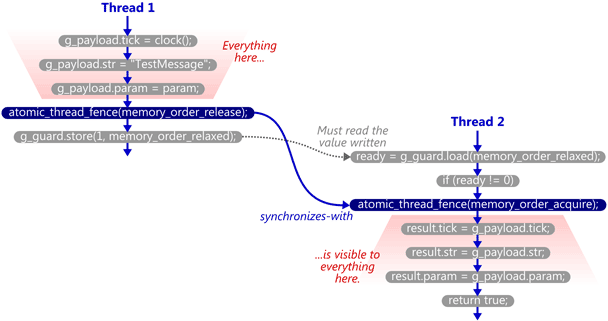
Let’s back up for a moment and consider this example in terms of the source control analogy I made a while back. Imagine shared memory as a central repository, with each thread having its own private copy of that repository. As each thread manipulates its private copy, modifications are constantly “leaking” to and from the central repository at unpredictable times. Acquire and release fences are used to enforce ordering among those leaks.
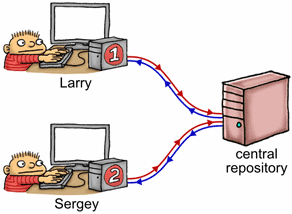
If we imagine Thread 1 as a programmer named Larry, and Thread 2 as a programmer named Sergey, what happens is the following:
- Larry performs a bunch of non-atomic stores to his private copy of
g_payload. - Larry issues a release fence. That means that all his previous memory operations will be committed to the repository – whenever that happens – before any store he performs next.
- Larry stores
1to his private copy ofg_guard. - At some random moment thereafter, Larry’s private copy of
g_guardleaks to the central repository, entirely on its own. Remember, once this happens, we’re guaranteed that Larry’s changes tog_payloadare in the central repository, too. - At some random moment thereafter, the updated value of
g_guardleaks from the central repository to Sergey’s private copy, entirely on its own. - Sergey checks his private copy of
g_guardand sees1. - Seeing that, Sergey issues an acquire fence. All the contents of Sergey’s private copy become at least as new as his previous load. This completes the synchronizes-with relationship.
- Sergey performs a bunch of non-atomic loads from his private copy of
g_payload. At this point, he is guaranteed to see the values that were written by Larry.
Note that the guard variable must “leak” from Larry’s private workspace over to Sergey’s all by itself. When you think about it, acquire and release fences are just a way to piggyback additional data on top of such leaks.
The C++11 Standard’s Got Our Back
The C++11 standard explicitly states that this example will work on any compliant implementation of the library and language. The promise is made in §29.8.2 of working draft N3337:
A release fence A synchronizes with an acquire fence B if there exist atomic operations X and Y, both operating on some atomic object M, such that A is sequenced before X, X modifies M, Y is sequenced before B, and Y reads the value written by X or a value written by any side effect in the hypothetical release sequence X would head if it were a release operation.
That’s a lot of letters. Let’s break it down. In the above example:
- Release fence A is the release fence issued in
SendTestMessage. - Atomic operation X is the relaxed atomic store performed in
SendTestMessage. - Atomic object M is the guard variable,
g_guard. - Atomic operation Y is the relaxed atomic load performed in
TryReceiveMessage. - Acquire fence B is the acquire fence issued in
TryReceiveMessage.
And finally, if the relaxed atomic load reads the value written by the relaxed atomic store, the C++11 standard says that the fences synchronize-with each other, just as I’ve shown.
I like C++11’s approach to portable memory fences. Other people have attempted to design portable memory fence APIs in the past, but in my opinion, few of them hit the sweet spot for lock-free programming like C++11, as far as standalone fences go. And while acquire and release fences may not translate directly into native CPU instructions, they’re close enough that you can still squeeze out as much performance as is currently possible from the vast majority of multicore devices. That’s why Mintomic, an open source library I released earlier this year, offers acquire and release fences – along with a consume and full memory fence – as its only memory ordering operations. Here’s the example from this post, rewritten using Mintomic.
In an upcoming post, I’ll highlight a couple of misconceptions about acquire & release fences which are currently floating around the web, and discuss some performance concerns. I’ll also talk a little bit more about their relationship with read-acquire and write-release operations, including some consequences of that relationship which tend to trip people up.
Acquire and Release Fences的更多相关文章
- Acquire and Release Semantics
An operation has acquire semantics if other processors will always see its effect before any subsequ ...
- Python用上锁和解锁 lock lock.acquire lock.release 模拟抢火车票
Python用上锁和解锁 lock lock.acquire lock.release 模拟抢火车票 import jsonimport timefrom multiprocessing impor ...
- Lock 深入理解acquire和release原理源码及lock独有特性acquireInterruptibly和tryAcquireNanos
https://blog.csdn.net/sophia__yu/article/details/84313234 Lock是一个接口,通常会用ReentrantLock(可重入锁)来实现这个接口. ...
- C11 memory_order
概念: 摘录自:http://preshing.com/20120913/acquire-and-release-semantics/ Acquire semantics is a property ...
- The JSR-133 Cookbook for Compiler Writers(an unofficial guide to implementing the new JMM)
The JSR-133 Cookbook for Compiler Writers by Doug Lea, with help from members of the JMM mailing lis ...
- Game Engine Architecture 5
[Game Engine Architecture 5] 1.Memory Ordering Semantics These mysterious and vexing problems can on ...
- An Introduction to Lock-Free Programming
Lock-free programming is a challenge, not just because of the complexity of the task itself, but bec ...
- android graphic(15)—fence
为何须要fence fence怎样使用 软件实现的opengl 硬件实现的opengl 上层使用canvas画图 上层使用opengl画图 下层合成 updateTexImage doComposeS ...
- 内存屏障 WriteBarrier 垃圾回收 屏障技术
https://baike.baidu.com/item/内存屏障 内存屏障,也称内存栅栏,内存栅障,屏障指令等, 是一类同步屏障指令,是CPU或编译器在对内存随机访问的操作中的一个同步点,使得此点之 ...
随机推荐
- Unity的资源加载以及AssetBundle的一些坑
https://www.cnblogs.com/sigmadruid/p/4040803.html AssetBundle加载完毕,进行其中Asset的初始化后,不能立即Unload().否则Asse ...
- (转)代码审计利器-RIPS实践
一.代码审计工具介绍 代码审计工具可以辅助我们进行白盒测试,大大提高漏洞分析和代码挖掘的效率. 在源代码的静态安全审计中,使用自动化工具辅助人工漏洞挖掘,一款好的代码审计软件,可以显著提高审计工作的效 ...
- 【java8新特性】日期和时间
Java 8 (又称为 jdk 1.8) 是 Java 语言开发的一个主要版本. Oracle 公司于 2014 年 3 月 18 日发布 Java 8 ,它支持函数式编程,新的 JavaScript ...
- 免sudo使用docker
前沿:通过root安装完docker,在普通用户下执行docker相关命令的时候,报权限不足: 查看sock文件的权限: [hadoop@slave1 monitor]$ ll /var/run/do ...
- django post 403
同一个地址GET方式可以正常访问 在POST 提交数据过程中报403错误, 原来是1.3版本settings.py 文件中 'django.middleware.csrf.CsrfViewMiddle ...
- HBase-概述
一种分布式.可扩展.支持海量数据存储的 NoSQL 数据库. 逻辑上,HBase 的数据模型同关系型数据库很类似,数据存储在一张表中,有行有列.但从 HBase 的底层物理存储结构(K-V)来看,HB ...
- OpenJudge计算概论-骑车与走路
/*============================================================ 骑车与走路 总时间限制: 1000ms 内存限制: 65536kB 描述 ...
- 阶段5 3.微服务项目【学成在线】_day18 用户授权_14-细粒度授权-我的课程细粒度授权-需求分析
3.3 我的课程细粒度授权 3.3.1 需求分析 1.我的课程查询,细粒度授权过程如下: 1)获取当前登录的用户Id 2)得到用户所属教育机构的Id 3)查询该教学机构下的课程信息 最终实现了用户只允 ...
- python读取csv文件、excel文件并封装成dict类型的list,直接看代码
# coding=UTF-8import csvimport xlrd class ReaderFile(): """ 读取csv文件 filePath:文件路径 &qu ...
- 利用Python获取cookie的方法,相比java代码简便不少
1.通过urllib库,是python的标准库,不需要另外引入,直接看代码,注意代码的缩进: # coding=UTF-8import cookielibimport urllib2 class Ry ...