
「CODVES 1922 」骑士共存问题(二分图的最大独立集|网络流)&dinic
首先是题目链接 http://codevs.cn/problem/1922/
结果发现题目没图(心情复杂
然后去网上扒了一张图
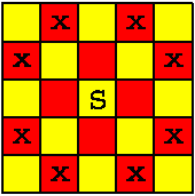
大概就是这样了。
如果把每个点和它可以攻击的点连一条边,那问题就变成了求二分图的最大独立集了 (二分图最大独立集:即一个点集,集合中任两个结点不相邻),然后就是建图了。
题图非常好心的帮忙染色了,所以我们可以看出来,一个点可以到达的点和它的颜色是不一样的,所以只需要黑白染色就可以了,然后把黑点看作一个集合, 白点看作一个集合,又因为二分图最大独立集=顶点总数 - 最大匹配,而后我们就只需要求最大匹配就可以了。
最大匹配最经典的就是匈牙利啦,但是网络流也可以做, 而且dinic在边容量为一的时候跑得特别快,所以就用dinic了(顺便练习一下dinic233
建图方法:超级源S连接所有的黑点,且边的容量为1, 黑点连接它所有能攻击到的白点,边的容量为INF, 然后所有的白点再连接超级汇T, 容量仍然是为1。跑一遍dinic就可以了(建图的正确性可以自己画图证明
 #include <cstdio>

 #include <vector>

 #include <cstring>

 #include <algorithm>

 #include <queue>

 #include <iostream>

 using namespace std;

 const int N = ;

 int n, m, cnt, w;

 struct Edge{

     int from, to, cap, flow;

 };

 vector < int > G[N*N];

 vector < Edge > edge;

 bool vis[N*N];

 int s, t, d[N*N], cur[N*N], INF = (<<), flag[N][N];

 int py[][] = {{, }, {, -}, {-, }, {-, -}, {, }, {, -}, {-, }, {-, -}};

 inline void read(int &ans){

     static char buf = getchar();

     register int neg = ;

     ans = ;

     for (;!isdigit(buf); buf = getchar())

         if (buf == '-')  neg = -;

     for (;isdigit(buf); buf = getchar())

         ans = ans* + buf - '';

     ans *= neg;

 }

 inline void Add(int from, int to, int cap){

     edge.push_back((Edge){from, to, cap, });

     edge.push_back((Edge){to, from, , });

     int m = edge.size();

     G[from].push_back(m - );

     G[to].push_back(m - );

 }

 bool ok(int x, int y){

     if (x >  && x <= n && y >  && y <= n)

         if (flag[x][y] != -)

             return true;

     return false;

 }

 inline void build(){

     for (int i = ; i <= n; i++)

         for (int j = ; j <= n; j++)

             if (flag[i][j] == -)    continue;

             else if (flag[i][j] < cnt){

                 for (int k = ; k < ; k++){

                     int x = i + py[k][];

                     int y = j + py[k][];

                     if (ok(x, y))

                         Add(flag[i][j], flag[x][y], INF);

                 }

                 Add(, flag[i][j], );

             }

             else Add(flag[i][j], w, );

 }

 inline bool BFS(){

     memset(vis, , sizeof(vis));

     memset(d, 0xff, sizeof(d));

     queue < int > q;

     q.push(s);

     d[s] = ;

     vis[s] = ;

     while(!q.empty()){

         int u = q.front(); q.pop();

         for (int i = ; i < G[u].size(); i++){

             Edge& e = edge[G[u][i]];

             if (!vis[e.to] && e.cap > e.flow){

                 d[e.to] = d[u] + ;

                 vis[e.to] = ;

                 q.push(e.to);

             }

         }

     }

     return vis[t];

 }

 int dfs(int x, int a){

     if (x == t || a == )    return a;

     int flow = , f;

     for (int& i = cur[x]; i < G[x].size(); i++){

         Edge& e = edge[G[x][i]];

         if (d[x] +  == d[e.to] && (f = dfs(e.to, min(e.cap - e.flow, a))) > ){

             e.flow += f;

             edge[G[x][i]^].flow -= f;

             flow += f;

             a -= f;

             if (a == )    break;

         }

     }

     return flow;

 }

 inline int dinic(){

     int ans = ;

     while(BFS()){

         memset(cur, , sizeof(cur));

         ans += dfs(, INF);

     }

     return ans;

 }

 int main(){

     read(n); read(m);

     for (int i = ; i < m; i++){

         int x, y;

         read(x); read(y);

         flag[x][y] = -;

     }

     cnt = ;

     w = (n * n + )/ + ;

     for (int i = ; i <= n; i++)

         for (int j = ; j <= n; j++)

             if ((i + j)% == ){

                 if (flag[i][j] != -) flag[i][j] = cnt;

                 cnt++;

             }

             else{

                 if (flag[i][j] != -)  flag[i][j] = w;

                 w++;

             }

     s = , t = n*n + ;

     build();

     printf("%d", n*n - m - dinic());

     return ;

 }
然而这道题最开始写的时候TLE了
然后就加了当前弧优化
然后就A了(滑稽
但是可以看得出来非常的慢
测试点#kni0.in 结果:AC 内存使用量: 1512kB 时间使用量: 1ms
测试点#kni1.in 结果:AC 内存使用量: 1388kB 时间使用量: 1ms
测试点#kni10.in 结果:AC 内存使用量: 7256kB 时间使用量: 415ms
测试点#kni2.in 结果:AC 内存使用量: 1516kB 时间使用量: 1ms
测试点#kni3.in 结果:AC 内存使用量: 1644kB 时间使用量: 1ms
测试点#kni4.in 结果:AC 内存使用量: 1772kB 时间使用量: 3ms
测试点#kni5.in 结果:AC 内存使用量: 1772kB 时间使用量: 4ms
测试点#kni6.in 结果:AC 内存使用量: 1768kB 时间使用量: 2ms
测试点#kni7.in 结果:AC 内存使用量: 2020kB 时间使用量: 4ms
测试点#kni8.in 结果:AC 内存使用量: 4444kB 时间使用量: 143ms
测试点#kni9.in 结果:AC 内存使用量: 11732kB 时间使用量: 927ms
然后上网搜了一下其他的题解,发现其他的代码都跑得很快,然后就把建图方式改了一下
 #include <cstdio>

 #include <vector>

 #include <cstring>

 #include <algorithm>

 #include <queue>

 #include <iostream>

 using namespace std;

 const int N = ;

 int n, m, cnt, w;

 struct Edge{

     int from, to, cap, flow;

 };

 vector < int > G[N*N];

 vector < Edge > edge;

 bool vis[N*N];

 int s, t, d[N*N], cur[N*N], INF = (<<), flag[N][N], b[N*N];

 int py[][] = {{, }, {, -}, {-, }, {-, -}, {, }, {, -}, {-, }, {-, -}};

 inline void read(int &ans){

     static char buf = getchar();

     register int neg = ;

     ans = ;

     for (;!isdigit(buf); buf = getchar())

         if (buf == '-')  neg = -;

     for (;isdigit(buf); buf = getchar())

         ans = ans* + buf - '';

     ans *= neg;

 }

 inline void Add(int from, int to, int cap){

     edge.push_back((Edge){from, to, cap, });

     edge.push_back((Edge){to, from, , });

     int m = edge.size();

     G[from].push_back(m - );

     G[to].push_back(m - );

 }

 bool ok(int x, int y){

     if (x >  && x <= n && y >  && y <= n)

         if (flag[x][y] != -)

             return true;

     return false;

 }

 inline int hash(int i,int j){

     return (i - )*n + j;

 }

 inline bool BFS(){

     memset(vis, , sizeof(vis));

     memset(d, 0xff, sizeof(d));

     queue < int > q;

     q.push(s);

     d[s] = ;

     vis[s] = ;

     while(!q.empty()){

         int u = q.front(); q.pop();

         for (int i = ; i < G[u].size(); i++){

             Edge& e = edge[G[u][i]];

             if (!vis[e.to] && e.cap > e.flow){

                 d[e.to] = d[u] + ;

                 vis[e.to] = ;

                 q.push(e.to);

             }

         }

     }

     return vis[t];

 }

 int dfs(int x, int a){

     if (x == t || a == )    return a;

     int flow = , f;

     for (int& i = cur[x]; i < G[x].size(); i++){

         Edge& e = edge[G[x][i]];

         if (d[x] +  == d[e.to] && (f = dfs(e.to, min(e.cap - e.flow, a))) > ){

             e.flow += f;

             edge[G[x][i]^].flow -= f;

             flow += f;

             a -= f;

             if (a == )    break;

         }

     }

     return flow;

 }

 inline int dinic(){

     int ans = ;

     while(BFS()){

         memset(cur, , sizeof(cur));

         ans += dfs(, INF);

     }

     return ans;

 }

 int main(){

     read(n); read(m);

     for (int i = ; i < m; i++){

         int x, y;

         read(x); read(y);

         b[hash(x, y)] = ;

     }

     cnt = ;

     s = , t = n*n + ;

     for(int i = ; i <= n;i++)

             for(int j = ; j <=n; j++){

                 if(!b[hash(i,j)] && ((i+j)&)){

                     Add(s, hash(i,j), );

                     if(i >  && j >  && !b[hash(i-,j-)])

                         Add(hash(i,j), hash(i-,j-), INF);

                     if(i >  && j +  <= n && !b[hash(i-,j+)])

                         Add(hash(i,j), hash(i-,j+), INF);

                     if(i >  && j >  && !b[hash(i-,j-)])

                         Add(hash(i,j), hash(i-,j-), INF);

                     if(i >  && j +  <= n &&!b[hash(i-,j+)])

                         Add(hash(i,j), hash(i-,j+), INF);

                     if(i +  <= n && j >  && !b[hash(i+,j-)])

                         Add(hash(i,j), hash(i+,j-), INF);

                     if(i +  <= n && j +  <= n && !b[hash(i+,j+)])

                         Add(hash(i,j), hash(i+,j+), INF);

                     if(i +  <= n && j >  && !b[hash(i+,j-)])

                         Add(hash(i,j), hash(i+,j-), INF);

                     if(i +  <= n && j +  <= n && !b[hash(i+,j+)])

                         Add(hash(i,j), hash(i+,j+), INF);

                 }

                 if(!b[hash(i,j)] && !((i+j)&))   Add(hash(i,j), t, );

             }

     printf("%d", n*n - m - dinic());

     return ;

 }
修改之后
测试点#kni0.in 结果:AC 内存使用量: 1640kB 时间使用量: 2ms
测试点#kni1.in 结果:AC 内存使用量: 1512kB 时间使用量: 2ms
测试点#kni10.in 结果:AC 内存使用量: 7256kB 时间使用量: 178ms
测试点#kni2.in 结果:AC 内存使用量: 1512kB 时间使用量: 2ms
测试点#kni3.in 结果:AC 内存使用量: 1640kB 时间使用量: 2ms
测试点#kni4.in 结果:AC 内存使用量: 1772kB 时间使用量: 2ms
测试点#kni5.in 结果:AC 内存使用量: 1772kB 时间使用量: 2ms
测试点#kni6.in 结果:AC 内存使用量: 1772kB 时间使用量: 2ms
测试点#kni7.in 结果:AC 内存使用量: 2020kB 时间使用量: 4ms
测试点#kni8.in 结果:AC 内存使用量: 4568kB 时间使用量: 92ms
测试点#kni9.in 结果:AC 内存使用量: 11608kB 时间使用量: 52ms
少了一个二维循环 + 减少了常数
结果快了1200ms(一脸懵逼
「CODVES 1922 」骑士共存问题(二分图的最大独立集|网络流)&dinic的更多相关文章
- loj #6226. 「网络流 24 题」骑士共存问题
#6226. 「网络流 24 题」骑士共存问题 题目描述 在一个 n×n\text{n} \times \text{n}n×n 个方格的国际象棋棋盘上,马(骑士)可以攻击的棋盘方格如图所示.棋盘上 ...
- 「AHOI2014/JSOI2014」骑士游戏
「AHOI2014/JSOI2014」骑士游戏 传送门 考虑 \(\text{DP}\). 设 \(dp_i\) 表示灭种(雾)一只编号为 \(i\) 的怪物的代价. 那么转移显然是: \[dp_i ...
- 【刷题】LOJ 6226 「网络流 24 题」骑士共存问题
题目描述 在一个 \(\text{n} \times \text{n}\) 个方格的国际象棋棋盘上,马(骑士)可以攻击的棋盘方格如图所示.棋盘上某些方格设置了障碍,骑士不得进入. 对于给定的 \(\t ...
- 「日常温习」Hungary算法解决二分图相关问题
前言 二分图的重点在于建模.以下的题目大家可以清晰的看出来这一点.代码相似度很高,但是思路基本上是各不相同. 题目 HDU 1179 Ollivanders: Makers of Fine Wands ...
- 洛谷P3355 骑士共存问题 二分图_网络流
Code: #include<cstdio> #include<cstring> #include<queue> #include<vector> #i ...
- 【wikioi】1922 骑士共存问题(网络流/二分图匹配)
用匈牙利tle啊喂?和网络流不都是n^3的吗(匈牙利O(nm), isap O(n^2m) 但是isap实际复杂度很优的(二分图匹配中,dinic是O(sqrt(V)*E),不知道isap是不是一样. ...
- 「CH6901」骑士放置
「CH6901」骑士放置 传送门 将棋盘黑白染色,发现"日"字的两个顶点刚好一黑一白,构成一张二分图. 那么我们将黑点向源点连边,白点向汇点连边,不能同时选的一对黑.白点连边. 当 ...
- 「THUWC 2017」随机二分图
「THUWC 2017」随机二分图 解题思路 : 首先有一个 \(40pts\) 的做法: 前 \(20pts\) 暴力枚举最终的匹配是怎样的,check一下计算方案数,后 \(20pts\) 令 \ ...
- # 「NOIP2010」关押罪犯(二分图染色+二分答案)
「NOIP2010」关押罪犯(二分图染色+二分答案) 洛谷 P1525 描述:n个罪犯(1-N),两个罪犯之间的仇恨值为c,m对仇恨值,求怎么分配使得两件监狱的最大仇恨值最小. 思路:使最大xxx最小 ...
随机推荐
- css 多行超长点点点
超长?不是很好吗?什么?不好?有什么坏处吗?会使人想哭的! 这里来说下,超长点点点的处理: 一行超长点点点,这个很多都会吧! text-overflow: ellipsis; white-space: ...
- Android 学习笔记之 个人认为最简单的查看Android源码方案
相信很多人都会疑惑如何使用Eclipse ADT查看源码? 下面我们将介绍 如何查看Android源码. 本文有如下优点: 1.不用费心去找Android源码地址:一个字烦,网上的东西杂七杂八的... ...
- Struts2基础学习(一)—初识Struts2
目录 一.什么是Struts2 二.搭建Struts2的开发环境 三.Struts2的配置文件 四.MVC模式 一.什么是Struts2 Struts2是一个非常优秀的MVC框架,由传统 ...
- Linux 安装Xampp以后,Apache服务器无法启动,以及启动后,连接sql数据库遇到的问题的解决方法
xampp安装以后,搭建服务器的时候,我们会遇到哪些问题呢?1.MySQL Database 可以启动,而Apache Web Server无法启动?应该是80端口被占用,那么如何解决呢?我们可以通过 ...
- Cookie中文乱码问题
页面一登录,页面二保存用户信息,放入Cookies里. 但是Cookies放入中文会引起编码问题,如报错“Control character in cookie value, consider BAS ...
- 免费给自己的网站加 HTTPS
简介 本文是通过 Let's Encrypt 提供的免费证书服务,实现让自己的网站加上 HTTPS.我的网站 -- hellogithub,就是通过这种方式实现的 HTTPS,效果如下: Let's ...
- Linux--管道pipe
管道是一种最基本的IPC机制,由pipe函数创建:#include <unistd.h> int pipe(int filedes[2]); 调用pipe函数时在内核中开辟一块缓冲区(称为 ...
- Sencha+cordova 构造 华丽手机程序,并讲讲,在商用项目中经常用到的cordova插件(一)
采用 Sencha Architect 3 ,编辑设计,我只想说一个结论,jq能搞的 Sencha touch也能做到(只是 设计思路 更面向对象,学习知识量大点而已 ,不理解 MVC 就不用选了), ...
- 第二章、元组和列表(python基础教程第二版 )
最基本的数据结构是序列,序列中每个元素被分配一个序号-元素的位置,也称索引.第一个索引为0,最后一个元素索引为-1. python中包含6种内建的序列:元组.列表.字符串.unicode字符串.buf ...
- C语言学习的第一章
首先,学习编写程序要先知道什么是程序,我们为什么要写程序? 程序就是为了让计算机执行某些操作或解决某个问题而编写的一系列有序指令的集合.程序里有很多算法,算法是解决问题的具体方法和步骤,就像我们想要得 ...