
[LeetCode] 236. Lowest Common Ancestor of a Binary Tree 二叉树的最小共同父节点
Given a binary tree, find the lowest common ancestor (LCA) of two given nodes in the tree.
According to the definition of LCA on Wikipedia: “The lowest common ancestor is defined between two nodes p and q as the lowest node in T that has both p and q as descendants (where we allow a node to be a descendant of itself).”
Given the following binary tree: root = [3,5,1,6,2,0,8,null,null,7,4]
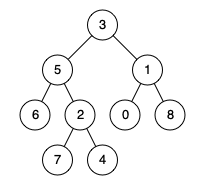
Example 1:
Input: root = [3,5,1,6,2,0,8,null,null,7,4], p = 5, q = 1
Output: 3
Explanation: The LCA of nodes5and1is3.
Example 2:
Input: root = [3,5,1,6,2,0,8,null,null,7,4], p = 5, q = 4
Output: 5
Explanation: The LCA of nodes5and4is5, since a node can be a descendant of itself according to the LCA definition.
Note:
- All of the nodes' values will be unique.
- p and q are different and both values will exist in the binary tree.
这道求二叉树的最小共同父节点的题是之前那道 Lowest Common Ancestor of a Binary Search Tree 的 Follow Up。跟之前那题不同的地方是,这道题是普通是二叉树,不是二叉搜索树,所以就不能利用其特有的性质,我们只能在二叉树中来搜索p和q,然后从路径中找到最后一个相同的节点即为父节点,可以用递归来实现,在递归函数中,首先看当前结点是否为空,若为空则直接返回空,若为p或q中的任意一个,也直接返回当前结点。否则的话就对其左右子结点分别调用递归函数,由于这道题限制了p和q一定都在二叉树中存在,那么如果当前结点不等于p或q,p和q要么分别位于左右子树中,要么同时位于左子树,或者同时位于右子树,那么我们分别来讨论:
- 若p和q分别位于左右子树中,那么对左右子结点调用递归函数,会分别返回p和q结点的位置,而当前结点正好就是p和q的最小共同父结点,直接返回当前结点即可,这就是题目中的例子1的情况。
- 若p和q同时位于左子树,这里有两种情况,一种情况是 left 会返回p和q中较高的那个位置,而 right 会返回空,所以最终返回非空的 left 即可,这就是题目中的例子2的情况。还有一种情况是会返回p和q的最小父结点,就是说当前结点的左子树中的某个结点才是p和q的最小父结点,会被返回。
- 若p和q同时位于右子树,同样这里有两种情况,一种情况是 right 会返回p和q中较高的那个位置,而 left 会返回空,所以最终返回非空的 right 即可,还有一种情况是会返回p和q的最小父结点,就是说当前结点的右子树中的某个结点才是p和q的最小父结点,会被返回,写法很简洁,代码如下:
解法一:
class Solution {

public:

    TreeNode* lowestCommonAncestor(TreeNode* root, TreeNode* p, TreeNode* q) {

       if (!root || p == root || q == root) return root;

       TreeNode *left = lowestCommonAncestor(root->left, p, q);

       TreeNode *right = lowestCommonAncestor(root->right, p , q);

       if (left && right) return root;

       return left ? left : right;

    }

};
上述代码可以进行优化一下,如果当前结点不为空,且既不是p也不是q,那么根据上面的分析,p和q的位置就有三种情况,p和q要么分别位于左右子树中,要么同时位于左子树,或者同时位于右子树。我们需要优化的情况就是当p和q同时为于左子树或右子树中,而且返回的结点并不是p或q,那么就是p和q的最小父结点了,已经求出来了,就不用再对右结点调用递归函数了,这是为啥呢?因为根本不会存在 left 既不是p也不是q,同时还有p或者q在 right 中。首先递归的第一句就限定了只要遇到了p或者q,就直接返回,之后又限定了只有当 left 和 right 同时存在的时候,才会返回当前结点,当前结点若不是p或q,则一定是最小父节点,否则 left 一定是p或者q。这里的逻辑比较绕,不太好想,多想想应该可以理清头绪吧,参见代码如下:
解法二:
class Solution {

public:

    TreeNode* lowestCommonAncestor(TreeNode* root, TreeNode* p, TreeNode* q) {

       if (!root || p == root || q == root) return root;

       TreeNode *left = lowestCommonAncestor(root->left, p, q);

       if (left && left != p && left != q) return left;

       TreeNode *right = lowestCommonAncestor(root->right, p , q);
    if (left && right) return root;

       return left ? left : right;

    }

};
讨论:此题还有一种情况,题目中没有明确说明p和q是否是树中的节点,如果不是,应该返回 nullptr,而上面的方法就不正确了,对于这种情况请参见 Cracking the Coding Interview 5th Edition 的第 233-234 页。
Github 同步地址:
https://github.com/grandyang/leetcode/issues/236
类似题目:
Lowest Common Ancestor of a Binary Search Tree
参考资料:
https://leetcode.com/problems/lowest-common-ancestor-of-a-binary-tree/
LeetCode All in One 题目讲解汇总(持续更新中...)
[LeetCode] 236. Lowest Common Ancestor of a Binary Tree 二叉树的最小共同父节点的更多相关文章
- [LeetCode] Lowest Common Ancestor of a Binary Tree 二叉树的最小共同父节点
Given a binary tree, find the lowest common ancestor (LCA) of two given nodes in the tree. According ...
- [LeetCode] 236. Lowest Common Ancestor of a Binary Tree 二叉树的最近公共祖先
Given a binary tree, find the lowest common ancestor (LCA) of two given nodes in the tree. According ...
- [leetcode]236. Lowest Common Ancestor of a Binary Tree二叉树最近公共祖先
Given a binary tree, find the lowest common ancestor (LCA) of two given nodes in the tree. Accordi ...
- [leetcode]236. Lowest Common Ancestor of a Binary Tree 二叉树最低公共父节点
Given a binary tree, find the lowest common ancestor (LCA) of two given nodes in the tree. According ...
- LeetCode 236 Lowest Common Ancestor of a Binary Tree 二叉树两个子节点的最低公共父节点
/** * Definition for a binary tree node. * struct TreeNode { * int val; * TreeNode *left; * TreeNode ...
- [leetcode]236. Lowest Common Ancestor of a Binary Tree树的最小公共祖先
如果一个节点的左右子树上分别有两个节点,那么这棵树是祖先,但是不一定是最小的,但是从下边开始判断,找到后一直返回到上边就是最小的. 如果一个节点的左右子树上只有一个子树上遍历到了节点,那么那个子树可能 ...
- leetcode@ [236] Lowest Common Ancestor of a Binary Tree(Tree)
https://leetcode.com/problems/lowest-common-ancestor-of-a-binary-tree/ Given a binary tree, find the ...
- leetcode 236. Lowest Common Ancestor of a Binary Tree
Given a binary tree, find the lowest common ancestor (LCA) of two given nodes in the tree. According ...
- (medium)LeetCode 236.Lowest Common Ancestor of a Binary Tree
Given a binary tree, find the lowest common ancestor (LCA) of two given nodes in the tree. According ...
随机推荐
- CDN的智能调度,链路优化的详细解答
您的用户在请求资源的过程中,可能受到网络.地域.带宽等影响,无法保证请求一定是按照最优访问路径进行传递,猫云 CDN 通过对全网链路进行实时监控,结合自研的 GSLB 调度体系和智能路由技术,从以下几 ...
- Pytest 使用简介
前言 最近在听极客时间的课程,里面的讲师极力推崇 pytest 框架,鄙视 unittest 框架,哈哈!然后查了些资料,发现了一条 python 鄙视链:pytest 鄙视 > unittes ...
- layui 数据表格里面的html代码转义
table.render({ elem: '#release_table' ,url:'data_list' ,where: {table: 'release'} //两步转义转义,先将原始数据 ...
- 【模板】gcd和exgcd
1. gcd: int gcd(int a,int b) { return !b?a:gcd(b,a%b); } exgcd: int exgcd(int a,int b,int& x,int ...
- Mysql 常用数据类型 占用字节数 [转]
数据类型是定义列中可以存储什么数据以及该数据实际怎么存储的基本规则.Mysql的常用数据类型主要有: 串数据类型:最常用的数据类型,有两种基本的串类型:分别为定长串和不定长串.定长串结束长度固定的字符 ...
- 修改VisualStudio的智能提示字体大小
最近换了一个高分辨率显示器,便觉得VisualStudio的字体过小了,虽然VisualStudio换字体还比较简单,大部分位置的字体基本上很顺利的就换掉了,然而一直找不到智能提示的字体所在位置,放狗 ...
- 2019-11-29-WPF-模拟触摸设备
原文:2019-11-29-WPF-模拟触摸设备 title author date CreateTime categories WPF 模拟触摸设备 lindexi 2019-11-29 08:47 ...
- vs2015 创建MVC项目
直接上图吧! 第一步:新建项目 第二步:选择模板 第三步:系统自动生成项目文件 第四步:创建控制器(C):找到Controllers文件夹->右键->添加->控制器 第五步:添加控制 ...
- electron——ipcMain模块、ipcRenderer模块
ipcMain 从 主进程 到 渲染进程 的异步通信. ipcMain模块是EventEmitter类的一个实例. 当在主进程中使用时,它处理从渲染器进程(网页)发送出来的异步和同步信息. 从渲染器进 ...
- Jsp调用淘宝IP地址库获取来访IP详细信息
Jsp调用淘宝IP地址库获取来访IP详细信息 示例网页点击:www.trembler.cn/ipinfo/ipinfo(服务器有其他用处,页面已失效) String ip = request.ge ...